
How to Charge a Motorcycle Battery

To charge a motorcycle battery, use a smart charger rated about 0.75 to 2 amps, set it to the battery’s type (flooded, AGM, gel or lithium), connect red to positive and black to negative, then plug the charger in. A half-empty battery usually needs about 4 to 10 hours and a flat one about 12 to 24 hours. Unplug before removing the clamps.
Motorcycle batteries are small. A typical street bike battery holds about 5 to 14 amp-hours, compared with 50 to 70 for a car battery. That makes them quick to drain when the bike sits, and easy to damage with a charger that is too strong. A 10 amp car charger can overheat a bike battery in a short time.
The fix is simple: use a low-amp smart charger with the right mode, and give it time. This guide covers how to choose the charger, how to reach the battery on different bikes, how long charging takes, and how to handle lithium batteries, which are now common. For general charger hookup and safety, our guide on how to use a trickle charger covers the basics.
Choose the Right Charger
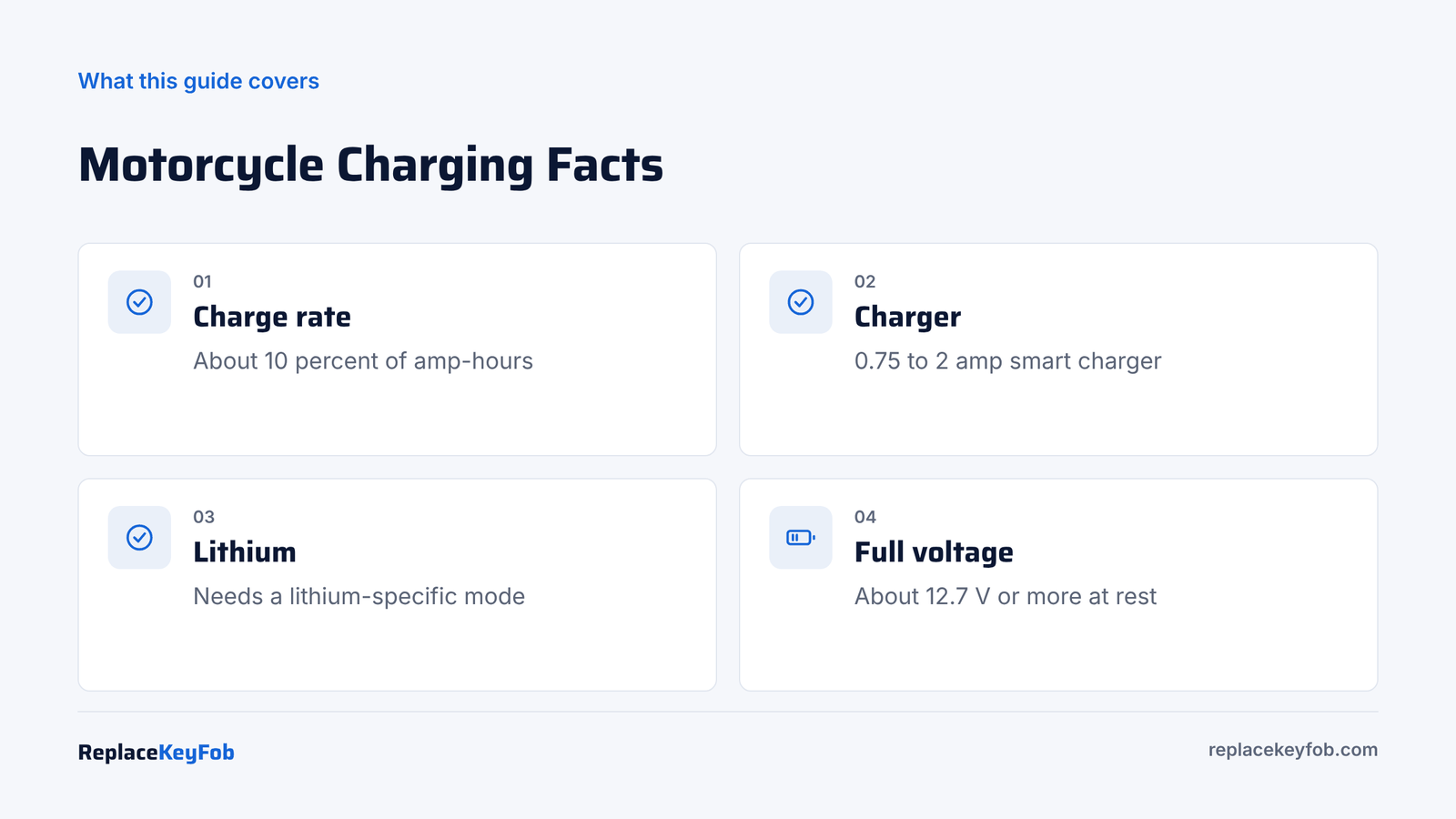
A good rule is to charge at about 10 percent of the battery’s amp-hour rating. A 10 Ah battery likes about 1 amp. You can go a little higher, but avoid car chargers on their high setting.
| Battery size | Recommended charge rate | Good charger choice |
|---|---|---|
| 3 to 6 Ah (scooters, small bikes) | About 0.5 to 0.75 A | Small maintainer with motorcycle mode |
| 8 to 14 Ah (most street bikes) | About 0.75 to 1.5 A | 1 to 2 amp smart charger |
| 18 to 30 Ah (touring bikes, big cruisers) | About 2 to 3 A | 2 to 4 amp smart charger |
Look for a charger with a motorcycle or small-battery mode, automatic float, reverse-polarity protection, and a lithium mode if your bike has a lithium battery.
Motorcycle Battery Charger and Maintainer
Pick a 0.75 to 2 amp smart charger with motorcycle mode, lithium support if needed, and a ring-terminal pigtail for easy hookup.
As an Amazon Associate, ReplaceKeyFob earns from qualifying purchases.
Know Your Motorcycle Battery Type
| Type | How to recognize | Charging note |
|---|---|---|
| Conventional flooded | Removable caps, visible fluid levels | Check fluid; charge on standard mode |
| AGM (factory-activated sealed) | Sealed, often labeled AGM or maintenance free | Use AGM mode |
| Gel | Labeled gel | Needs a gel-compatible charger and lower voltage |
| Lithium (LiFePO4) | Light weight, often labeled lithium | Use a lithium mode; no desulfation |
Lithium batteries are common on sport bikes and as upgrades. Charging them on a lead-acid profile can trigger their protection circuits or damage them, and desulfation pulses are harmful to them.
How to Charge a Motorcycle Battery Step by Step
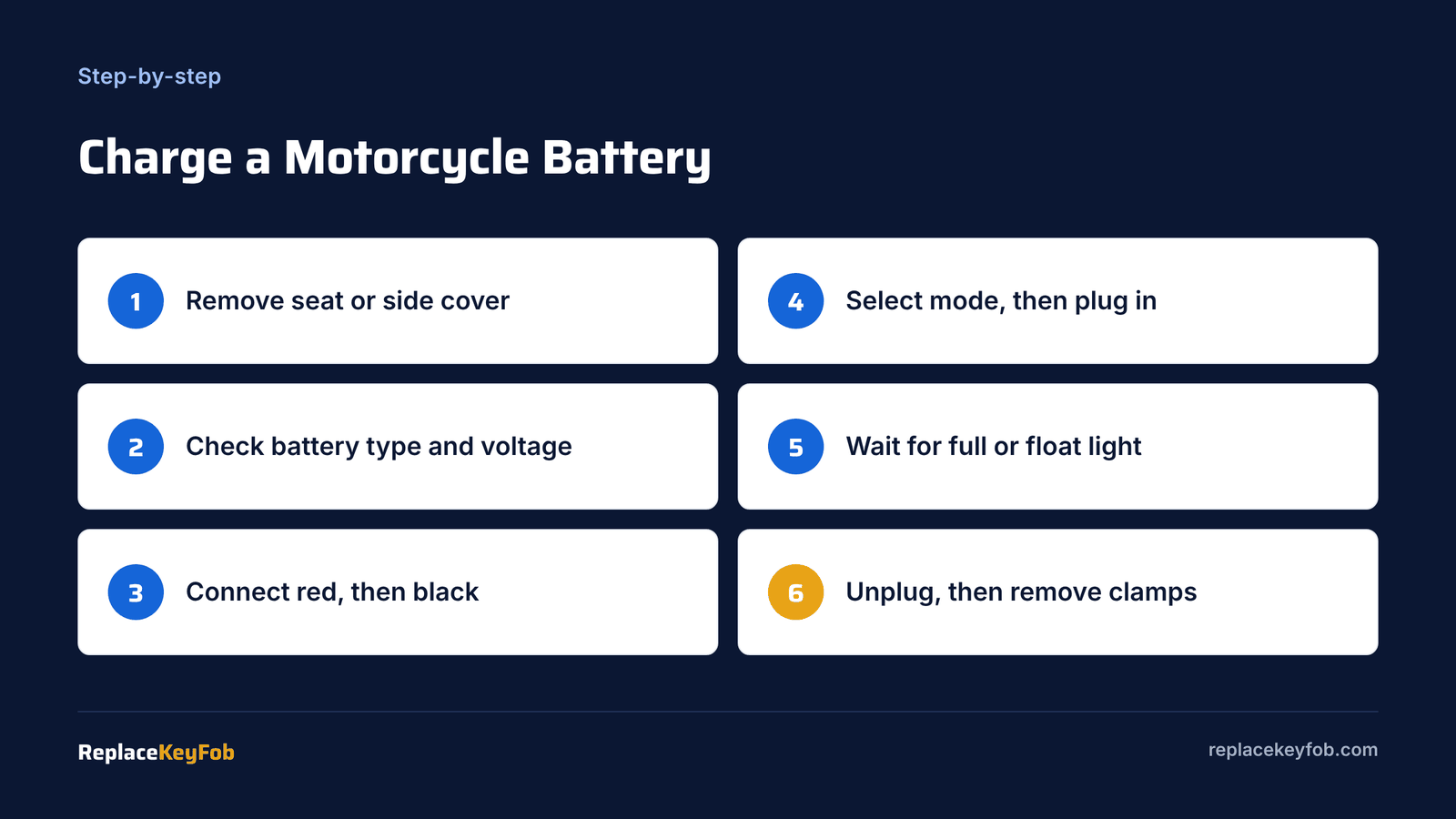
- Find the battery. It is usually under the seat, behind a side cover, or under the fuel tank on some sport bikes. Check your manual.
- Turn the ignition off and remove the key.
- Check resting voltage with a multimeter. A lead-acid bike battery is full at about 12.7 volts or more, half full at about 12.2 volts, and flat below about 12.0 volts. Lithium batteries rest higher, about 13.2 volts or more when full.
- Decide whether to remove the battery. You can usually charge it on the bike. Remove it if the terminals are hard to reach, or if you are charging indoors.
- Connect red to positive (+).
- Connect black. On the bike, use the negative post or a bare metal frame ground. Off the bike, connect straight to the negative post.
- Select the mode that matches the battery type.
- Plug the charger in and switch it on.
- Wait for the full or float indicator.
- Unplug the charger first, then remove black, then red.
- Check voltage again after a couple of hours of rest.
Why low amps matter on bike batteries
A small battery has small plates. Pushing a high current heats them and can boil off electrolyte in flooded batteries or swell sealed ones. A low charge rate lets the battery absorb charge evenly and stay cool.
How Long to Charge a Motorcycle Battery
| Battery and state | 0.75 amp charger | 1.5 amp charger |
|---|---|---|
| 12 Ah, half charged | About 8 to 10 hours | About 4 to 6 hours |
| 12 Ah, flat | About 16 to 20 hours | About 8 to 10 hours |
| 6 Ah, half charged | About 4 to 5 hours | About 2 to 3 hours |
| 20 Ah, half charged | About 14 to 16 hours | About 7 to 9 hours |
These are rough estimates. Cold batteries and older batteries take longer, and smart chargers slow down near the end of the charge.
How long to charge a dead motorcycle battery
A battery that dropped below about 10.5 volts may not be detected by a smart charger. Some chargers have a repair or force mode for this. If it charges, expect a full day. A lead-acid battery left fully flat for weeks often has permanent sulfation and will not hold a charge. Lithium batteries with low-voltage protection may need a charger with a lithium wake-up function.
Install a Charging Pigtail
A charging pigtail bolts onto the battery terminals and ends in a weatherproof plug you can tuck under the seat or near the side cover. Once fitted, charging is just a plug-in, with no seat removal. Most bike chargers include one. Keep the inline fuse in place and the cap closed when riding.
Charging Without a Charger
- Riding the bike charges the battery, but short rides may not be enough. Ride at least 30 minutes at normal speeds.
- Jump starting from a car can get the bike running. Keep the car engine off so the car’s alternator does not push a large current into the small battery. Connect red to the bike positive and car positive, black to the car negative and the bike frame. See how to jump start a car for the safety order.
- Portable jump starters work on bikes too; choose a small one and follow its instructions.
Winter Storage
- Charge the battery fully before storage.
- Keep a maintainer connected, or charge every 4 to 6 weeks if removed.
- Store a removed battery indoors, off the floor, away from heat and sparks.
- Check fluid levels on flooded batteries before and after storage.
For more on storage, see how to store a car battery for winter, which uses the same principles.
Troubleshooting
| Problem | Likely cause | Fix |
|---|---|---|
| Charger will not start | Voltage too low or wrong mode | Use repair or lithium wake mode; check clamps |
| Charger finishes fast but bike will not start | Battery cannot hold charge | Load test or replace |
| Battery hot or swollen | Overcharging, wrong charger | Stop charging; replace battery |
| Battery dies after a few days parked | Parasitic drain, alarm, or aging battery | Use a maintainer; test for drain |
| Lithium battery reads 0 V | Protection circuit tripped | Use a lithium charger with wake-up mode |
Charging Tips for Different Bikes
Sport bikes
Batteries often sit under the rider or passenger seat, sometimes beneath the fuel tank front. Many sport bikes use small lithium batteries from the factory or as upgrades. Confirm the type before choosing a mode.
Cruisers and touring bikes
Larger batteries, often 18 to 30 amp-hours, sit behind a side cover or under the seat. They tolerate a 2 to 3 amp charger. Touring bikes with heated grips, audio and GPS drain faster when parked, so a maintainer is worth it.
Scooters, dirt bikes and ATVs
Small batteries charge quickly and are easy to overcharge. Use a charger with a 0.75 amp or lower setting. Dirt bikes and ATVs that sit for months benefit most from a pigtail and maintainer.
Older bikes with conventional batteries
Check the fluid level in each cell before charging, and top up with distilled water only after charging. See how to add water to a car battery, which follows the same method.
Mistakes to Avoid
- Using a car charger on high. Too much current for a small battery.
- Charging lithium on a lead-acid mode.
- Leaving a basic charger connected for days. Use a smart charger with float.
- Charging a frozen or swollen battery.
- Pinching wires when refitting the seat or side cover.
When to Replace
Motorcycle batteries typically last about 3 to 5 years. A new lead-acid or AGM bike battery typically costs about $50 to $150, and lithium about $100 to $300. If the battery fails a test after a full charge, replace it. See the best car battery testers for tools that also test bike batteries.
Frequently Asked Questions
With a 0.75 to 1.5 amp charger, a half-charged battery usually needs about 4 to 10 hours, and a flat one about 12 to 24 hours.
Only on a low setting of about 2 amps or less, and only if it has the right battery type mode. A dedicated motorcycle charger is safer.
Usually not. You can charge it on the bike with the ignition off. Remove it if the terminals are hard to reach or you are charging indoors.
Use a charger with a lithium mode. Do not use desulfation or lead-acid modes, which can damage lithium batteries.
About 12.7 volts or more for lead-acid and AGM batteries at rest, and about 13.2 volts or more for lithium.