
How to Use a Portable Jump Starter Step by Step

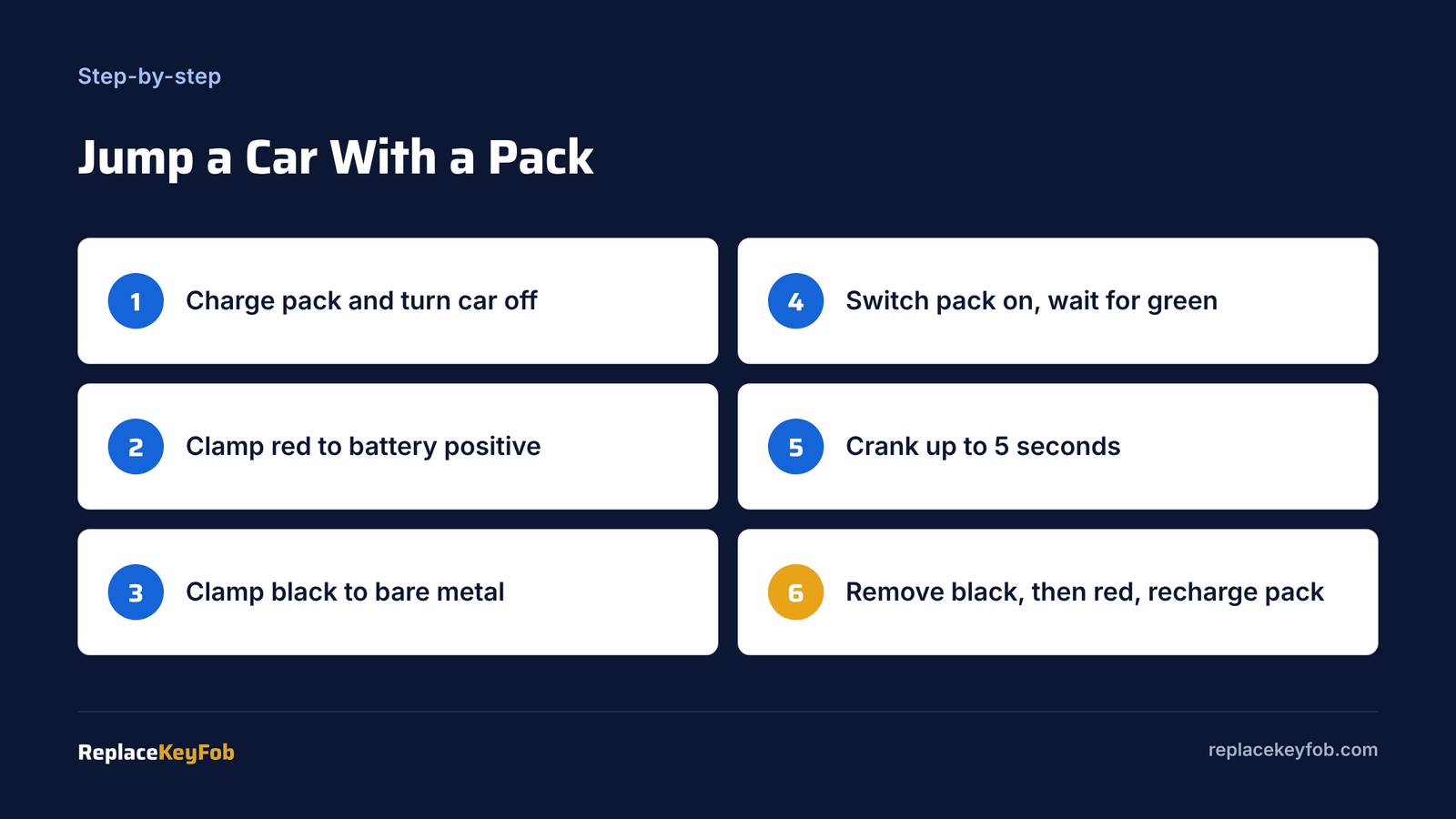
To use a portable jump starter, make sure the pack is charged, turn the car off, then connect the red clamp to the battery’s positive post and the black clamp to bare metal or the negative post. Switch the pack on and wait for the ready light. Start the car, cranking no more than about 5 seconds. Then turn the pack off and remove black first, then red.
A portable jump starter is a battery pack built to deliver a short burst of high current to a dead car battery. Unlike jumper cables, it does not need a second car, so you can get going alone in a parking lot or a cold driveway. Most modern packs use lithium cells, fit in a glove box, and have smart clamps that will not power up if the clamps are reversed.
Using one is simple, but a few details make the difference between a clean start and a dead pack: correct clamp order, short cranking, and knowing when to use boost or override mode. This guide covers all of that. If you are still choosing a pack, see our best portable jump starters, or compare jump starter vs jumper cables to decide which to keep in the car.
What You Need
- A charged jump starter sized for your engine. Small packs work on most 4-cylinder cars; larger engines and diesels need more.
- The pack’s clamps connected to the pack, if they are detachable.
- Safety glasses and gloves.
- Your owner’s manual, to find remote jump posts if the battery is in the trunk or under a seat.
Lithium Portable Jump Starter
Choose a pack rated for your engine size, with spark-proof smart clamps, reverse-polarity protection, and USB charging; diesel trucks need higher-rated packs.
As an Amazon Associate, ReplaceKeyFob earns from qualifying purchases.
Pick the right size
| Engine | Typical pack size |
|---|---|
| 4-cylinder gas | Small to medium pack |
| V6 gas | Medium pack |
| V8 gas, full-size trucks | Medium to large pack |
| Diesel trucks | Large pack rated for diesel |
| Motorcycles and hybrids | Small pack |
Peak amp numbers on the box are not standardized, so compare packs by the engine sizes the maker says they support. For bigger engines, see the best jump starters for V8 trucks and SUVs and the best jump starters for diesel trucks.
Before You Connect
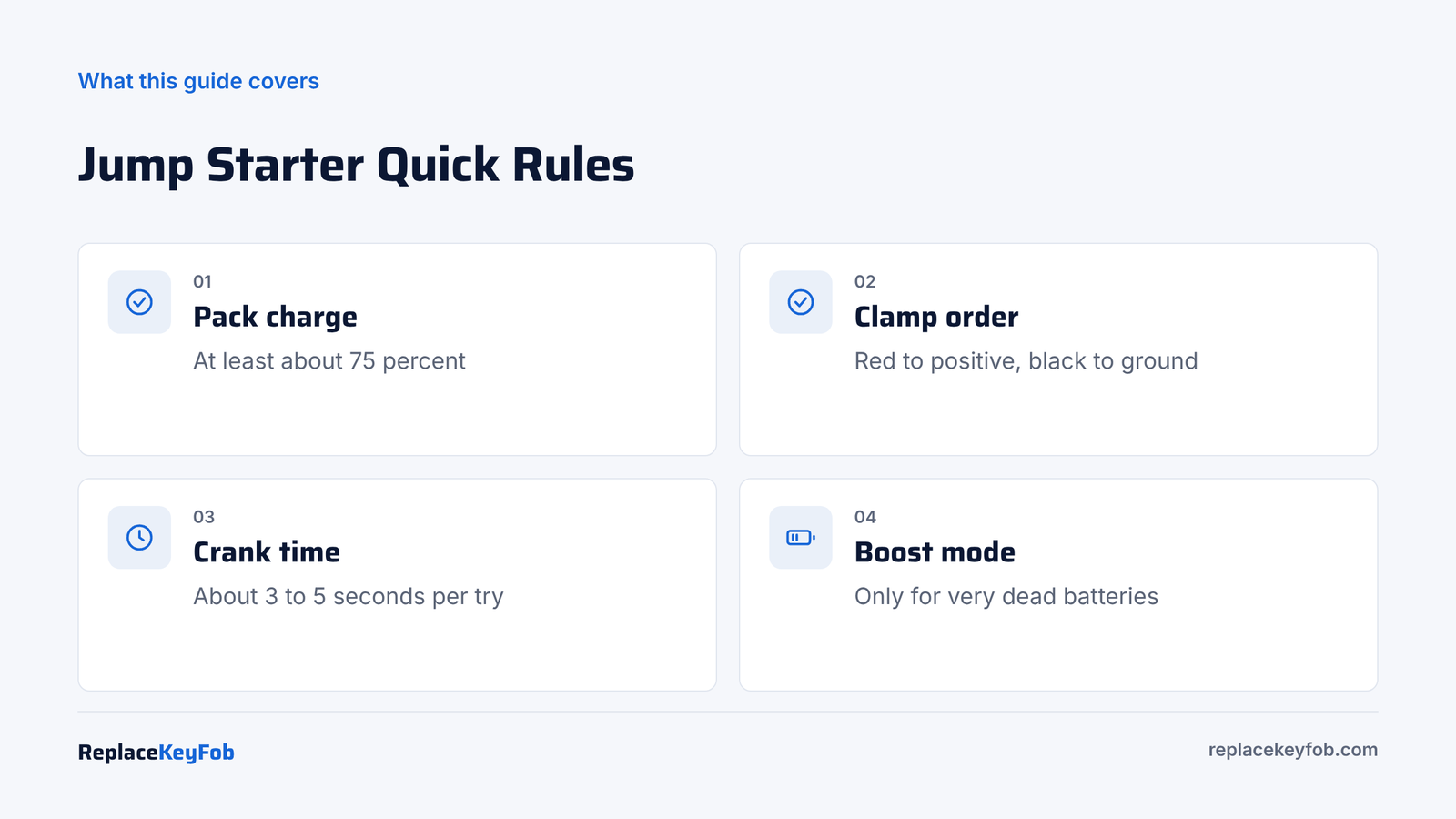
- Check the pack charge. Most packs show a percentage or LED bars. Use one with at least about 75 percent.
- Turn off the car, lights, radio, climate control and any phone chargers.
- Check the battery. Do not jump a cracked, swollen, leaking or frozen battery.
- Clean heavy corrosion from the terminals if the clamps cannot bite. See battery terminal corrosion.
- Find the connection points. If the battery is in the trunk or under a seat, use the remote jump posts under the hood.
How to Use a Jump Starter Step by Step
- Make sure the pack is off and the clamps are plugged into it.
- Connect the red clamp to the positive (+) battery terminal or the positive jump post.
- Connect the black clamp to bare, unpainted metal on the engine or chassis, away from the battery. If that is hard, the negative (-) post works on most packs, since they are spark-protected.
- Turn the pack on. On many packs, a green or white light shows the clamps are connected correctly. A red light or warning beep usually means reversed clamps or a problem.
- Wait about 30 seconds if the instructions recommend it. Some packs prime the battery before cranking.
- Start the car. Crank for no more than about 3 to 5 seconds.
- If it does not start, wait 30 to 60 seconds before trying again. This lets the pack and the starter cool. Most packs allow several attempts.
- Once the engine runs, turn the pack off.
- Remove the black clamp first, then the red clamp.
- Leave the engine running or drive for at least 20 to 30 minutes to put some charge back in the battery.
- Recharge the pack as soon as you can.
Why the black clamp goes on bare metal
The last connection is where a spark is most likely. A battery can release hydrogen gas, especially when it is deeply discharged or being charged. Connecting the ground clamp away from the battery keeps any spark away from that gas. Smart clamps reduce the risk, but the habit is still the safest approach.
Boost and Override Modes
Most smart packs will not send power if they cannot detect a battery, as a safety feature. A battery that has dropped very low, often below about 2 to 3 volts, may not be detected.
- Boost or override mode forces the pack to send power anyway. On many NOCO Boost models, you press and hold the boost button for a few seconds until the boost light comes on.
- Use it only when needed, and only after double-checking clamp polarity, because boost bypasses the reverse-polarity protection on many packs.
- Turn it off right after starting.
If the battery is that flat, it may have a dead cell or deep sulfation. Plan on testing it after the car starts; see how to load test a car battery.
How to Use a NOCO Jump Starter
NOCO Boost packs follow the same process, with a few specific notes:
- Press the power button to wake the pack and see its charge level.
- Connect the clamps, red first, then black.
- A white or green light near the clamps on many models shows a good connection. An error light usually means reversed clamps or a poor connection.
- Start the car. Use boost mode only if the pack does not detect the battery.
- Turn the pack off, then remove the clamps.
Model features vary. See our comparisons NOCO GB40 vs GB70 and NOCO vs GOOLOO jump starters for differences between popular packs.
Using a Jump Starter on Hybrids, EVs and Motorcycles
- Hybrids: connect to the under-hood jump terminal, then press the brake and power button until READY appears. See how to jump start a hybrid car.
- Teslas: a pack can release the frunk and wake the low-voltage system. See how to jump start a Tesla.
- Motorcycles: small packs work well. Do not crank for long.
Troubleshooting
| Problem | Likely cause | What to do |
|---|---|---|
| Pack shows error or red light | Reversed clamps or poor contact | Recheck polarity; clean contact points |
| Pack does not detect battery | Battery very low | Use boost mode carefully |
| Engine clicks, does not crank | Pack too small or bad connection | Check clamp contact; use larger pack |
| Cranks but will not start | Fuel, spark or immobilizer issue | Not a battery problem; see car starts then dies immobilizer |
| Starts then dies right away | Weak alternator or immobilizer | Test charging; check key |
| Pack dead when needed | Not recharged after use or storage | Recharge every 3 to 6 months |
If the car keeps needing jumps, the battery or charging system needs attention. See car clicks but won’t start for a fuller diagnosis.
Mistakes to Avoid
- Cranking for too long. Long cranking overheats the pack and starter.
- Leaving the pack connected after the engine starts.
- Using boost mode without checking polarity.
- Storing the pack in a hot car all summer. Heat shortens lithium life. Cold reduces output.
- Forgetting to recharge. A pack at 30 percent may not start a big engine.
- Clamping onto painted surfaces. Paint blocks current.
How to Store and Maintain a Jump Starter
- Recharge after every use and every 3 to 6 months in storage.
- Keep it in the cabin, not under the hood or in direct sun.
- In very cold weather, bring it indoors overnight so it delivers full power.
- Check the clamps and cable for damage before each use.
- Replace the pack if it will not hold a charge or the case swells.
When to Call for Help
If the car will not start after three or four attempts, stop. Repeated cranking can overheat the starter. Roadside assistance typically costs about $50 to $150 per call if not included with insurance or a membership. If the battery is worn out, a replacement typically costs about $150 to $400 installed; see car battery replacement cost.
Frequently Asked Questions
Charge the pack, turn the car off, connect red to positive and black to bare metal or negative, switch the pack on, then start the car. Turn the pack off and remove black first, then red.
No more than about 3 to 5 seconds per attempt, with a 30 to 60 second rest between tries.
Bare metal on the engine or chassis is safest. Most smart packs also work on the negative post, which is fine if no ground point is handy.
Only when the pack cannot detect a very dead battery. Double-check polarity first, since boost bypasses some safety features.
After every use, and every 3 to 6 months while stored.