
How to Use a Stanley FatMax Jump Starter (Jump, Compressor and Charging)

To use a Stanley FatMax jump starter, make sure it is charged, clamp red to the battery positive and black to bare metal ground, then turn the unit’s power or jump switch on and crank for up to 5 seconds. Switch it off, remove black then red, and recharge the unit right away.
Stanley FatMax is a family of products rather than one model. The best-known units are the large orange-and-black cases with a sealed lead-acid battery, jumper cables wrapped around the side, an air compressor on the front and a few power outlets. There are also newer lithium FatMax packs and higher-rated models sold as 1000A, 1200A and up, plus smaller units around 350A aimed at small cars.
The jumping steps are similar across the range. What differs is the switch, the display and how the unit charges. This guide explains the common setup and calls out where your model may differ.
Know Your FatMax Unit
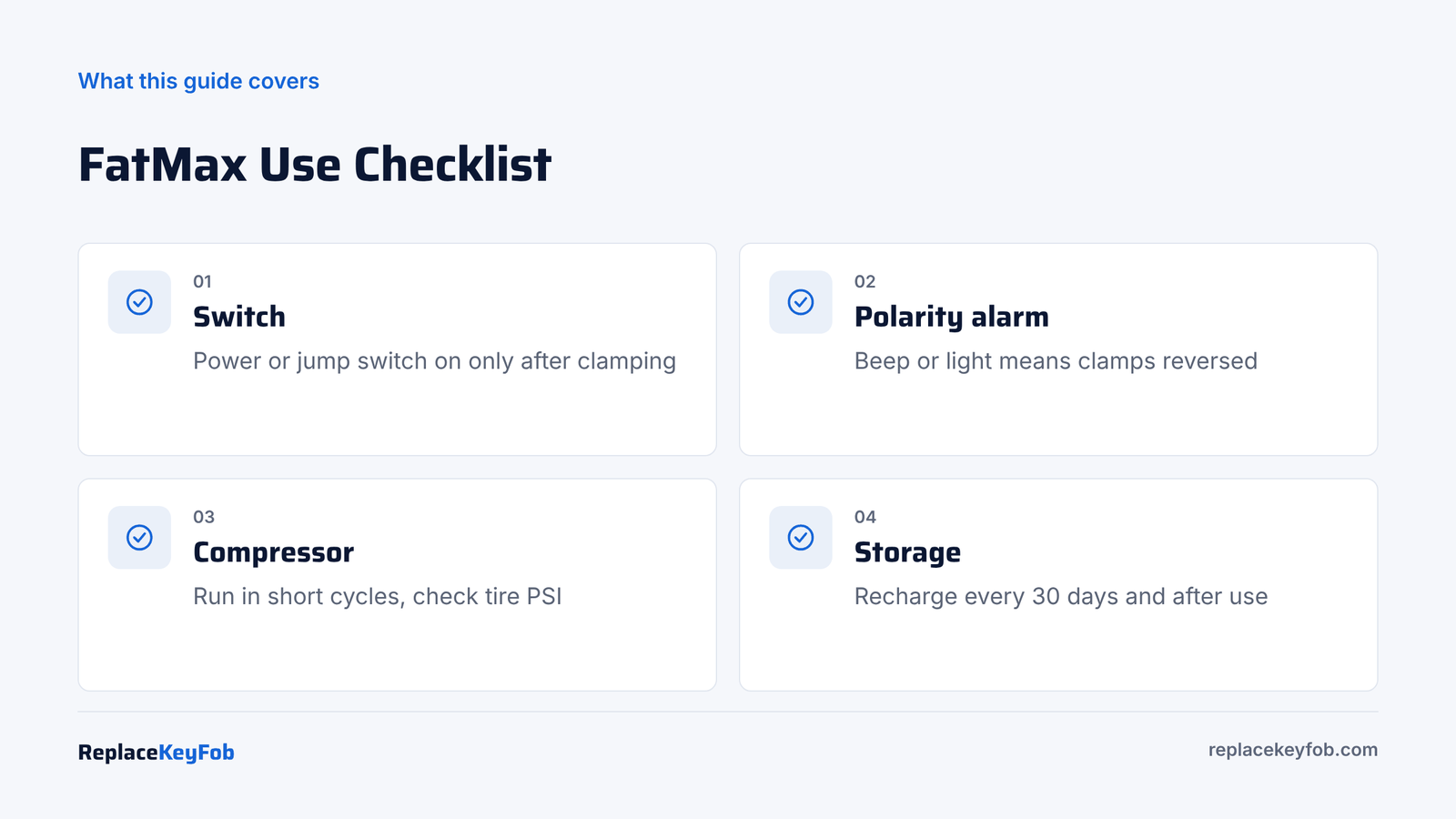
Turn the unit around and read the label. It names the peak amp rating and how the unit charges. Then look at the front panel:
- Power or jump switch: many lead-acid FatMax units have a rocker or push switch that sends power to the clamps. On some, the clamps are always live, so you must clamp carefully.
- Battery status button or display: shows charge level, usually with LEDs or a small voltage readout.
- Reverse polarity alarm: many models beep or light up if the clamps are on the wrong terminals.
- Compressor: a separate switch, a hose with a gauge or digital readout, and sometimes an auto-stop PSI setting.
- Outlets: USB ports, a 12V socket, and on some models a household AC outlet.
| Rating you may see | What it is good for |
|---|---|
| Around 350A peak | Small 4-cylinder cars in mild weather |
| Around 700A to 1000A peak | Most cars, small SUVs, V6 engines |
| Around 1200A peak and up | Larger V6 and V8 engines, some trucks |
Peak amp numbers on lead-acid jump boxes are not directly comparable to lithium pack ratings, so treat them as a rough size guide.
Heavy-duty extension cord for charging
Many lead-acid jump boxes charge from a household extension cord; a short 14 or 16 gauge indoor cord keeps the unit charged on a shelf near an outlet.
As an Amazon Associate, ReplaceKeyFob earns from qualifying purchases.
How to Use a Stanley FatMax Jump Starter
Prepare
- Check the charge. Press the battery status button. Do not try a jump on a unit showing low charge; it may click the starter and drain itself without starting the car.
- Turn the vehicle off and switch off headlights, HVAC and radio.
- Put on safety glasses. Inspect the car battery. Never jump a frozen, cracked or leaking battery.
- Make sure the FatMax power switch is off.
Connect
- Unwrap the cables fully so they reach without stretching.
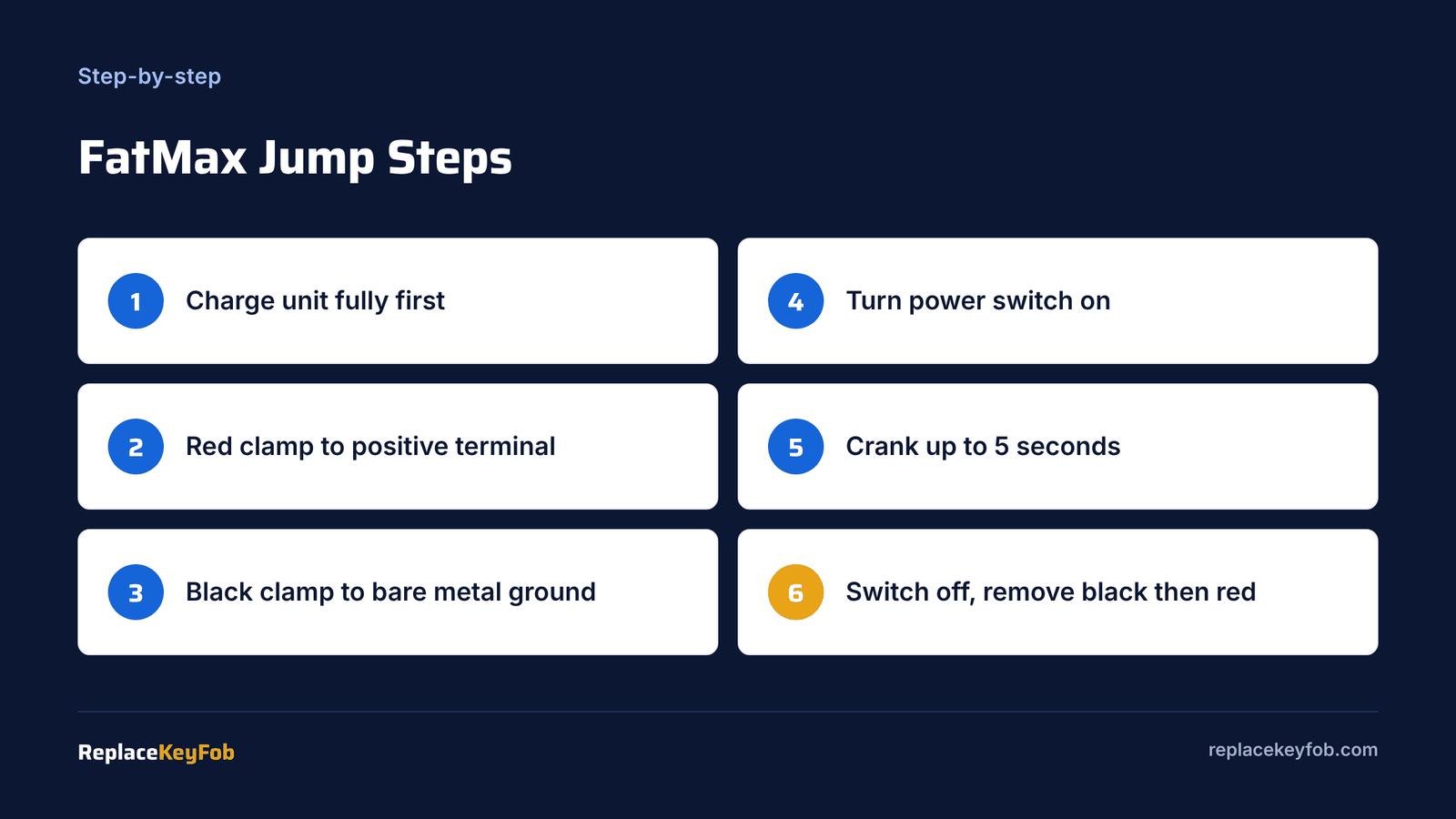
- Clamp red to the positive (+) battery terminal or remote positive jump post.
- Clamp black to a bare metal ground: an engine bolt or the chassis ground point, away from the battery. The battery negative terminal also works, but grounding away from the battery is the safer habit.
- If the reverse polarity alarm sounds or a warning light comes on, stop, remove both clamps and reconnect correctly.
Jump
- Turn the power or jump switch on.
- Crank the engine for up to 5 seconds.
- If the engine does not start, turn the switch off and wait about 1 to 2 minutes before trying again. Lead-acid jump boxes recover a little between attempts, and the starter cools down.
- Once the engine runs, turn the switch off.
- Remove the black clamp, then the red clamp, and wrap the cables back on the unit.
Drive the car at least 20 to 30 minutes so the alternator can put charge back into the car battery.
How to Use the Stanley FatMax 1200 and Other High-Amp Units
The bigger FatMax models (often sold as 1000A or 1200A peak) use the same steps, with a few habits that help on larger engines:
- Let the box charge the battery for a minute. On some units, if the car battery is deeply drained, leaving the switch on for 1 to 3 minutes before cranking lets a little charge flow into the battery first. Check that your manual allows this.
- Use the engine block for ground on V8s and trucks; it gives the starter a shorter return path.
- Make two or three short attempts rather than one long crank.
For trucks and diesels, see our full guide on how to jump start a truck.
How to Use the FatMax Air Compressor
- Start the car if possible. Running the compressor from the internal battery drains it fast.
- Screw or clip the hose onto the tire valve.
- Read the current pressure on the gauge or display.
- If your model has auto-stop, set the target PSI from the door-jamb sticker (not the tire sidewall maximum).
- Turn the compressor switch on. Run it in cycles of a few minutes, then let it cool. Most small compressors are not made for continuous duty.
- Turn it off, remove the hose and recheck with a separate tire gauge.
The compressor is fine for topping up tires and filling a slow leak to get home. It is slow for filling a completely flat truck tire. If you want a lighter 2-in-1, see jump starters with air compressor.
How to Charge a Stanley FatMax
Depending on the model, a FatMax charges through:
- A household extension cord plugged into a built-in charger socket on the back.
- A separate AC wall adapter.
- A 12V DC cord from a car socket (slow, and only while driving).
Charge it fully before first use; many lead-acid units need a long first charge. Then recharge after every use and at least every 30 days. Do not leave a lead-acid unit sitting flat; sulfation will ruin the internal battery. Our guide on how to charge a jump starter explains timing and storage.
If It Won’t Start the Car
| Symptom | Likely cause | Fix |
|---|---|---|
| Alarm sounds when clamping | Reverse polarity | Move red to positive, black to ground |
| Nothing happens with switch on | Unit flat, switch fault, loose cable | Check status; charge; inspect clamp wires |
| Starter clicks once | Poor clamp contact or starter fault | Clean terminals; ground to engine block |
| Cranks slowly | Unit too small or low charge | Charge fully; let it pre-charge 1 to 3 minutes |
| Starts, then dies | Charging system issue | Test alternator output |
| Unit will not hold charge | Internal battery worn | Replace internal battery or unit |
If the starter clicks no matter what you do, read car clicks but won’t start to tell a battery problem from a starter problem.
Using the Outlets and Work Light
Most lead-acid FatMax units double as a small power source. A few rules keep them from draining the battery you need for a jump:
- USB ports are fine for charging a phone during a breakdown, but each full phone charge uses a noticeable part of the battery.
- The 12V socket can run a small inflator, a cooler or a phone charger. Larger loads, such as a 12V vacuum, drain the unit quickly.
- The AC outlet (on models that have one) is for small loads like a laptop charger. Check the watt limit on the label and never plug in a heater or power tool.
- The work light draws very little and is safe to use while you set up the jump.
After using any outlet for more than a few minutes, recharge the unit before you put it back in the trunk.
First-Time Setup Checklist
- Unbox the unit and read the warning label on the side.
- Charge it fully before any use, following the manual’s first-charge time.
- Unwrap the cables once and check the clamp jaws and cable insulation for shipping damage.
- Test the battery status button so you know what “full” looks like on your model.
- Note the date on a piece of tape so you know when the 30-day recharge is due.
Safety Notes
- Keep the clamps clipped in their holders when not in use; touching clamps on a live unit can spark.
- Do not jump with the unit sitting on top of the engine; set it on the ground or a fender cover.
- Never use the AC outlet on the unit while jumping.
- If the unit case is swollen, cracked or smells of acid, retire it.
Is It Worth Fixing an Old FatMax?
Many lead-acid jump boxes use a standard sealed lead-acid battery inside. On some models a replacement battery can be fitted with basic tools, typically for about $30 to $70. If the case, cables or compressor are worn, a new unit (typically about $100 to $200 in 2026) usually makes more sense. A lithium pack is lighter and holds charge longer, but loses the built-in compressor unless you buy a combo model.
Frequently Asked Questions
Charge it, clamp red to positive and black to ground, turn the power switch on, and crank for up to 5 seconds. On a deeply drained battery, some models let you wait 1 to 3 minutes with the switch on before cranking.
On most models a beep or warning light means reverse polarity. Remove both clamps and reconnect red to positive and black to ground.
Lead-acid units often need a long first charge and about 10 to 24 hours from low. Check the indicator and the manual for your model.
Only if the manual says it has an automatic charger that is safe to leave connected. Otherwise charge it fully, unplug it, and recharge every 30 days.
It suits small 4-cylinder engines in mild weather. For V6, V8 or cold climates, a higher-rated unit is more reliable.