
How to Charge a Portable Jump Starter (and How Often)

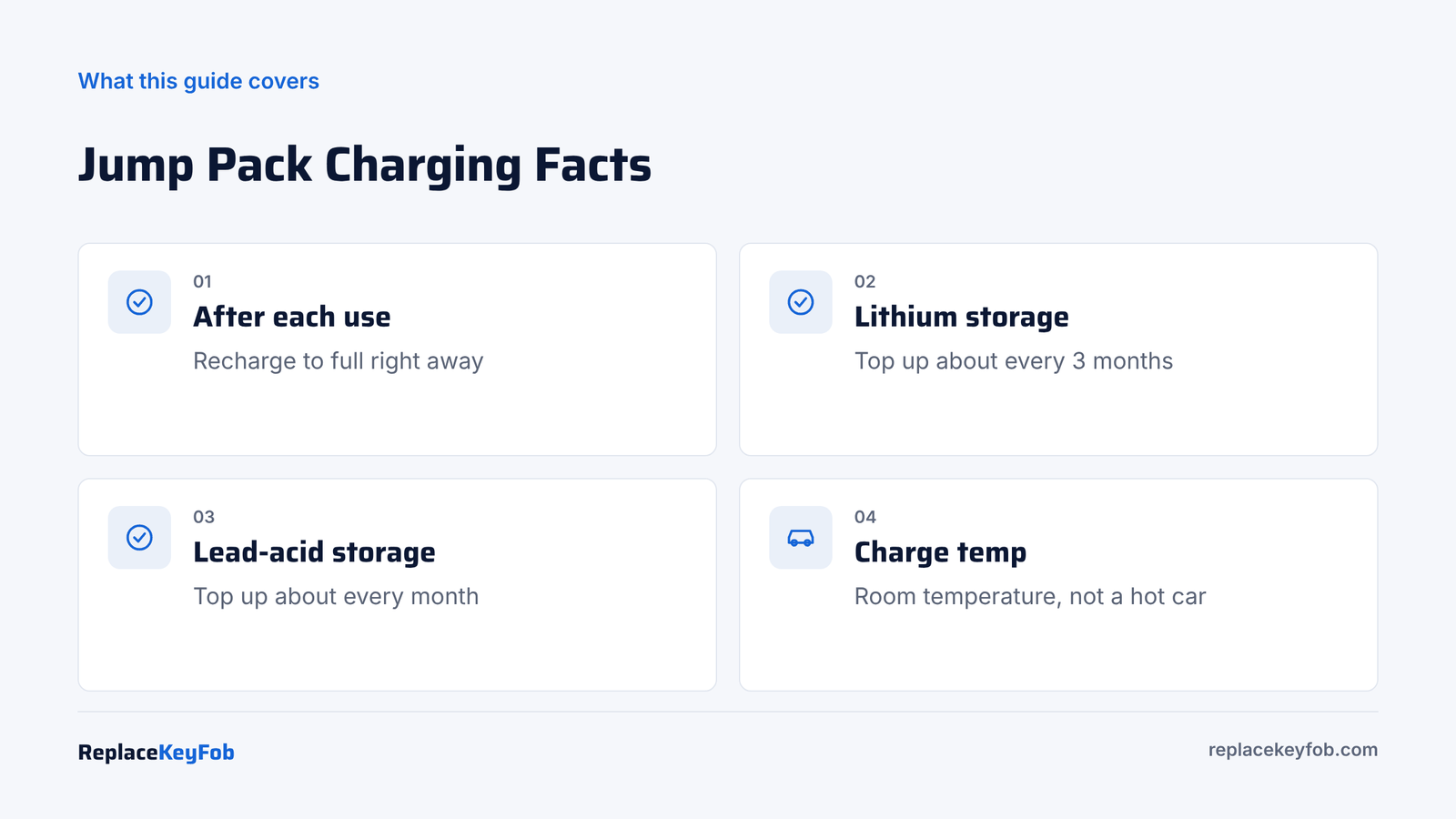
To charge a jump starter, plug it into the charger that came with it: a USB-C or micro-USB wall adapter for most lithium packs, or the AC cord or adapter for lead-acid units. Charge indoors until every indicator light is solid. Recharge right after each use and top up about every 3 months for lithium, monthly for lead-acid.
The most common reason a jump starter fails is not a weak battery. It is a pack that sat in the trunk for a year and quietly drained to nothing. Charging it right takes a few minutes of attention a few times a year.
There are two main families of portable jump starters, and they charge very differently. Compact lithium packs (NOCO Boost, GOOLOO, AstroAI, Duralast lithium, many Schumacher lithium models) charge through a USB port. Larger “jump box” units with a sealed lead-acid (AGM) battery inside, often with an air compressor, charge through an AC cord or a wall adapter.
Which Type of Jump Starter Do You Have?
| Feature | Lithium pack | Lead-acid jump box |
|---|---|---|
| Size and weight | Phone to hardback-book size, 1 to 3 lb | Large case with handle, 10 to 25 lb |
| Charging port | USB-C, micro-USB, sometimes 12V DC barrel | AC cord, AC wall adapter, or 12V car plug |
| Typical full charge | About 2 to 6 hours | About 10 to 40 hours |
| Self-discharge | Slow, a few percent a month | Faster, needs monthly charging |
| Best storage | Charged to full, cool and dry | Plugged in or charged monthly |
The label on the back or the manual will name the input port and input rating, for example “Input: USB-C 5V 3A” or “Input: 15V DC.” That rating tells you which charger is safe.
How to Charge a Lithium Jump Starter
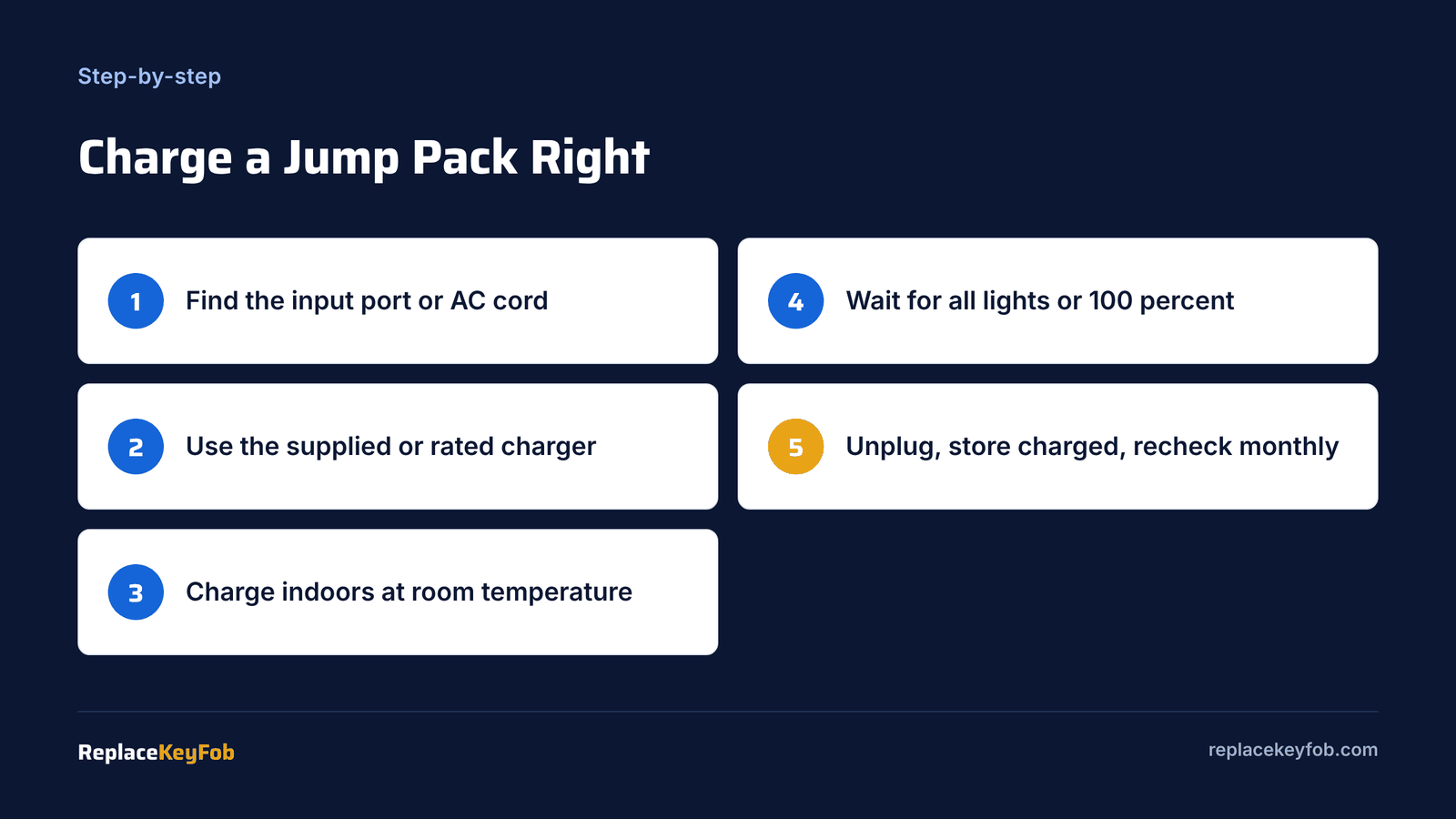
- Disconnect the clamps from the pack (if they detach) and from any vehicle.
- Find the input port. It is usually labeled “IN” or “Input.” Many newer packs use USB-C; older ones often use micro-USB.
- Use the right wall adapter. The supplied cable plus a wall adapter that meets the input rating is the safe choice. A pack listed as USB-C PD charges faster from a PD wall charger (for example 18W, 30W or 60W), while a cheap 5W phone cube can take all day.
- Charge indoors at room temperature. Most lithium packs should only be charged between about 32 and 104 degrees F (0 to 40 C). Charging below freezing can damage lithium cells permanently.
- Watch the indicator. Most show four LEDs that blink as they fill or a percentage screen. Full is usually all LEDs solid or 100 percent.
- Unplug when full. Most packs stop charging on their own, but do not leave them on a charger for weeks in a hot room.
USB-C PD wall charger
Choose a wall charger whose wattage meets or exceeds your jump pack’s USB-C input rating so it charges in a few hours instead of a full day.
As an Amazon Associate, ReplaceKeyFob earns from qualifying purchases.
Can you charge a lithium jump starter in the car?
Some packs come with a 12V car charging cable, and many can charge from a car’s USB-C port. Charging from the car is handy on a road trip, but a car parked in summer sun can heat well past the safe charging range. Charge while driving, then bring the pack inside if the car will sit in heat.
How to Charge a Lead-Acid Jump Box
Lead-acid units from Schumacher, Stanley, EverStart, DeWalt, Duralast and DieHard often charge one of three ways: a built-in AC charger that takes a standard household extension cord, a separate AC wall adapter, or a 12V DC cord from the car.
- Turn the unit off and make sure the clamps are stowed in their holders. Clamps touching each other while charging can short.
- Plug in the AC cord or adapter into the unit’s charge port and a wall outlet.
- Check the charge indicator. Most have a battery status button with three or four LEDs, or a small voltmeter. Some show “charging” in red and “charged” in green.
- Charge fully before first use. New units often need a long first charge. Many manuals suggest charging overnight or longer before the first jump.
- Recharge after every use and at least every 30 days while stored.
Lead-acid units lose charge faster than lithium and are damaged by being left flat. A jump box stored discharged over winter can sulfate and never hold a full charge again.
How Long Does It Take to Charge a Jump Starter?
Charge time depends on the battery capacity and how much power the charger can deliver.
| Pack type and input | Typical charge time from empty |
|---|---|
| Small lithium, 5V 2A micro-USB | About 4 to 6 hours |
| Mid-size lithium, USB-C 5V 3A | About 3 to 5 hours |
| Large lithium, USB-C PD 30W to 65W | About 2 to 4 hours |
| Lead-acid jump box, AC built-in charger | About 10 to 24 hours |
| Lead-acid jump box, 12V car cord | Often 20 hours or more, only while driving |
If you are still choosing a pack, charging speed is one of the real differences between brands; our NOCO vs GOOLOO comparison covers it.
Brand Notes
GOOLOO jump starters
Most current GOOLOO packs charge over USB-C, and some larger ones accept fast charging. A row of LEDs or a display shows charge level. GOOLOO packs also work as power banks, which is handy but drains the pack you need for a jump. Recharge after using it to charge a phone. See our GOOLOO A3 review for one example.
Schumacher jump starters
Schumacher sells both lithium packs (USB charged) and lead-acid jump boxes. Many lead-acid models charge through a built-in AC charger with a household extension cord, and a few have an automatic charger that can stay plugged in. Check the label on the unit to see if it is designed to stay connected.
NOCO Boost
Older NOCO Boost models such as the GB40 charge over micro-USB, while the newer Boost X line uses USB-C. NOCO packs show charge level with a set of white LEDs.
How Often Should You Charge a Jump Starter?
- After every jump. Even one jump can use a big chunk of a small pack.
- After using it as a power bank.
- Every 3 months for lithium, or every month in very hot or very cold climates.
- Every month for lead-acid, or keep it on an automatic charger if the manual allows.
- Before long trips and before winter. Cold reduces available power, so start winter at 100 percent.
A simple habit: check the pack each time you change your wipers, rotate tires or change your clocks for daylight saving.
Why a Jump Starter Won’t Charge
| Symptom | Likely cause | Fix |
|---|---|---|
| No lights when plugged in | Wrong cable, bad wall adapter, dirty port | Try the original cable and a known-good adapter |
| Charges very slowly | Low-watt charger | Use a charger that meets the input rating |
| Lights blink, never go solid | Deeply discharged or damaged cells | Leave on charger 12 hours; if no change, contact maker |
| Shows full, dies fast | Worn battery, often from storage flat | Replace the unit or battery if serviceable |
| Pack hot or swollen | Damaged lithium cell | Stop using it, store outdoors away from flammables, recycle it |
| Lead-acid box will not hold charge | Sulfation from being stored flat | Replace the internal battery or the unit |
Mistakes That Shorten Pack Life
- Storing it empty. Lithium and lead-acid both degrade when left flat.
- Leaving it in a hot car all summer. Heat speeds aging; a glove box can reach 140 degrees F or more.
- Charging below freezing. Warm a cold lithium pack to room temperature first.
- Using an unknown high-power charger on a pack with a low input rating, or a non-matching DC barrel adapter.
- Charging with clamps touching. Always separate the clamps.
Charge the Pack or Charge the Car Battery?
A jump starter starts the car, it does not recharge the car battery. If your battery is dying often, test it and charge it with a proper battery charger. Our guides on jump starter vs battery charger and how to charge a car battery at home explain the difference.
When to Replace a Jump Starter
Lithium packs typically last about 3 to 6 years with good care, lead-acid boxes about 2 to 5 years. Replace the unit if it cannot hold a charge for a month, it swells, or it can no longer crank the car it used to start easily. In 2026, quality lithium packs typically cost about $70 to $250, and lead-acid boxes with a compressor about $100 to $200. If you are shopping, see our list of portable jump starters.
Frequently Asked Questions
Charge it fully before the first use with the supplied cable or AC cord. Lithium packs often arrive partly charged; lead-acid boxes usually need a long first charge, often overnight or longer.
Most modern packs stop charging when full, so a few extra hours does no harm. Do not leave a lithium pack on a charger in a hot space for weeks, and only leave a lead-acid unit plugged in if the manual says it has an automatic maintainer.
Lithium Schumacher packs charge over USB. Many lead-acid Schumacher jump boxes charge through a built-in AC charger using a household extension cord. Check the model label and charge until the indicator shows full.
Most GOOLOO packs charge over USB-C with the included cable and a wall adapter. The LEDs or display show progress, and the pack is full when all indicators are solid or it reads 100 percent.
A good lithium pack loses only a few percent a month and can hold usable charge for 3 to 6 months. Lead-acid boxes lose charge faster and should be topped up monthly.