
How to Use a Schumacher Jump Starter (and Charge It Right)

To use a Schumacher jump starter, check the charge, turn the car off, clamp red to the positive terminal and black to bare metal ground, then switch the unit on and crank for up to 5 seconds. Switch it off, remove black then red, and recharge it. Most lead-acid Schumacher units should be charged every 30 days in storage.
Schumacher Electric has made battery chargers and jump starters for decades, and its range is wide: large lead-acid jump boxes with air compressors and inverters, professional “ProSeries” boosters, and compact lithium packs. That variety is why the first step is figuring out which one you have.
This guide covers how to identify your unit, the safe jump sequence, model-type differences, charging, and where to find manuals and support.

Step 1: Identify Your Schumacher Unit
Look on the back, side or bottom for a label with the model number (a mix of letters and numbers) and the peak amp rating. That label tells you:
- Battery type: lithium (small, light, USB charging) or lead-acid/AGM (heavy case, AC charging).
- Charging input: USB-C, micro-USB, AC wall adapter, or a built-in charger that takes a household extension cord.
- Rated voltage: almost all consumer units are 12V. Some professional models switch between 12V and 24V.
With the model number in hand, you can find the manual on Schumacher’s website or the retailer’s product page.
What You Need
- The charged Schumacher unit.
- Safety glasses and gloves.
- A wire brush if the terminals look crusty.
- The vehicle’s owner’s manual to find the battery or jump posts.
Battery terminal protector spray
After a jump, cleaning and coating the terminals helps stop the corrosion that causes weak starts in the first place.
As an Amazon Associate, ReplaceKeyFob earns from qualifying purchases.
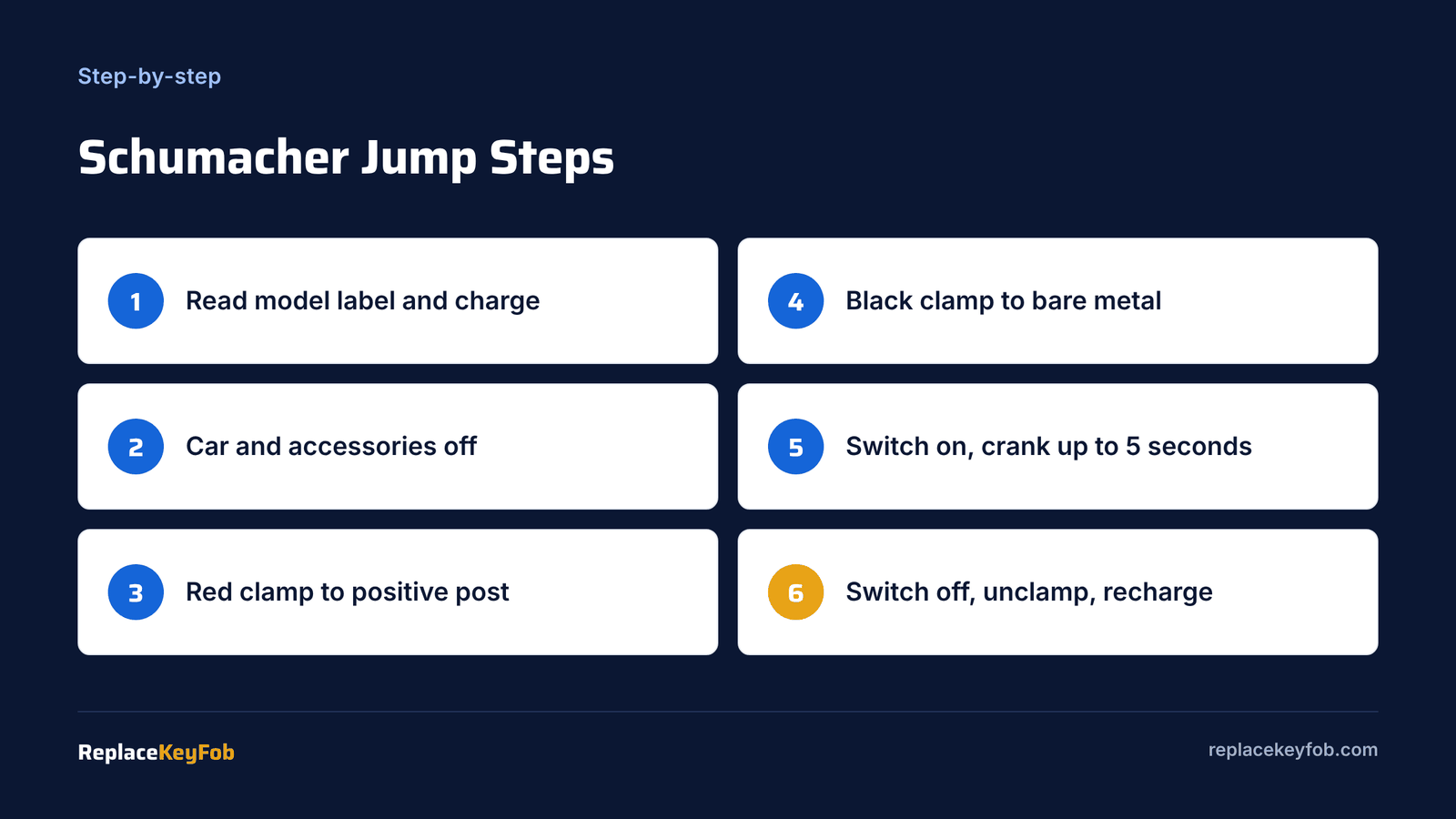
Step 2: Jump the Car
- Turn the vehicle off and switch off all accessories.
- Make sure the unit is off. Many Schumacher boxes have a power or jump switch; set it to off.
- Connect red to positive. Clamp to the battery’s positive (+) terminal or the remote positive jump post.
- Connect black to ground. Choose a bare metal bolt on the engine block or chassis, at least a foot from the battery.
- Check the indicators. A reverse-hook-up light or alarm means you must disconnect and reverse the clamps.
- Switch the unit on.
- Crank for up to 5 seconds. If it does not start, switch off and wait about 2 minutes before trying again.
- Once running, switch the unit off.
- Remove black first, then red.
- Drive the car for 20 to 30 minutes.
Lead-Acid Schumacher Jump Boxes
These are the big units with a carry handle, often with an air compressor, USB ports, a 12V socket and sometimes an AC inverter. A few habits help:
- Do not run the inverter or compressor while jumping. All the power should go to the starter.
- Use the engine block for ground on trucks and V8s.
- Give a very flat battery a minute. On some models you can leave the unit connected and on for a minute or two before cranking to add a little charge. Check your manual first.
- Keep the cables wrapped and clamps docked when not in use.
Lithium Schumacher Packs
Compact Schumacher lithium packs work like most lithium jump starters:
- Plug the clamp cable into the pack if it detaches.
- Clamp the car, then wait for the ready light.
- Crank, then unplug the clamps from the pack once the engine runs.
- Use the pack’s boost or override function only when the car battery is too flat to detect, and only after checking clamp polarity.
For general lithium technique, see how to use a jump starter.
How to Charge a Schumacher Jump Starter
Lead-acid models
- Turn the unit off and dock the clamps.
- Plug the charging cord into the unit. Many models have a built-in charger and use a standard household extension cord; others use a wall adapter.
- Charge until the indicator shows full. Before first use, give it a long, complete charge as the manual directs.
- Some models have automatic charging and can stay plugged in; others should be unplugged when full. The manual will say.
- Recharge after each use and at least every 30 days in storage.
Lithium models
- Use the included USB cable and a wall adapter that meets the input rating.
- Charge indoors at room temperature until all LEDs are solid.
- Recharge after each use and every 3 months.
More detail, including charge times, is in our guide on how to charge a jump starter.
Using the Schumacher Website for Manuals and Support
The Schumacher Electric website has product pages, manuals and warranty information listed by model number. Search your model, open the manual PDF and look for:
- The first-charge time and storage charging interval.
- Whether the unit is safe to leave on its charger.
- The internal fuse location (some larger units have one).
- Warranty length and how to claim it.
If you bought it at a big-box or parts store, the retailer may also handle returns in the first weeks.
Troubleshooting
| Symptom | Likely cause | What to do |
|---|---|---|
| Reverse hook-up light or alarm | Clamps on wrong terminals | Disconnect and reverse |
| No output with switch on | Unit discharged or internal fuse | Charge fully; check manual for fuse |
| Starter clicks only | Poor clamp contact | Clean terminals, move ground to engine block |
| Cranks slowly | Unit low or too small for engine | Charge; allow a short pre-charge |
| Unit won’t charge | Bad cord or charger, sulfated battery | Try another cord; replace battery if it never fills |
| Car dies again later | Car battery or alternator problem | Test both |
If the car needs a jump repeatedly, check whether the car battery or the alternator is to blame. Our guide on testing an alternator with an OBD2 scanner is a quick first look.
Schumacher Jump Starter vs Battery Charger
Schumacher also makes battery chargers, and some chargers have an “engine start” mode. Those are different from a portable jump box: an engine-start charger plugs into the wall and must reach the car. A portable unit works anywhere. Neither replaces a bad battery. See jump starter vs battery charger for when to use each.
ProSeries and 12V/24V Models
Schumacher’s professional boosters are built for shops, fleets and tow operators. They usually have longer, heavier cables, a bigger internal battery and sometimes a 12V/24V selector.
- Set the voltage selector before clamping. 24V is only for 24V systems such as some heavy trucks and equipment. Using 24V on a 12V car can destroy its electronics.
- For 24V systems, clamp the 24V positive point (the free positive of the series battery pair) and ground.
- Expect more weight and more current. These units can crank large diesels, so the clamp contact and ground point matter even more.
For home use, a standard 12V unit is the right choice. For truck tips, see how to jump start a truck.
Storing a Schumacher Jump Starter
- Location: a garage shelf or the trunk is fine, but avoid long summer heat and hard freezes. A lead-acid unit in a freezing garage still works, but has less power.
- Charge level: store it full. Set a monthly phone reminder for lead-acid and a quarterly one for lithium.
- Before winter: fully charge it and test it once on your own car, so you know it works before you need it.
- After a long storage gap: charge it fully before use, even if the indicator still shows some charge.
Safety Reminders
- Wear eye protection and keep flames and sparks away from the battery.
- Never jump a frozen, swollen or cracked battery.
- Do not stand over the battery while cranking.
- Charge the unit in a ventilated area.
- Recycle worn lead-acid units at a store that accepts batteries.
Cost and Replacement
In 2026, Schumacher lithium packs typically cost about $60 to $180, and lead-acid jump boxes with compressors about $90 to $250. Professional boosters cost more. If a lead-acid unit no longer holds charge after a full overnight charge, the internal battery is worn and the unit usually needs replacing.
Frequently Asked Questions
Turn the car off, clamp red to positive and black to bare metal ground, switch the unit on, and crank for up to 5 seconds. Switch off, remove black then red, and recharge the unit.
Lead-acid models charge with an AC wall adapter or a household extension cord into a built-in charger. Lithium models charge over USB. Charge fully before first use and after every jump.
Only if the manual says the model has automatic charging that is safe to leave connected. Otherwise unplug it when full and recharge every 30 days.
Find the model number on the unit’s label and look it up on the Schumacher Electric website, where manuals are listed by model.
Usually the clamps are not making good contact, or the unit is low. Clean the terminals, ground to the engine block, and make sure the unit is fully charged.