
How to Use a DieHard Jump Starter (Portable Power and Lithium)

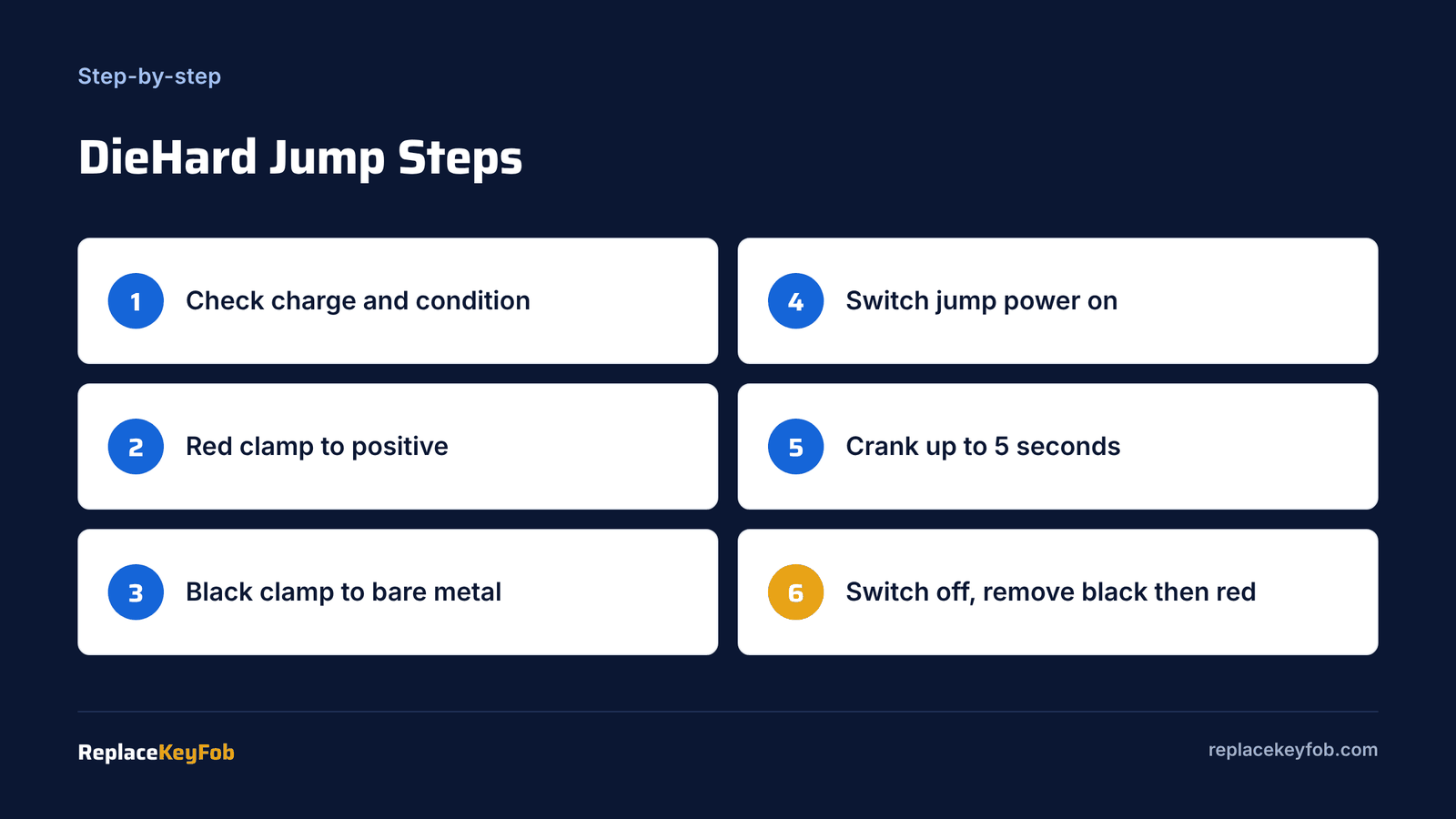
To use a DieHard jump starter, check that it is charged, turn the car off, clamp red to positive and black to bare metal ground, then turn the jump switch or power button on and crank for up to 5 seconds. Switch it off, remove black then red, and recharge it the same day.
The DieHard name has been around since the 1960s, first on Sears batteries and later on a long line of jump starters. Today the brand is sold through Advance Auto Parts, and you can find two very different products under it: older lead-acid “Portable Power” jump boxes (including the well-known 1150 peak amp model with an air compressor and inverter) and newer compact lithium packs.
Because many people inherit or buy a used DieHard, this guide also covers how to check that an older unit is still worth using.

First, Check the Unit
Before relying on any DieHard jump starter, especially an older one:
- Read the label. Note the model number, peak amp rating and charging method.
- Look at the case. Cracks, swelling or acid residue around seams mean the internal battery is failing. Do not use it.
- Check the cables. The insulation should be intact, the clamps should spring shut firmly, and the copper jaws should not be badly corroded.
- Charge it fully. Then check it the next day. If the charge indicator has already dropped, the internal battery is weak.
An older lead-acid box that has been stored flat for a year or more often will not hold a charge. Replacing the internal sealed battery can revive some units; otherwise it is time for a new one.
What You Need
- The DieHard unit, fully charged.
- Safety glasses and gloves.
- A wire brush.
- The car’s owner’s manual for jump post locations.
Lithium jump starter pack
If an old lead-acid jump box no longer holds charge, a compact lithium pack sized to your engine is lighter and holds charge for months.
As an Amazon Associate, ReplaceKeyFob earns from qualifying purchases.
How to Use a DieHard Jump Starter Step by Step
- Turn the vehicle off. Remove the key and switch off lights, radio and HVAC.
- Make sure the jump starter is off. Many DieHard boxes have a jump or power switch; lithium packs often have a power button.
- Clamp red to the positive (+) terminal or the positive jump post under the hood.
- Clamp black to a bare metal ground on the engine block or chassis. Stay away from the battery, fuel lines and moving parts.
- Watch for a reverse polarity warning. If a light or alarm comes on, disconnect and swap the clamps.
- Turn the jump power on. Lithium packs with smart clamps may show a green ready light instead.
- Crank for up to 5 seconds.
- Wait 1 to 2 minutes between attempts if the engine does not start.
- Once it runs, turn the jump starter off.
- Remove the black clamp, then the red clamp, and dock them.
Drive the car 20 to 30 minutes so the alternator can recharge its battery. A short trip will not do it.
Using the DieHard 1150 Portable Power
The 1150 peak amp Portable Power box was a common Sears-era model with a compressor, work light, 12V outlet and AC inverter. If you have one:
- Turn off the inverter and compressor before jumping.
- Ground to the engine block, not a thin bracket.
- Give a very flat battery a minute. Some lead-acid boxes can stay connected and switched on for a minute or two before cranking. Check the manual for your unit.
- Expect less power from an older unit. A box that is many years old may still show full charge but deliver less current under load. If the engine cranks slowly, the unit’s battery is likely tired.
Using a Newer DieHard Lithium Pack
Lithium DieHard packs work like most compact packs:
- Plug the smart clamp cable into the pack if it detaches.
- Clamp red to positive, black to ground.
- Wait for the ready indicator.
- Crank, then unplug the clamps from the pack when the engine runs.
- If the car battery is too dead to detect, use the boost or override function only after confirming polarity.
The general steps in how to use a jump starter apply to all lithium packs.
Finding a DieHard Jump Starter Manual
- Newer models: look up the model number on the Advance Auto Parts product page or the DieHard brand site; many list manuals and warranty information.
- Older Sears-era models: search the model number from the label with the word “manual.” Many older manuals are archived online by Sears parts and manual sites.
Look for the first-charge time, whether it can stay plugged in, and the internal fuse location, if it has one.
How to Charge a DieHard Jump Starter
Lead-acid boxes
Most charge through an AC adapter or a built-in charger that takes an extension cord, and some include a 12V DC cord. Charge fully before first use. Recharge after every use and at least every 30 days. Do not leave a lead-acid unit on charge for months unless the manual says it has an automatic maintainer.
Lithium packs
Charge over USB with the included cable and a wall adapter that meets the input rating. Top up every 3 months.
See how to charge a jump starter for charge times and storage tips.
Can You Replace the Battery in an Old DieHard Jump Box?
Many lead-acid jump boxes use a standard sealed lead-acid battery inside the case, held by screws. If you are handy:
- Make sure the unit is off and unplugged.
- Remove the case screws and note how the wires connect.
- Match the new battery’s voltage, amp hour rating and terminal type to the old one.
- Reconnect in the same order and close the case.
Typical replacement batteries cost about $30 to $70. If the cables, switch or compressor are also worn, a new unit is usually the better buy. If you are not comfortable working with batteries and wiring, skip this.
How to Test an Old Jump Box at Home
Before trusting an old DieHard on a cold morning, test it with a digital multimeter:
- Charge the unit fully and let it rest for at least 12 hours.
- Set the meter to DC volts and measure across the clamp jaws with the jump switch on (or at the 12V outlet). A healthy 12V lead-acid unit at rest usually reads about 12.6 to 13.0 volts.
- A reading under about 12.4 volts after a full charge and rest means the internal battery is losing capacity.
- Do a real test on your own healthy car: clamp it up and crank. If the engine spins at normal speed, the unit is fine. If it barely turns, the internal battery cannot deliver current anymore.
Our guide on how to test a car battery with a multimeter uses the same voltage readings.
Jump Starter or Roadside Help?
A working jump starter saves time and a service call. But call roadside assistance instead if the battery is leaking or swollen, the car is a hybrid or EV you are unsure about, or the car still clicks after two good jump attempts. That points to a starter, cable or ground problem a jump cannot fix.
Troubleshooting
| Symptom | Likely cause | Fix |
|---|---|---|
| No output with switch on | Unit flat, bad switch or fuse | Charge fully; check manual for fuse |
| Alarm or warning light | Reverse polarity | Swap clamps |
| Clicks, will not crank | Weak contact or old internal battery | Clean terminals; ground to block; test unit |
| Charge indicator full, weak crank | Worn internal battery | Replace battery or unit |
| Will not charge | Charger or cord failed | Try a known-good cord or adapter |
| Car starts but dies again | Car battery or alternator | Test both |
If the car keeps needing jumps, read car clicks but won’t start and test the battery. For a new battery, our article on Interstate vs DieHard batteries compares two common choices.
Safety
- Never jump a cracked, swollen or frozen battery.
- Keep sparks and flames away; batteries vent hydrogen.
- Keep the unit on the ground, not on the engine.
- Dock the clamps whenever the unit is on.
- Recycle old lead-acid units at an auto parts store that accepts batteries.
Cost in 2026
New DieHard lithium packs typically cost about $70 to $200 depending on rating, and lead-acid boxes with compressors about $100 to $200. A roadside jump without a membership typically costs about $50 to $125.
Frequently Asked Questions
Turn off the inverter and compressor, clamp red to positive and black to engine ground, turn the jump switch on and crank for up to 5 seconds. Switch off before removing the clamps.
Search the model number from the label with “manual.” Newer models are listed on the Advance Auto Parts or DieHard product pages; older Sears models are often archived online.
Lead-acid models charge with an AC adapter or an extension cord into a built-in charger. Lithium packs charge over USB. Charge after every use and monthly for lead-acid.
The internal lead-acid battery is likely sulfated from being stored flat. Some units can take a replacement sealed battery; otherwise replace the unit.
Not when used correctly. Connect red to positive and black to ground, avoid reverse polarity, and turn the unit off before disconnecting.