
How to Bleed an ABS Module With a Scan Tool

This post contains affiliate links. As an Amazon Associate, ReplaceKeyFob earns from qualifying purchases, at no extra cost to you.
To bleed an ABS module with a scan tool, first do a normal brake bleed at all four wheels. Then connect a scan tool with an ABS bleed function, select the ABS module and run the automated bleed. The tool cycles the pump and valves while you open each bleeder as prompted. Finish with another normal bleed until the pedal is firm.
A normal brake bleed pushes fluid from the master cylinder to the calipers. On most cars, that fluid passes through the ABS hydraulic control unit (HCU) without opening its internal valves and pump circuits. If air gets into those hidden passages, it stays there. The pedal feels soft or sinks after you bleed, then the air moves out the next time ABS activates.
A scan tool ABS bleed, also called an automated bleed or HCU bleed, opens those valves and runs the pump so the trapped air can be pushed out. This guide shows when you need it, how to do it, and what to do if you do not have a capable scanner.
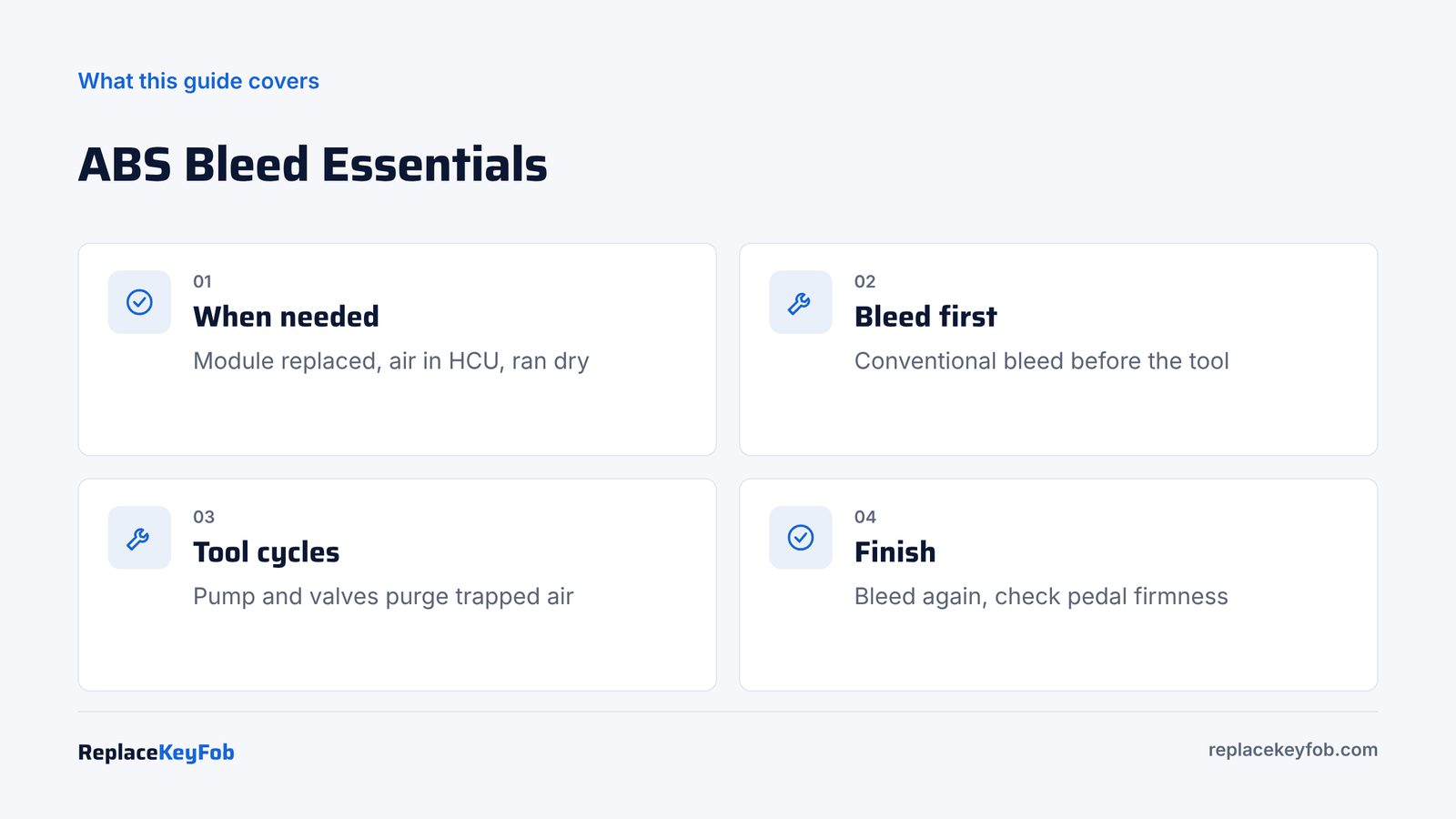
When You Need an ABS Bleed
| Situation | ABS bleed needed? |
|---|---|
| Routine brake fluid flush | Usually no |
| Pads, rotors or a caliper replaced (no air reached HCU) | Usually no |
| Master cylinder ran dry | Often yes |
| ABS module or HCU replaced | Yes, on many vehicles |
| Brake line replaced near the ABS unit | Often yes |
| Pedal still soft after a careful conventional bleed | Likely yes |
| Pedal soft after ABS activated on ice | Possible trapped air |
What You Need
- A scan tool with an ABS bleed or automated bleed function for your make
- The correct brake fluid (check the reservoir cap; often DOT 3 or DOT 4)
- A clear hose and a catch bottle for each bleeder
- A bleeder wrench (often 8mm, 10mm or 11mm)
- A helper, or a pressure or vacuum bleeder
- Jack stands, wheel chocks and safety glasses
- A battery maintainer: the bleed routine can run the pump for several minutes
Scan tool with ABS bleed function
Check that the tool lists ABS automated bleed for your exact make, model and year, since coverage varies more for this function than for code reading.
As an Amazon Associate, ReplaceKeyFob earns from qualifying purchases.
Our guide to the best OBD2 scanner for brake bleed compares tools. A basic engine code reader will not do this.
Step 1: Conventional Bleed First
- Raise the car safely and remove the wheels if you need access to the bleeders.
- Fill the reservoir to MAX with fresh fluid.
- Bleed each wheel in the order given in your service information. Many vehicles use the wheel farthest from the master cylinder first (often right rear, left rear, right front, left front), but many others specify a different order. Follow the manual.
- Bleed until the fluid runs clear with no bubbles.
- Keep the reservoir above MIN the whole time. Letting it run low pulls new air in.
Why first: if the lines are full of air, the scan tool routine just moves that air into the module. Starting with a solid conventional bleed means only the trapped HCU air is left.
Step 2: Connect the Scan Tool
- Connect a battery maintainer if available.
- Plug the scan tool into the OBD2 port and turn the ignition on, engine off.
- Select your vehicle, then the ABS or brake module.
- Read and clear ABS codes first. Many bleed routines will not run with active ABS codes.
- Open special functions and choose “ABS bleed”, “automated bleed”, “HCU bleed” or “brake bleeding”.
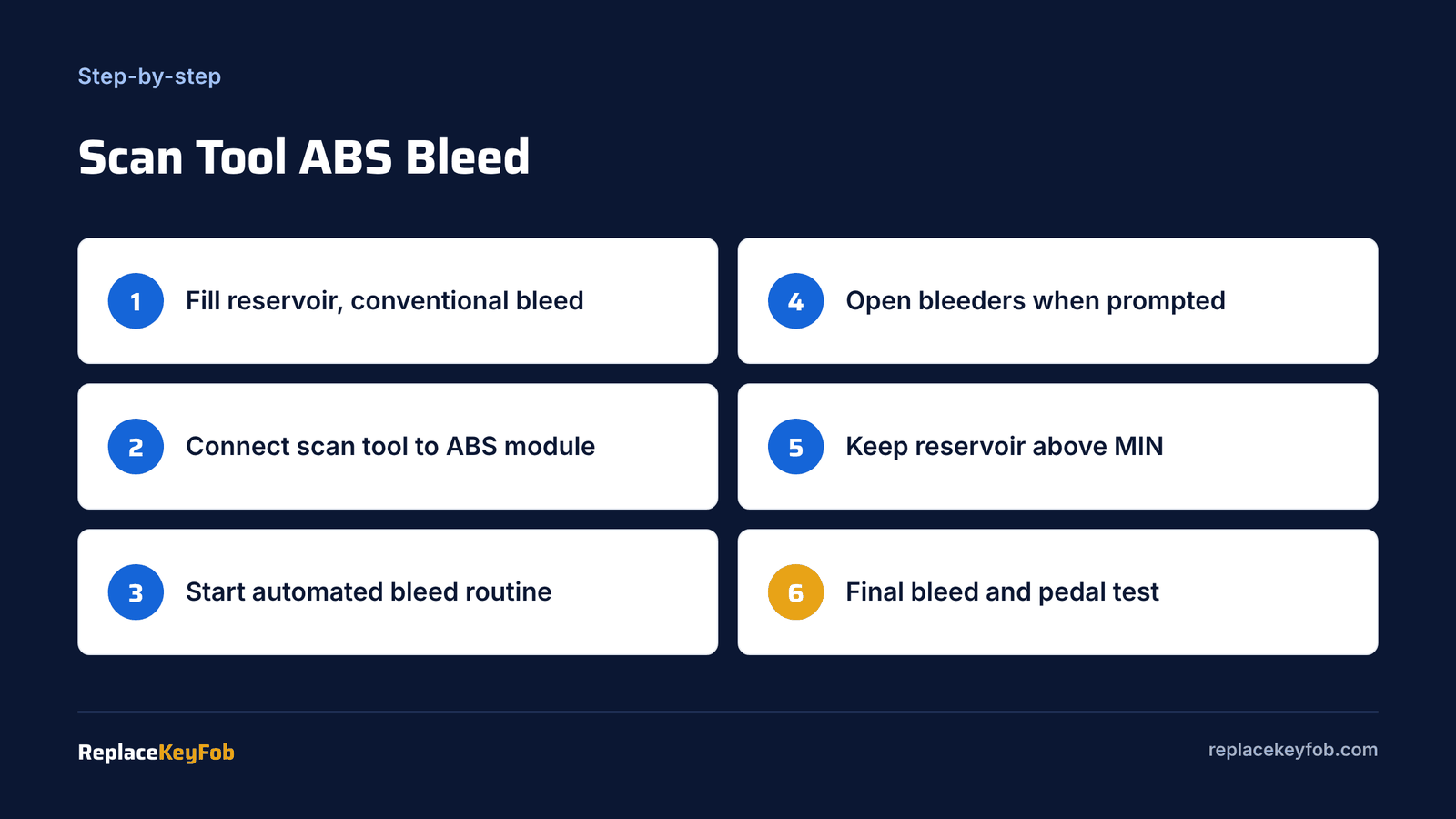
Step 3: Run the Automated Bleed
The routine guides you one wheel at a time. A typical sequence looks like this:
- The tool asks you to open a specific bleeder and have a helper press and hold the brake pedal, or keep pressure applied with a pressure bleeder.
- The tool runs the ABS pump and cycles the valves for that circuit. You will hear the pump buzz for several seconds.
- The tool asks you to close the bleeder and release the pedal.
- Repeat for the next wheel or circuit.
- Check the reservoir level between steps and top it up.
Some routines repeat each step several times. Follow every prompt exactly. Many tools stop the routine if the pump runs too long, so the motor can cool.
Step 4: Final Bleed and Pedal Test
- Do one more conventional bleed at all four wheels. The routine often pushes small bubbles out of the HCU and into the lines.
- Top up the reservoir to MAX and fit the cap.
- With the engine off, press the brake pedal. It should be firm and high, not spongy.
- Start the engine. The pedal will drop slightly with the brake booster active, which is normal.
- Clear any ABS codes and test drive at low speed in a safe area. Make several firm stops before driving normally.
How to Bleed ABS Module Without a Scan Tool
If you do not have a scan tool with this function:
- Avoid letting air in. When replacing calipers or hoses, clamp the line or keep the reservoir full. Air that never reaches the HCU does not need an ABS bleed.
- Pre-filled replacement units: many new or remanufactured ABS units come pre-filled. If you install them without letting the module run dry, a careful conventional bleed is often enough. Check the instructions that come with the unit.
- Pressure bleeding: a pressure bleeder pushes fluid more steadily than pedal pumping and moves some trapped air on certain systems, but it does not open the closed valves.
- Have a shop do only the bleed step: many shops will run an automated bleed for a modest fee if you have done the rest.
You may read about activating ABS on a gravel road to move trapped air. This is unpredictable and unsafe with a soft pedal. Do not drive a car with a pedal that sinks.
How to bleed GM ABS module without scan tool
On many GM vehicles, the service procedure for a module replacement calls for an automated bleed with a GM-capable scan tool. For brake work that did not let air into the module, a conventional bleed is usually all that is needed. If air did reach the module and you have no tool, the safest options are a shop bleed or borrowing a scan tool that lists GM ABS bleed.
If the Pedal Is Still Soft
| Symptom | Likely cause |
|---|---|
| Pedal sinks slowly to the floor with steady pressure | Master cylinder bypassing internally |
| Pedal soft, then firm after pumping | Air still in the system |
| Pedal soft only on one side of the car | Air or a leak in that circuit |
| Fluid level dropping | External leak at a line, hose or caliper |
| Pedal firm with engine off, hard to press running | Booster or vacuum problem |
| ABS light on after bleeding | Stored code or a sensor disturbed during work; see how to reset the ABS light |
Safety and Mistakes to Avoid
- Brake fluid damages paint. Wipe spills right away with water.
- Never reuse old fluid from the bleed bottle.
- Do not mix fluid types. DOT 5 silicone fluid must never be added to a DOT 3 or DOT 4 system.
- Do not let the reservoir run dry during the scan tool routine.
- Do not drive with a soft pedal.
- Keep the battery charged. Low voltage can stop the pump mid-routine.
Cost
| Service | Typical 2026 US cost |
|---|---|
| Brake fluid flush | About $90 to $200 |
| ABS automated bleed at a shop | About $100 to $250 |
| ABS module replacement plus bleed | About $600 to $2,000+ |
| Master cylinder replacement plus bleed | About $300 to $700 |
If you bought a scan tool for ABS work, it may also read ABS codes and calibrate the steering sensor; see whether an OBD2 scanner can read ABS codes and how to calibrate a steering angle sensor.
Frequently Asked Questions
Do a conventional bleed first, then connect a scan tool with an ABS bleed function, select the ABS module and run the automated bleed. Open each bleeder when prompted while the tool runs the pump and valves, then do a final conventional bleed.
Not for routine bleeding or pad and rotor jobs. You usually need one when the ABS unit was replaced, the master cylinder ran dry, or air got into the hydraulic unit and the pedal stays soft.
Sometimes. If air never reached the module, or a pre-filled unit was fitted carefully, a conventional or pressure bleed may be enough. If air is trapped in the module valves, a scan tool or shop bleed is the reliable fix.
Many mid-range and professional bidirectional scanners include ABS automated bleed. Check the coverage list for your exact make, model and year before buying.
There may still be air in the ABS unit or a line, a leak, or a failing master cylinder. Run an ABS bleed if the system needs one, check for leaks and test the master cylinder if the pedal sinks with steady pressure.