
How to Check Transmission Temperature With OBD2

This post contains affiliate links. As an Amazon Associate, ReplaceKeyFob earns from qualifying purchases, at no extra cost to you.
To check transmission temperature with OBD2, use a scanner or app that reads enhanced manufacturer data, because most cars do not send transmission fluid temperature through generic OBD2. Plug in the adapter, select your make, add the TFT or ATF temperature item to the dashboard, then drive. A healthy automatic usually runs about 160 to 200°F.
Transmission fluid temperature is one of the most useful numbers for anyone who tows, drives in hills or sits in hot traffic. Heat is the main killer of automatic transmissions. A rule of thumb used across the industry is that fluid life drops sharply for every 20°F above about 175 to 200°F. Being able to see that number early can save a costly rebuild.
The catch is that the standard OBD2 list of parameters does not include transmission temperature on most vehicles. You need a tool that speaks your manufacturer’s own data, or an app that lets you add a custom PID. This guide shows both approaches. It builds on our guide to checking battery voltage with an OBD2 scanner, which uses the same live data screens.
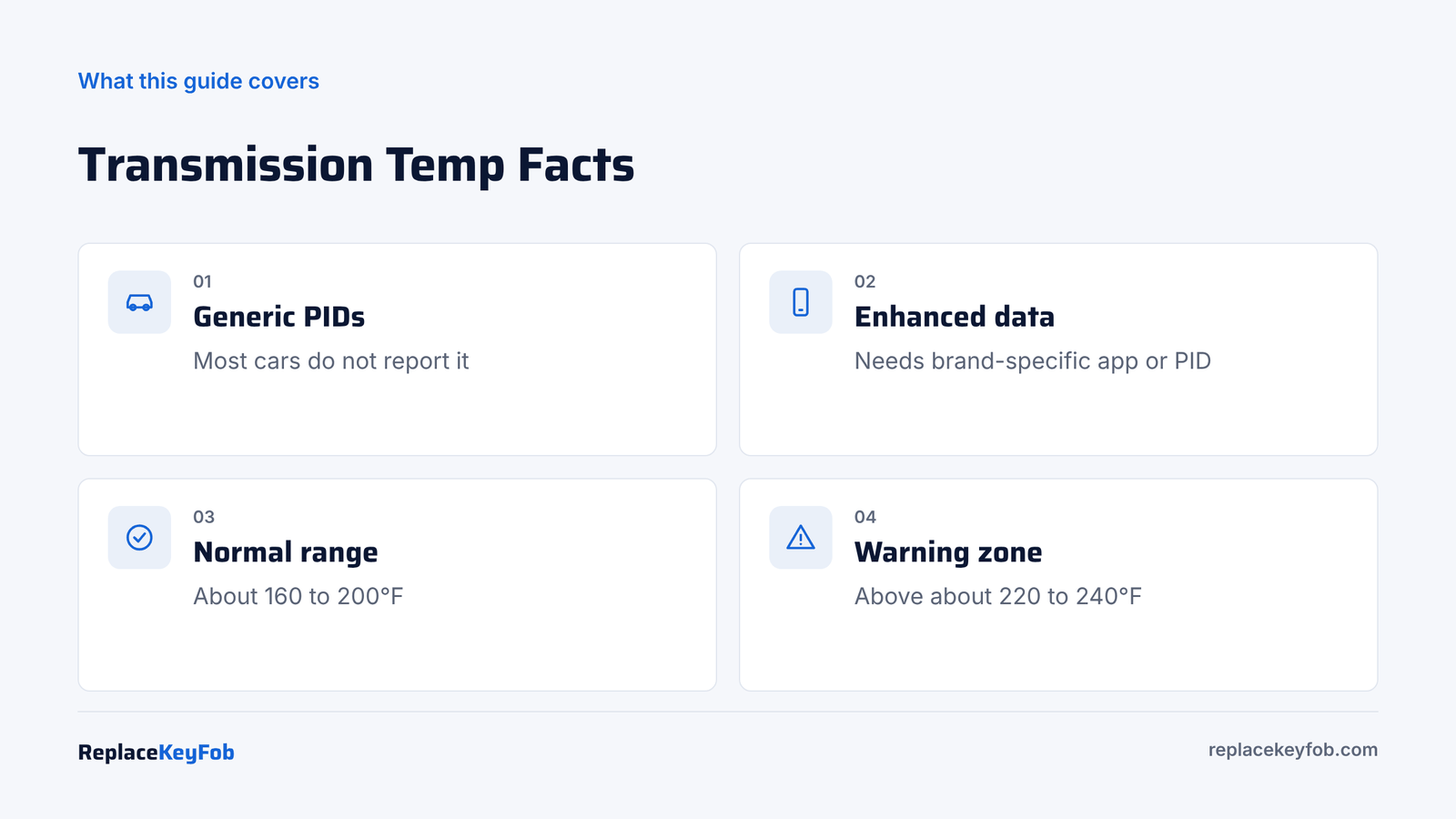
Why Generic OBD2 Apps Often Show No Transmission Temp
OBD2 was designed for emissions. The standard Mode 01 parameter list covers engine items like RPM, coolant temperature, fuel trims and oxygen sensors. Transmission fluid temperature is usually stored in the transmission control module (TCM) or engine computer under the manufacturer’s own codes.
| Tool type | Can it read trans temp? | Notes |
|---|---|---|
| Basic code reader | Usually no | Engine codes and generic PIDs only |
| Generic Bluetooth app (free mode) | Usually no | Unless the car reports it as a standard PID |
| App with enhanced data for your make | Often yes | Look for TFT, ATF temp or Trans Temp |
| App with custom PID support | Often yes | You enter the PID formula yourself |
| Plug-in gauge with presets | Often yes on supported trucks | Many cover popular GM, Ford and Ram trucks |
| Full-system handheld or tablet | Usually yes | Under the transmission module’s live data |
If you are not sure what live data screens look like, start with how to read live data on an OBD2 scanner.
What You Need
- A quality OBD2 adapter (a fast Bluetooth or Wi-Fi model holds a steady connection on long drives)
- An app or scanner that supports enhanced data for your make, or allows custom PIDs
- A phone mount if you plan to watch it while driving, placed so it does not block your view
- Your exact vehicle details, including transmission type
Bluetooth OBD2 adapter with enhanced data support
Choose an adapter that works with the brand-specific app you plan to use (for example FORScan for Ford or an enhanced app for GM) and holds a stable connection during long drives.
As an Amazon Associate, ReplaceKeyFob earns from qualifying purchases.
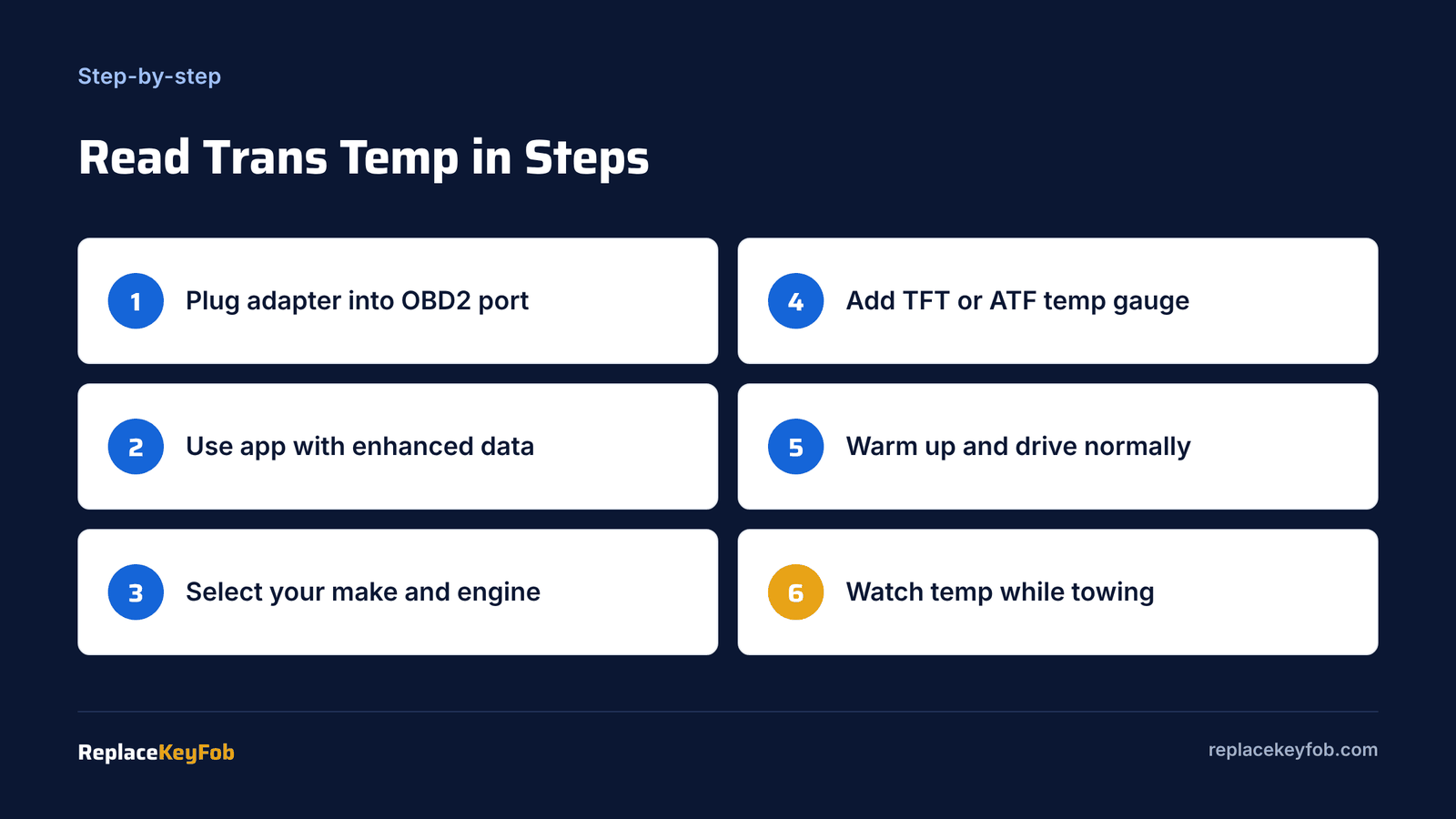
Step-by-Step: Read Transmission Temperature
- Plug the adapter into the OBD2 port under the driver side dash.
- Start the engine so the transmission module is awake and the fluid is circulating.
- Open your app and connect to the adapter from inside the app.
- Select your exact vehicle. Enhanced data only appears when the app knows the make, model, engine and transmission.
- Open the transmission module or enhanced PID list and look for TFT, ATF Temp, Trans Fluid Temp or TOT (transmission oil temperature).
- Add it to a gauge or dashboard. Set an alarm at about 220°F if the app allows it.
- Drive normally for 15 to 20 minutes. The reading should climb and settle as the fluid reaches operating temperature.
- Watch it under load. Towing, climbing a grade or slow traffic will push the number up. That is when the data matters most.
Brand-Specific Ways to Read It
- Ford: FORScan with a compatible adapter shows TFT under the PCM or TCM on many models. Our guide to FORScan compatible OBD2 adapters shows which adapters work best.
- GM trucks and SUVs: many enhanced apps and plug-in gauges list transmission fluid temperature for 6L and 8L and 10-speed automatics.
- Ram and Jeep: enhanced apps often read transmission temperature from the TCM; some cluster screens show it too.
- Toyota: many models report ATF temperature through enhanced data; some trucks show it in the multi-info display.
- Honda and Nissan CVT models: CVT fluid temperature is usually only available through enhanced data, and CVT limits differ from conventional automatics.
Plug-in gauges such as the ScanGauge 3 often include presets for transmission temperature on popular trucks, so you do not need to enter PIDs. See our ScanGauge 3 review for how its custom gauges work.
Using a custom PID
Apps with custom PID support ask for a mode, PID number, formula, units and header. These values come from the vehicle maker and vary by model. Enter them only from a trusted source for your exact vehicle, because a wrong formula shows a believable but wrong number. If the reading does not change as the truck warms up, the PID is wrong.
What Is a Normal Transmission Temperature?
| Fluid temperature | What it means |
|---|---|
| Below about 140°F | Still warming up; normal on short trips |
| About 160 to 200°F | Normal operating range for most automatics |
| About 200 to 220°F | Warm; fine for short periods under load |
| About 220 to 240°F | Hot; fluid breaks down faster, back off |
| Above about 240°F | Damaging; pull over safely and let it cool |
These are general automatic transmission guidelines. CVTs and dual-clutch transmissions have their own limits set by the maker. Check your owner’s manual or service information.
What to Do If Transmission Temperature Is High
- Ease off. Reduce speed, especially on grades, and avoid stop-and-go if you can.
- Use a lower gear when towing so the torque converter locks up and slips less.
- Turn on tow/haul mode if your vehicle has it.
- If temperature passes about 240°F, pull over safely, put the transmission in Park and let the engine idle so the cooler keeps working. Do not shut the engine off right away.
- Check fluid level and condition once cool. Dark, burnt-smelling fluid needs attention.
- Look at the cooler for blockage from bugs, mud or debris.
Troubleshooting Transmission Temperature Readings
| Problem | Likely cause | Fix |
|---|---|---|
| No trans temp item listed | App lacks enhanced data for your make | Use a brand-specific app or custom PID |
| Reading stuck at one value | Wrong PID or unsupported module | Verify PID for your exact vehicle |
| Reading -40°F | Sensor open circuit or wrong formula | Check codes, verify formula |
| Temp climbs fast with light driving | Low fluid, slipping, blocked cooler | Check fluid and cooler |
| Connection drops while driving | Weak adapter or phone sleep | Use a stable adapter, keep app open |
Transmission codes alongside high temperature need more than live data. See the best OBD2 scanners for transmission codes for tools that read TCM faults.
Who Should Monitor Transmission Temperature
- Anyone who tows a trailer, boat or camper, especially in summer or mountains
- Owners of trucks with aftermarket tuning or bigger tires, which add load and heat
- Drivers in hot climates who sit in slow traffic for long periods
- Owners of high-mileage vehicles where the cooler or fluid may be tired
For most daily commuters, a quick check once or twice a year is enough. For towing, keep the gauge on the screen every trip.
Mistakes to Avoid
- Watching the phone instead of the road. Set an alarm and glance only when safe.
- Trusting a reading that never changes. That usually means a wrong PID.
- Shutting off a hot transmission immediately. Idle in Park so fluid keeps flowing to the cooler.
- Ignoring early warnings. Repeated readings above 220°F while towing point to a need for an auxiliary cooler or service.
When to Call a Pro
If temperatures stay high in normal driving, the fluid smells burnt or the transmission slips, have a shop inspect it. In 2026 a transmission diagnostic typically costs about $100 to $200, a fluid service about $150 to $400, and an auxiliary cooler install about $250 to $600. Those are small bills next to a rebuild.
Frequently Asked Questions
Usually not. Most cheap code readers only read generic engine data. You need an app or tool with enhanced data for your make, or one that allows custom PIDs.
Most automatics are comfortable around 160 to 200°F and can handle short periods up to about 220°F. Above about 240°F, slow down or stop and let it cool.
On many Ford vehicles, yes. FORScan with a compatible adapter usually lists transmission fluid temperature under the PCM or TCM live data.
A reading of -40 usually means the PID is wrong or the sensor circuit is open. Check for transmission codes and confirm the PID for your exact vehicle.
Some trucks show it in the dash display. Otherwise, an aftermarket gauge with a sensor in the cooler line is another option, though OBD2 is usually easier.