
How to Reset the TPMS Light on a Subaru

This post contains affiliate links. As an Amazon Associate, ReplaceKeyFob earns from qualifying purchases, at no extra cost to you.
To reset the TPMS light on a Subaru, check all four tires cold, inflate them to the pressure on the driver door placard, then drive above about 20 mph for roughly 10 minutes. Subaru has no TPMS reset button; the light turns off once every sensor reports good pressure. A light that flashes before staying on means a sensor problem.
Subaru uses direct sensors in each wheel on its US models, from the Impreza and Crosstrek to the Outback, Forester, Ascent and WRX. The system is reliable, but it is also strict. If one tire is a few PSI under target, the light stays on. If a wheel has no sensor at all, such as a winter wheel set bought without them, the light flashes at every start.
Most Subaru TPMS questions come down to three cases: a normal low pressure light, a flashing system light, or new sensors that the car does not know yet. This guide covers each. For other brands, see our general guide on how to reset the TPMS light.
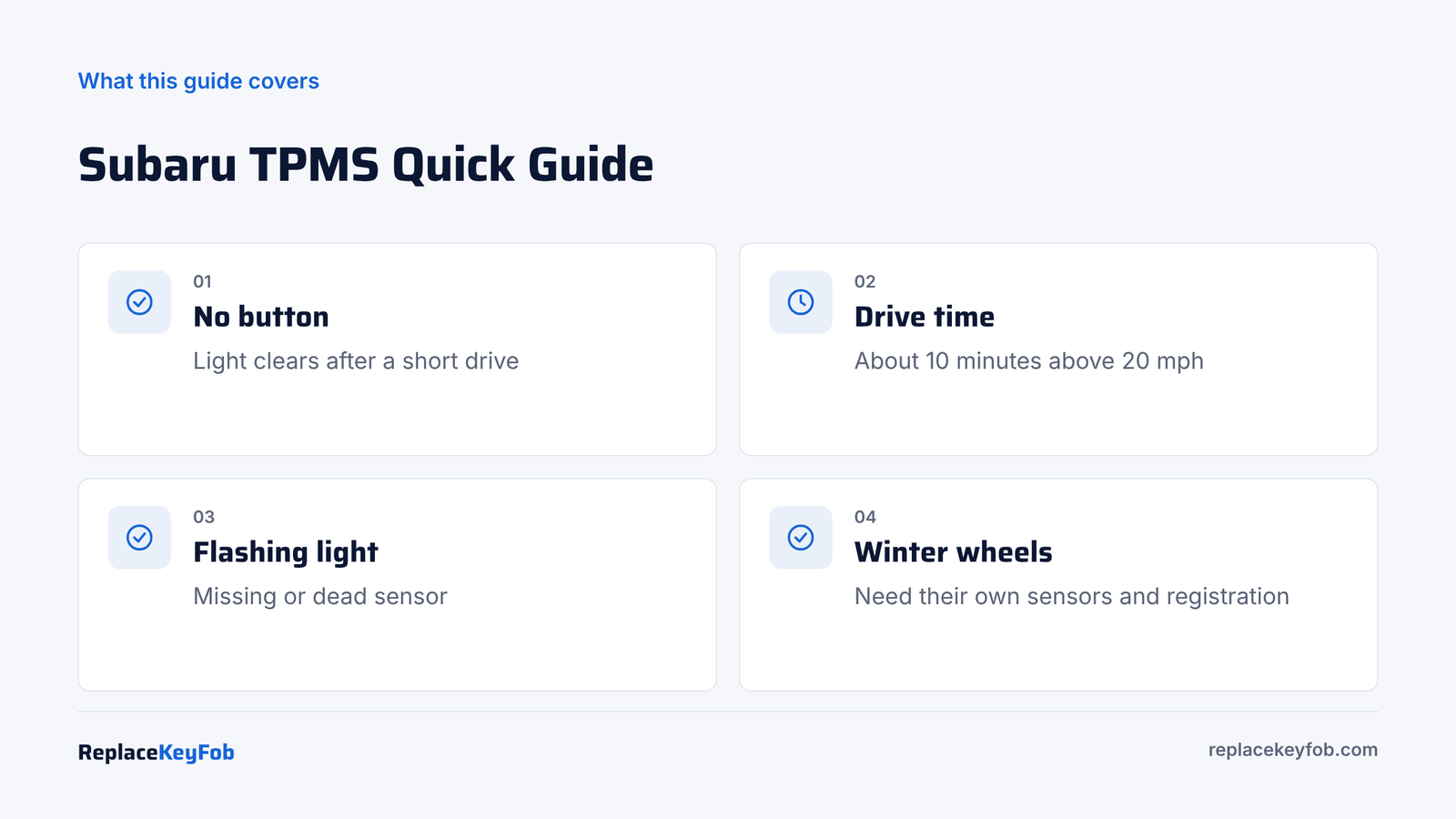
How the Subaru TPMS Works
Each sensor sits inside the wheel behind the valve stem and sends pressure readings by radio. The car compares each reading to its warning threshold. When a tire drops well below the placard pressure, the yellow light turns on. Newer Subarus with larger driver displays may also show each tire’s pressure.
There is no calibration and no reset menu on most models. Because the sensor reads actual pressure, fixing the pressure fixes the light.
What You Need
- An accurate tire gauge
- An air source
- The placard on the driver door jamb or B-pillar
- A TPMS tool only for new sensors, wheel sets or a fault
Dial or digital tire gauge with bleed valve
A gauge with a bleed button lets you overfill slightly and let air out to the exact placard pressure, which is the fastest way to bring a Subaru’s tires into range.
As an Amazon Associate, ReplaceKeyFob earns from qualifying purchases.
How to Reset the Subaru TPMS Light
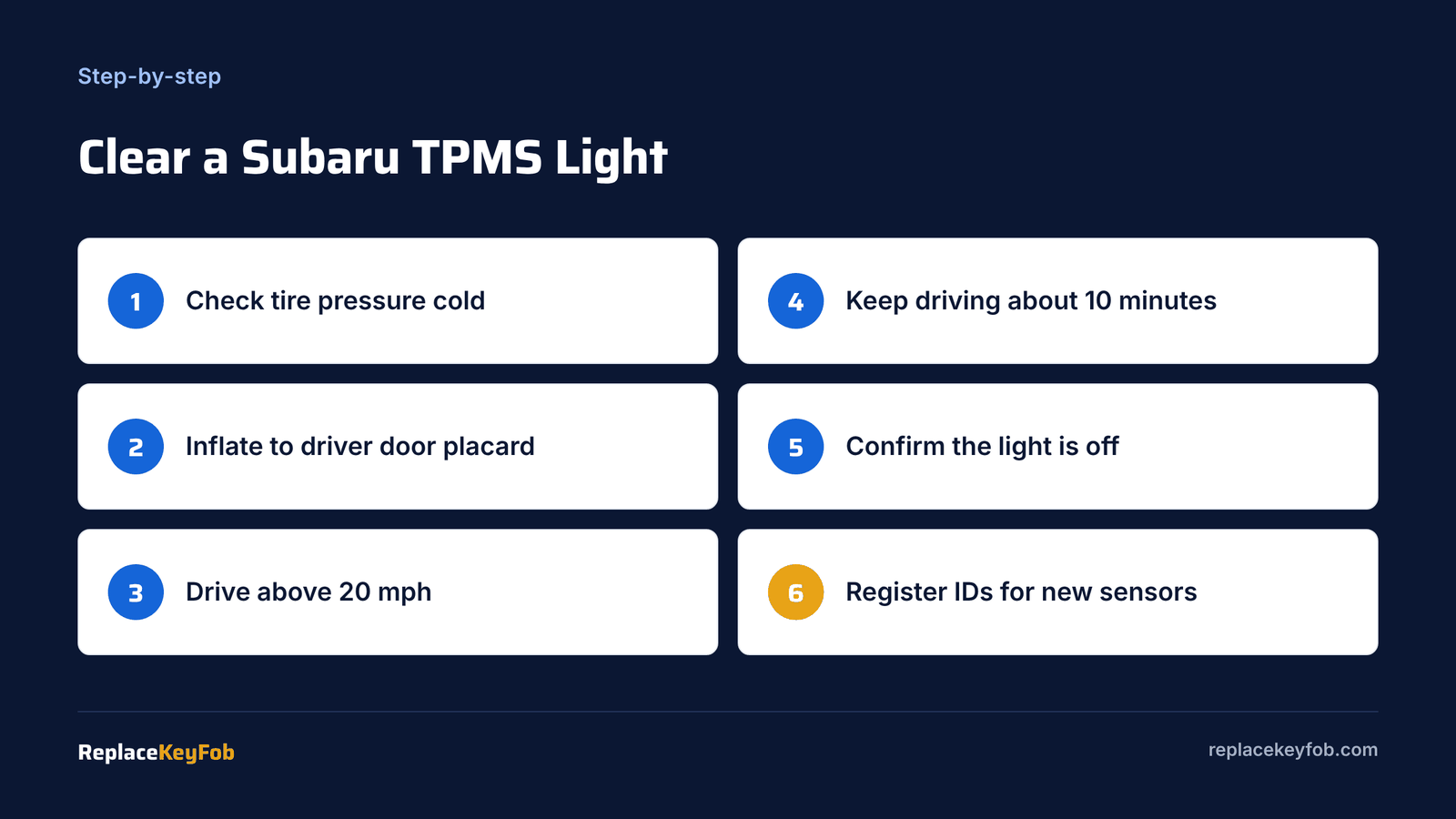
- Check the tires cold. Before your first drive, or after three hours parked. Subaru AWD systems are also sensitive to uneven tire size, so even pressure matters beyond the light.
- Find the placard. It lists front and rear pressure. Some models list different numbers for full loads.
- Inflate every tire to the placard number. Use an accurate gauge; a few PSI off can keep the light on.
- Drive above about 20 mph. Steady road driving works best.
- Keep going about 10 minutes. The light should go off once the system receives good readings from all four sensors.
- Check again the next cold morning. If the light comes back, a tire may have a slow leak.
The reason the drive matters is that sensors send updates more often when the wheels are turning. Sitting in the driveway with the ignition on will not clear it.
2019 Subaru Crosstrek TPMS Light Reset
The 2019 Crosstrek follows the same method. There is no reset button. Inflate all four tires to the placard pressure cold, then drive above about 20 mph for around 10 minutes. If you just bought a second set of wheels for winter and the light now flashes for about a minute before staying on, those wheels probably have no sensors, or their sensors have not been registered.
Subaru Winter Wheels and the Flashing Light
This is the most common Subaru TPMS problem. Many owners in snowy states run a second set of wheels with winter tires.
| Winter wheel setup | What happens | Fix |
|---|---|---|
| Wheels with no sensors | Light flashes then stays on all winter | Fit sensors, or accept the light |
| Wheels with new sensors, not registered | Light flashes then stays on | Register the new IDs with a tool |
| Wheels with sensors registered | Light behaves normally | Nothing needed |
| Swapping back to summer wheels | Car must relearn original IDs | Register original IDs again |
Most Subarus store only one set of sensor IDs. That means every seasonal swap needs a registration unless the shop programs sensors with cloned IDs. Many tire shops offer this service when you buy a winter set from them.
How Subaru Sensor Registration Works
Registration tells the car the ID of each sensor. You need it after:
- Replacing a sensor
- Fitting new wheels with sensors
- Swapping seasonal wheel sets with different sensors
A Subaru dealer uses its own diagnostic system. Many aftermarket TPMS tools can do the same job through the OBD2 port: they read each sensor’s ID at the valve stem, then write the IDs to the car. Follow the tool’s steps exactly, usually starting at the left front. After registration, drive about 10 minutes to confirm the light is off.
Some aftermarket sensors can be programmed with the same ID as your old ones. That avoids registration, but only if the shop has the old IDs. For more on the tools involved, read the difference between a TPMS tool and an OBD2 scanner.
Model Notes
- Crosstrek and Impreza: no reset button; standard inflate and drive.
- Outback and Legacy: many newer years show tire pressures in the driver display. Use it to find the low tire.
- Forester: standard method; check the spare is not mistaken for a monitored tire, as most compact spares have no sensor.
- Ascent: larger SUV with higher load ratings; check the placard for loaded pressure if towing.
- WRX: performance tires can run specific pressures front and rear; follow the placard exactly.
Why Even Pressure Matters on a Subaru
Subaru’s symmetrical all-wheel drive is designed around four tires of nearly the same rolling diameter. An under-inflated tire has a slightly smaller rolling diameter, so it turns faster than the others. Small differences are normal, but a tire that is badly low adds wear and strain to the drivetrain over time. That is one more reason to fix the pressure as soon as the TPMS light comes on rather than waiting.
The same thinking applies when you replace tires. Subaru generally recommends replacing all four at once, or shaving a new tire to match the tread depth of the others, to keep diameters close. A tire shop can measure tread depth and advise you.
Quick monthly check
- Check all four tires cold once a month, plus the spare.
- Look at the tread for nails, cuts or uneven wear.
- Inspect valve stem caps; a missing cap lets dirt into the valve core.
Seasonal Notes
Pressure drops about 1 PSI for every 10°F fall in temperature. A Subaru set to placard in a warm garage can read 5 PSI lower outside on a cold morning, which often sets the light. Check and top up pressures outside or after the car has cooled, not in a heated garage, during winter months.
Troubleshooting a Subaru TPMS Light
| What you see | Likely cause | Fix |
|---|---|---|
| Light stays on after inflation | One tire still low, or drive too short | Recheck cold, drive 10 minutes above 20 mph |
| Light flashes then stays on | Missing, dead or unregistered sensor | TPMS tool check and registration |
| Light after rotation | Usually none needed | If light appears, recheck pressures |
| Light every winter morning | Temperature drop | Set pressure in cold conditions |
| Light after new tires | Sensor damaged during mounting | Have the shop test sensors |
| Pressure display shows dashes | Sensor not reporting | Drive; if it stays, diagnose |
Mistakes to Avoid
- Setting pressure in a heated garage. It will read low outside.
- Buying winter wheels without sensors and expecting the light to stay off.
- Using a generic code reader to reset it. Most cannot write sensor IDs. See can an OBD2 scanner reset the TPMS light.
- Ignoring uneven tire pressure on an AWD Subaru. It also affects tire wear.
When to Call a Pro and What It Costs
If the light flashes, you have new sensors, or you swap wheel sets each season, a tire shop or Subaru dealer can register sensors quickly. In 2026 typical US costs are about $25 to $75 for registration, about $60 to $150 per installed sensor, and about $40 to $100 for a seasonal wheel swap with registration at many tire shops. If you want your own tool, see the best OBD2 scanners for Subaru.
Frequently Asked Questions
No. Inflate all tires to the placard pressure cold and drive above about 20 mph for about 10 minutes. The light turns off on its own.
A light that flashes for about a minute before staying on means a sensor problem, often a winter wheel without a sensor, a dead sensor battery or an unregistered new sensor.
Usually about 10 minutes of driving above 20 mph after the tires are at the correct pressure.
If you want the TPMS light to stay off, yes. The sensors also need to be registered, or programmed with cloned IDs, on most models.
No. The light only clears when every sensor reports good pressure, or after a fault is fixed and sensors are registered.