
P0101 Symptoms: What That Check Engine Light Is Trying to Tell You

A P0101 code means your engine computer has detected Mass Air Flow (MAF) sensor readings that don’t match expected values.
Most common symptoms: rough idle, hesitation on acceleration, stalling, poor fuel economy, and black exhaust smoke.
Top causes: dirty MAF sensor (most frequent), vacuum leaks, intake air leaks, or a failing sensor.
Urgency: Moderate. You can drive short distances but should diagnose within 1–2 weeks to prevent catalytic converter damage.
You scanned your car, got a P0101 code, and now you’re staring at your phone wondering how serious this is. You’re not alone. This is one of the top 10 most common OBD-II codes across all vehicle makes.
The good news: P0101 is rarely a catastrophic failure. The bad news: ignoring it can destroy your catalytic converter — a $1,200+ repair. Let’s break down exactly what’s happening, what symptoms to watch for, and what to do next.
This takes about 7 minutes to read. By the end, you’ll know whether to clean your MAF sensor, hunt for a vacuum leak, or head to a mechanic.
What the P0101 Code Actually Means
Your engine computer — the ECM or PCM — constantly compares actual MAF sensor readings against calculated values. It knows roughly how much air your engine should pull in at any given RPM and throttle position.
When actual readings fall outside the expected range for too long, the computer triggers P0101. The full definition is “Mass Air Flow Sensor Circuit Range/Performance.” Translation: the sensor is sending data, but the numbers don’t add up.
This matters because your engine needs a precise air-fuel ratio — 14.7 parts air to 1 part fuel — to burn cleanly. Wrong air readings throw everything off.
P0101 does not always mean your MAF sensor is bad. It means the readings are wrong. The root cause could be the sensor, but it could also be a vacuum leak, a dirty air filter, or an intake leak — all of which change actual airflow without the sensor failing.
The 7 Most Common P0101 Symptoms

P0101 symptoms range from barely noticeable to impossible to ignore. The severity depends on how far off the MAF readings are. Here are the seven symptoms you’re most likely to experience.
1. Rough or Unstable Idle
Your engine shakes or surges while sitting at a stoplight. RPMs bounce up and down by 100–300. This happens because the ECM keeps adjusting fuel delivery based on inaccurate air readings.
You’ll feel it most when the engine is warm and idling in gear. The roughness may come and go.
2. Hesitation on Acceleration
You press the gas and the car pauses before responding. That half-second lag is the ECM struggling to calculate the right fuel dose with bad airflow data.
This is most noticeable when merging onto highways or pulling away from a stop. The hesitation may feel worse under hard acceleration.
3. Engine Stalling
The engine cuts out completely — usually at low speeds or when coming to a stop. Stalling with P0101 typically means the MAF readings are severely off.
If your car stalls more than once, stop driving and diagnose immediately. Stalling in traffic is dangerous.
If stalling happens alongside a flashing check engine light, pull over immediately. A flashing light means active misfires that can destroy your catalytic converter within minutes.
4. Poor Fuel Economy
You’re filling up more often — sometimes losing 3 to 6 MPG. When the ECM can’t trust MAF readings, it defaults to a rich fuel mixture as a safety measure. Rich means more fuel than needed.
Track your mileage over a full tank. A sudden drop without a change in driving habits strongly points to a MAF-related issue.
5. Black Smoke From the Exhaust
Black smoke means unburned fuel exiting the tailpipe. This is the rich-running condition made visible. It’s most obvious during hard acceleration or cold starts.
Diesel engines with P0101 may produce heavier black smoke than gasoline engines under the same condition.
6. Hard Starting or No-Start
The engine cranks longer than normal before firing up. In severe cases, it won’t start at all — especially when cold. The ECM needs accurate MAF data to set the initial fuel mixture for startup.
7. Check Engine Light With Companion Codes
P0101 rarely appears alone. You’ll often see it paired with:
- P0171 / P0174 — System too lean (banks 1 and 2). Vacuum leaks often trigger both P0101 and lean codes simultaneously.
- P0100 / P0102 / P0103 — Other MAF circuit faults. These confirm a sensor-side issue rather than an air leak.
- P0300 — Random misfire. The wrong air-fuel ratio causes incomplete combustion across multiple cylinders.
If you see P0101 alongside P0171, your problem is likely a vacuum leak — not the MAF sensor itself. This is the single most important diagnostic clue most people miss.
What Most People Get Wrong About P0101
The biggest mistake: replacing the MAF sensor immediately. Parts stores love selling $200 MAF sensors. But research from across automotive forums and repair databases shows that roughly 40% of P0101 cases are caused by something other than a failed sensor.
Wrong belief #1: “The code says MAF sensor, so the sensor is bad.” P0101 is a performance code — not a circuit-failure code. The sensor is still working. It’s just reporting numbers the ECM doesn’t believe. A dirty sensor, a vacuum leak, or a restricted air filter all produce the same code.
Wrong belief #2: “Cleaning the MAF sensor always fixes it.” Cleaning works when dirt or oil residue is the problem. It does nothing for vacuum leaks, wiring issues, or internal sensor failure. Cleaning is step one — not the whole repair plan.
Wrong belief #3: “My car runs fine, so the code doesn’t matter.” A P0101 code means your engine is running outside its designed parameters. Even without noticeable symptoms, your fuel mixture is off. Over months, that extra fuel washes cylinder walls, dilutes oil, and slowly poisons the catalytic converter.
Before buying any parts, check your long-term fuel trim (LTFT) with a scan tool. Readings above +10% at idle that drop closer to 0% at higher RPM strongly indicate a vacuum leak — not a bad MAF sensor.
What Causes P0101 Beyond a Bad MAF Sensor
The MAF sensor is only one piece of the intake system. Five common causes trigger P0101 without the sensor itself failing.
Dirty MAF sensor. Over time, dust, oil vapor, and debris coat the sensor’s hot wire or film. The sensor can’t accurately measure airflow through a layer of grime. This accounts for roughly 35–40% of P0101 cases. Cleaning with MAF-specific spray restores function in minutes.
Vacuum leaks. Unmetered air enters the engine after the MAF sensor — through cracked hoses, loose intake boots, or a failing PCV valve. The ECM sees less air through the MAF than the engine is actually consuming. This is the second most common cause, especially when P0101 pairs with lean codes.
Intake air leaks after the MAF. Similar to vacuum leaks but specifically in the intake tract. A torn intake boot, loose clamp, or cracked airbox lets air bypass the MAF sensor. Inspect every connection from the air filter housing to the throttle body.
Clogged or dirty air filter. A severely restricted air filter reduces airflow below what the ECM expects. The MAF reads low, the ECM flags the discrepancy. Air filters need replacement every 15,000–30,000 miles depending on conditions.
PCV system problems. A stuck-open PCV valve creates an internal vacuum leak inside the engine. This pulls in unmetered air and throws off MAF readings. PCV valves cost $10–30 and take 5 minutes to replace on most engines.
Can You Drive With a P0101 Code?
You can drive short distances — to a parts store or mechanic — but this isn’t something to ignore for weeks. Here’s why.
When the ECM detects unreliable MAF data, it switches to speed-density calculations for fuel delivery. This is a backup strategy. It’s safe temporarily but less precise than MAF-based fueling. Your engine runs rich as a protective measure.
Rich running over extended periods causes three problems: carbon buildup on intake valves, oil dilution from fuel washing past piston rings, and catalytic converter overheating. The catalytic converter is the most expensive casualty — replacement typically runs $800 to $2,500 depending on the vehicle.
| Driving Scenario | Safe? | What to Do |
|---|---|---|
| No symptoms, CEL only | Yes — short term | Diagnose within 1–2 weeks |
| Rough idle, hesitation | Limited | Diagnose within days |
| Stalling while driving | No | Tow to a shop immediately |
| Flashing check engine light | No — pull over now | Tow to a shop; stop engine |
The table above shows exactly when driving with P0101 is acceptable — and when it’s not.
The decision comes down to symptoms. No symptoms and a steady check engine light? You have time. Stalling or a flashing light? You don’t.
How to Diagnose P0101 Step by Step
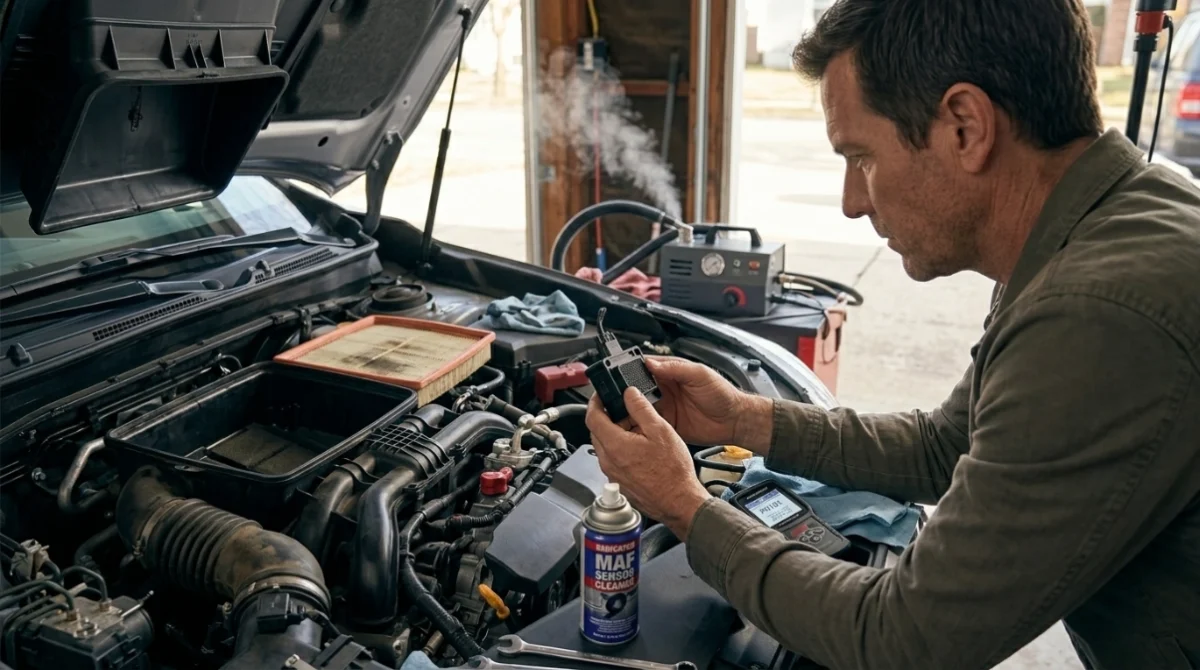
You don’t need to be a mechanic to narrow down the cause. A basic scan tool and 30 minutes will point you in the right direction. Follow these steps in order.
Step 1 — Check the air filter. Pop the airbox and look at the filter. If it’s caked with dirt, leaves, or debris, replace it. A $15 filter sometimes resolves P0101 on its own. Even if it doesn’t, it’s a necessary first step.
Step 2 — Inspect the intake tract. Trace every hose and connection from the air filter housing to the throttle body. Look for cracks, loose clamps, or disconnected hoses. Pay special attention to the intake boot — the flexible rubber section — which cracks with age and heat.
Step 3 — Clean the MAF sensor. Remove the sensor (usually two screws and an electrical connector). Spray the sensing element with MAF cleaner only — never carb cleaner or brake cleaner. Let it air dry completely before reinstalling. Do not touch the sensing wire with anything.
Step 4 — Check fuel trims with a scan tool. With the engine warm and idling, read long-term fuel trim (LTFT). Values above +10% suggest a vacuum leak. Values near 0% but P0101 persists suggest a sensor or wiring issue. This step separates air-leak problems from sensor problems.
Step 5 — Smoke test for vacuum leaks. If fuel trims suggest a leak, a smoke test finds it in minutes. Shops charge $40–80 for this. You can also use a DIY method with carb cleaner: spray small amounts around intake gaskets and hoses while monitoring RPM. An RPM change pinpoints the leak location.
What most people don’t think to ask is whether a recent oil change or air filter service triggered the code. If a shop recently had your intake apart, check for loose connections first. Unmetered air often starts leaking right after someone touched the intake system.
P0101 Fix Cost and Repair Options
Your repair cost depends entirely on the root cause. Here’s what to expect for each scenario.
| Fix | DIY Cost | Shop Cost | Time |
|---|---|---|---|
| Clean MAF sensor | $8–15 (cleaner spray) | $50–100 | 15 min |
| Replace air filter | $10–30 | $40–80 | 5 min |
| Replace PCV valve | $10–30 | $60–120 | 10 min |
| Replace MAF sensor | $50–300 | $200–500 | 20 min |
| Fix vacuum leak | $5–50 (hose/clamp) | $100–400 | 30–90 min |
Cost ranges cover most common vehicles. Luxury and European models may run higher for parts.
If you’re in situation A — P0101 is the only code and symptoms are mild — start with cleaning the MAF sensor and replacing the air filter. These two steps cost under $50 total and resolve roughly half of all P0101 cases.
If you’re in situation B — P0101 appears with P0171 or P0174 — hunt for vacuum leaks. The lean codes are a stronger signal than the MAF code itself. A smoke test is worth the money here.
If you’re in situation C — P0101 persists after cleaning, with no vacuum leaks found — replace the MAF sensor. Buy OEM or a reputable brand like Denso or Bosch. Cheap no-name sensors cause more problems than they solve.
Avoid the cheapest MAF sensors on Amazon or eBay. Off-brand sensors frequently produce readings 10–15% outside spec right out of the box. You’ll chase the same code for weeks before realizing the “new” sensor was defective from day one.
P0101 is a performance code — not a death sentence for your MAF sensor. Roughly 40% of cases stem from vacuum leaks, dirty air filters, or intake tract issues that cost under $50 to fix. The code tells you the readings are wrong, not that the sensor itself failed.
What surprises most people is that a $15 air filter or a $10 PCV valve fixes the problem as often as a $200 MAF sensor does.
Your next move: pop the hood and check your air filter right now. If it’s dirty, replace it and clear the code. If the code returns, move to MAF cleaning and fuel trim diagnosis. Two cheap steps before one expensive guess.
Frequently Asked Questions
Will a P0101 code clear itself?
Sometimes. If the underlying issue is intermittent — like a loose connection that temporarily seals — the ECM may clear the code after several drive cycles without detecting the fault. But the problem remains. Intermittent P0101 codes almost always return within days or weeks.
Can a bad battery cause a P0101 code?
A weak or dying battery can cause voltage fluctuations that confuse multiple sensors, including the MAF sensor. If you’re seeing P0101 alongside other unrelated codes across different systems, test your battery and alternator before chasing sensor problems.
Does P0101 affect transmission shifting?
Yes — in many vehicles, the transmission uses MAF data to determine engine load for shift timing. A P0101 code can cause harsh shifts, delayed shifts, or erratic shift behavior. This is especially common in Nissan, Toyota, and Honda vehicles where MAF data feeds directly into transmission logic.
Is P0101 the same across all car brands?
The generic definition is universal — Mass Air Flow Sensor Circuit Range/Performance. But some manufacturers add brand-specific sub-definitions. BMW and Mercedes, for example, may trigger P0101 under slightly different parameters than Toyota or Ford. The symptoms and diagnostic approach remain the same across all makes.
How long does it take to fix a P0101 code?
Cleaning the MAF sensor takes 15 minutes. Replacing an air filter takes 5 minutes. Diagnosing and repairing a vacuum leak can take 30 to 90 minutes. A full MAF sensor replacement takes about 20 minutes for most vehicles. The diagnosis phase — finding the actual cause — accounts for most of the total repair time.
