
P0172 Symptoms: What a Rich Fuel Code Feels Like

P0172 symptoms usually include a check engine light, poor fuel economy, rough idle, fuel smell, black exhaust smoke, hesitation, and hard starting. The code means Bank 1 is running rich, so the engine gets too much fuel or not enough air. Start with fuel trim data, intake airflow, and fuel pressure before replacing parts.
You scanned your car and saw P0172, but the car still drives. That makes the code confusing.
The problem is not the code itself. The problem is the rich fuel condition behind it, because extra fuel affects combustion, spark plugs, oxygen sensor readings, catalytic converter heat, and fuel economy.
This takes about 8 minutes to read. By the end, you’ll know which P0172 symptoms matter most and what to check first.
Quick check: If the car smells like raw fuel, idles rough, or shows black smoke, treat P0172 as more than a warning light. Those signs point to an active rich-running condition.
P0172 Symptoms Drivers Notice First

P0172 symptoms start when the engine computer sees Bank 1 running too rich. Bank 1 means the side of the engine that contains cylinder 1.
A rich mixture means the engine receives more fuel than the available air can burn cleanly. Gasoline engines commonly target an air-fuel ratio near 14.7:1 under stoichiometric conditions, as shown in Energy.gov fuel glossary material.
- Check engine light after one or more drive cycles
- Poor fuel economy from excess fuel delivery
- Rough idle because combustion becomes uneven
- Fuel smell near the exhaust or engine bay
- Black exhaust smoke from unburned carbon-rich fuel
- Hesitation during acceleration
- Hard starting after sitting or after refueling
The strongest symptom is not always the loudest one. A mild fuel smell with falling MPG can reveal a rich condition before smoke appears.
What P0172 Means for Bank 1
P0172 means the engine control module sees Bank 1 fuel trim moving too far rich. In plain terms, the computer is trying to reduce fuel, but the mixture still stays rich.
Mitsubishi service information describes P0172 as a condition where fuel trim becomes too small and the ECM checks whether fuel trim stays within range. The same logic appears across many OBD-II vehicles, even though thresholds vary by model.
The Mitsubishi P0172 technical description explains the monitor through long-term fuel trim and short-term fuel trim. That matters because P0172 is not just an oxygen sensor complaint.
Warning: Replacing the oxygen sensor first can waste money. The oxygen sensor often reports the rich condition; it does not always cause it.
Fuel trim is the correction the computer applies after reading oxygen sensor feedback. Industry diagnostic references such as AA1Car fuel trim guidance explain that negative fuel trim means the computer is pulling fuel away.
That is why scan data matters. A code reader tells you P0172 exists, but live fuel trim data shows how severe the rich condition is.
Symptom Patterns Point to the Cause
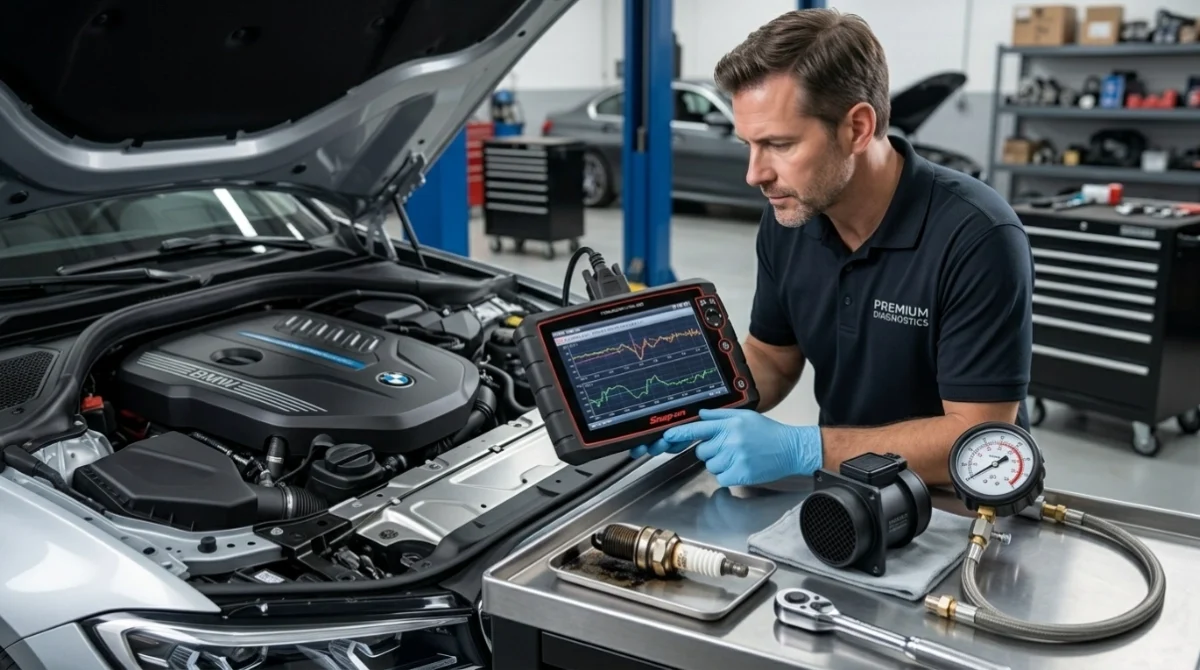
The best way to read P0172 symptoms is to match the symptom pattern to the system involved. Random part replacement creates repeat repairs.
This table shows what each common symptom usually means.
| P0172 symptom | Likely system | Why it happens |
|---|---|---|
| Fuel smell | Fuel injectors or fuel pressure | Too much fuel enters the cylinders. |
| Black smoke | Rich combustion | Fuel burns incompletely and leaves carbon. |
| Rough idle | Spark plugs or air-fuel control | Wet or fouled plugs misfire under load. |
| Poor MPG | Fuel trim correction | The engine burns more fuel per mile. |
| Hesitation | MAF sensor or intake airflow | Wrong airflow data leads to wrong fuel delivery. |
The key conclusion is simple. Symptoms tell you where to start, but fuel trim confirms the direction.
IMAGE SUGGESTION: Close-up of an OBD-II scanner showing P0172 with short-term and long-term fuel trim values.
ALT TEXT: P0172 symptoms scan tool showing rich fuel trim readings
What Most People Get Wrong About P0172 Symptoms
The biggest mistake is treating P0172 as a single-part problem. P0172 is a system warning, not a parts list.
Wrong belief 1: P0172 means the oxygen sensor is bad
The oxygen sensor measures exhaust oxygen and reports mixture behavior. A rich-running engine can make a good oxygen sensor look suspicious.
Replace the oxygen sensor only after checking fuel trim, intake airflow, exhaust leaks before the sensor, fuel pressure, and injector leakage. That order protects your budget.
Wrong belief 2: No smoke means no rich condition
A car can run rich without visible black smoke. Modern engine control systems can hide early symptoms by adjusting fuel trim.
The quieter warning signs are lower MPG, fuel smell, rough idle, and negative long-term fuel trim. Those signs appear before severe exhaust smoke.
Wrong belief 3: Clearing the code fixes the issue
Clearing P0172 only erases the stored warning. The rich condition will return when the ECM sees the same fuel trim pattern again.
That is why the correct fix requires a repeat scan after the repair. The code should stay gone after warm idle, steady cruise, and normal acceleration.
First Checks Before Replacing Parts
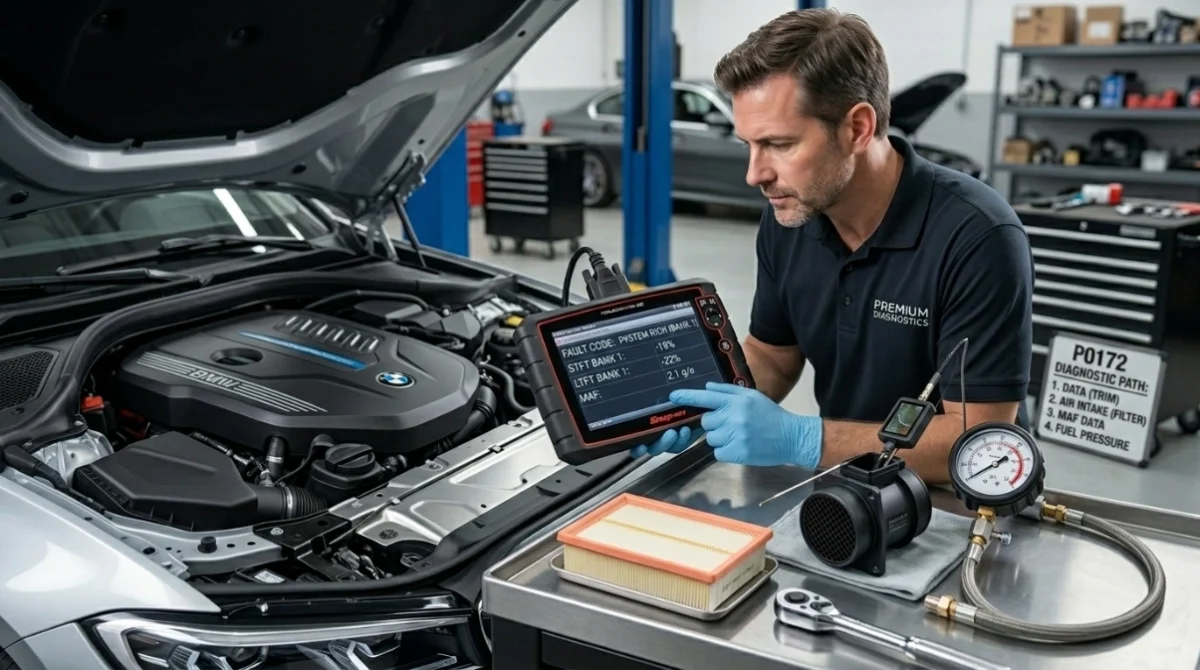
Start with checks that prove the direction of the fault. This prevents replacing the MAF sensor, oxygen sensor, and injectors without a confirmed reason.
- Read freeze-frame data to see when P0172 appeared.
- Check short-term fuel trim at warm idle.
- Check long-term fuel trim during steady cruise.
- Inspect the air filter for blockage or oil contamination.
- Inspect the MAF sensor for dirt or wrong readings.
- Test fuel pressure against vehicle specifications.
- Check injectors for leakage after shutdown.
The unasked question is this: does the rich condition happen at idle only, cruise only, or all the time?
Idle-only richness often points toward fuel pressure, leaking injectors, purge valve issues, or sensor error at low airflow. Cruise-rich conditions often point toward MAF reporting, fuel trim learning, or load calculation errors.
IMAGE SUGGESTION: Simple diagnostic flowchart showing P0172 symptoms leading to fuel trim, airflow, fuel pressure, and injector checks.
ALT TEXT: P0172 symptoms diagnostic flowchart for rich fuel condition
When P0172 Symptoms Need Urgent Attention
P0172 needs urgent attention when symptoms show raw fuel, misfire, or exhaust overheating risk. Extra fuel can damage spark plugs and overheat the catalytic converter.
If the car only has a check engine light and drives smoothly, schedule diagnosis soon and avoid long trips. If the car smells like fuel, smokes, shakes, or loses power, stop driving until the fuel system is checked.
Decision block:
- If you see only P0172, scan fuel trim first.
- If you smell fuel, check leaks and injector sealing.
- If you see black smoke, test fuel pressure next.
- If idle is rough, inspect spark plugs and misfire data.
- If P0172 and P0175 appear together, check shared airflow and fuel pressure causes.
P0172 paired with P0175 means both banks run rich on a V-style engine. That pattern points more toward shared systems, such as MAF data, fuel pressure, or purge flow.
P0172 alone points more toward Bank 1-specific causes. Examples include one leaking injector, Bank 1 sensor feedback, or a localized exhaust issue before the upstream sensor.
P0172 symptoms mean Bank 1 is running rich, so diagnose fuel trim, airflow, fuel pressure, and injector behavior before replacing parts.
Newer scan tools make this easier because live data can show whether richness appears at idle, cruise, or every driving condition.
Take 2 minutes now and write down your symptoms, freeze-frame data, and short-term fuel trim reading.
Frequently Asked Questions
Can I drive with P0172 symptoms?
You can drive a short distance with mild P0172 symptoms if the engine runs smoothly and no fuel smell appears. Do not take long trips. Fuel smell, black smoke, rough shaking, or power loss means the car needs diagnosis before more driving.
Does P0172 always cause poor gas mileage?
P0172 often causes poor gas mileage because the engine runs richer than intended. The change can start small, especially if the computer still controls fuel trim. A sudden MPG drop with a check engine light makes P0172 more suspicious.
Can a dirty air filter cause P0172?
Yes, a restricted air filter can contribute to P0172 because the engine receives less air than expected. The computer then sees a rich mixture. Check the air filter before buying sensors because it is fast, cheap, and easy to inspect.
Can P0172 damage the catalytic converter?
Yes, P0172 can damage the catalytic converter when unburned fuel enters the exhaust. The converter can overheat while burning that extra fuel. Rough idle, fuel smell, misfire codes, or black smoke raises the risk.
Why does P0172 come back after clearing it?
P0172 comes back after clearing because the rich condition still exists. Clearing the code resets the warning, not the cause. The ECM stores the code again when fuel trim readings move outside the accepted range during normal driving.
