
10 Best OBD2 Scanner With Live Data for Home Mechanics — Top Picks, Features, and Buying Guide

Onboard diagnostics (OBD2) scanners give home mechanics a direct view into a car’s computer. They read trouble codes, reset check-engine lights, and—most usefully—display live data like engine RPM, coolant temperature, and fuel trims. For DIY repairs and routine checks, a scanner with clear live-data graphs and real-time updates can save time and help us diagnose problems without a trip to the shop.
Not all OBD2 scanners handle live data the same way. Screen size, refresh rate, number of parameters shown at once, and whether the device records or graphs data matter most. The best choice balances clear, fast live-data display with reliable code reading and easy app or device setup. We tested and compared models to find scanners that make real-time vehicle troubleshooting straightforward for home mechanics.
Best OBD2 Scanners with Live Data
We tested and compared OBD2 scanners that show live data and suit home mechanics. Our list focuses on easy setup, clear live-data display, and reliable diagnostics to help you pick the right tool.
FOXWELL NT301

We recommend this if you want a simple, reliable OBD2 reader that shows live data and helps fix common check-engine issues.
Pros
- Easy to use right out of the box; reads and clears codes quickly.
- Live data graphing helps spot trends while driving.
- Solid build and clear 2.8″ screen that’s readable in daylight.
Cons
- Only basic OBD2 functions; no ABS, SRS, or advanced resets.
- Updates require Windows; no Mac or iOS support.
- Some features depend on vehicle make, model, and year.
We plugged the NT301 into several older cars and a newer SUV and it woke up instantly. The menu felt straightforward, and the read/clear routine worked exactly as expected.
Watching live sensors in graph form made it easier to spot a fluctuating oxygen sensor and a slow coolant rise. We liked logging data without needing a phone app or subscription.
The readiness lights and dedicated I/M key saved us a trip anxiety before emissions checks. Still, we missed advanced system scans and bidirectional controls when diagnosing ABS and airbags.
Overall, this unit is a great home mechanic tool for basic engine checks and live data viewing, but not a full shop-grade scanner.
BlueDriver Pro Next-Gen
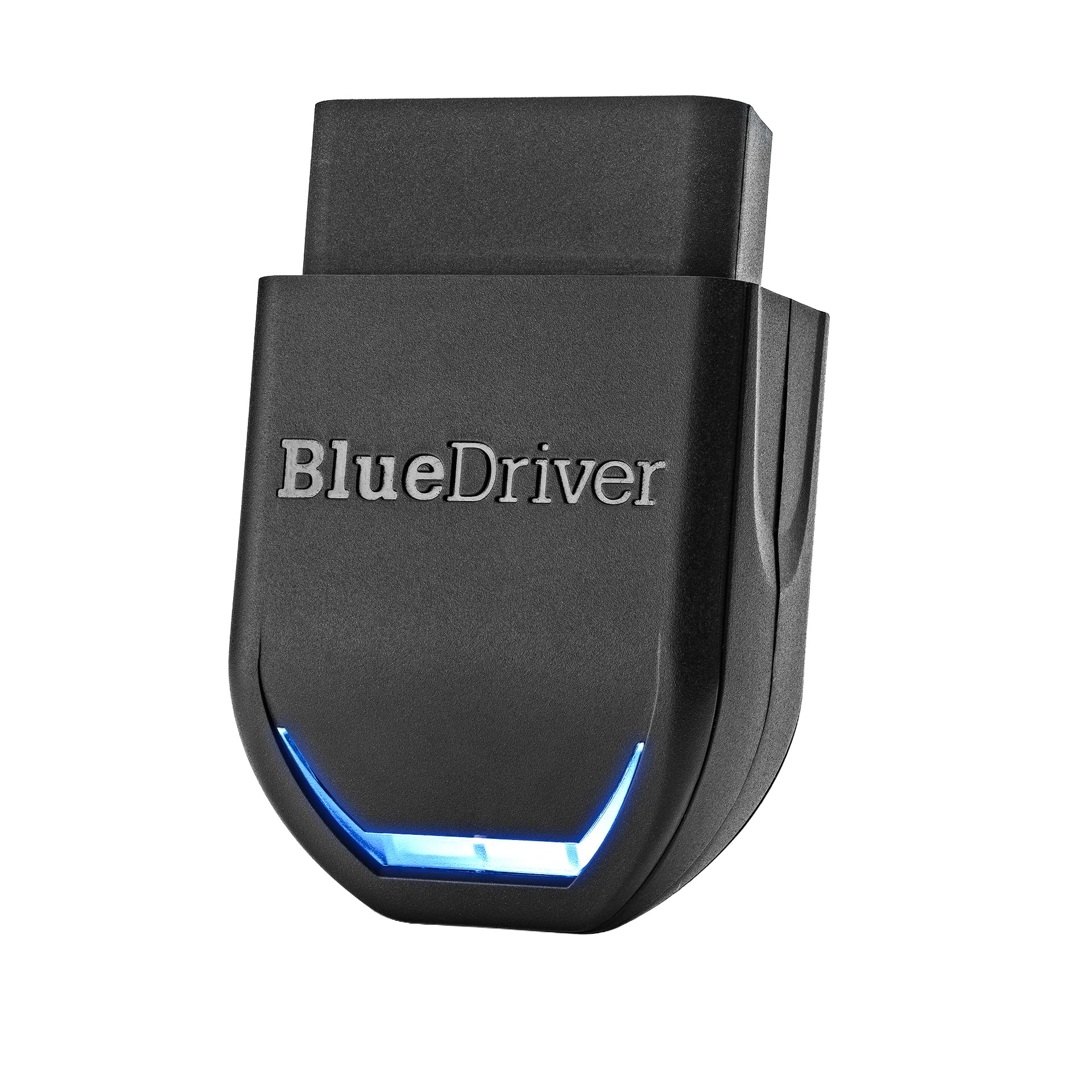
We recommend this for DIY mechanics who want pro-level live data and verified fixes without subscriptions.
Pros
- Clear, easy-to-read live data and verified repair reports.
- Wireless Bluetooth setup — compact and always ready.
- No subscription fees; app updates included.
Cons
- Some vehicle brands show better coverage than others.
- Initial pairing can need support for certain phones.
- Advanced features depend on app and vehicle support.
We left it plugged into our truck for weeks as a bedside tool for check-engine lights and it paid off. The live data stream felt responsive and we could watch sensors change while revving the engine.
We used the verified fix reports tied to the VIN and they saved us time and guesswork. The app gave clear causes and suggested repairs so we avoided a few unnecessary parts.
We did hit a pairing hiccup with one phone but customer support helped quickly. Coverage was excellent on our common brands, though some niche models showed limited data. Overall, it acted like a professional scanner without the price or a subscription.
Foxwell NT604 Elite

We recommend this scanner if you want reliable live data and multi-system reads without paying dealer prices.
Pros
- Clear live data and easy AUTOVIN lookup.
- Solid carrying case and ready-to-use out of the box.
- Reads Engine, ABS, SRS, and Transmission faults.
Cons
- No advanced service functions or bidirectional controls.
- AUTOVIN may fail on older or rare vehicles.
- Some users report occasional update or file errors.
We plugged the NT604 into a few cars and liked how fast it pulled up VIN and system status. The screen and menus felt straightforward, so we could jump into live data and watch sensors change while we ran the engine.
We used it to trace a persistent ABS light and it showed live wheel speed and ABS codes that helped pinpoint the bad sensor. Clearing codes worked after we fixed the issue, but the tool won’t perform repairs or resets for maintenance functions.
We found the case very handy for storing the unit and cables. Updates are free for life, yet some models needed a manual VIN entry and one or two updates took longer than expected. Overall, this is a solid pick for home mechanics who want clear diagnostics without dealer costs.
Innova 5210
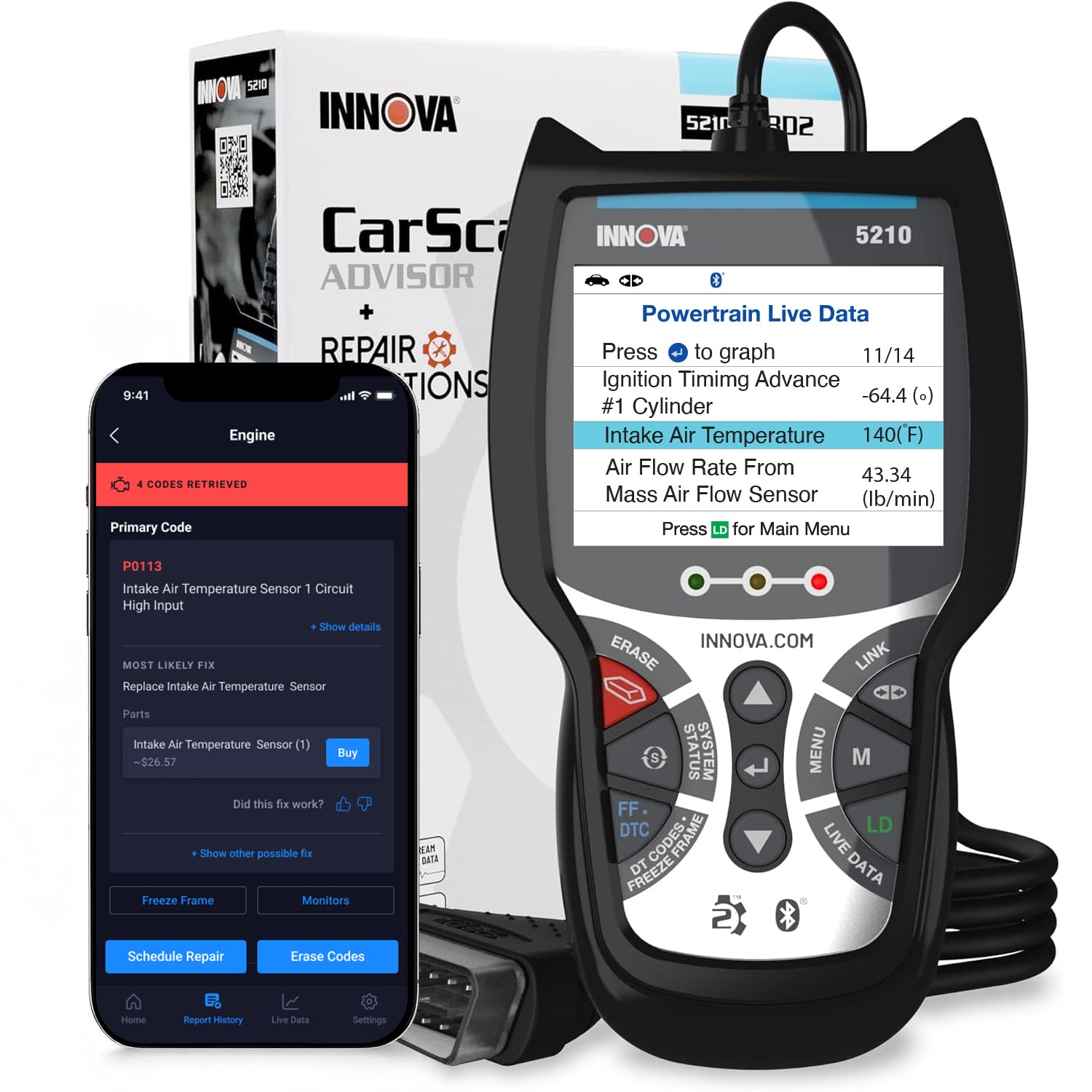
We recommend the Innova 5210 if you want a solid OBD2 scanner that shows live data and also tests your battery without a subscription.
Pros
- Shows live engine data clearly and helps us spot issues fast.
- Includes battery and alternator checks that saved us a tow once.
- Free RepairSolutions2 app gives step-by-step fixes from ASE techs.
Cons
- Not every advanced feature works on every car make or year.
- Bluetooth can be finicky on some phones when pairing.
- Screen is small compared to phone-based apps.
We plugged this into several cars and liked how quickly it pulled live data like RPM, temps, and fuel trims. The readouts helped us see real-time changes while revving the engine and testing sensors.
Using the battery tester felt practical. It flagged a weak alternator on an older truck before it left us stranded, which let us plan the repair.
The RepairSolutions2 app paired to the tool and offered repair ideas that matched what we found under the hood. Sometimes the app didn’t list the exact replacement part, but it still pointed us in the right direction.
Coverage varied across vehicles in our tests, so we verified compatibility before using all features. Clearing codes and resetting the oil light worked cleanly, but readiness monitors need a drive cycle to repopulate after a battery disconnect.
Overall, the Innova 5210 gave us reliable live data and useful battery checks without monthly fees, making it a strong choice for home mechanics who want handheld diagnostics and trusted repair guidance.
ANCEL AD310

We recommend this if you want a simple, reliable code reader that shows live data and helps you clear basic engine and emission codes quickly.
Pros
- Easy to use right out of the box
- Sturdy cable and compact for garage use
- Live data display helps with quick checks
Cons
- Only reads emission-related OBD-II codes
- No advanced system tests or bi-directional controls
- Limited to OBD-II vehicles (not OBD-I)
We plugged this into a few cars and it gave fast, clear code reads. The screen is big enough to scan live data without squinting, and the buttons work even with greasy hands.
We liked how solid the cable felt while working under the hood. It powered up from the car, so we never hunted for batteries, and the unit fit easily on the dash while we watched freeze-frame and live sensors.
We did notice limits on deeper diagnostics. For tasks beyond emissions codes—like ABS, SRS, or module programming—we had to use a more advanced tool. Still, for home mechanics who want quick code checks and live data, this is a dependable, no-frills pick.
ANCEL AD410
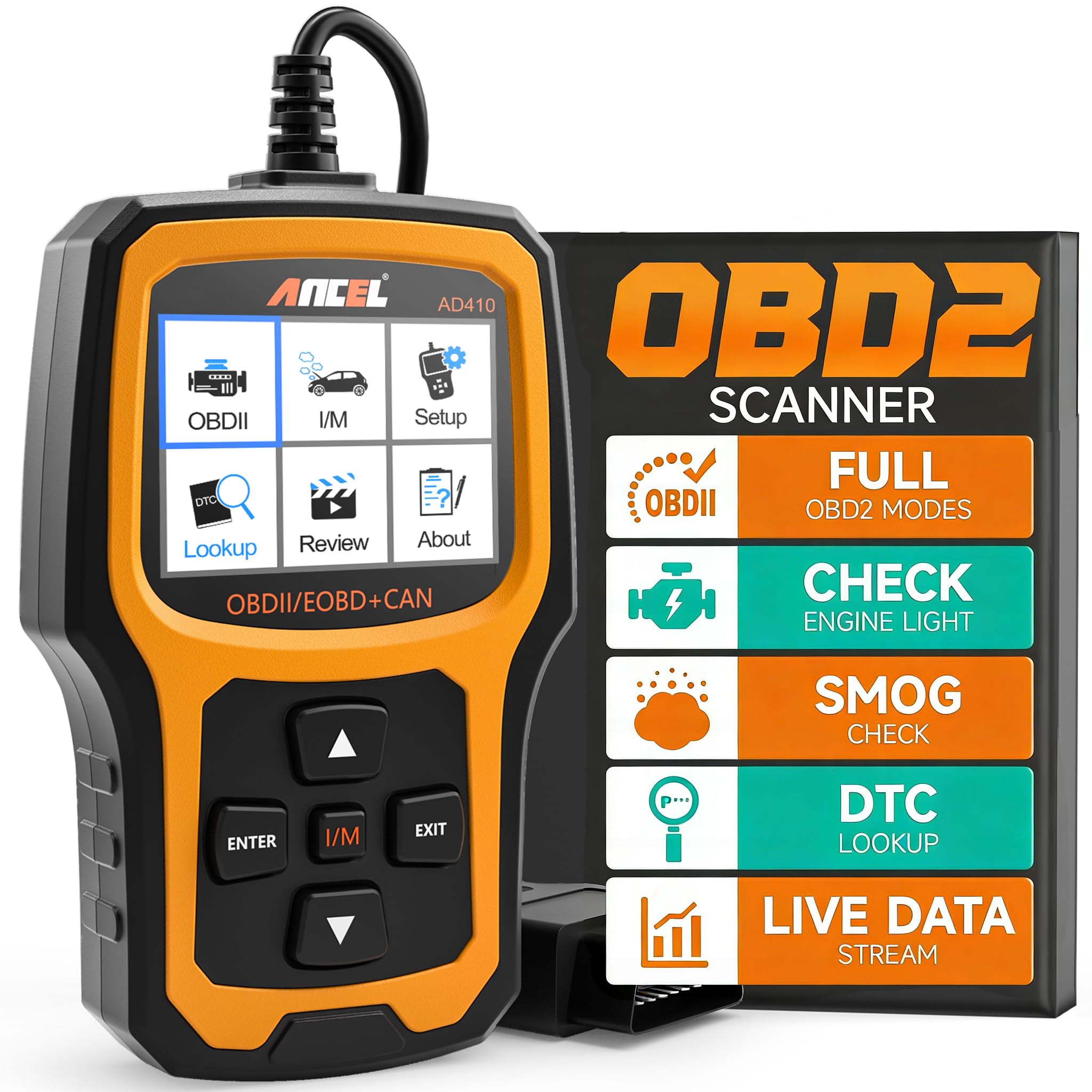
We recommend this if you want a simple, no-app OBD2 scanner that reads live data and helps you solve common check engine issues at home.
Pros
- Easy plug-and-play use without a phone or apps.
- Clear live data that helped us spot running issues quickly.
- Built-in code definitions make troubleshooting faster.
Cons
- Only reads engine/emission systems, not ABS or SRS.
- Small screen can feel cramped when viewing lots of live parameters.
- Manual and some explanations could be clearer.
We used the AD410 on a few cars and it was straightforward to start. Plugging into the OBD2 port powered it up immediately and the menus were simple to navigate. The unit pulled codes fast and showed on-screen definitions that helped us understand the likely cause.
Watching live data was the most useful part for us. RPM, coolant temp, and fuel trim updates let us spot odd behavior while the engine ran. The 2.4″ display is readable, though we found scrolling through many parameters a bit slow on certain vehicles.
Clearing codes after a repair worked every time during our tests. For basic home mechanics this tool speeds up diagnosis and helps decide if a shop visit is needed. Just remember it won’t replace a full shop scanner for ABS, airbag, or advanced reset functions.
Innova 5610

We recommend this if you want dealer-level live data and bidirectional controls without paying shop prices.
Pros
- Shows live OEM data for ABS, SRS, transmission, and engine.
- Bidirectional commands let us activate components for testing.
- Works with a helpful RepairSolutions2 app and US support.
Cons
- Not universal — coverage varies by make and year.
- App pairing can be finicky at first.
- Some features need vehicle-specific support to work.
We connected the Innova 5610 to several cars and liked how fast it pulled live data. Viewing engine and ABS streams felt very clear on the small screen, and the app made sense when it mapped data to likely causes.
We used bidirectional tests to switch a fuel pump and cycle an EPB on a late-model vehicle. Those functions saved us time compared with guessing parts and gave confidence during repairs.
We did run into a few hiccups with the mobile app connection and a couple of vehicles that the tool wouldn’t fully cover. Calling support helped once, and the free updates seemed to add coverage over time.
Overall, this tool acted like a pro-level scanner at a DIY price when it matched the vehicle. If your car is supported, it will speed up diagnosis and let us test things instead of only reading codes.
FOXWELL NT301 Plus
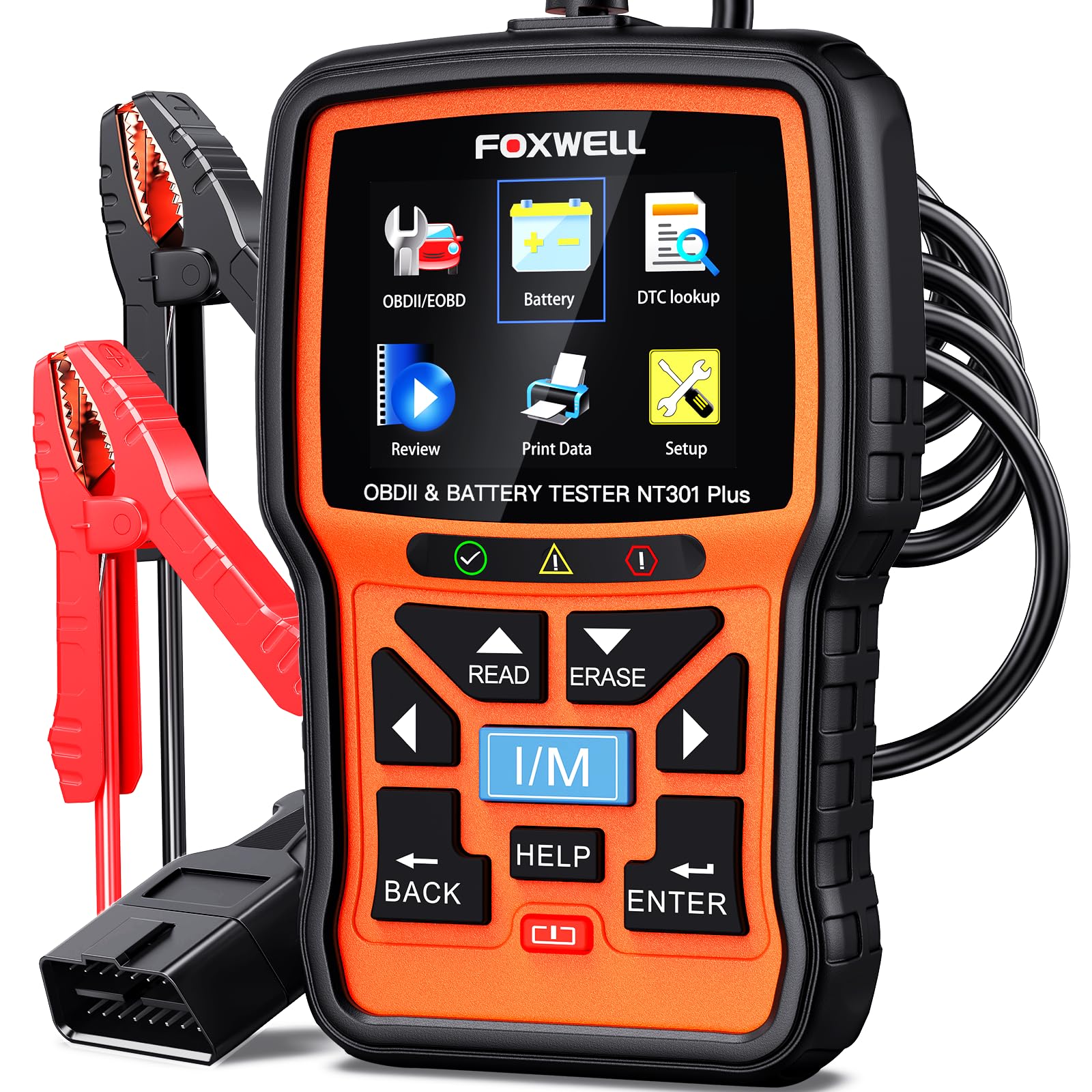
We recommend this if you want an easy-to-use OBD2 reader with battery testing that helps DIYers catch problems before they get worse.
Pros
- Quick code reads and clear live data that helped us find issues fast.
- Built-in battery check saved us from a dead-start surprise.
- No subscription or phone app required — plug and go.
Cons
- It only covers engine and 12V battery diagnostics, not ABS or airbags.
- Windows-only updates, so Mac/iPhone users can’t update the unit.
- Some vehicle makes or older models may not be fully supported.
We plugged the NT301 Plus into several cars and immediately liked the bright 2.8″ screen. Reading live RPM and coolant temp felt instant, and the DTC lookup descriptions made the codes easy to understand without hunting online.
Battery testing proved useful after a weekend of errands. The unit showed battery health and charging status clearly, and that helped us decide to recharge instead of buying a new battery right away.
Using the I/M readiness test was handy when checking a used car before buying. The pass/fail LED and beeps gave a quick answer, and the EVAP test helped us spot a loose gas cap on one vehicle.
The tool is lightweight and felt solid in hand, but we were careful aligning the OBD pins to avoid bending them. Updates require a Windows PC, which may be a hassle for some, and advanced systems like ABS or key programming are out of scope.
Overall, this scanner cuts the guesswork for home mechanics who need fast engine codes and battery checks without paying for extra features they won’t use.
ANCEL AD410 PRO
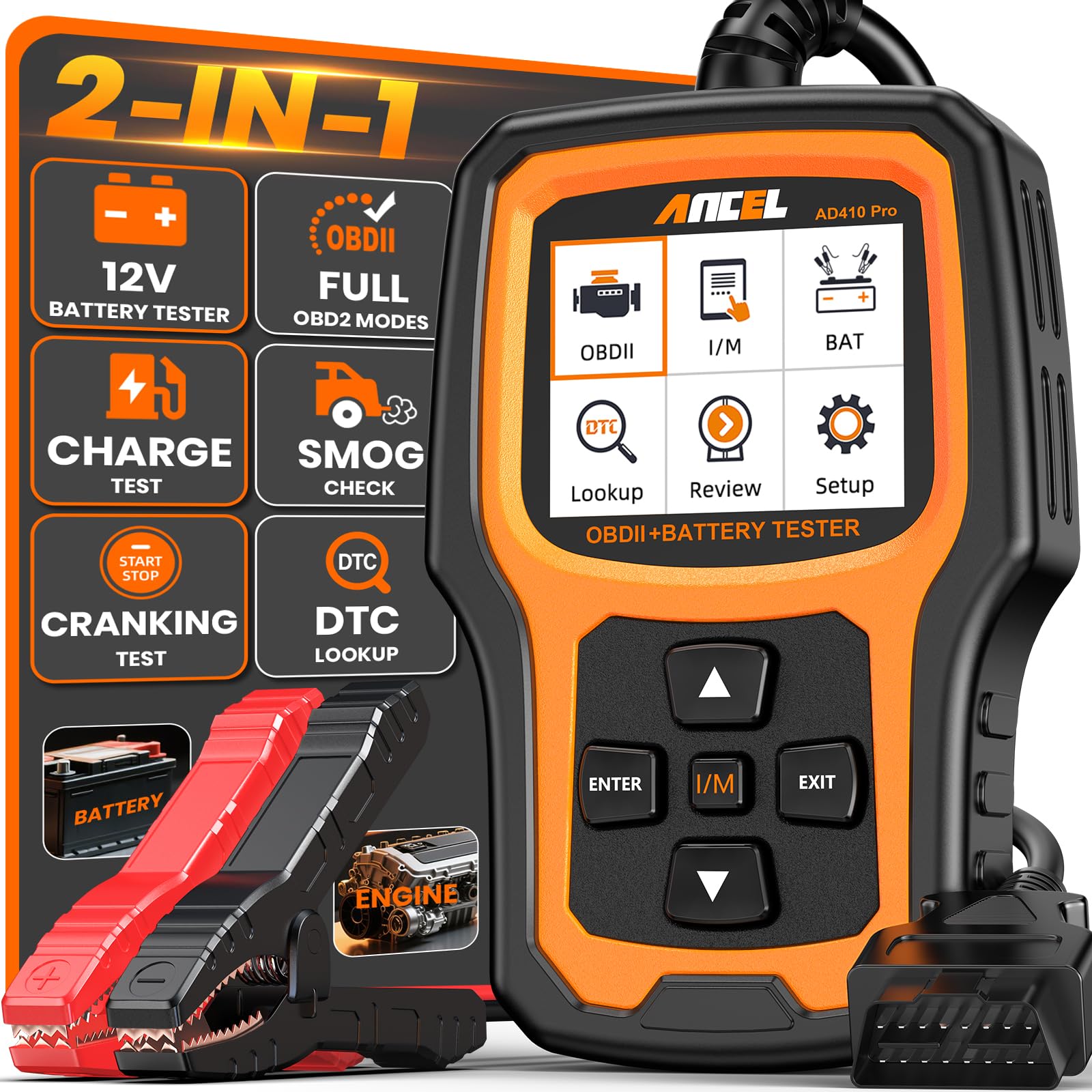
We recommend this if you want a simple plug-and-play scanner that also tests batteries and gives clear live data for home repairs.
Pros
- Combines engine diagnostics and battery testing in one compact tool.
- Live data and freeze-frame help us see what caused a fault in real time.
- Very easy to use — no apps or setup required.
Cons
- Doesn’t read ABS, SRS, or transmission systems.
- Small screen limits how much live data we can view at once.
- Limited advanced features compared to tablet-based scan tools.
We used the AD410 PRO on a few older cars and found it fast to get running. Plugging into the OBDII port, the screen lit up and the menus were straightforward. Reading codes felt like using a simple gadget rather than a complex diagnostic rig.
Watching live data made a difference on one vehicle with a rough idle. The waveform and live numbers showed us a misfiring pattern and confirmed a fuel trim issue. Freezing the frame at the moment of fault saved us a lot of guesswork and got the repair right the first time.
Battery testing was genuinely helpful during a cold morning. The AD410 PRO ran a cranking and charging test and showed whether we needed a replacement or just a weak alternator. For a home mechanic who wants one tool to check both codes and battery health, this felt like good value.
CrysGuard V519
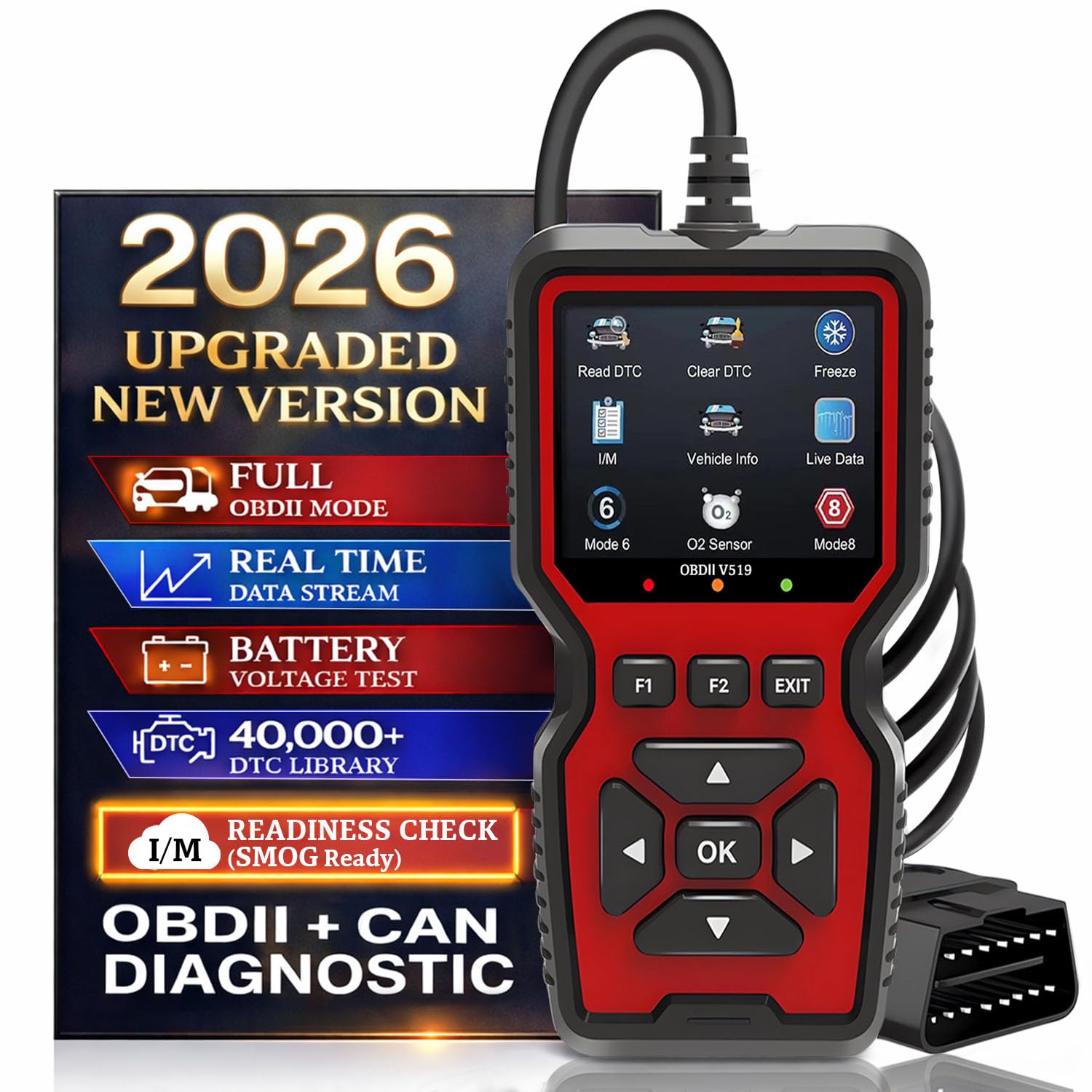
We recommend this scanner if you want strong live-data tools and pro-level modes in a simple plug-and-play unit.
Pros
- Deep live data and freeze-frame capture for spotting intermittent faults.
- Professional Mode 6/8 support lets us test components, not just read codes.
- Lifetime updates and easy USB export of diagnostic reports.
Cons
- Feels lightweight and a bit fragile in the hand.
- Menus can be dense the first few uses.
- Some users report occasional compatibility quirks on certain models.
We plugged the V519 into several cars and liked how fast it powered up from the OBDII port. The live graphs for O2 sensors and fuel trim made it easy to see real-time changes while we revved the engine. Capturing freeze frames helped us catch a misfire that showed up only under load.
Navigating Mode 6 and Mode 8 felt like using a tool we’d expect in a small shop. We used active tests to trigger components and verify repairs without guesswork. The DTC library on the screen gave clear definitions so we didn’t need to hunt online for basic meanings.
The unit’s small plastic shell made us handle it carefully; we wouldn’t toss it on a fender. Initial menu navigation took a few minutes to get comfortable with, especially when switching languages. Overall, the V519 saved us time and reduced trips to the shop for the vehicles we tested.
Buy the CrysGuard V519 on Amazon
Buying Guide
We look for tools that make car troubleshooting simple and fast. Live data is key; it shows real-time engine readings so we can spot problems as they happen.
We check compatibility first. Does the scanner support OBD2 protocols for our vehicle year and model? Also confirm app or software support for our phone or computer.
We weigh connection type and ease of use. Bluetooth or Wi‑Fi adapters let us view live data on a screen. Handheld units have built-in displays for quick checks without a phone.
We evaluate live-data features. Look for graphing, customizable PIDs, freeze-frame, and data logging. These let us compare readings over time and save results for later review.
We consider durability and build quality. A sturdy case, clear screen, and responsive buttons matter if we use the tool in a garage. Battery life and power options also affect usability.
We compare data access and update policy. Frequent software updates and a clear PID library help us stay current. Check if the manufacturer or app offers help, guides, or community support.
We set a budget and prioritize features. Decide whether we need advanced functions like bi-directional control or basic live data and code reading. Balance cost against the features we will actually use.
We read reviews and test reports. Focus on real-world performance, not marketing claims. Prioritize scanners that consistently deliver reliable live data and easy operation for home mechanics.
Editor’s Choice
We pick the Autel MaxiAP AP200 as our top OBD2 scanner with live data for home mechanics. It pairs with smartphones and tablets and shows live engine data in clear graphs and charts. The app is easy to use and updates regularly.
We like the AP200 for its balance of features and price. It reads and clears trouble codes, displays real-time data, records sessions, and supports most OBD-II protocols. The live-data trace is smooth, which helps when diagnosing intermittent issues.
We trust its build and app support. The dongle is compact and plugs into the OBD port without blocking nearby connectors. The app offers guided fixes and printable reports for basic diagnostics.
Key pros:
- Affordable and feature-rich
- Intuitive app with live graphs
- Good compatibility with modern cars
Minor drawbacks:
- Some advanced functions need paid unlocks
- Bluetooth range can be limited in crowded areas
We recommend the Autel MaxiAP AP200 for hobbyists who want reliable live data without a steep learning curve. It gives clear, actionable information for common repairs and maintenance.
Conclusion
We picked scanners that balance price, features, and ease of use for home mechanics. Each option gives clear live data, so we can diagnose common issues without guesswork.
For basic needs, a simple Bluetooth OBD2 adapter plus a good app works well. It keeps costs low and still shows key live sensors like RPM, coolant temp, and O2 readings.
If we want more built-in features and durability, a handheld unit with a color screen is worth the extra money. Those models usually give faster updates, better graphing, and more reliable connections.
Here are quick buying points to remember:
- Compatibility: Make sure the scanner supports your car’s protocol and year.
- Live data quality: Look for fast refresh rates and clear graphs or gauges.
- Ease of use: Favor simple menus and good app reviews.
- Extra features: Bi-directional controls and freeze-frame can be helpful, but not always necessary.
We recommend choosing based on how often we work on cars and what data we need most. For occasional DIY repairs, a basic Bluetooth adapter and app often suffice. For frequent, deeper diagnostics, invest in a mid-range or advanced handheld scanner.
We’ll use these criteria to pick a tool that saves time and reduces frustration while we work on our vehicles.
FAQs
What is live data and why does it matter?
We read real-time sensor values like RPM, coolant temp, and O2 readings. Live data helps us spot intermittent problems and verify repairs quickly.
Do I need a paid app or special hardware?
Some scanners work with free apps, but many advanced features require paid apps or a dedicated scanner. We recommend checking compatibility before buying.
Can a basic OBD2 scanner clear codes?
Yes. Most OBD2 tools can read and clear generic codes. However, they may not show live data or advanced manufacturer codes.
Will any scanner work on my car?
Most cars sold after 1996 in the U.S. use OBD2, but protocols vary by make and model. We check device compatibility lists to avoid surprises.
How accurate is live data from Bluetooth adapters?
Bluetooth adapters are usually accurate for common sensors. They can produce delays or dropouts on low-cost units. We prefer adapters with stable connections and good reviews.
What features should we prioritize?
We focus on live-data refresh rate, ease of use, compatibility, and data logging. Those features help us diagnose faster and keep clearer records.
Can we use these tools for emissions testing?
Some scanners can help check readiness monitors. They do not replace official emissions tests. We use them to pre-check our cars before going to a test station.
How do we store and share live-data logs?
Many apps let us export CSV or save screenshots. We use logs to compare before-and-after repairs and to show mechanics if needed.
