
10 Best OBD2 Scanner with Graphing Live Data in 2026

A code reader that only spits out a five-digit fault code leaves you halfway to a diagnosis. The other half comes from watching how your engine actually behaves in real time: whether the oxygen sensor swings the way it should, whether fuel trims drift under load, whether a coolant temperature reading lags or spikes. That’s where graphing live data earns its keep, turning a static code into a visual story you can actually trust.
Live data graphing works by streaming PIDs (parameter IDs) from your vehicle’s ECU and plotting them on a timeline instead of a single changing number. A scan tool that refreshes slowly or only shows one value at a time makes it hard to catch a stumble or a sensor lag. A tool with a fast refresh rate and multi-parameter graphs lets you watch several systems misbehave at once, which is often how intermittent problems get caught.
Not every scanner marketed with “live data” actually graphs it well, and that distinction matters more than any spec sheet claim. Some tools show numbers that update sluggishly or only handle one PID visually at a time; others let you overlay four or five channels and scrub back through a recorded drive. We looked at code readers and full-system scanners across price points, from basic plug-and-read units to bidirectional pro-style tools, to find which ones make live data genuinely useful instead of just present.
Best for budget DIY diagnostics: FOXWELL NT301
Best for smartphone users who want repair guidance: BlueDriver OBD2 Scanner
Best for battery and charging system checks: Innova 5210
Best for broad module coverage on a budget: FOXWELL NT604 Elite
Best for app power users and tuning software: OBDLink MX+
Best for straightforward wireless code reading: BLCKTEC 440
Best for professional-style bidirectional testing: TOPDON AD900 Lite
Best for simple plug-and-read code clearing: ANCEL AD310
Best for low-cost app-based monitoring: Veepeak OBDCheck BLE
Best for dedicated dashboard-mounted gauges: ScanGauge 3
FOXWELL NT301

Buy this if you want a no-subscription handheld that graphs the core engine parameters without any phone pairing hassle.
Pros
- Graphs O2 sensor, fuel trim, RPM, and coolant data directly on its 2.8-inch screen
- One-click I/M readiness with color-coded pass/fail LEDs for smog prep
- Lifetime free updates with no app or account required
Cons
- Engine-system data only; no ABS, SRS, or transmission modules
- Small screen limits how many graphed parameters you can view comfortably
- Windows-only for updates, no Mac support
The NT301 covers the basics diagnosticians actually reach for first: fuel trims, O2 sensor sweep, coolant temp, and RPM, all plotted so you can watch a sensor drift instead of guessing from a single number. The EVAP and O2 test modes add a layer most $30 code readers skip entirely.
Its limits show up fast if you’re chasing anything outside engine and emissions. There’s no ABS or SRS access here, so a check-engine-only scope is the honest way to think about this unit. For that scope, though, the graphing is genuinely more useful than its price suggests.
BlueDriver OBD2 Scanner
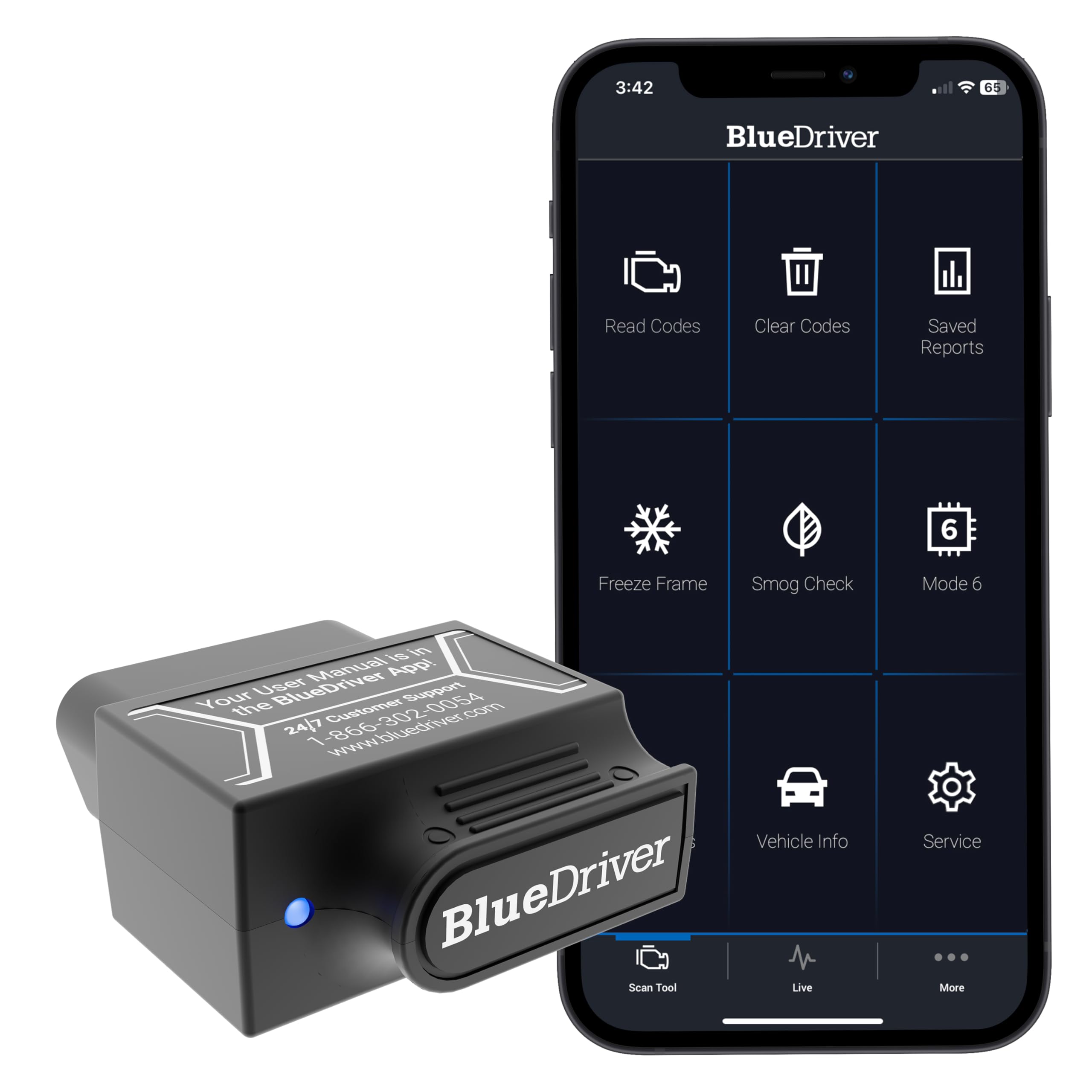
Buy this if you want your phone’s screen doing the graphing work, paired with repair reports that explain what the data actually means.
Pros
- Live data graphs plus freeze frame and Mode 6 test results in one app
- Reads ABS, SRS, TPMS, and transmission codes beyond basic engine scans
- One-time purchase with no subscription fees, ever
Cons
- Requires a phone or tablet; no standalone screen
- Bluetooth dongle depends on phone battery and app updates
- Enhanced coverage varies by make, so European and Asian depth isn’t universal
BlueDriver’s app turns your phone into the graphing display, and it does this well: pinch-to-zoom on live PIDs, log a drive, and scrub back through it later. The verified repair reports tied to your specific VIN are a genuine differentiator, translating a raw code into “this is what usually fixes it” language.
The catch is that you’re tied to a phone for every session. There’s no dedicated screen, so if your phone dies mid-diagnosis, the tool goes dark too. For most DIYers who already carry a phone to the driveway, that trade-off is a minor one against the depth of module coverage.
Innova 5210
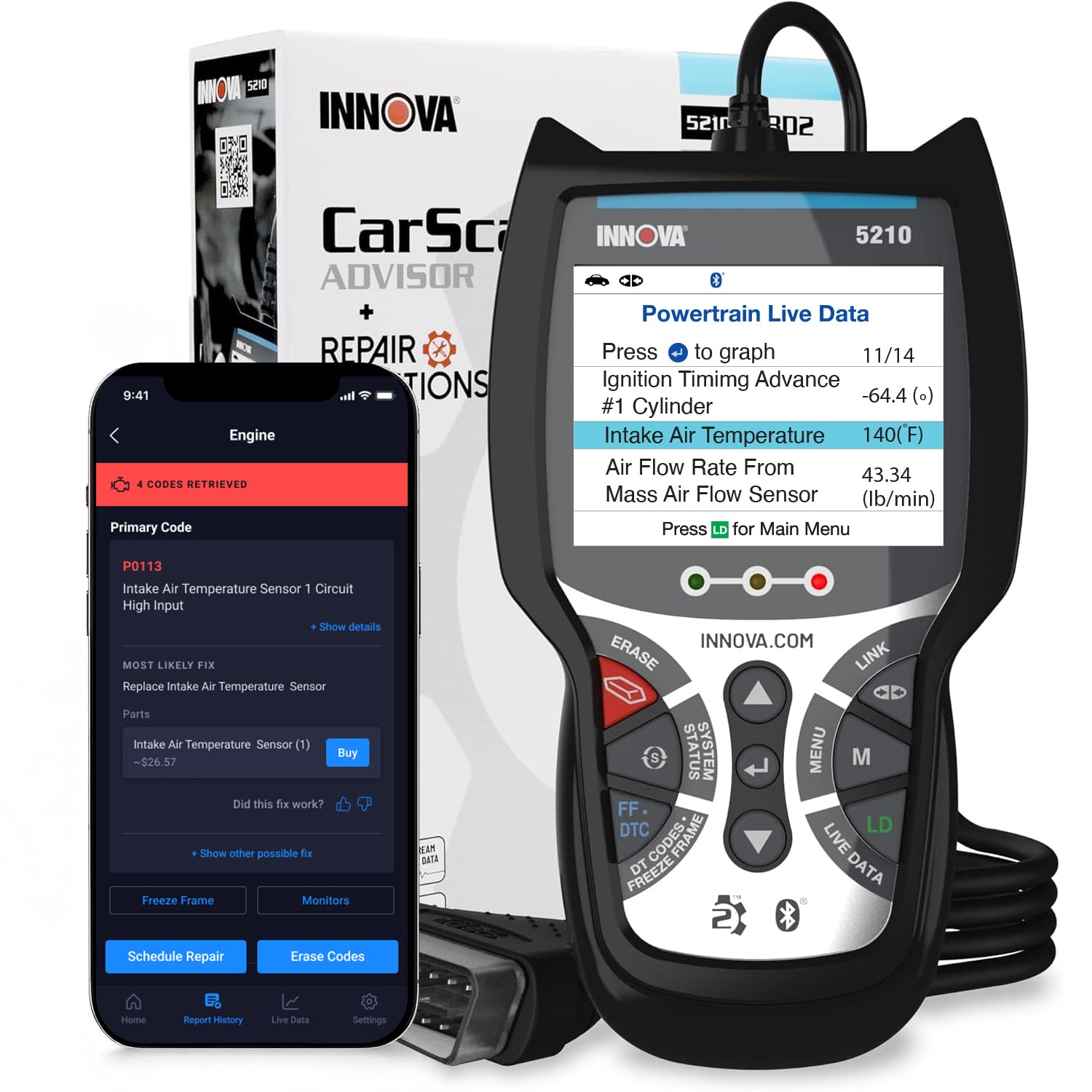
Buy this if you want live-data graphing plus a built-in battery and alternator test in a single handheld.
Pros
- Combines OBD2 live data with battery and charging system testing
- Oil reset function for post-service maintenance light clearing
- RepairSolutions2 app adds verified fixes at no extra cost
Cons
- ABS coverage varies significantly by vehicle
- No standalone battery power; the reader itself needs to stay plugged in
- App pairing adds a setup step some users find inconsistent
The battery tester is the standout here. Checking alternator output alongside live engine PIDs means you can rule out an electrical cause for a rough idle without a separate multimeter. Fuel trim and O2 graphing works cleanly through the app, and the RepairSolutions2 tie-in gives context most bare code readers don’t.
ABS support is the soft spot; Innova is upfront that coverage varies by model, so check compatibility before counting on it for airbag or brake-module work.
FOXWELL NT604 Elite

Buy this if you want engine, ABS, SRS, and transmission graphing on one larger screen without paying pro-scanner prices.
Pros
- Four-system coverage (engine, ABS, SRS, transmission) on a 4.3-inch screen
- AUTOVIN pulls vehicle info automatically instead of manual entry
- Sturdy protective case included, unlike most competitors’ plastic bags
Cons
- No bidirectional control or reset functions like oil or throttle relearn
- SRS clearing limited to non-crash-related codes
- Some owners report inconsistent live-data accuracy on certain parameters
For the price, the NT604 Elite’s four-module reach is hard to match. Graphing spans across systems, so a transmission shudder can be cross-checked against engine data on the same screen instead of switching tools. The bigger display over the NT301 makes multi-parameter graphs easier to read at a glance.
It stops short of bidirectional testing and service resets, so it diagnoses but doesn’t drive components like a solenoid or ABS motor for active testing. That’s the line separating this from the TOPDON below.
OBDLink MX+

Buy this if you already use apps like Torque, FORScan, or Carista and want a fast, reliable Bluetooth bridge that graphs everything those apps support.
Pros
- Enhanced OEM-level PIDs for Ford, GM, Toyota, Honda, and more
- Works across dozens of third-party apps, not locked to one ecosystem
- Compact size with battery-drain and over-voltage protection built in
Cons
- No standalone display; entirely app-dependent
- Enhanced parameter depth depends on which app you pair it with
- Setup requires picking the right app for your specific diagnostic goal
This is the tool serious app users reach for. Paired with something like Torque or Car Scanner, it streams manufacturer-specific PIDs, ABS, SRS, TPMS data at a refresh rate that outpaces most budget Bluetooth dongles. That speed is what makes its graphs feel closer to real time rather than a slow-motion replay.
The trade-off is total reliance on your app choice. Buy this expecting to also invest a little time picking and learning the right companion software for your vehicle.
BLCKTEC 440

Buy this if you want a plug-and-play unit with live data graphing and a battery/charging test, minus any app dependency for basic scanning.
Pros
- Live data graphing on a bright 2.8-inch color screen
- Battery and charging system test built in
- Free lifetime updates with a straightforward one-year warranty
Cons
- Short OBD cable makes in-seat viewing awkward in larger vehicles
- Engine-focused; no ABS/SRS module access
- Fewer third-party integrations compared to Bluetooth-first competitors
BLCKTEC’s 440 covers similar ground to the FOXWELL NT301, with the addition of a battery test that’s genuinely handy when a check-engine light coincides with a weak start. Graphing performance on fuel trims and O2 data is smooth enough for real diagnostic work, not just a demo feature.
The main complaint from owners is cable length; it’s workable, but plan on setting the unit somewhere stable rather than holding it in your lap while driving.
TOPDON AD900 Lite

Buy this if you want pro-level bidirectional testing and full-system graphing on a large tablet-style screen, and don’t mind the bulk.
Pros
- Bidirectional control actively tests injectors, pumps, and other components
- Full-system scans cover engine, transmission, ABS, SRS, TPMS, and more
- Eight reset functions including oil, EPB, and steering angle
Cons
- Large 8-inch tablet body is bulkier than pocket scanners
- Update downloads can run long, and warranty support is split by region
- DTC repair guide currently limited to select Chrysler/Dodge/Jeep/Fiat models
This is the closest thing on this list to a shop-grade scanner. Bidirectional control means it doesn’t just read what’s happening; it can trigger a cooling fan or cycle a solenoid so you can confirm a component actually works rather than inferring it from a code. Live data graphing spans every supported module, which matters for chasing multi-system faults like a transmission code tied to an ABS wheel-speed sensor.
Its size and weight reflect that capability, and it’s overkill for someone who just wants to clear a check-engine light. For anyone doing real diagnostic work on multiple vehicles, the bidirectional testing alone justifies the extra bulk.
ANCEL AD310

Buy this if your priority is fast, reliable code reading and basic live data, not multi-parameter graphing depth.
Pros
- Extremely simple operation, no app or account setup
- Reads live data and freeze frame alongside standard code reading
- Broad OBD2 protocol support across gas vehicles from 1996 onward
Cons
- Small monochrome-style screen limits graph readability
- Emissions-related codes only; can’t read non-emissions engine faults
- No ABS, SRS, or transmission access
The AD310 does one job cleanly: tell you what’s wrong and clear it once it’s fixed. Live data is present, but the small screen and basic display format make it better suited to spot-checking a single PID than watching several graphed values at once.
For a first scanner or a glovebox backup, it’s hard to beat on simplicity. Just don’t expect the graphing depth that dedicated live-data tools offer.
Veepeak OBDCheck BLE

Buy this if you want the cheapest reliable path into app-based live-data graphing, provided you pick the right companion app.
Pros
- Compact Bluetooth LE dongle works with multiple third-party apps
- Compatible with vehicle-specific apps like BimmerCode and Dr. Prius
- Low cost of entry for phone-based diagnostics
Cons
- No standalone screen or storage; fully app-dependent
- ABS/SRS and service resets not supported
- Some apps require separate in-app purchases for full functionality
Veepeak’s dongle is a bridge, nothing more, and that’s fine as long as you know what you’re buying. Paired with Car Scanner or OBD Fusion, it streams live PIDs at a rate that’s genuinely graphable rather than a laggy approximation.
The catch is entirely on the software side. Picking an incompatible or subscription-gated app will make this feel far more limited than the hardware actually is, so read the app compatibility notes before assuming full functionality.
ScanGauge 3

Buy this if you want a permanently mounted digital gauge cluster that also reads and clears codes, rather than a handheld you plug in occasionally.
Pros
- Touch screen displays up to nine gauges simultaneously across custom pages
- Suction-mount design keeps it visible while driving, unlike handheld scanners
- Free wireless updates keep the software current without a computer
Cons
- Higher cost than most handheld code readers
- Limited third-party documentation makes advanced setup a bit of a learning curve
- No ABS/SRS diagnostic access, engine and trip data only
The ScanGauge 3 is built for a different use case than a glovebox scanner: constant monitoring while driving, not occasional post-fault diagnosis. Mounted on the dash, it graphs transmission temp, EGT, or boost pressure continuously, which is genuinely useful for towing, tuning, or watching a suspected overheating issue develop in real time.
It won’t replace a full-system scanner for chasing ABS or airbag codes. As a dedicated live-data instrument cluster, though, it does something none of the handhelds here attempt.
Buying Guide
Refresh Rate and Graph Clarity
A scanner’s refresh rate determines whether its graphs show real vehicle behavior or a smoothed-over approximation. Slower Bluetooth-based tools can lag behind a wired connection, which matters when you’re trying to catch a quick sensor dropout or a misfire event. Look for stated PID refresh speed, not just “live data” as a checkbox feature.
Module Coverage
| Coverage Level | What It Includes | Best For |
|---|---|---|
| Basic | Engine/emissions only | Check-engine light diagnosis |
| Mid-range | Engine, ABS, SRS, transmission | Broader drivability and safety issues |
| Full-system | All of the above plus body, chassis modules | Multi-system fault tracing |
Buy for the modules you’ll actually use. Paying for full-system coverage on a vehicle you only ever scan for a check-engine light wastes money.
Bidirectional Control vs. Passive Reading
Passive scanners read what the ECU reports. Bidirectional tools send commands back, cycling a fan, firing an injector, running a component test, which confirms whether a part actually functions instead of relying on inferred behavior from sensor data alone.
App-Dependent vs. Standalone
Dongle-style scanners cost less but need a compatible phone and app, and their live-data quality depends heavily on which app you pair them with. Standalone handhelds cost more but work independently of phone battery, app updates, or subscription changes.
Update Policies
Some manufacturers offer free lifetime updates; others charge annual fees for expanded vehicle coverage. Check this before buying, since a scanner that seems affordable upfront can get expensive if new-model support requires a paid subscription.
Editor’s Choice
The BlueDriver OBD2 Scanner earns the top recommendation for most DIY diagnosticians. Its live-data graphing, spanning engine, ABS, SRS, and TPMS, gets paired with VIN-specific repair reports that explain what those graphs actually mean, all without a subscription fee attached.
For readers who want a dedicated screen with no phone dependency, the FOXWELL NT604 Elite is the pick. Four-system coverage on a 4.3-inch display covers more diagnostic ground than most handhelds near its price.
Anyone doing serious bidirectional component testing should look at the TOPDON AD900 Lite. Its ability to actively trigger components rather than just read their reported state puts it in a different diagnostic category from every other tool here.
Conclusion
Choosing among these ten scanners comes down to matching graphing depth to the diagnosis you’re actually trying to confirm. A check-engine light chase only needs engine-system PIDs graphed clearly, which the FOXWELL NT301, BLCKTEC 440, or ANCEL AD310 handle without extra cost. A suspected ABS, SRS, or transmission fault calls for broader module access, where the NT604 Elite or BlueDriver pull ahead.
Bidirectional testing separates casual diagnosis from real repair confirmation, and the TOPDON AD900 Lite stands alone on that front here. App-based users get more flexibility and lower upfront cost from the OBDLink MX+ or Veepeak BLE, provided the companion app supports the depth of data needed.
Match the tool to the system you’re chasing, not the longest feature list on the box.
FAQS
Does live data graphing require a subscription? Most of these tools graph data without any subscription. BlueDriver, OBDLink MX+, and the FOXWELL units all work with free lifetime app or firmware updates. Some enhanced OEM-specific PIDs through third-party apps may require separate in-app purchases.
Can a phone-based scanner graph data as well as a handheld? Yes, provided the Bluetooth connection is stable and the paired app supports graphing. BlueDriver’s app graphs live data cleanly with pinch-to-zoom controls, while dongles like OBDLink MX+ depend on which third-party app you choose.
What’s the difference between live data and bidirectional control? Live data is passive: the scanner reads sensor values reported by the ECU. Bidirectional control sends commands back to the vehicle, actively cycling components like fans or injectors so you can confirm a part works rather than inferring it from sensor readings alone.
Do I need ABS and SRS coverage if I only care about the check-engine light? No. If check-engine diagnosis is the only goal, an engine-focused scanner like the FOXWELL NT301 or ANCEL AD310 covers what’s needed without paying for modules you won’t use.
Is CAN-FD support important for graphing live data? CAN-FD matters mainly for newer vehicles (roughly 2020 and later) with high-speed data networks. The TOPDON AD900 Lite supports it; most budget code readers do not, so check your vehicle’s model year against a tool’s protocol support before buying.
