
How to Fix P0507: Diagnose High Idle Before Replacing Parts

Quick Answer
To fix P0507, confirm the code with an OBD2 scanner, check for vacuum or intake leaks, inspect the throttle body, review live idle data, and determine whether your vehicle needs an idle relearn. P0507 means the engine is idling faster than the computer expects, but it does not automatically mean the throttle body or idle air control valve has failed. A manufacturer P0507 diagnostic example shows why checking intake leaks before replacing major parts matters.
Quick P0507 Fixing Order
- Scan all codes: Record P0507, pending codes, freeze-frame information, and any related lean or throttle codes.
- Look for leaks: Inspect vacuum hoses, PCV plumbing, the intake duct, manifold connections, and other possible unmetered-air paths.
- Check the throttle: Look for deposits, sticking, damage, or a throttle plate that is not returning correctly.
- Review live data: Compare actual RPM, commanded idle, throttle position, and fuel-trim behavior when your scanner supports them.
- Perform the correct relearn: Use manufacturer instructions if the battery, throttle body, ECM, or idle-control system was recently serviced.
- Verify the repair: Clear the code only after fixing the cause, then confirm that normal idle returns and P0507 stays away.
P0507 can look like a simple “high idle” code, yet I treat it as an airflow diagnosis rather than a parts-replacement instruction. An OBD2 scanner tells you what the computer noticed, not which component you should buy.
I’ve seen the same basic mistake around vehicle electronics for years: someone replaces the expensive component before checking the simple inputs around it. With P0507, a loose hose, throttle service, or skipped relearn can matter just as much as a failed assembly.
In This Guide
What Does P0507 Mean?
P0507 is an OBD-II powertrain trouble code meaning Idle Control System RPM Higher Than Expected. The engine computer has detected idle speed above the level it expects under the conditions being monitored.
That description identifies a condition, not a failed part. This distinction can save you from buying a throttle body or idle air control valve unnecessarily.
Definition: An OBD2 scanner is a diagnostic tool that communicates with vehicle control modules to retrieve trouble codes, freeze-frame information, readiness data, and, on capable models, live sensor information.
- Actual idle RPM: How fast the engine is currently turning.
- Target or commanded idle: The speed the engine computer wants under current operating conditions.
- IAC valve: An idle air control valve used on many older designs to regulate bypass air at idle.
- Electronic throttle body: A motor-controlled throttle assembly that handles idle control on many newer vehicles.
The exact threshold for setting P0507 is vehicle-specific. For example, Mitsubishi service information for one 2019 application describes a monitor where actual idle remains at least 200 rpm above target for 10 seconds.
That example should not be treated as a universal P0507 threshold. Your make, model, year, engine, and calibration determine the actual monitor logic.
Technician’s note: always use service information for the exact vehicle before treating a generic code description as a component diagnosis.
What Causes a P0507 Code?
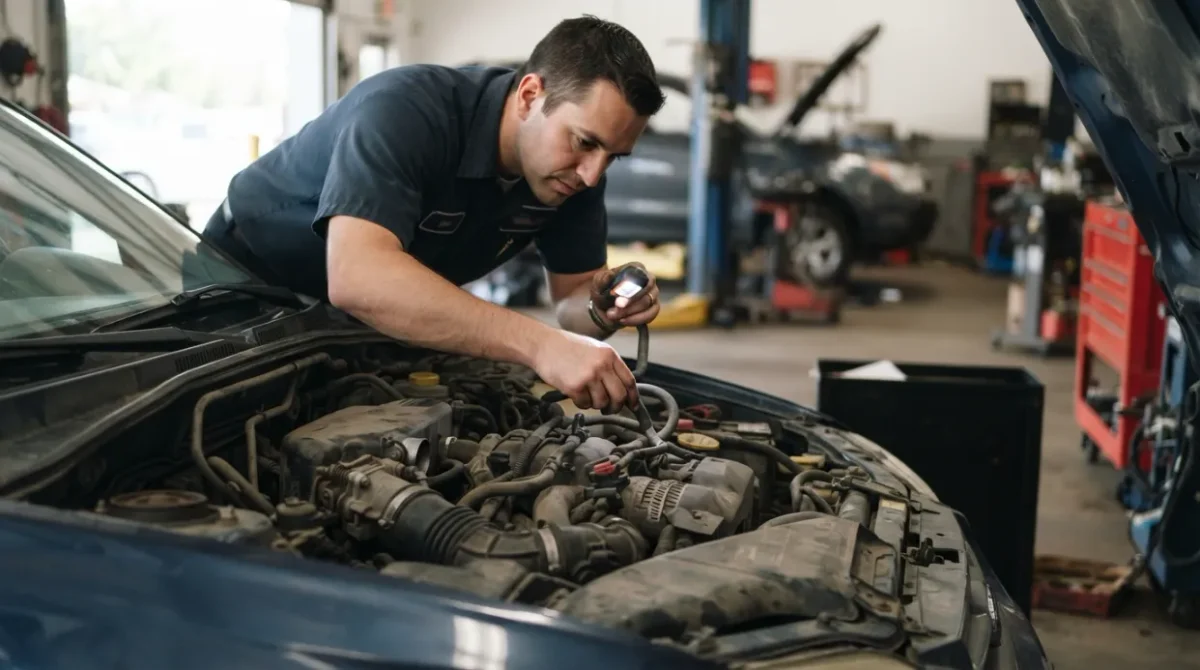
P0507 usually appears when the engine receives more air than the computer expects at idle or when the throttle-control system cannot reduce airflow correctly. Start by looking for the reason behind the extra airflow.
Vacuum or intake leaks
A vacuum leak can let air enter downstream of the normal airflow measurement point. The computer may then struggle to pull idle speed back toward its target.
- Cracked or disconnected vacuum hoses
- Split PCV or crankcase-breather hoses
- Loose intake connections
- Leaking intake manifold gaskets
- Brake-booster vacuum leaks
- Other post-throttle or post-MAF air leaks
Dirty or sticking throttle body
Deposits around the throttle plate can affect how airflow behaves near the closed-throttle position. A mechanical problem can also prevent the plate from returning as expected.
Do not force an electronic throttle plate unless the vehicle’s service procedure specifically allows it. Some throttle assemblies can be damaged by incorrect handling.
Idle air control valve problems
Older engines may use a separate idle air control valve, often shortened to IAC. A sticking valve, electrical problem, or blocked passage can interfere with idle control.
Many newer drive-by-wire vehicles have no separate IAC valve. The electronic throttle body performs the idle-control job instead.
PCV or EVAP airflow problems
A PCV system fault can create an unexpected air path into the intake. A purge-system problem can also affect idle airflow on some applications.
Lost throttle or idle adaptation
P0507 can appear after throttle-body cleaning, throttle replacement, battery work, ECM service, or other procedures that disturb learned idle values. Some vehicles then require a manufacturer-specific relearn.
| Possible Cause | Useful Clue | First Check | Replace Parts Immediately? |
|---|---|---|---|
| Vacuum leak | High idle, possible hissing, fuel trims more positive at idle | Visual inspection and smoke testing | No |
| Dirty/sticking throttle | Idle hangs or changed after throttle service | Inspect throttle condition and movement | No |
| Idle relearn needed | High idle began after battery or throttle work | Check manufacturer relearn requirements | No |
| IAC fault | Older vehicle with separate idle-control valve | Test valve, circuit, and air passage | Only after testing |
| Electronic throttle fault | Throttle-related codes or abnormal scan data | Follow vehicle-specific actuator diagnostics | Only after testing |
How Do You Diagnose P0507 With an OBD2 Scanner?
The best P0507 diagnosis starts with the scanner and moves toward physical testing. Don’t clear the code until you record the information that may explain why it appeared.
1. Read every stored and pending code
Record P0507 and any accompanying codes. Lean-mixture, airflow, throttle, EVAP, misfire, or idle-control codes can change the diagnostic direction.
2. Save freeze-frame data
Freeze-frame information captures operating conditions around the time the computer stored a fault. Look at RPM, coolant temperature, throttle data, calculated load, and fuel trims when your scanner provides them.
3. Compare actual idle with expected behavior
Warm the engine according to manufacturer requirements and observe idle RPM. Remember that cold-start idle, air-conditioning load, electrical load, and steering input can legitimately change idle speed.
4. Review fuel trims
If your tool shows short-term and long-term fuel trim, compare their behavior at idle and around 2,500 rpm. A vacuum leak can sometimes create a stronger positive correction at idle because the leak becomes proportionally less important as airflow rises.
Fuel trim is a clue, not proof. Sensor faults, fuel-delivery problems, exhaust leaks, and other conditions can also influence trim readings.
5. Inspect the intake system
Check hoses and intake plumbing by hand rather than relying only on a quick visual glance. Small cracks often hide underneath molded rubber elbows or near clamps.
A professional smoke test is useful when the leak cannot be seen. Manufacturer diagnostic information for P0507 commonly includes checking the intake for leaks before condemning major hardware.
6. Check manufacturer information
Vehicle-specific bulletins, service procedures, and recalls can change the correct repair path. You can also search your VIN and vehicle information through the NHTSA recall and manufacturer-communications system.
Locksmith’s note: electronic diagnosis works best when you verify the vehicle first. I use the same principle with immobilizers and key systems before programming or replacing anything.
Section Takeaway: scan P0507, preserve the data, check for extra airflow, and test the relevant control system before buying parts.
How Do You Fix P0507?
You fix P0507 by correcting the fault that is allowing idle speed to remain higher than commanded. The correct repair therefore depends on what your diagnosis proves.
- Repair vacuum leaks: Replace split hoses, reconnect loose fittings, or repair leaking intake components found during inspection or smoke testing.
- Correct PCV problems: Repair leaking breather hoses or replace a confirmed faulty PCV component using the correct part for the vehicle.
- Service the throttle body: Clean deposits only when the manufacturer permits cleaning and specifies an approved procedure.
- Perform the required relearn: Complete throttle or idle adaptation after service when the manufacturer calls for it.
- Test the IAC system: On vehicles with a separate valve, test the valve, wiring, connector, and passages before replacement.
- Diagnose electronic throttle faults: Compare commanded and actual throttle information and follow the manufacturer’s circuit tests before replacing an assembly.
- Clear and retest: After the confirmed repair, clear the code and verify normal idle during the required drive cycle or operating conditions.
What should you avoid doing?
Do not automatically replace the throttle body because P0507 appears on a code reader. Even manufacturer troubleshooting can place an intake-leak inspection ahead of throttle-body replacement.
- Don’t erase freeze-frame data before recording it.
- Don’t spray flammable chemicals around a running engine to hunt for leaks.
- Don’t force an electronic throttle plate without confirming the approved procedure.
- Don’t copy a relearn sequence from another make, engine, or model year.
- Don’t assume a separate IAC valve exists on every vehicle.
Pro tip: use the VIN, exact engine, model year, and manufacturer service information before ordering an electronic throttle component.
Does P0507 Need an Idle Relearn?
Sometimes. An idle or throttle relearn is especially relevant when P0507 started shortly after throttle-body cleaning, throttle replacement, battery disconnection, ECM work, or another procedure that disturbed learned values.
Relearn requirements differ significantly between manufacturers. That is why I do not recommend copying pedal-and-key sequences from random vehicles online.
Nissan documentation provides a good example of how specific these procedures can be. Its published Idle Air Volume Learning service information lists operating conditions that must be satisfied before learning can complete.
- Engine coolant must be within the specified temperature range.
- Battery voltage must meet the required level.
- The transmission selector must be in the required position.
- Electrical loads may need to be switched off.
- The steering wheel may need to remain centered.
- The vehicle must be stopped.
- The transmission may need to be warmed.
Those requirements are an example, not a universal P0507 relearn procedure. Use the service manual or scan-tool function designed for your exact vehicle.
If your scanner supports bidirectional or special-service functions, look for throttle adaptation, idle learn, idle air volume learning, or a similarly named procedure. A basic code reader may not support those functions.
Technician’s note: when a relearn repeatedly fails, stop repeating it and check whether an enabling condition or underlying mechanical problem is still present.
Can You Drive With P0507, and What Can Repair Cost?
A vehicle with mild P0507 symptoms may still run, but an abnormal high idle should not be ignored. The engine may creep harder in gear, shift abruptly, or feel less predictable when you release the brake.
Stop driving and have the vehicle inspected if the throttle appears physically stuck, engine speed rises uncontrollably, braking becomes difficult, or the vehicle surges unexpectedly. Those symptoms go beyond a routine check-engine-light diagnosis.
How much does P0507 cost to fix?
There is no meaningful single P0507 repair price because the code does not identify one failed component. A cracked hose, a professional smoke test, throttle cleaning, an idle relearn, and electronic throttle replacement are completely different jobs.
- Low-cost repair path: Reconnecting or replacing a simple hose or fixing a minor intake leak.
- Moderate repair path: Diagnostic labor, smoke testing, throttle-body service, or manufacturer-specific relearning.
- Higher-cost repair path: Intake manifold work, electronic throttle replacement, wiring repair, or module-level diagnosis.
Prices also change with labor rates, parts availability, vehicle design, and region. For a vehicle-specific estimate, AAA provides an approved repair-shop locator and repair-cost estimator.
As of 2026, the safest budgeting approach is to pay for diagnosis before pricing expensive parts. Replacing a throttle body that turns out to be healthy can cost far more than finding a small intake leak first.
Pro tip: ask the shop what test confirmed the failed component before approving an expensive throttle-body or electronic-control repair.
P0507 Frequently Asked Questions
What is the most common fix for P0507?
There is no universal single fix. Vacuum or intake leaks, throttle-body problems, idle-control faults, and relearn issues are common diagnostic paths, so the correct repair should follow testing rather than the code description alone.
Can a dirty throttle body cause P0507?
Yes, on some vehicles. Deposits or sticking around the throttle plate can interfere with controlled idle airflow, although cleaning should follow the manufacturer’s procedure because some electronic throttle bodies require special handling or relearning afterward.
Can a vacuum leak cause P0507?
Yes. Unmetered air entering the intake can raise idle speed beyond the computer’s target, which is why inspecting for intake leaks is an important early diagnostic step in manufacturer P0507 procedures.
Why did P0507 appear after cleaning the throttle body?
Cleaning may change airflow around the throttle plate compared with the values the computer previously learned. Some vehicles require throttle or idle adaptation afterward, but you should also confirm that no hose was disconnected or damaged during service.
Will disconnecting the battery fix P0507?
No reliable repair comes from disconnecting the battery alone. It may erase learned values or temporarily remove the warning light, but P0507 can return if an air leak, throttle fault, or other underlying problem remains.
Can I clear P0507 with an OBD2 scanner?
Most OBD2 scanners can clear an emissions-related code after repairs. Clearing P0507 does not fix the condition, so record stored codes and freeze-frame information before erasing anything.
Do all P0507 vehicles have an idle air control valve?
No. Many older engines use a separate IAC valve, while newer drive-by-wire vehicles often control idle through the electronic throttle body instead.
Final takeaway: The smart way to fix P0507 is to diagnose airflow first, not guess at expensive parts. Confirm the code, check for intake leaks, inspect the throttle system, use live scanner data, and perform only the relearn procedure specified for your vehicle.
If P0507 returns after those checks, have a qualified technician perform smoke testing and manufacturer-level throttle diagnostics before approving major parts replacement.
