
VEHLIVE V860 OBD2 Scanner Review: Worth It?

The VEHLIVE V860 is a corded handheld OBD2 scanner aimed at drivers who want more than a basic “read and erase” code reader without moving into an app-based or shop-grade diagnostic tool. Its standout claims are four-parameter live-data graphing, Mode 6 and emissions-readiness checks, battery-voltage testing, O2 and EVAP monitor tests, plus USB-C report export. That makes it especially interesting for DIY check-engine diagnosis and pre-smog inspection checks.
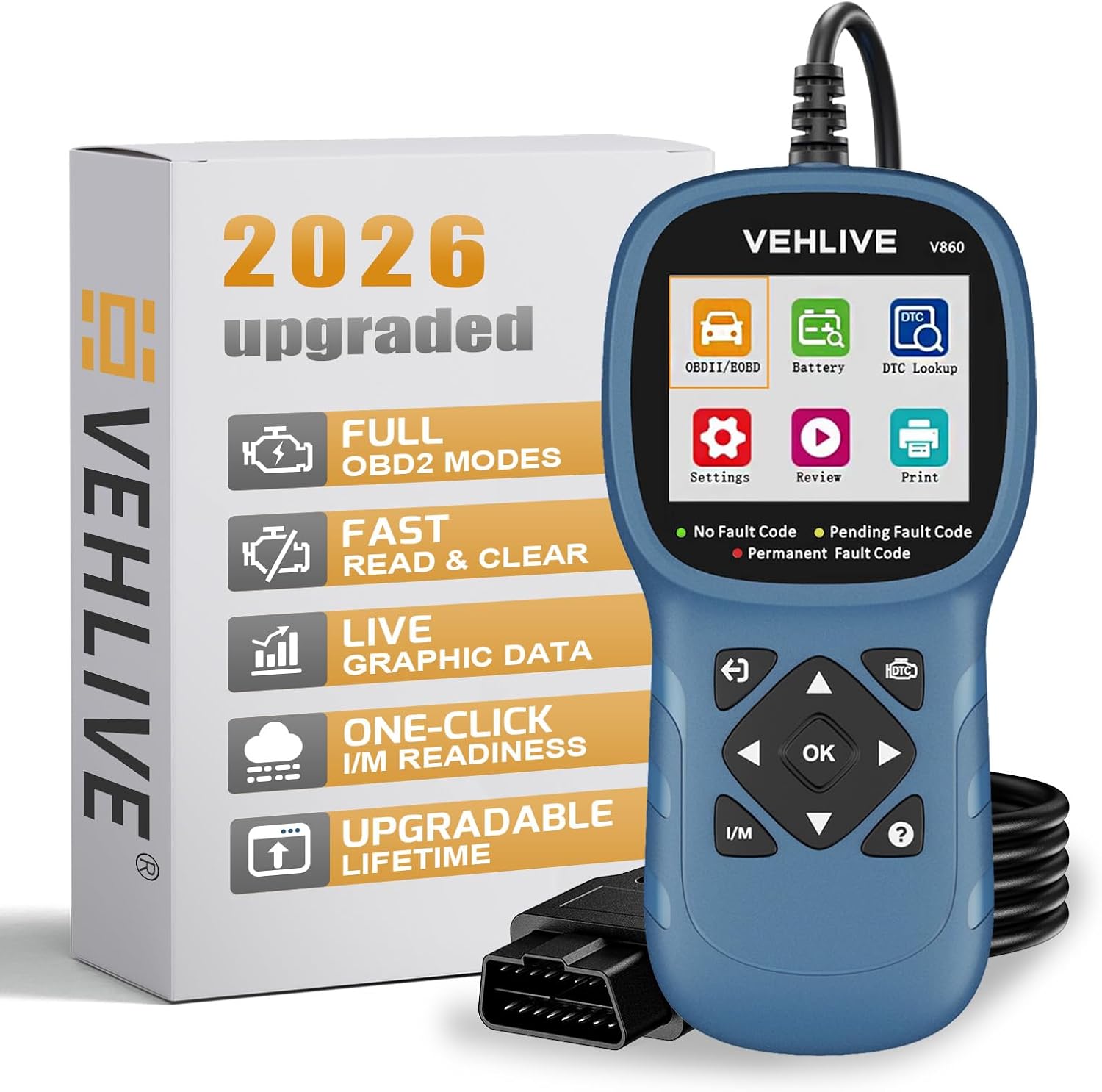
Quick Overview and Specs
| Feature | VEHLIVE V860 |
|---|---|
| Display | 2.8-inch integrated screen |
| Core diagnostics | Read/clear DTCs, freeze frame, vehicle information, ECU information |
| Live data | Real-time stream and graphing of up to 4 parameters simultaneously |
| Emissions tools | I/M readiness, Mode 6, O2 sensor test, EVAP monitor test |
| Extra functions | Battery-voltage test, replay/log review, USB-C report export/printing |
| Compatibility claim | Most U.S. OBD2 vehicles from 1996+, many EU/Asian vehicles from 2003+ |
| Size | 6.34 × 3.35 × 0.98 inches |
| Warranty / updates | 1-year warranty; lifetime free software updates claimed |
First Impressions
The V860 is refreshingly self-contained. There is no Bluetooth pairing, account creation, or phone battery to manage: connect the cable to the vehicle’s OBD2 port and the scanner powers from the car. At 6.34 inches long and under an inch thick, it is compact enough for a glove box while still offering a dedicated 2.8-inch screen.
The current Amazon listing shows a 4.6/5 average from 83 reviews, which is encouraging, although independent long-term testing of this exact model is scarce. The physical package includes the scanner, connection cable, and instructions, and VEHLIVE lists a one-year warranty.
Performance & Feel
For generic OBD2 work, the V860’s feature list is stronger than a bare-bones code reader. It reads and clears engine DTCs, displays freeze-frame information, retrieves vehicle data, and includes a built-in library that VEHLIVE says contains 98,963 universal code definitions. The more useful upgrade is live data: it can graph up to four parameters at once, then replay logged information so you can look for patterns rather than staring at a single number.
If you are deciding whether that matters, this guide to OBD2 scanners with live data versus basic code readers explains the practical difference. For intermittent faults, pairing current sensor values with freeze-frame versus live-data troubleshooting can be more useful than repeatedly clearing a warning light.
Live Data & Emissions Readiness
This is the V860’s most compelling secondary capability. I/M readiness lets you see whether emissions monitors have completed before an inspection, while Mode 6 exposes onboard monitor test results that can help with misfire, catalyst, and sensor troubleshooting. The scanner also lists O2-monitor and EVAP-monitor tests. These functions depend on what the vehicle ECU supports, so an “EVAP test” should not be confused with a bidirectional command that actively opens valves on every vehicle.
For a deeper look at why this matters, see the site’s guide to OBD2 scanners with Mode 6 data.
Durability
The corded design has a reliability advantage: there is no internal rechargeable battery or wireless connection to age. The rounded housing also looks better suited to glove-box storage than a phone dongle. Still, VEHLIVE does not publish an IP rating or meaningful drop-test claim, and independent durability data is limited. Treat it as an electronic diagnostic instrument, not a rugged shop tablet. The one-year warranty is useful but not exceptional.
Value for Money
The V860 makes the strongest case when it is priced alongside mainstream budget handheld scanners. Its U.S. Amazon page did not expose a stable price during research, so check the live price before judging value. At a typical entry-level handheld price, four-PID graphing, Mode 6, battery-voltage checking, and printable report export are a generous combination. If its price approaches an enhanced-diagnostics tool, however, the lack of ABS/SRS and manufacturer-specific module access becomes more important.
Comparison to Similar Competing Products
ANCEL AD310: a proven basic handheld that also supports live data and freeze frame. The V860 differentiates itself by claiming simultaneous four-PID graphing, battery-voltage testing, Mode 6, and USB-C report export.
FOXWELL NT301: another wired scanner with live-data graphing, logging, O2 testing, and I/M readiness. The NT301 adds dedicated red/yellow/green readiness LEDs and an audible indicator, making emissions checks especially easy to read at a glance.
BlueDriver: uses a phone app and, on supported vehicles, can reach enhanced systems such as ABS, airbag, and transmission modules that the V860 does not claim to cover. That is a different level of diagnostic depth. The site’s BlueDriver vs. ANCEL AD310 comparison is useful if you are choosing between basic handheld and deeper app-based diagnostics.
Pros & Cons
Pros
- Graphs up to four live-data parameters at once
- Mode 6, I/M readiness, O2 and EVAP monitor functions
- Battery-voltage test and freeze-frame data
- USB-C report export and lifetime update claim
- No app, subscription, or wireless pairing required
Cons
- No claimed ABS, SRS, TPMS, or transmission enhanced-code coverage
- No bidirectional controls, coding, or service resets
- Only a 2.8-inch display
- Limited independent long-term testing for this exact model
Who Should Buy This?
Buy the V860 if you mainly troubleshoot check-engine lights, want to watch several engine PIDs together, or need a quick emissions-readiness check before inspection. It also makes sense for drivers who prefer a dedicated handheld over a Bluetooth dongle and phone app. Skip it if you routinely diagnose ABS, airbags, body modules, transmission faults, or need active tests and maintenance resets.
Extended FAQ
Does the VEHLIVE V860 work on every 1996-and-newer vehicle?
No scanner is universal in every function. VEHLIVE says it supports all standard OBD2 protocols and most U.S. vehicles from 1996 onward, with many EU and Asian vehicles from 2003 onward. Before buying, confirm your vehicle is OBD2 compliant. This OBD1 vs. OBD2 scanner guide helps if you own an older vehicle.
Can it diagnose ABS or airbag lights?
The current V860 listing emphasizes engine OBD2/EOBD diagnostics and does not claim enhanced ABS or SRS module coverage. For those systems, choose a scanner that explicitly supports your make, model, and module.
Can the V860 reset a check-engine light?
Yes, it can clear OBD2 engine DTCs after the underlying fault is repaired. Clearing a code before fixing the cause does not solve the problem, and readiness monitors may reset to incomplete.
Does it need a phone or subscription?
No. It has its own screen and receives power through the vehicle’s diagnostic port. VEHLIVE also advertises lifetime free software updates.
What does the battery test do?
The listing describes a battery-voltage test. That is useful for checking system voltage, but it should not be treated as a substitute for a dedicated battery analyzer that measures cold-cranking performance and battery health.
Can it print diagnostic reports?
VEHLIVE says reports can be exported through USB-C to a computer for printing, which is handy for keeping records or sharing findings with a repair shop.
Final Verdict
The VEHLIVE V860 offers an unusually broad generic OBD2 toolkit for a compact corded scanner: four-PID live graphing, freeze frame, Mode 6, emissions readiness, O2/EVAP monitor information, battery voltage, and report export. Its limitation is equally clear—it is not presented as a full-system diagnostic platform. For DIY engine diagnostics and smog-prep checks, that balance is appealing; for ABS/SRS or bidirectional work, move up to a scanner with explicit enhanced-system coverage.
As an Amazon Associate, we earn from qualifying purchases…
