
Key Fob Not Detected Near Car: What It Means and How to Fix It Fast

When your car says the key fob not detected near car, the vehicle is telling you it is not receiving a valid signal from the fob. On a push-button start system, that signal is what lets the car unlock, start, and confirm that the right key is inside the vehicle.
That warning can be annoying, but it usually points to a short list of causes: a weak fob battery, a weak car battery, signal interference, a damaged fob, or a problem with the car’s receiver or antenna. The good news is that you can often narrow it down in a few minutes without tools.
If you want a broader overview of the warning and the most common fixes, this guide on why your car says the key fob is not detected is a useful companion read.
What the “Key Fob Not Detected” Message Means
Your car is looking for an RF signal from the key fob. If that signal is weak, blocked, or not reaching the receiver, the car may refuse to unlock or start.
That does not always mean the fob is totally dead. The buttons may still work intermittently, but the signal can be too weak for the car to trust it. In other cases, the fob is fine and the car battery or receiver side is the real problem.
Think of it this way: the fob has to “introduce itself” to the car. If the car cannot hear that introduction clearly, it plays it safe and stays locked out.
Fastest Fixes to Try First
If you are stranded in a parking lot or driveway, try these in order:
-
Move the fob closer to the car or start button.
Hold it right next to the start button, steering column area, or the backup sensing spot your owner’s manual shows. -
Remove other electronics from the area.
Put your phone, wireless charger, tablet, and any other key fobs away from the fob. -
Try the fob again with the doors closed.
Sometimes the car will detect the fob more reliably when you are not standing in a noisy RF environment with the door open. -
Use the spare key fob if you have one.
This is one of the fastest ways to tell whether the original fob is the problem. -
Check for a weak car battery.
If the dash is dim, the starter sounds sluggish, or multiple electrical systems are acting odd, the vehicle battery may be part of the issue.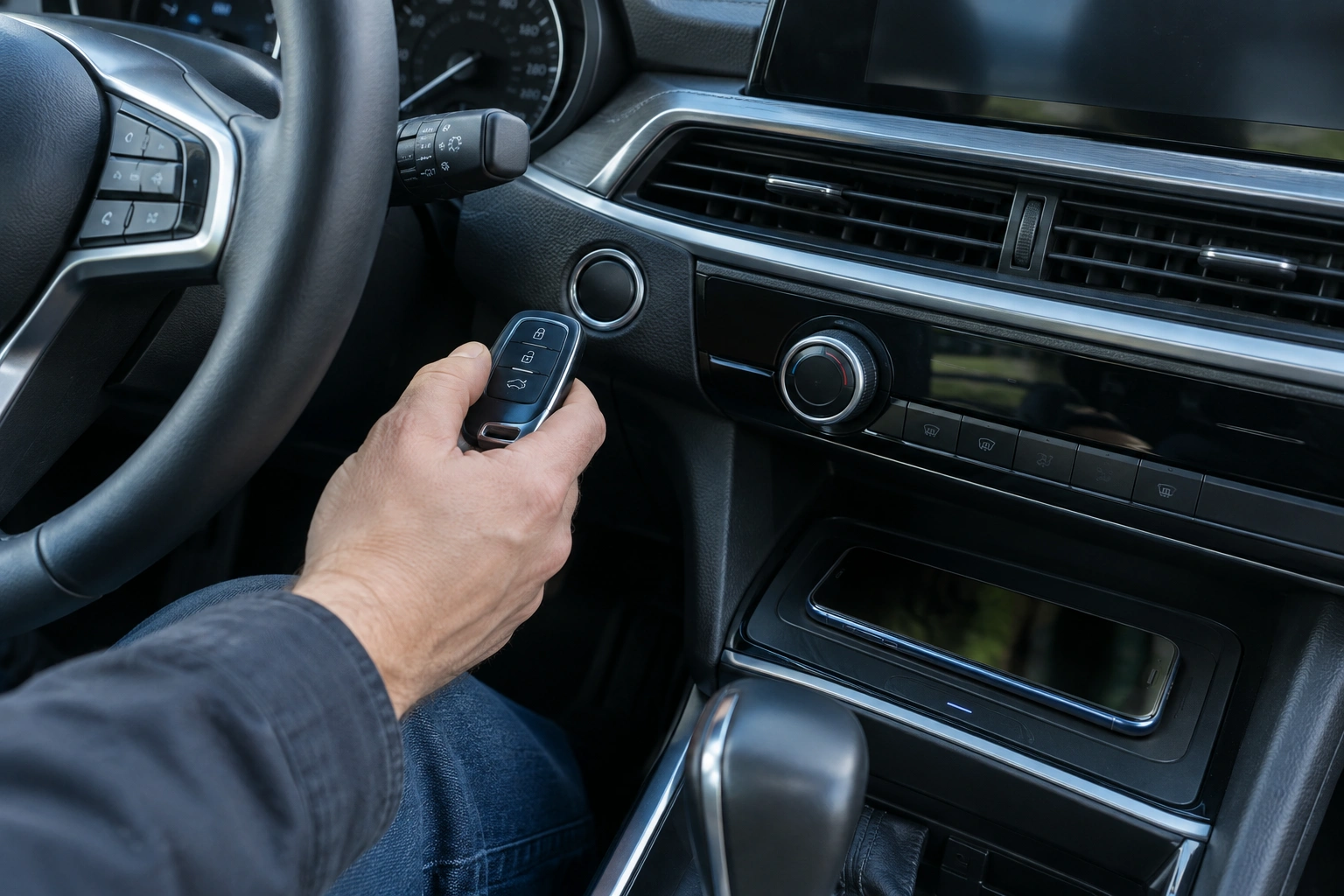
Try the fob close to the start button, then rule out interference.
These steps are worth doing before you assume the fob is finished.
How to Start the Car When the Fob Isn’t Detected
Many push-button start vehicles have an emergency start method. The exact location and method vary by make and model, so check the owner’s manual for the exact backup sensing location on your vehicle. Some cars use a marked slot, some use a backup pocket or console area, and others require you to touch the fob to a specific button or sensing point.
In many vehicles, that area is near the start button, steering column, or a marked spot in the center console or cup holder area. Your owner’s manual is the safest source for the exact location on your car.
A practical way to try it:
- Hold the fob flat against the marked sensing area or right next to the start button.
- Keep your foot on the brake.
- Press the start button as you normally would.
If the car starts this way, that strongly suggests the fob signal is weak, the battery inside the fob is low, or the system is having a detection problem rather than a full ignition failure.
For a deeper look at the “car won’t start because the fob isn’t detected” scenario, see this troubleshooting guide.
Most Likely Causes, in Order
Here is the most practical order to think through the problem.
| Likely cause | What it usually looks like | Best first fix | When to escalate |
|---|---|---|---|
| Weak or dead key fob battery | Intermittent detection, buttons may work sometimes | Replace the fob battery | If a new battery does not help |
| Weak car battery | Slow cranking, dim lights, other electrical oddities | Test or charge the car battery | If the battery keeps dropping low |
| Signal interference | Problem appears near phones, chargers, or other electronics | Move devices away and retry | If it still happens in multiple locations |
| Damaged key fob | Cracked case, water exposure, dropped fob, worn buttons | Inspect and replace battery first | Replace the fob if behavior stays erratic |
| Receiver/antenna issue | Both fobs fail, battery is good, car still won’t detect | Professional diagnosis | Usually needs a locksmith, dealer, or mechanic |
That order matters because it keeps you from replacing expensive parts before checking the simple stuff.
How to Tell Whether the Problem Is the Fob or the Car
The spare key fob is your best diagnostic tool.
If the spare works
The original fob is the likely problem. That usually means:
- the fob battery is weak,
- the fob has internal damage,
- or the original fob needs reprogramming or replacement.
If neither fob works
The issue is more likely on the vehicle side. That points toward:
- a weak car battery,
- a receiver or antenna problem,
- wiring trouble,
- or a start-button/immobilizer issue.
If both work sometimes
That often suggests interference or a marginal battery somewhere in the system. Intermittent failures are frustrating, but they are also useful clues.
Check the Key Fob Battery
A weak fob battery is one of the most common reasons a car won’t detect the key fob. The tricky part is that the fob may still seem partly alive. You might be able to unlock the doors from close range, but not get a reliable start signal.
Look for these signs:
- the range has gotten shorter,
- the car only detects the fob occasionally,
- the warning appears more often in cold weather,
- the buttons work, but only after several presses.
If your fob battery is user-replaceable, swapping it is usually the cheapest first move. Match the battery type exactly to your fob design and make sure the battery is seated correctly. A reversed or loose battery can mimic a dead fob.
If the battery change restores normal detection, you’ve likely solved it. If not, the fob itself may be damaged or the problem may be elsewhere.
Check the Car Battery and Other Electrical Clues
A weak vehicle battery can absolutely create keyless entry and keyless start problems. The car’s receiver, control modules, and start system all depend on stable power.
Watch for clues like:
- dim interior lights,
- slow or weak cranking,
- warning lights that appear and disappear,
- electronics behaving strangely,
- the problem getting worse after the car sits overnight.
If the car battery is low, the vehicle may not wake up the keyless system properly even if the fob is fine. That is why a “key not detected” message can sometimes be an early warning sign of a broader electrical problem.
For general battery and electrical guidance, the NHTSA is a solid place to start when you want safety-focused vehicle information.
Rule Out Signal Interference
Radio frequency interference can block or weaken the signal between the fob and the car. You do not need fancy equipment to test this.
Try this:
- move your phone away from the fob,
- turn off or move any wireless charger,
- separate the fob from other keys and electronic devices,
- try the fob again in a different spot,
- if possible, test the car in a different parking area.
This is especially worth checking if the issue appears near office buildings, garages, or places full of electronics.
What to Do If the Spare Key Fob Works
If the spare fob works immediately, you have a useful comparison test.
That usually means the car is fine and the original fob is the weak link. At that point, the next decision is usually between:
- replacing the battery in the original fob,
- repairing damage to the original fob if possible,
- or replacing the whole fob if it has water damage, cracked casing, or worn-out buttons.
If the spare works and the original does not, do not keep guessing at the car side unless the problem returns with the spare too.
Signs the Key Fob Is Damaged
A fob can fail without looking completely broken. Still, some signs are hard to ignore:
- visible water damage,
- a cracked shell,
- buttons that feel mushy or stuck,
- a fob that was dropped hard,
- intermittent detection that seems random,
- battery contacts that look corroded.
If the fob has been wet, the internal electronics may be damaged even if it still works occasionally. In that case, a battery swap may not solve the underlying issue.
A damaged fob that fails only sometimes can be the most misleading kind, because it may work just enough to delay replacement.
When the Car’s Receiver, Antenna, or Immobilizer May Be the Problem
If a good battery, a spare fob, and a clean interference test still do not help, the vehicle itself may be the issue.
Possible vehicle-side problems include:
- a faulty receiver,
- damaged antenna wiring,
- a malfunctioning start button assembly,
- or an immobilizer communication problem.
These are not usually DIY fixes. They often need a diagnostic scan or hands-on testing by a locksmith, dealer, or mechanic. If both fobs fail in the same vehicle, that is the point where I would stop replacing batteries and start looking at the car.
When Resyncing, Reprogramming, or Professional Help Is Needed
Some vehicles can lose synchronization in the passive entry/passive start system, and some owner’s manuals include a specific relearn or resync procedure after a battery replacement. If your manual lists that step, follow the model-specific instructions before assuming the fob or car is damaged.
If you have already:
- tried the spare fob,
- replaced the fob battery,
- checked for interference,
- and confirmed the car battery is healthy,
then professional help is the next smart move.
A locksmith is often the right call when you need key fob programming, emergency access, or a replacement fob matched to the vehicle. A dealer may be necessary for certain models or when programming requires manufacturer-specific tools. A mechanic makes more sense if the car battery, receiver, or other electrical systems seem suspect.
If you want the practical “what to do next” version of this decision, the guide on key fob not detected but the car starts covers a useful middle ground between simple battery issues and deeper vehicle-side faults.
Replace the Battery, Repair the Fob, or Replace the Whole Fob?
Here is the simplest decision rule:
- Replace the battery first if the fob is old, the battery has never been changed, or the symptoms are mild and intermittent.
- Repair the fob if the casing is intact but a button, contact, or internal piece seems loose.
- Replace the whole fob if there is water damage, severe cracking, repeated battery failure, or no improvement after a fresh battery.
If the original fob still does not communicate reliably after a battery swap, replacing the entire unit is often more sensible than keeping a failing fob in service.
FAQs
Why does my car say key fob not detected near car?
The car is not receiving a valid signal from the fob. That can happen because the fob battery is weak, the car battery is low, there is interference, or one of the vehicle’s receiver components is having trouble.
Can I still start my car if the key fob is not detected?
Often, yes. Many vehicles have an emergency start method that lets the car read the fob when it is held very close to the start button or another backup sensing area.
Is the key fob battery dead or is something wrong with the car?
A spare fob is the quickest way to tell. If the spare works, the original fob is the likely issue. If neither works, look at the car battery or the vehicle’s receiver system.
Where should I hold the key fob so the car detects it?
That depends on the model. Common backup spots include near the start button, steering column, center console, or cup holder area. Check the owner’s manual for the exact location.
Does a dead car battery cause key fob detection problems?
Yes, it can. A weak vehicle battery may stop the keyless system from waking up properly, even if the fob itself is fine.
Should I replace the battery or the whole fob?
Replace the battery first unless the fob is visibly damaged or has already failed after a fresh battery. If the casing is cracked, water-damaged, or the buttons are worn out, replacing the whole fob may make more sense.
Final Takeaway
If your car says the key fob is not detected near car, work the problem from the easiest fix to the more expensive ones: check interference, try the backup sensing spot, test the spare fob, replace the fob battery, and then look at the car battery and receiver side if the issue keeps coming back. That sequence saves time and usually points you to the real cause faster than guessing.
