
Key Fob Won’t Lock the Car After a Battery Change? Here’s How to Fix It

If your key fob won’t lock car after battery change, the good news is that the problem is often something simple: the battery is the wrong type, installed backward, not seated correctly, or not making solid contact inside the fob.
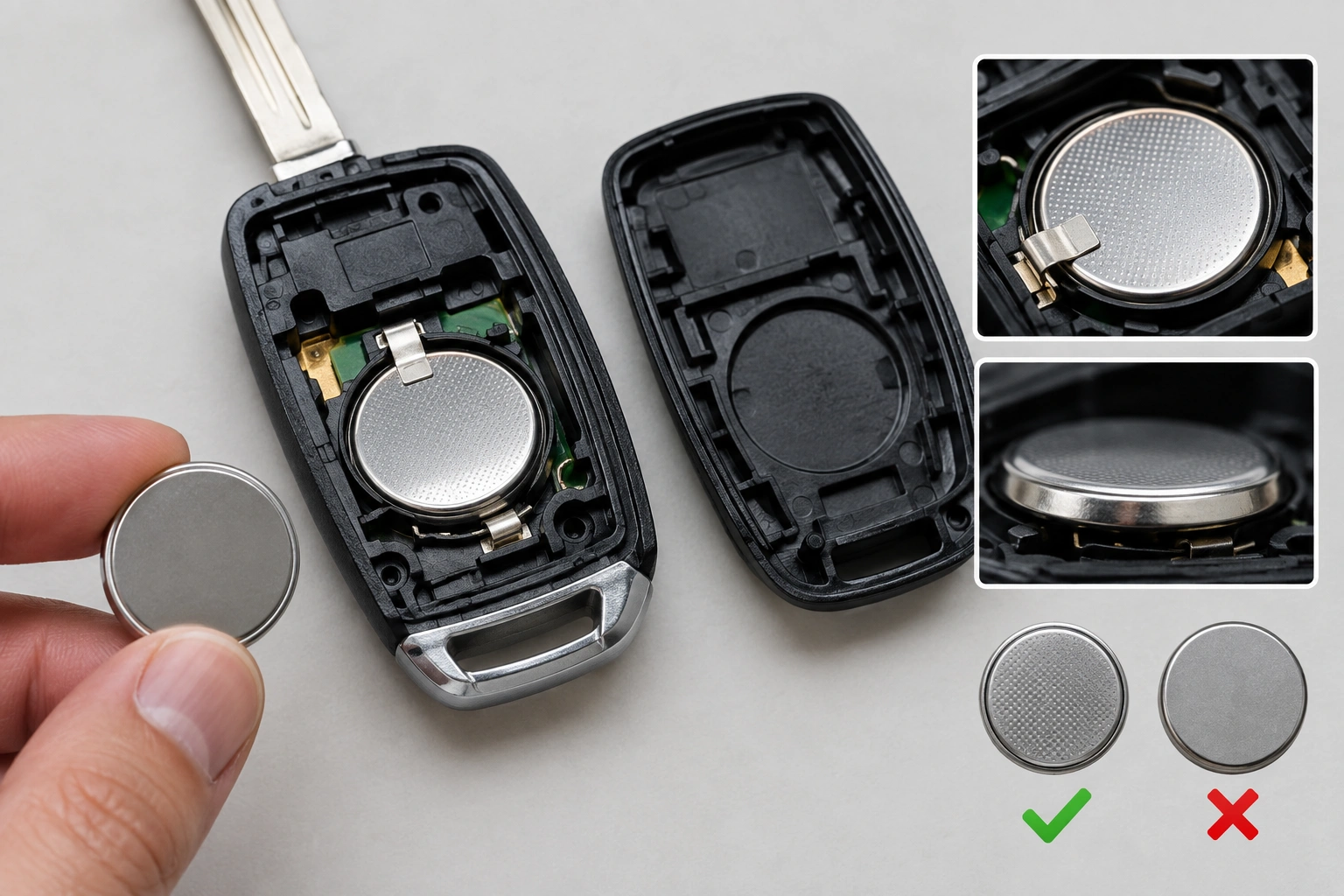
What matters most is narrowing the fault fast. A lock-button problem can come from the fob itself, the car’s receiver, or the central locking system. The trick is to test in the right order so you do not replace parts blindly.
Quick diagnosis: what the symptom usually means
A key fob that worked before the battery swap and then stopped locking the car often points to one of four things:
- the new battery is incorrect or installed wrong
- the battery contacts inside the fob are not touching properly
- the fob may need to be resynced
- the issue is actually on the vehicle side
If the unlock button still works but the lock button does not, that is a useful clue. It often points to a worn button pad, a weak contact inside the fob, or a vehicle-side lock problem rather than a complete fob failure.
If both lock and unlock fail, the battery fitment, contact alignment, or vehicle receiver becomes more likely.
| Symptom | Most likely cause | Best next step |
|---|---|---|
| Nothing works after battery change | Wrong battery, reversed polarity, poor contact, or lost sync | Recheck battery type and fit |
| Unlock works, lock does not | Worn lock button, contact issue, or lock circuit problem | Inspect contacts and test the spare fob |
| Works only when held close | Weak battery contact or low battery output | Reseat battery and test range |
| Both remotes fail | Vehicle battery, fuse, receiver, or central locking issue | Check the car side next |
| Fob worked before opening the case | Internal contact shifted or shell not closing correctly | Open and inspect the battery area again |
A fresh battery does not automatically mean the fob is healthy. A new CR2032 or CR2025 can still be the wrong size, installed backward, or seated loosely enough to break contact.
Most likely causes, in the order I’d check them
From a technician’s point of view, the fastest path is usually this:
- Battery type or polarity mistake
- Battery not seated firmly
- Bent or weak battery contacts
- Fob may need resync or reprogramming
- Damaged button pad or circuit board
- Vehicle-side locking or receiver issue
That order matters because the first three are common, cheap to fix, and easy to confirm. Reprogramming is not always required after a battery change, and on many cars the key’s code stays stored in the vehicle’s memory. In other words, changing the battery does not usually erase the fob’s identity.
Step 1: confirm the battery type, polarity, and fit
Open the fob again and compare the battery to the old one. A CR2032 and CR2025 can look similar at a glance, but they are not always interchangeable. Some fobs need one specific size and thickness to press firmly against the contacts.
Check three things:
- Battery model: match the old battery exactly if possible
- Polarity: the + and – sides must match the markings inside the fob
- Seating: the battery should sit flat and snug, not tilted or loose
If the battery is backward, the fob may act dead or behave inconsistently. If it is the wrong thickness, the case may close but the contacts may not press hard enough.
A simple example: a driver replaces a CR2032, snaps the shell shut, and the unlock button works only when the fob is squeezed. That usually means the battery is not making solid contact, not that the remote needs a dealer visit.
Step 2: inspect the battery contacts and fob internals
If the battery is correct, look closely at the metal contacts inside the fob. They should press firmly against the battery. If one is bent inward, corroded, or sitting off-center, the fob may lose power every time the lock button is pressed.
Also inspect the shell and button pad:
- cracked case halves can shift the battery
- worn button membranes can make one button fail before the others
- dirt or residue can keep the battery from sitting flat
This is where many people miss the real issue. The battery can be brand new and still not work if the contact is barely touching. That is a physical fit problem, not an electronic one.
If you find a bent contact, be careful. Use a non-metal tool if possible and move it only slightly. Forcing it can snap the tab or damage the circuit board.
For a related symptom where the car says the key is not detected, our guide on key fob not detected after replacing the battery walks through the same contact and fit checks.
Step 3: test whether the fob needs to resync
Some vehicles will automatically recognize the fob after a battery swap. Others may need a manual resync or reset procedure. That is why the answer is not universal across makes and models.
A good rule: if the fob stopped working immediately after the battery change and the battery checks out, try a resync before replacing the whole remote.
A common pattern is this:
- the fob worked before the battery swap
- the battery is installed correctly
- the contacts look fine
- the remote still will not lock the car
That is the point where a resync becomes worth trying.
A model-agnostic example of what a reset can look like is pressing the lock and unlock buttons together for a few seconds, then testing the fob again. On some vehicles, the procedure may involve inserting the key, cycling the ignition, or following a button sequence inside the car. Procedures vary by vehicle, so check the owner’s manual before trying anything specific.
Keep expectations realistic, though. If the fob has internal damage, reprogramming will not fix broken circuitry or a failed microchip. Likewise, if the car’s receiver is the real problem, the fob can be perfectly fine and still not lock the doors.
If you want a deeper look at the “not detected” side of the same issue, see this troubleshooting guide for a key fob not detected after battery replacement.
Step 4: isolate the problem with the spare fob and a distance test
The spare key fob is the fastest way to separate a fob problem from a car problem.
Try this:
- Use the spare fob on the same vehicle.
- Test lock and unlock from the same distance.
- Move closer to the car and test again.
- Compare the original fob to the spare.
If the spare works normally, the car is probably fine and the original fob is the likely culprit. That points you back to the battery, contacts, buttons, or internal damage.
If both fobs act the same way, the issue is more likely vehicle-side. That could mean the car battery is weak, a fuse has blown, the receiver is not picking up the signal, or the central locking system has a fault.
Distance matters because a weak signal can look like a dead fob. If it works only when you are standing right next to the door, do not assume the battery is the only issue. A poor contact or weak output can show up as short range before total failure.
Step 5: check the car battery, fuse, receiver, and central locking system
When more than one remote fails, stop focusing only on the fob.
Start with the simplest vehicle-side checks in this order:
- Test the spare fob
- Check the car battery’s voltage and overall condition
- Check any relevant fuses for the locks or body control system
- Then consider receiver, actuator, or central locking faults
A weak car battery can make central locking behave strangely. Also look for a blown fuse related to the locks or body control system if your owner’s manual identifies one.
Vehicle-side issues can mimic a bad fob in a few ways:
- the car does not respond to any remote
- one door locks differently from the others
- locking works intermittently
- the system works from some distances but not others
If the driver’s door lock actuator is failing, you may hear the system try to lock but not complete the cycle. That is a different repair from replacing a battery in the remote.
For general remote troubleshooting patterns, the RAC’s overview of what to do when a key fob stops working is a useful reference point.
When the lock button works but unlock does not
A partial failure is a clue, not a mystery.
If one button works and the other does not, the problem is often local to that button. The membrane under the button may be worn, the contact pad may be dirty, or the circuit trace may be damaged. In that case, replacing the battery again will not help.
This is different from a full fob failure. A full failure usually affects both buttons and often points to battery fitment, contact problems, or vehicle-side issues.
A practical test: press the lock button while watching for any LED response on the fob, if your model has one. If the remote gives feedback but the car does not respond, the issue may be transmission or vehicle-side. If the button feels mushy or inconsistent, the button pad itself may be worn.
When to replace the battery, repair the fob, or replace the whole key fob
Use the test results to make the decision:
- Reinstall the battery if the polarity, type, or seating looks wrong
- Replace the battery again if the new one seems defective or the wrong size
- Repair the fob if the contacts, shell, or button pad are the problem
- Replace the whole fob if the circuit board is damaged, the case is cracked badly, or the buttons are worn out
- Check the car side if multiple remotes fail the same way
One important trade-off: a cheap battery swap is worth trying first, but repeated random fixes waste time if the case or board is already damaged. If the remote has been dropped, exposed to moisture, or used hard for years, internal damage may be the real reason it will not lock the car.
When to Replace the Fob or Get Professional Help
Call a locksmith, dealer, or auto electrician when:
- the fob still will not sync after a proper battery check
- both the spare and original fob fail
- the car’s central locking acts erratically
- the receiver, fuse, or body control system may be involved
- the fob case or circuit board is visibly damaged
A locksmith is often the better first stop than a dealer when the issue is clearly remote-related, especially if you need diagnosis rather than a full vehicle repair. Dealer programming may still be required on some vehicles, but you should only go that route after the basic battery and contact checks are done.
How to avoid the same problem next time
A few habits make the next battery swap much easier:
- match the old battery model before opening the package
- note the battery orientation before removing it
- avoid prying hard on the contacts
- close the case fully and evenly
- test lock and unlock immediately after reassembly
That last step is the one most people skip. If the fob is going to fail because of a contact issue or wrong battery, you want to catch it while the case is already open.
FAQ
Does a key fob need to be reprogrammed after a battery change?
Not always. Many vehicles keep the key’s code stored in nonvolatile memory, so a battery change does not erase it. If the fob stopped working right after the swap, try battery fitment and resync checks first.
Why will my fob unlock but not lock the car?
That often points to a worn lock button, a contact issue, or a vehicle-side locking problem. It is less likely to be a total battery failure if one function still works.
Could a new battery be bad?
Yes. A fresh battery can still be the wrong size, installed backward, or defective. Always compare it with the old one and confirm the polarity before moving on.
What if the spare fob works fine?
If the spare works normally, the original fob is the likely problem. Focus on the battery, contacts, button pad, or internal damage in that remote.
Can the car battery affect the key fob?
Yes. A weak car battery or a fuse issue can affect the central locking system and make it seem like the remote is failing.
Is this usually a fob problem or a car problem?
If only one fob fails, it is usually the fob. If both fail the same way, the car side becomes more likely.
Should I replace the whole fob if the lock button still does not work?
Only after checking the battery, contacts, resync, and spare fob. If the circuit board or button membrane is damaged, full replacement may be the practical fix.
Can I fix this without a dealer?
Often, yes. Many cases come down to battery fitment, contact alignment, or a simple resync. Dealer help is more likely when programming or vehicle-side faults are involved.
If you want more help with related symptoms, our guide to key fob not detected and the car won’t start covers the vehicle-side checks that overlap with this problem.
