
Key Fob Starts the Car but Won’t Unlock the Doors: What’s Going On and How to Fix It

If your key fob starts car but won’t unlock doors, you’re dealing with a split problem: the fob is still being recognized well enough for starting, but the remote unlock function is failing somewhere else. That can happen because the starting system and the door-unlock system do not always rely on the exact same signal strength, battery health, or vehicle-side components.
In plain English, the car may still “see” the fob for ignition authorization, while the unlock button signal is too weak, the button itself is failing, or the vehicle’s receiver, fuse, or lock system is the real issue. The good news is that you can narrow it down pretty quickly without guessing.
Quick diagnosis: why the car starts but the doors won’t unlock
On many vehicles, push-button start uses a passive entry or immobilizer system that can still recognize the fob at short range or through a backup method, while the remote unlock button needs a clean wireless signal to reach the car. That said, the exact setup varies by make and model, so the two functions may share some components on one vehicle and be more separate on another.
A useful way to think about it is this:
- Passive start authorization = the car confirms the fob is present enough to allow the engine to start.
- Remote unlock = the fob sends a separate command that the car must receive and process.
So if the engine starts but the doors won’t unlock, don’t assume the fob is fine. The unlock side may be the first thing to fail when battery voltage drops or a button wears out.
Some vehicles also have separate backup methods or power paths for passive start versus remote functions, which is another reason the car may still start even when remote unlocking fails.
Most likely causes, in the order I’d check them
Here’s the practical order I’d use as a former tech:
- Weak or dead key fob battery
- Bad spare-or-main fob issue — worn unlock button, loose battery contacts, cracked case, internal board damage
- Vehicle battery problem
- Blown fuse or keyless-entry receiver issue
- Door lock actuator or central locking fault
- Programming or sync problem
That order saves time because the first two checks are cheap and easy, and a weak fob battery or damaged fob is far more common than a car-side fault. The vehicle battery comes next because low voltage can affect body electronics and remote-entry behavior even when the engine still starts. Receiver, fuse, actuator, and programming issues usually make sense to check after that because they require more car-side diagnosis and are less likely than a simple fob problem.
For a broader symptom comparison, the NHTSA’s vehicle safety information is a good place to verify whether a battery or electrical issue might also affect other systems in your car.
Step 1: Replace the key fob battery and retest
A weak or dead fob battery is the first thing I’d test, even if the car still starts. That’s because a low battery can sometimes be “good enough” for passive start but not strong enough for the unlock signal.
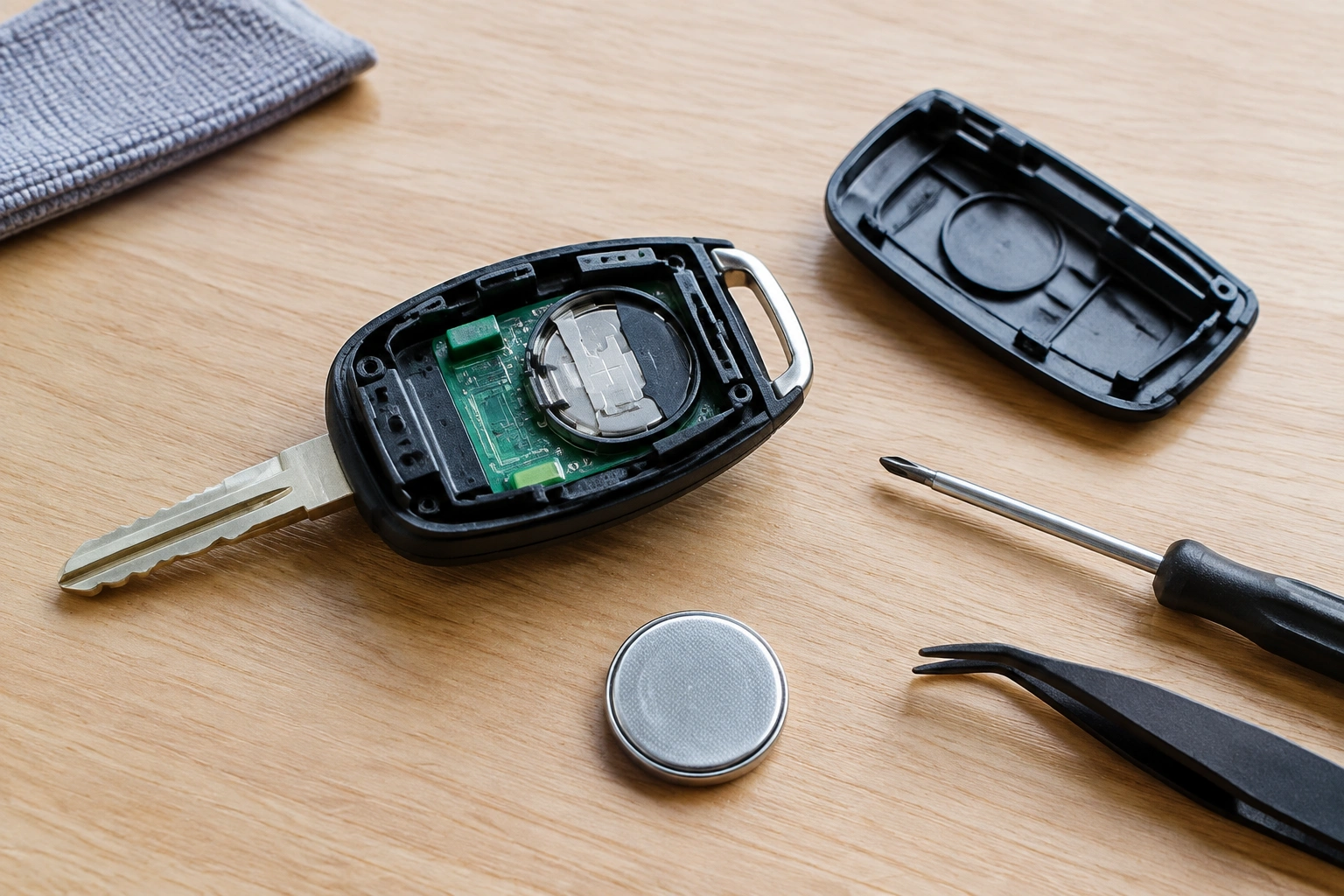
What to do:
- Replace the battery with the exact type your fob uses.
- Reassemble the fob carefully so the contacts sit flat.
- Test every button, not just unlock.
A simple example: if the lock button works from a few feet away but unlock only works when you’re right next to the car, that’s a classic weak-battery pattern. If the fob has been acting inconsistent for weeks, battery replacement is even more worth trying first.
If the battery replacement fixes it, you’re done. If not, move on before you buy a whole new fob.
Step 2: Test the spare key fob
The spare fob is one of the fastest ways to isolate the fault. If the spare unlocks the doors normally, the problem is probably in the original fob, not the car.
That usually points to one of these:
- Dead or weak battery in the original fob
- Worn unlock button
- Loose internal battery contact
- Internal circuit-board failure
If both fobs start the car but neither unlocks the doors, the odds shift toward the vehicle side: receiver, fuse, body control module, or door lock system.
That’s why the spare matters. It tells you whether the problem follows the fob or stays with the vehicle.
Step 3: Use the manual key and confirm the lock cylinder still works
If your fob has a hidden mechanical key, use it. That gives you two useful pieces of information:
- You can still get into the car.
- The door lock cylinder itself still works, which means the mechanical lock is not the issue.
If the manual key opens the door but the remote doesn’t, the problem is in the electronic side, not the physical latch.
Be gentle with the manual key. If the lock cylinder feels stiff, don’t force it. A little graphite or professional cleaning may be better than twisting the key harder and damaging the cylinder.
Step 4: Look closely at the fob itself
Sometimes the battery is fine, but the fob hardware is not.
Check for:
- A mushy or unresponsive unlock button
- Cracked casing
- Battery that moves around inside the shell
- Corrosion on the battery contacts
- Signs the fob has been dropped or wet
I’ve seen plenty of fobs where one button still works and another doesn’t. That usually means the board or button contact is wearing out, not that the whole car is failing.
If only the unlock button is dead but lock, trunk, or panic still work, the button contact inside the fob is a strong suspect.
Step 5: Check the vehicle battery and basic electrical health
A weak vehicle battery can create confusing symptoms. The car may still start, especially if it’s just been driven or jump-started, but body electronics and remote entry can act up before the engine side fully gives up. That said, the exact behavior varies by vehicle, so treat this as a clue rather than a universal rule.
Look for signs like:
- Slow cranking
- Dim interior lights
- Warning lights after startup
- Recent battery replacement or disconnect
- Other electrical oddities, such as a laggy infotainment screen or odd lock behavior
A quick DIY check is to try the fob again after a jump start or battery replacement. If the remote unlock suddenly works normally afterward, that points toward low-voltage-related body electronics behavior rather than a dead fob alone.
A drained car battery can make it seem like the key isn’t working at all. If the vehicle battery is marginal, fix that first. Remote locking often depends on stable body-module power, and a weak battery can disrupt that.
For a general consumer overview of vehicle electrical symptoms, Edmunds’ car battery guides can help you compare what a weak battery feels like versus a fob problem.
Step 6: Inspect fuses, receiver, and door lock components
If both fobs fail and the vehicle battery is healthy, move to the car-side system.
Things to check:
- Fuse related to central locking or keyless entry
- Keyless-entry receiver or antenna
- Door lock actuators
- Body control module or lock wiring
A blown fuse can knock out remote locking without affecting the engine start system on some vehicles, but not all, so treat it as a possibility rather than a rule. A failed receiver can do the same. And if only one door or one side of the car won’t respond, a door lock actuator is more likely than a fob issue.
A helpful clue: if the car responds inconsistently, such as unlocking sometimes but not always, that can point to a marginal receiver, loose wiring, or a failing actuator rather than a dead fob battery.
Step 7: Try resyncing or reprogramming only after the basics
Resyncing or reprogramming can help in some cases, especially after a battery disconnect or if the fob lost communication with the car. But I would not jump there first.
Try this only after:
- You replaced the fob battery
- The spare fob has been tested
- The vehicle battery checks out
- No obvious button or casing damage is present
If the vehicle’s manual gives a specific resync procedure, follow that exact process. Avoid random internet steps that are not made for your model. Some cars use very specific timing or button sequences, and the wrong procedure can waste time or make the diagnosis murkier.
How to tell whether the problem is in the fob or the car
This quick comparison helps narrow it down fast.
| Symptom | Most likely cause | What to do next |
|---|---|---|
| One fob fails, spare works | Original fob battery, button, or internal failure | Replace battery first, then consider fob replacement |
| Both fobs start the car but won’t unlock doors | Vehicle-side issue, receiver, fuse, or lock system | Check vehicle battery, fuses, and door lock components |
| Unlock works only very close to the car | Weak fob battery or weak signal from the fob | Replace fob battery and retest |
| Lock works but unlock does not | Worn unlock button or internal fob fault | Inspect button and contacts |
| Manual key works, remote doesn’t | Electronic side fault, not mechanical lock failure | Check battery, receiver, fuse, or programming |
| Problem started after battery disconnect | Sync or programming issue may be possible | Try the manufacturer-approved reset or reprogramming path |
When to consult a locksmith
Call a locksmith, dealer, or qualified mechanic when the simple checks don’t isolate the problem. A locksmith is usually the better fit when the symptoms point to a fob-specific issue, such as a weak battery, a damaged shell, a worn button, loose battery contacts, or a fob that needs straightforward replacement or basic programming.
A dealer is often the better choice when the problem looks car-side or model-specific, such as:
- Both key fobs fail even after battery checks
- The car battery is good, but remote unlock still doesn’t work
- A fuse keeps blowing
- One door or multiple doors won’t respond
- The vehicle needs manufacturer-specific programming tools
- You suspect receiver, actuator, body-module, or security-module trouble
In other words, a locksmith is often a smart middle ground if the issue is likely fob-related or routine programming-related. A dealer may be the better call if the vehicle uses a more complex security system, if the car needs model-specific diagnostics, or if module-level troubleshooting is required.
Repair and replacement options, in practical terms
Here’s how the usual fixes compare:
- Fob battery replacement: cheapest and easiest; worth trying first
- Fob shell or button repair: useful if the button is worn but the electronics still work
- Full fob replacement: makes sense if the board is damaged or the fob is water-damaged
- Reprogramming: worth trying when the fob and vehicle are otherwise healthy
- Fuse or receiver repair: needed when both fobs fail and the car-side system is the culprit
- Door lock actuator replacement: likely when one door or one side of the car won’t respond
In many cases, the least expensive fix is the right one. But if the car-side system is at fault, replacing the fob won’t solve it. That’s why the spare fob test and the vehicle-battery check matter so much.
If you want to compare this symptom with the opposite problem, see our guide on why a car won’t start but the key fob unlocks the doors. If your car says the fob is not detected but still starts, our article on why a key fob may not be detected but the car still starts is a helpful next step.
FAQ
Why can my car start but the key fob won’t unlock the doors?
Usually because the start authorization path and the remote unlock path are not failing in the same way. The fob may still be recognized well enough for start authorization, while the unlock signal, receiver, fuse, or body electronics are the weak point.
Can a bad car battery affect remote unlocking?
Yes, it can on some vehicles. A weak vehicle battery may still allow the engine to start in certain situations while remote entry or body electronics act up first.
What if the spare fob also doesn’t work?
That usually shifts suspicion away from the fob and toward the car-side system, such as the vehicle battery, fuse, receiver, wiring, or lock module.
How do I unlock the car if the fob fails completely?
Use the hidden mechanical key if your fob has one. If the key cylinder is stiff, don’t force it; a locksmith can help if the cylinder is seized or hard to turn.
Bottom line
When a key fob starts the car but won’t unlock the doors, the unlock side of the system is usually the first thing to fail. The fastest path is simple: replace the fob battery, test the spare, then check the vehicle battery. If those don’t solve it, move on to car-side diagnostics like fuses, the receiver, and door lock components. That approach keeps you from replacing parts blindly and gets you to the real fault faster.
