
Key Fob Buttons Not Responding: A Practical Troubleshooting Guide for Car Owners

When key fob buttons are not responding, the fastest fix is often simpler than people expect. In my shop days, I saw plenty of “dead” remotes that were really just dealing with a weak battery, a worn button pad, or a fob shell that no longer lined up properly. The trick is to separate a fob-side problem from a car-side problem before you spend money on the wrong part.
If your remote is acting up, work through the checks below in order. That gives you the best shot at getting the fob working again without guessing.
Quick diagnosis: what the fob is doing and what it usually means
A fob that fails in one of a few common ways can point you in the right direction.
- Nothing happens at all when you press any button: the battery may be dead, the battery may be installed incorrectly, or the internal circuit board may have failed.
- One button works and another does not: the problem may be mechanical, such as a worn button contact or a damaged rubber pad.
- The fob works only when you are very close to the car: that often points to a weak battery or a weak transmitter signal.
- The buttons work sometimes and not others: intermittent contact, corrosion, moisture damage, or a cracked solder joint may be involved.
- Neither the original nor the spare fob works: the issue may be with the car’s receiver, vehicle battery, or central locking system rather than the fob itself.
If you want a quick comparison of what usually makes sense to repair, replace, or test first, keep reading. A small clue like “works only when pressed hard” can save you from replacing a good battery when the real issue is a worn contact.
Try the fastest fixes first: replace the battery, check the battery orientation, and retest
A coin cell battery is one of the first things to check. It may still have enough power to light an indicator LED, but not enough to reliably send a transmitter signal to the car. That’s why a fob can seem “half alive” before it fails completely.
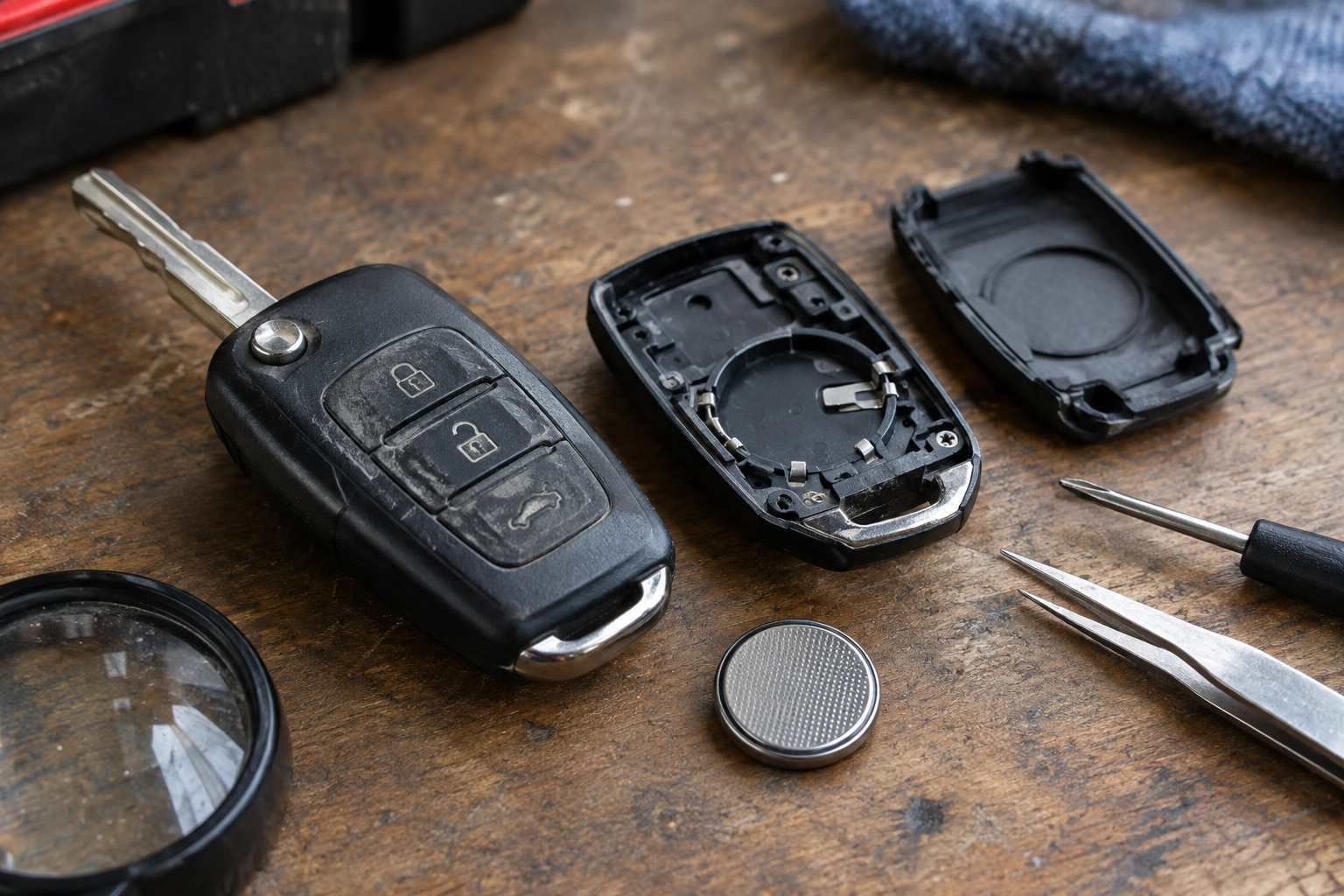
Before opening the fob, confirm the battery type in the owner’s manual or on the old cell. Then:
- Open the fob carefully so you do not crack the shell or lose the small parts.
- Remove the old coin cell.
- Check for corrosion, bent contacts, or residue around the battery tray.
- Install the new battery in the correct orientation.
- Snap the fob back together and test every button from a normal standing distance.
If the remote starts working again, you likely found the issue. If it still acts the same, don’t assume the battery was wasted effort. Battery replacement is still the cheapest first step, and it helps rule out one of the most common causes before you move on.
One caution: if the battery compartment looks wet, green, or crusted, stop and inspect the inside more closely before forcing anything back together.
Quick at-home transmission check: if your vehicle uses an infrared-style remote, point the fob at a phone camera while pressing a button; many phone cameras can show the IR LED flashing if the fob is transmitting. If your fob is radio-frequency only, a dedicated key fob tester or a locksmith/dealer scan tool is a more reliable way to confirm transmission. This test helps separate “not sending anything” from “sending, but the car is not responding.”
For background on vehicle access and backup starting concerns, our guides on how to start a car when the key fob is not detected and emergency start when the key fob is not detected can help if the remote issue is affecting entry or starting.
Use the spare key fob to isolate the fault
The spare fob is one of the best diagnostic tools you already own. It tells you whether the problem lives in the original remote or somewhere else in the vehicle.
Here’s the logic:
- Spare works normally, original does not: the original fob likely needs repair, reprogramming, or replacement.
- Both fobs behave the same way: look at the car battery, receiver, or central locking system.
- Spare works only at very close range too: that can point to a vehicle-side issue, not just a worn original fob.
This comparison matters because it keeps you from blaming the wrong part. I’ve seen people replace a remote, then discover the car battery was weak enough to interfere with normal remote operation. The spare fob test is simple, but it cuts through a lot of guesswork.
Inspect the buttons and internal contacts for wear, sticking, or damage
If a button feels mushy, requires extra pressure, or sinks farther than the others, the issue may be mechanical rather than electronic. The rubber pad inside the shell can wear down, shift out of position, or stop pressing the contact pad on the circuit board consistently.
Look for these signs:
- A button that sticks after you press it
- A cracked or split rubber pad
- A shell that no longer closes tightly
- A button that works only when pressed in a certain spot
- Visible wear or flattening on the button face
A fob shell replacement can make sense when the electronics still work but the housing no longer supports the buttons properly. That is usually cheaper and simpler than replacing the whole unit. But if the circuit board is damaged too, a shell swap alone will not fix it.
If the buttons feel fine yet nothing happens, move on to the internal inspection. Mechanical wear and electronic failure can look similar from the outside.
Check for dirt, corrosion, or moisture damage inside the fob
Dirt and moisture can interrupt the button contacts or the circuit board. Even a small amount of residue can keep a button from closing the circuit properly.
Open the fob and inspect for:
- White, green, or blue corrosion around the battery contacts
- Water spots or dried residue
- Dust, crumbs, or lint packed around the buttons
- A musty smell or visible liquid intrusion
- Rust or discoloration on metal parts
If you see light debris, clean it gently with the right tools and let everything dry fully before reassembly. If corrosion is heavy or the board looks damaged, cleaning may not be enough. Water intrusion can cause intermittent failures first, then full failure later.
Moisture damage is one of those problems that often gets worse with time. If the remote was dropped in water, washed, or left in a damp place, treat it as a serious clue rather than a coincidence.
For vehicle owners who want to compare symptoms and access issues, NHTSA’s vehicle safety resources can also be useful when you’re checking whether the car itself may be part of the problem.
Test for intermittent transmission and weak signal range
A fob that works only sometimes is often more frustrating than one that is fully dead, because it can trick you into thinking the problem is “just a glitch.” In reality, intermittent response usually means something is failing under pressure, movement, or low power.
A few examples:
- The lock button works only on the second or third press
- The unlock button works in the driveway but not across the parking lot
- The remote works after warming up in your hand
- The fob works when pressed firmly, but not with a light tap
Those patterns often point to weak battery power, worn button contacts, or a cracked internal connection. If the signal range suddenly became short, I would still check the battery first, then the physical condition of the buttons and shell. A weak transmitter signal can also show up before the fob fails completely.
If the fob works only right next to the vehicle, do not jump straight to reprogramming. Weak power and damaged contacts are more common than a lost program.
Decide whether reprogramming is needed
Reprogramming is worth considering when the battery is good, the buttons physically work, and the fob still does not communicate properly with the car. That said, reprogramming is not the first fix for every nonresponsive fob.
A clearer rule:
- If the spare fob works and the original does not, and the original has good buttons and a fresh battery, reprogramming may be needed.
- If the original has worn buttons, a bad shell, corrosion, or a damaged board, programming alone is unlikely to fix it.
- If neither fob works, focus on the car-side system before buying programming services.
Some vehicles allow owner-level programming, while others need a dealer or auto locksmith. If you are not sure which camp your vehicle falls into, check the owner’s manual or the manufacturer’s support information before buying parts. That step can save you from replacing a perfectly good fob that simply needs to be paired again.
Do not assume reprogramming will fix a button that is physically worn out. Programming can restore communication, but it cannot repair a broken contact pad or a damaged circuit board.
For readers comparing repair approaches, Edmunds’ car ownership and repair guidance is a helpful general resource when you want to understand repair trade-offs before paying for service.
Rule out vehicle-side problems: car battery, receiver, and central locking
When multiple fobs fail at once, the car itself deserves attention. That is especially true if the problem started after a dead battery, jump start, or electrical issue.
Check for these signs:
- The car battery is weak or recently went dead
- The central locking system is acting oddly from the driver’s switch too
- The vehicle responds inconsistently to both fobs
- The dash or interior electronics seem unstable
If the car battery is low, some vehicles may not respond normally to remote commands. The receiver or related modules may also behave oddly if the vehicle has an electrical fault. In that case, replacing the fob will not solve the real issue.
A practical next check helps here: if the interior lock switch works normally but the fob does not, the problem is more likely in the remote, its battery, or its programming. If the interior switch also acts up, the vehicle-side system moves higher on the list. If the car battery is weak, charge or replace it first, then retest the fob before moving on.
A useful comparison is simple: if the spare fob works and the original does not, the original is likely the problem. If neither works, the car-side system moves higher on the list.
Repair, replace the shell, or replace the whole fob: how to choose
Here’s the practical comparison most owners need.
| Fix option | Best when | Trade-off |
|---|---|---|
| Battery replacement | The fob is weak, intermittent, or recently started failing | Cheap and fast, but it won’t fix worn buttons or circuit damage |
| Shell replacement | Buttons are worn, the case is cracked, or the fob is misaligned | Good value if electronics still work, but it won’t help a damaged board |
| Circuit board repair | The board has a minor issue and the fob is otherwise worth saving | Can be worthwhile, but not always practical for a typical owner |
| Full fob replacement | The board is damaged, corroded, or the fob no longer responds reliably | More expensive, but often the cleanest fix when the remote is beyond repair |
If the shell is broken but the electronics still transmit, a shell swap may be enough. If the board shows corrosion or liquid damage, replacing the whole unit often makes more sense than trying to nurse it along.
OEM replacement fobs are usually the safer bet when compatibility matters most, but compatibility can vary by vehicle and supplier. Aftermarket options can cost less, but they vary more in quality and programming support. If you go aftermarket, confirm compatibility before ordering.
When to Consult a Locksmith
Call a locksmith or dealer when the fob still does not work after a battery change, the spare fob test points to programming trouble, or the board shows heavy corrosion or damage. A professional is also the right call if your vehicle needs dealer-level programming or if you cannot reliably unlock the car.
A locksmith may be able to help when the problem sits between the fob and the car, especially if pairing, shell condition, or electronics need to be checked together. Not every locksmith offers the same equipment or services, so it is worth asking what they can actually test before you book the visit. If the vehicle is your only way in and the remote is failing completely, that is not the time to keep experimenting.
FAQs
Why do my key fob buttons work sometimes and not others?
That usually points to a weak battery, worn button contacts, or moisture or corrosion inside the fob. Intermittent response is often a warning sign that the problem is getting worse.
Can a dead car battery make the key fob seem broken?
Yes, in some vehicles a weak or dead car battery can affect how the remote system behaves. If both fobs fail at the same time, check the vehicle battery and related electronics.
How do I know if the button itself is bad?
If one button needs extra pressure, sticks, or only works when pressed in a certain spot, the button pad or internal contact may be worn. That usually points to a shell or internal repair issue rather than a battery problem.
Should I replace the battery before anything else?
Yes. It is the fastest and cheapest first check, and it helps rule out one of the most common causes of a nonresponsive fob.
Is it worth repairing an old fob?
If the shell is cracked but the electronics still work, repair can be worthwhile. If the board is corroded or the fob has already failed in multiple ways, replacement is often the better long-term choice.
Can I reprogram the fob myself?
Sometimes, but not always. Some vehicles allow owner programming, while others need a dealer or auto locksmith. Check the owner’s manual before buying new parts.
What if the spare fob works but the original does not?
That usually means the original fob is the problem, not the car. If the original has a fresh battery and good buttons, reprogramming may be the next step. If the shell, contacts, or board are worn or damaged, repair or replacement is usually the better path.
Is an aftermarket fob okay?
It can be, but compatibility and quality vary. OEM fobs are usually more predictable, while aftermarket options may be cheaper but less consistent.
If you work through these checks in order, you can usually narrow down the cause without wasting money on parts you do not need. The simplest decision path is: replace the battery first, repair the shell or button contacts if the buttons are worn or intermittent, reprogram if the battery and buttons are good but the fob still will not pair, and call a locksmith or dealer when the spare test, vehicle battery, or receiver points to a car-side issue.
