
Car Won’t Start but Key Fob Unlocks Doors: What’s Really Going On and How to Fix It

If your car unlocks with the key fob but won’t start, that does not automatically mean the fob is fine. Door unlocking and engine-start authorization are separate jobs in many modern vehicles. A fob can still send enough signal to unlock the doors and yet fail to be recognized well enough to let the car start.
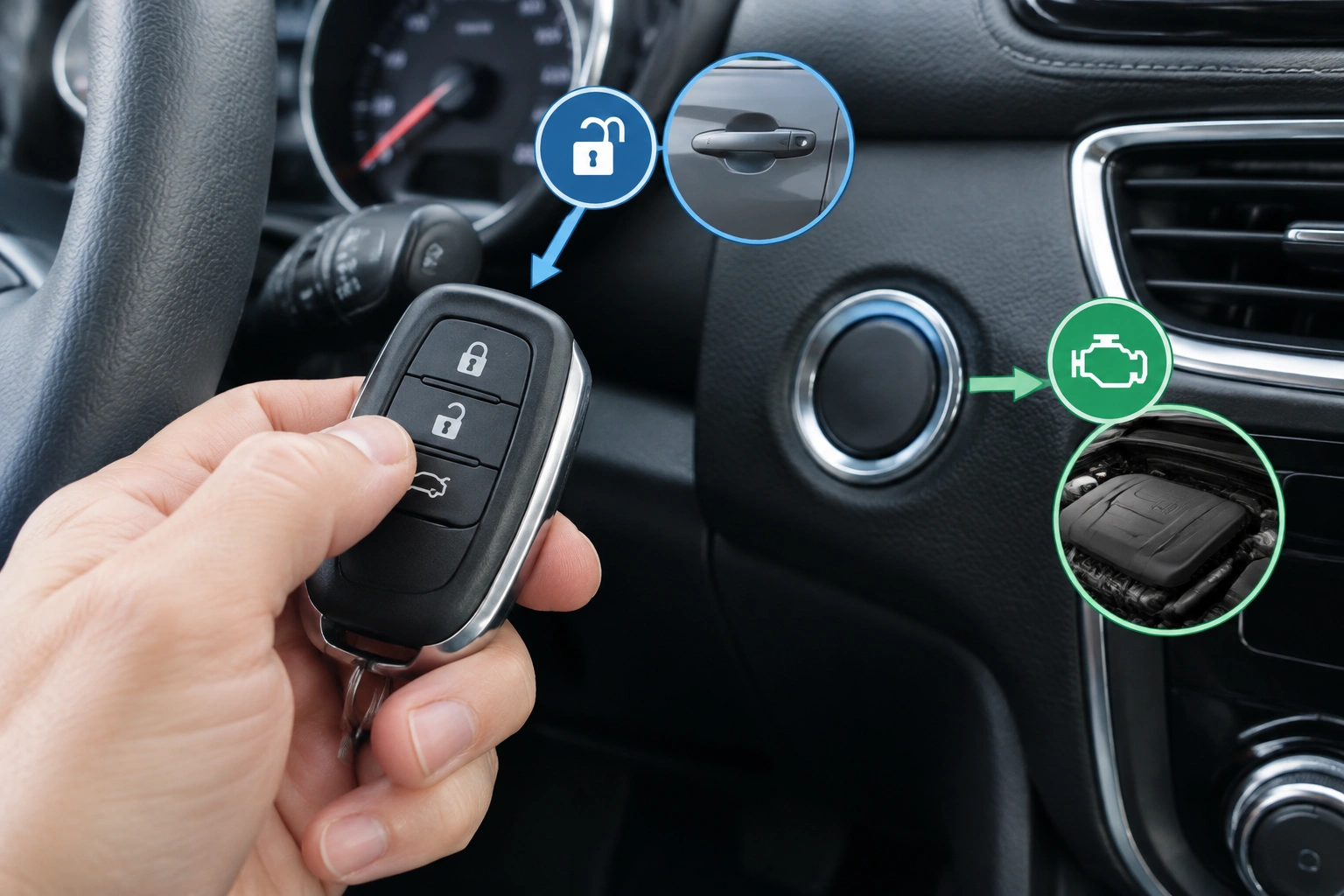
That’s why the fastest fix is not guessing — it’s checking the likely cause in the right order. In many cases, the issue is a weak fob battery, a weak car battery, or a push-button start system that isn’t detecting the fob properly. Less often, the problem is the immobilizer, brake pedal switch, starter, or ignition system.
Quick triage order: check the spare fob first, then look for car battery signs, then try the emergency start method in the owner’s manual, then confirm the brake lights work, and only after that move on to immobilizer, starter, or ignition-switch possibilities.
Quick Diagnosis: What It Means When the Doors Unlock but the Engine Won’t Start
Think of the key fob as having two separate jobs:
- Remote access: unlock and lock the doors
- Start authorization: tell the car it’s okay to run the engine
A fob battery can be weak enough that the range drops or detection gets flaky, but still strong enough to unlock the doors from close range. That’s why “the doors unlock” is not proof that the starting side of the system is healthy.
Also, unlocking the doors does not prove the immobilizer or transponder is being read correctly for engine start authorization. The car can accept the remote-lock signal and still reject the start signal.
A useful example: if the fob unlocks the car from the driveway but the dash says “key not detected” when you press the start button, the car may be seeing a weak signal, interference, or a detection problem rather than a dead fob battery alone.
For a deeper look at the “not detected” side of the problem, see our guide on key fob not detected and the car won’t start.
Check the Most Likely Cause First: Weak or Dead Key Fob Battery
A weak fob battery is one of the easiest problems to test for because it usually shows up in small warning signs before it fails completely.
Signs the fob battery is the issue
Look for patterns like these:
- The fob works only when you stand very close to the car
- You have to press buttons more than once
- The car unlocks, but start detection is inconsistent
- The dash shows a key-related warning
- The fob has been acting up for days or weeks, not just suddenly
That last point matters. A fob battery often gets worse gradually. By contrast, a dead car battery usually shows a more obvious all-at-once electrical failure.
If the fob is detected only intermittently or only when held very close to the start button, try moving away from other electronics and another nearby fob. Interference from a second fob, phones, or other devices can sometimes affect detection. If the problem keeps happening, replace the fob battery and test the spare fob if you have one.
Why unlocking can still work
Some vehicles need less power to unlock the doors than to authorize engine start. So yes, a fob battery can be weak and still unlock the doors. That’s especially common when the fob is near the car, because the short-range signal is easier to pick up.
What to do first
If the fob battery is old, replace it. That’s a low-cost, sensible first move when the symptoms point that way. If you have a second fob, test it before doing anything else. If the spare works normally, you’ve narrowed the problem quickly.
If the Fob Seems Fine, Test the Car Battery Next
A lot of drivers focus on the fob first and overlook the car battery. That can waste time.
A weak vehicle battery can still power some accessories or unlock functions, but not have enough strength to crank the engine. Common signs include:
- Dim headlights or interior lights
- Clicking when you try to start
- Slow power windows or sluggish electronics
- Dash lights that dim heavily when you press start
If the car lights up but won’t crank, think vehicle battery first, not fob first.
A simple comparison helps:
| Symptom | More likely cause | First thing to try |
|---|---|---|
| Doors unlock, but car says key not detected | Weak fob battery or detection issue | Try spare fob or emergency start method |
| Lights are dim, dash is weak, or you hear clicking | Weak or dead car battery | Jump-start or test the battery |
| Fob works only very close to car | Weak fob battery or interference | Replace fob battery |
| No crank, no click, brake pressed, push-button does nothing | Brake switch, starter, or start authorization issue | Check brake lights and start conditions |
If the car starts after a jump, that points strongly to the car battery or charging system, not the fob. For general battery and starting context, Edmunds has helpful owner-facing guidance on battery-related starting issues.
Push-Button Start Emergency Fixes
If your car has push-button start, there may be a backup way to get the vehicle to recognize the fob even when the battery is weak.
Try the emergency detection area
Many smart-key systems have a backup detection point. In some cars, holding the fob directly against the start button can help the car read the chip inside the fob. In others, there’s an emergency start slot or marked area in the cabin.
Use this order:
- Press the brake pedal firmly.
- Check your owner’s manual for the exact backup detection point for your vehicle.
- Hold the fob where the manual says to place it, or directly against the start button if that is the specified method.
- Try starting once.
- If it still does nothing, stop and move to the next check instead of hammering the button repeatedly.
This method varies by vehicle, so the owner’s manual is the best source for the exact procedure.
Use the backup key if you have one
Many fobs hide a mechanical key inside the shell. A small release switch often lets the metal key slide out. That backup key can open the door if the electronic side is failing.
Some vehicles also hide the door lock cylinder under a cap near the handle. If your car has that setup, the mechanical key may unlock the door even when the fob is not working normally. Because this varies by model, check the owner’s manual before prying on the handle or cap.
What this tells you
If the emergency start trick works, the fob may be weak, the battery may be low, or the smart-key detection system may be picky. If it doesn’t work, the issue may be beyond the fob itself.
Other Common Causes: Immobilizer, Smart Key Detection, Brake Switch, Starter, or Ignition Switch
When the fob unlocks the doors but the engine still refuses to start, the next suspects are the systems that allow or block starting.
Immobilizer or anti-theft system
The immobilizer looks for the correct transponder signal before allowing the engine to run. If it doesn’t recognize the fob, the car may crank and stall, or it may not crank at all depending on the vehicle.
Clues include:
- Security light flashing or staying on
- “Key not detected” or similar warning
- A spare fob works better than the main one
- The problem appears after a battery replacement or electrical event
Smart key detection problem
Sometimes the fob is fine, but the car isn’t reading it reliably. Causes can include interference, a failing receiver, or a weak fob battery that still unlocks doors but doesn’t consistently authorize the start.
If the issue is intermittent, that detail matters. Intermittent detection usually points more toward signal or sensor trouble than a hard mechanical failure.
Brake pedal switch
On many push-button cars, the brake has to be detected before the engine will start. If the brake switch fails, the car may not “see” that your foot is on the pedal.
A quick clue: check whether the brake lights come on when you press the pedal. If they don’t, the brake switch may be part of the problem.
Starter or ignition switch
On traditional key-start cars, the starter and ignition switch become much more important than the fob itself. A dead car battery usually causes weak or no dashboard lights, slow cranking, or repeated clicking. A failing starter, by contrast, often shows normal dash lights and accessories but only a single click or no crank when you turn the key. A bad ignition switch can also act inconsistently, with the dash lighting up but the starter not engaging reliably.
That difference helps you avoid replacing the wrong part:
- Dead or weak battery: dim lights, slow electronics, repeated clicking, or no power
- Starter problem: normal dash lights, but a single click or no crank
- Ignition switch problem: power may come on, but the start signal doesn’t consistently reach the starter
- Immobilizer/detection issue: the car refuses to authorize starting
Step-by-Step Troubleshooting Order
Use this sequence to save time and avoid unnecessary cranking:
1. Try the spare fob
If the spare works, the original fob or its battery is the likely problem.
2. Watch the dash and listen closely
A “key not detected” message, flashing security light, dim dash, or clicking sound tells you a lot.
3. Try the emergency start method if you have push-button start
Use the exact backup detection point in the owner’s manual.
4. Check the car battery signs
Dim lights, sluggish electronics, or clicking point toward the vehicle battery.
5. Check the brake pedal and brake lights
If the brake lights don’t come on, the brake switch may be preventing start.
6. Stop repeated attempts
Repeated start attempts can drain the battery further and waste time. If you’ve tried the likely fixes and nothing changes, it’s time to escalate.
Can You Drive It After a Temporary Fix?
Sometimes yes — but only if the fix is stable.
If the car starts after replacing the fob battery and behaves normally, you can usually drive it. If it starts after a jump or emergency start trick, treat that as a temporary workaround until you know why it failed.
Here’s a practical rule:
- Starts normally after a new fob battery: likely safe to drive
- Starts after a jump: battery or charging issue may return
- Only starts with the fob held in a specific spot: detection issue still needs attention
- Intermittent starting: don’t plan a long trip until it’s sorted out
If the car is starting unpredictably, I’d avoid assuming it’s fixed just because it started once in the driveway.
When to Consult a Locksmith
A locksmith is a smart call when the issue looks like a fob, transponder, or mechanical key problem rather than a full vehicle electrical failure.
Call a locksmith if:
- The fob battery is replaced but the car still won’t recognize the key
- The mechanical backup key won’t open the door properly
- You need help with a hidden key release or emergency start access
- The vehicle’s smart-key system seems to be reading the fob inconsistently
A dealer may be the better choice if the immobilizer or smart-key module needs model-specific diagnosis. A mechanic is usually the better fit if the problem points to the battery, starter, brake switch, or charging system.
FAQ
Why does my key fob unlock the doors but not start the car?
Because unlocking and starting are separate functions. The fob may still have enough power to unlock the doors but not enough signal, or the car may not be detecting it properly for engine start.
Is the key fob battery still good if the doors unlock?
Not necessarily. A weak battery can still handle basic unlocking while failing at the more demanding start authorization side.
Could the car battery be dead even if the fob works?
Yes. The fob can operate normally while the vehicle battery is too weak to crank the engine.
How do I start the car with a weak key fob battery?
Check the owner’s manual for the exact emergency detection method. On many push-button cars, holding the fob directly against the start button or in a marked backup area can help the car detect it.
What if the car says key not detected?
That usually points to a fob battery, detection, interference, or immobilizer issue. If a spare fob works, the original fob is the likely problem.
Should I replace the fob battery or jump-start the car first?
Replace the fob battery first if the fob has been acting weak or inconsistent. Jump-start first if the lights are dim, electronics are sluggish, or the car only clicks.
When should I tow the car?
Tow it if the car won’t start after the basic checks, the warning lights suggest an immobilizer or electrical fault, or you’re stuck somewhere unsafe and can’t risk repeated attempts.
Can a brake switch keep the car from starting?
Yes. On many push-button cars, the brake pedal has to be recognized before the car will start. If the brake lights don’t work, that’s a strong clue.
Why does the problem happen only sometimes?
Intermittent problems often point to a weak fob battery, signal interference, a failing smart-key receiver, or a connection issue that hasn’t fully failed yet.
If you want to compare this symptom with other keyless-start problems, our related guide on why your car says “key fob not detected” but still starts can help you narrow it down further.
