
How Far Should a Car Key Fob Work? Realistic Range, Common Problems, and Fixes

If your key fob only works when you’re practically standing on top of the car, that can feel like a sign something expensive is about to fail. Usually, it’s not that dramatic. In many cases, the issue comes down to battery strength, interference, or a vehicle-specific design quirk.
The honest answer to how far should a car key fob work is: it varies a lot by vehicle and system. A basic lock/unlock remote often works from a reasonable distance in normal conditions, while passive keyless entry can behave differently because the car is constantly looking for the fob nearby. Remote-start systems may have their own separate range expectations, and some are built with range-extending antennas. Capital One notes that some systems use larger antennas and that remote-start range can sometimes reach up to 2,500 feet, but that is not a universal number for every fob or every car. Capital One Auto Navigator
What “Normal” Key Fob Range Usually Looks Like
There isn’t one distance that applies to every car, but there is a practical way to judge whether your fob is behaving normally: compare it to how it used to work, and compare it to a similar vehicle if you can.
For a standard remote lock or unlock function, a realistic expectation is often somewhere around 30 to 100 feet in decent conditions, though some vehicles work farther and some work less. Vehicle design, antenna placement, battery strength, and nearby interference can all change that result.
Passive keyless entry is different. The car decides whether the key is close enough to unlock or start, so the “range” can feel shorter or less obvious. You may notice that one function still works normally while another does not. That does not automatically mean the fob is bad.
A useful rule of thumb: if the fob used to work from a comfortable distance and now only works very close to the car, something changed. The battery, the fob itself, the car’s receiver, or the environment is usually involved.
Why Key Fob Range Changes So Much
Key fob range is affected by more than just battery level. The signal has to get from the fob to the car, and several things can weaken that signal.
Battery strength
A weak battery is the first thing I’d check. A fob battery can still have enough power to work occasionally but not enough to transmit well at normal distance. That’s why a fob may seem “kind of dead” rather than completely dead.
Vehicle design
Different makes and models use different antenna setups, receiver locations, and keyless-entry systems. One car may respond from far across a lot, while another only responds when you’re closer.
Signal interference
Other radio signals can get in the way. Parking garages, dense buildings, nearby electronics, and even some metal structures can reduce range. This is one reason a fob may work fine in your driveway but act weak at the grocery store.
Physical obstructions
The signal can pass through some things, but walls, metal, thick barriers, or a fob buried in a bag can still weaken it. That’s why range often looks better in open air than it does indoors or near heavy structures.
Most Likely Causes of Short Key Fob Range
When a key fob suddenly becomes short-range, I’d think about the causes in this order:
- Weak fob battery
- Environmental interference
- Damaged or worn fob buttons or internal parts
- Vehicle receiver or antenna issue
- Programming or sync problem
That order matters because the first two are common and cheap to rule out. The last two usually need more diagnosis.
A good example: if your fob works from 30 feet in the driveway but only 5 feet in a parking garage, the fob may be fine. The garage is likely the problem. If the same fob works badly everywhere, even in an open lot, the battery or the fob itself moves higher on the list.
How to Troubleshoot a Short-Range Key Fob Step by Step
The fastest way to avoid replacing the wrong part is to test the fob in a clean, simple way.
1) Test in an open area, then compare the spare fob and battery
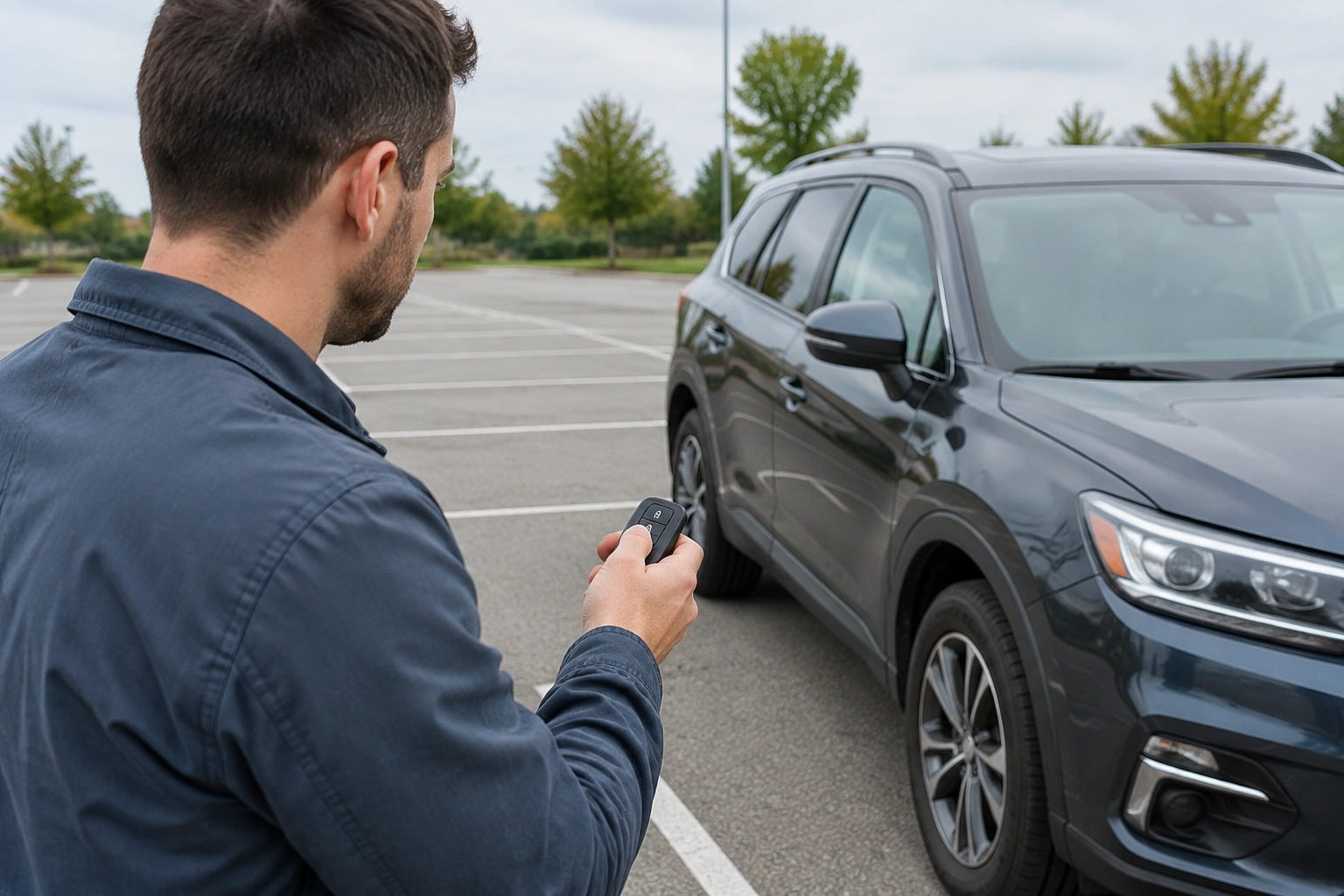
Start in an open driveway or parking lot and test the fob from a few different distances. Try the lock, unlock, and any panic or remote-start button if your vehicle has one.
Then use the spare fob in the same spot. If the spare works normally, the original fob is the likely problem. If both fobs act weak, the car’s receiver or antenna becomes more suspicious.
If the original fob is still weak after that, replace the battery if it’s old or unknown. Most key fobs use a coin-cell battery such as a CR2032, though not all do. Match the battery type to your fob before buying a replacement. If there’s no improvement after a fresh battery, the issue is more likely the fob hardware or the car-side system.
2) Move away from interference sources
Try the fob away from the garage, office building, power equipment, or crowded parking structure. If it works much better elsewhere, the environment is likely affecting the signal.
3) Check for physical damage
Look for cracked housing, loose buttons, corrosion, or signs the fob has been dropped or exposed to moisture. Internal damage can weaken the transmitter or create an intermittent connection.
4) Compare how the car reacts to different functions
If unlock works but remote start or passive entry does not, the issue may be specific to that system rather than the entire fob. That narrows the diagnosis.
When Replacing the Battery Is the Right First Move
Battery replacement is the right first move when the fob still works, but the range has clearly dropped. That’s especially true if:
- the battery is more than a year or two old,
- the fob is intermittent rather than completely dead,
- the range got worse gradually,
- the fob works better when held very close to the car.
After a battery swap, I’d expect the fob to regain normal or near-normal range if the battery was the main issue. If nothing changes, the battery was probably not the whole story.
If you want a deeper walk-through of battery-related symptoms, our guide on what to do when the key fob battery is dead covers the next steps once the battery is clearly weak.
Signs the Fob Itself May Be Failing
A new battery does not always fix a weak fob. That’s when I start looking for hardware failure.
Watch for these signs:
- range is still poor after battery replacement,
- buttons feel mushy, sticky, or inconsistent,
- the fob only works when pressed in a certain position,
- the case has been opened, cracked, or exposed to water,
- the fob works sometimes and then stops without warning.
Those symptoms point to worn internal contacts, a damaged circuit board, or a transmitter problem. At that stage, the fob may need repair or replacement rather than another battery.
An aftermarket replacement fob can be a practical lower-cost option, but compatibility and programming matter. OEM fobs are usually the safer choice when you want the closest match to original performance and fewer surprises.
When the Problem Is Likely the Car, Not the Fob
If two different fobs for the same car both have short range, the vehicle becomes the main suspect. That points toward the receiver, antenna, or a related system issue.
Here’s the pattern I look for:
- both fobs are weak in the same locations,
- the problem stays the same after new batteries,
- the car acts normally with locks and other electrical systems,
- the range changes depending on where the car is parked.
A vehicle-side issue is more likely when the fob works only when you’re almost touching the door handle, but the same fob was better before. In that case, the car may not be receiving the signal properly.
For a related troubleshooting path, our guide on how to resync a key fob to your car can help when the issue seems more like a sync problem than a pure range problem.
Normal Range vs Reduced Range: Quick Comparison
| Situation | What it usually suggests | Best next step |
|---|---|---|
| Works from across a driveway | Likely normal for that vehicle | No action needed |
| Works only a few feet away | Weak battery, interference, or fob issue | Test in open area, then replace battery |
| Works well in one place but not another | Environmental interference | Retest away from buildings/garages |
| Both fobs have the same short range | Vehicle receiver or antenna issue | Have the car diagnosed |
| New battery makes no difference | Fob hardware or car-side problem | Compare with spare fob and inspect for damage |
That table is the quickest way to avoid replacing parts blindly.
When to Consult a Locksmith
If the battery is fresh, the spare fob behaves the same way, and the car still has short range in an open area, it’s time to bring in help. A locksmith or automotive key specialist can test the fob, reprogram it if needed, and tell you whether the problem is the fob or the vehicle.
That’s also the right move if the fob has been dropped in water, the buttons are physically damaged, or you’ve already replaced the battery and the range is still poor. A proper diagnosis is usually faster than buying another part and hoping it solves the issue.
If you’re deciding between a replacement fob and a diagnosis, remember this: if the problem follows one fob, replace or repair that fob. If the problem follows the car, investigate the receiver or antenna.
FAQ
How far should a car key fob work normally?
It depends on the vehicle and the system. A standard lock/unlock fob often works from a comfortable distance in normal conditions, while passive keyless entry and remote-start systems may behave differently.
Why does my key fob only work a few feet away?
The most common reasons are a weak battery, interference, or a failing fob. If a spare fob works normally, the original fob is the likely problem.
Does a weak battery reduce key fob range?
Yes. A weak battery can let the fob work only at very close range or intermittently.
Can weather or parking garages affect range?
Yes. Buildings, metal structures, and other sources of interference can reduce range. Testing in an open area gives you a much cleaner result.
Should I replace the battery before buying a new fob?
Usually, yes. It’s the lowest-cost test and often solves the problem if the fob is still otherwise healthy.
What if both of my key fobs have short range?
That points more toward the car’s receiver or antenna than the fobs themselves.
Is an aftermarket fob as good as OEM?
Sometimes, but not always. Aftermarket fobs can save money, but OEM fobs are usually the safer bet for compatibility and consistent performance.
Can a key fob be too weak even if it still unlocks the car?
Yes. A fob can still function at short range even when the battery or transmitter is weakening.
When should I stop troubleshooting and get help?
If a fresh battery, a spare fob, and an open-area test do not improve range, the issue likely needs professional diagnosis.
