
Why Your Key Fob Won’t Turn Off the Car Alarm — and What to Do Next

If your car alarm is blaring and the key fob suddenly does nothing, the goal is simple: silence it safely, then figure out whether the problem lives in the fob, the car battery, or the alarm system itself. I’m Jason Carter, and in the shop this usually came down to one of three things: a weak fob battery, a low vehicle battery, or a system that lost sync and needs a reset or reprogramming.
The good news is that you can often narrow it down in a few minutes without replacing parts blindly. The trick is to work from the fastest, least risky checks first.
Fastest Way to Silence the Alarm Right Now
If the alarm is going off in a driveway or parking lot, do this first. Exact disarm steps vary by vehicle, so check the owner’s manual if your model behaves differently.
-
Try the unlock button once from close range.
If the fob still has partial communication, this is the quickest first check. -
If that fails, stand right by the driver’s door and try again.
A weak fob battery may work only at very short range. -
Use the physical key to unlock the driver’s door.
If your fob has a hidden key blade, use the driver’s door lock cylinder. On some vehicles, this is enough to stop the alarm or trigger a reset. -
Insert the key in the ignition or start the car with the fob present.
On many push-button vehicles, the alarm stops once the car recognizes the transponder or smart key. -
If the alarm still will not stop, look for the model-specific emergency disarm or override procedure in the owner’s manual.
Some vehicles have a dead-battery mechanical override or valet/override sequence, but the exact steps are manufacturer-specific.
If you’re unsure whether the issue is the fob or the car, this NHTSA vehicle safety guidance is a useful reminder to follow the manufacturer’s instructions when a warning system behaves unexpectedly.
How to Tell Whether the Problem Is the Key Fob, Car Battery, or Alarm System
The fastest way to avoid wasted effort is to match the symptom to the likely cause.
| Symptom | Most likely cause | Best next step |
|---|---|---|
| Fob locks the car but won’t disarm the alarm | Weak fob battery, failed unlock button/circuit, or sync issue | Replace the fob battery first, then try resyncing |
| Fob does nothing at all | Dead fob battery, damaged fob, or car-side issue | Try the spare fob and manual key |
| Alarm starts after the car has sat overnight | Weak car battery or vehicle electrical issue | Check battery voltage and starting behavior |
| Doors unlock manually but alarm keeps sounding | Alarm system may not be recognizing the unlock event | Use the manufacturer’s reset procedure |
| Fob works only very close to the car | Weak fob battery or failing internal electronics | Replace the battery and inspect the fob |
| Dash lights are dim or the car cranks slowly | Car battery problem | Test or charge the vehicle battery first |
A useful comparison: if the fob still locks the doors but won’t turn off the alarm, that often points to a weak fob battery, a worn unlock button or contact, or a syncing problem. If the car struggles to start, lights dim, or other electronics act strange, the vehicle battery deserves attention before you blame the remote. Also, some cars can still lock even when the disarm signal fails, so “locks but won’t unlock/disarm” is not the same as a totally dead fob.
For a related symptom pattern, see our guide on what it means when a key fob won’t unlock the car after a battery change.
Start With the Key Fob Battery and Basic Fob Checks
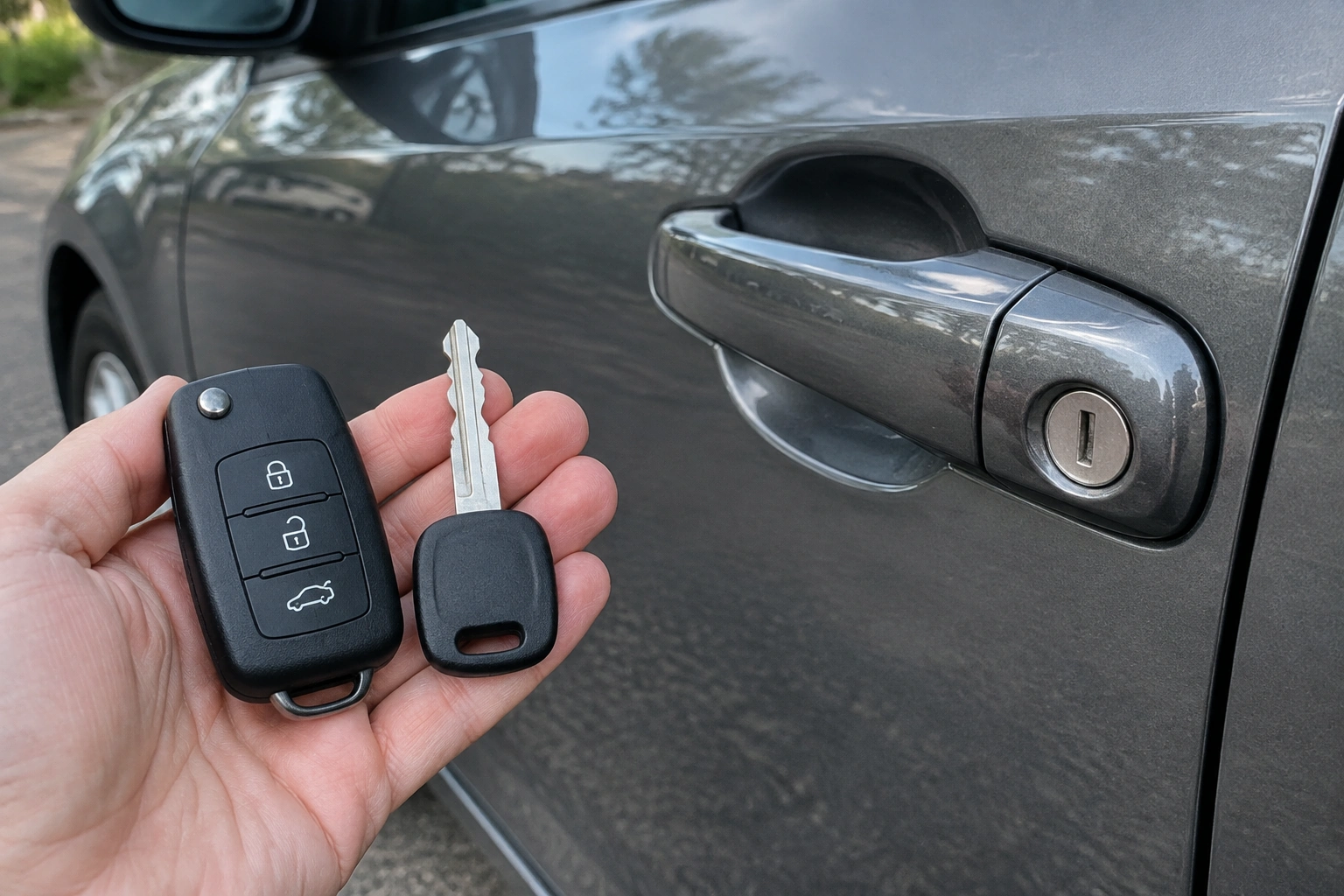
A weak key fob battery is the simplest fix, and it’s common enough that it should be your first real check.
Look for these clues:
- The fob works only when you’re standing right next to the car.
- The response is delayed or inconsistent.
- Locking works better than unlocking, or vice versa.
- You have to press the button several times before the car reacts.
If that sounds familiar, replace the fob battery before you do anything more complicated. That’s a low-cost step and it often restores normal range and response. Just make sure you use the correct battery type and install it with the right polarity.
Also inspect the fob itself:
- Cracked housing
- Loose buttons
- Corrosion inside the battery compartment
- Signs it was dropped or exposed to moisture
A fob that has been physically damaged may behave like a weak battery problem at first, but battery replacement won’t fix a broken circuit board.
Use the Physical Key and Manual Door Lock to Disarm or Reset the System
If the fob isn’t helping, the manual key is your best backup.
Here’s the cleanest way to try it:
- Remove the hidden key blade from the fob if your vehicle uses one.
- Unlock the driver’s door using the lock cylinder.
- Open the door and pause for a moment.
- Insert the key into the ignition or press the start button if your vehicle uses smart-key start.
- Watch the security light and listen for the alarm to stop.
On some cars, manual unlock is enough to disarm the alarm. On others, it only stops the siren temporarily until the system sees a valid key signal. That difference matters: if the alarm quits for a moment but returns the next time you lock or unlock the car, the system may not be recognizing the fob correctly.
If the alarm only stops briefly and then re-triggers, that usually points to a recognition or reset issue rather than a mechanical lock problem. In other words, the door lock is working, but the car is not accepting the key signal it expects.
A manual unlock is still worth trying because it tells you something useful. If the alarm responds to the key but not the fob, the vehicle is at least seeing the car-side mechanical action. That narrows the fault to the remote, its battery, or the communication between the fob and the car.
Check for Car Battery Problems That Can Trigger Alarm Issues
A low car battery can create weird alarm behavior. I’ve seen vehicles that would chirp, flash, or set off the security system after sitting overnight with a weak battery. Low voltage can also confuse modules that control the alarm and immobilizer.
Watch for these signs:
- Slow cranking
- Dim interior or dashboard lights
- Electrical features acting oddly
- The alarm going off after the car has been parked for a while
- Multiple warning lights or strange dash behavior
If you’re seeing those symptoms, don’t assume the key fob is the only problem. A dead or weak car battery can make the alarm system behave as if the fob failed, when the real issue is the vehicle’s power supply.
The comparison is simple:
- Dead key fob battery: remote functions fail first, but the car may otherwise act normal.
- Dead car battery: the whole vehicle may show low-voltage symptoms, including alarm trouble.
- Alarm system fault: the fob and car battery may both seem fine, but the alarm still won’t disarm properly.
If the car battery looks suspect, charge or test it before buying a new fob. Replacing the remote won’t help if the car itself is undervoltage.
For broader context on vehicle warning behavior, Edmunds’ car battery resources can help you recognize low-battery symptoms before they turn into bigger electrical problems.
If the Fob Still Fails, Try Resyncing or Reprogramming It
If the battery is fresh and the manual key didn’t solve it, the next step is often resyncing or reprogramming.
These are not always the same thing:
- Resyncing usually means the fob and car lost their handshake and need to recognize each other again.
- Reprogramming is a deeper setup step that may require a specific sequence, a scan tool, or professional equipment.
Some vehicles have a simple owner-level procedure. Others don’t, so check the owner’s manual or the manufacturer’s procedure before trying anything else.
A practical example: if the fob still works intermittently after a battery change, but the alarm won’t disarm consistently, a lost sync is more likely than a completely dead fob. If the fob is totally dead after a drop or water exposure, reprogramming may not help because the internal electronics may be damaged.
When the Fob Is Damaged or Needs Replacement
There comes a point where a new battery is not enough.
Signs the fob itself may be failing:
- It works one day and fails the next
- Buttons feel mushy or stuck
- The case is cracked
- The battery contacts are bent or corroded
- The fob was dropped hard or got wet
- It only works after you wiggle it or press very hard
If you’ve already replaced the battery and the alarm still won’t disarm, replacement may be more practical than repeated troubleshooting. That’s especially true if the fob is physically damaged or if the buttons are worn out.
There’s a trade-off here: reprogramming can be cheaper if the fob is still healthy, but replacement is often the faster path when the remote is clearly damaged. If you’re not sure which one applies, a locksmith or dealer can usually tell you whether the fob is worth saving.
When the Alarm System or Immobilizer Needs Professional Diagnosis
If the fob battery is good, the manual key doesn’t help, and the car battery checks out, the problem may be on the vehicle side.
Watch for these warning signs:
- The security light flashes in a way that seems abnormal for your model
- The alarm returns even after manual unlock
- The car starts inconsistently
- The immobilizer appears to block starting after the alarm issue
- Multiple electrical modules act up at once
At that point, you’re likely past the simple DIY fixes. The alarm system, body control module, or immobilizer may need diagnosis with the right scan equipment.
A locksmith can be a good option when the issue looks remote-related or when the vehicle needs key fob programming, as long as that service is available for your make and model. A dealer is often the better next step for brand-specific programming, immobilizer diagnosis, or procedures that require manufacturer tools. A mechanic is the more relevant choice when the symptoms point to battery, charging, or broader electrical faults.
What to Do If the Alarm Keeps Coming Back
If the alarm stops, then returns later, use the pattern to decide your next move:
- Works after a new fob battery, then fails again later: inspect the fob for damage or poor contacts.
- Works only after manual unlock: the car may not be recognizing the remote consistently.
- Fails after the car sits overnight: test the car battery and charging system.
- No change after battery replacement and manual steps: suspect reprogramming or a vehicle-side fault.
If you need outside help, a locksmith may be a good first call when the issue looks remote-related or when you need key fob programming, depending on the vehicle and the shop’s capabilities. A dealer is often the better option for brand-specific programming or immobilizer diagnosis. A mechanic makes more sense when the problem looks like battery, charging, or module trouble rather than a simple remote issue.
If you want a broader picture of what locksmiths typically handle, see how a full-service locksmith describes its services or this example of a shop offering car key fob replacement and programming services. For a listing focused on replacement service, this Detroit key fob replacement provider is another example of the kind of help available.
Common Mistakes to Avoid While Troubleshooting
A few mistakes can turn a simple problem into a bigger one:
- Forcing the door lock cylinder. If the key feels stuck, stop and check that you’re using the correct blade.
- Pressing random buttons repeatedly. That can confuse the situation and waste the fob battery.
- Replacing the fob before checking the car battery. If the vehicle voltage is low, the new remote won’t solve it.
- Assuming manual unlock means the problem is fixed. If the alarm returns, the underlying issue is still there.
- Disconnecting the car battery without knowing the risks. Some vehicles don’t like sudden power loss, and you can create new problems if you’re not careful.
Bottom Line
If your key fob won’t turn off car alarm, the fastest path is usually: try the fob close to the car, use the manual key, check the fob battery, then look at the car battery and the vehicle’s reset or reprogramming procedure. When those steps don’t work, the issue is often beyond a simple battery swap.
The goal is not to guess harder. It’s to narrow the fault quickly so you can stop the alarm and choose the right fix the first time.
FAQ
Why won’t my key fob turn off the car alarm?
Most often, the fob battery is weak, the fob lost sync with the car, or the vehicle battery is low. If the fob still locks the car but won’t disarm the alarm, that points more toward the unlock/disarm side of the fob or the car’s recognition of that signal.
Will unlocking the door manually stop the alarm?
Sometimes yes, sometimes only temporarily. If the alarm stops after a manual unlock but comes back later, the car may not be recognizing the fob correctly.
Should I replace the fob battery first?
Yes, if the fob has been working weakly or inconsistently. It’s the simplest first step and often the fastest way to restore normal range.
Could a bad car battery cause the alarm problem?
Yes. Low vehicle voltage can trigger strange alarm or immobilizer behavior, especially if the car has been sitting overnight or is slow to crank.
When does the fob need replacement instead of reprogramming?
If the fob is cracked, water-damaged, corroded, or still fails after a fresh battery and basic reset steps, replacement is often the better move.
When should I call a locksmith or dealer?
A locksmith may be a good option for remote-related issues or key fob programming if they support your vehicle. A dealer is often better for brand-specific programming or immobilizer diagnosis, while a mechanic is the better choice for battery, charging, or electrical faults.
