
Car Key Fob Repair Near Me: How to Diagnose the Problem and Choose the Right Local Fix

If your key fob has stopped working, you probably want two things: a fast answer and a nearby shop that can actually fix it. The tricky part is that “dead fob” can mean a simple battery issue, a worn button, a damaged shell, a loose contact, or a programming problem. The good news is that many of those issues are diagnosable without replacing the whole remote.
Before you call around, do a quick check of the symptoms. A fob that only works when you stand close to the car often points to a weak battery or a fading internal connection. A fob with buttons that feel mushy or only work when pressed hard usually has worn contacts or a cracked case. If the fob got wet, or stopped working right after rain, a drop in the sink, or a wash cycle, water damage becomes a much bigger concern.
For a deeper walkthrough of “not detected” warnings and start-button issues, you may also find our guide on key fob not detected near car helpful.
Quick Diagnosis: What Your Key Fob Symptoms Usually Mean
A key fob problem is easiest to solve when you match the symptom to the likely cause.
Intermittent range or weak signal
If the fob works only at very close range, the battery is the first thing to check. That said, a weak battery is not the only possibility. Loose battery contacts or corrosion can create the same “works sometimes” behavior.
Buttons that only work when pressed hard
This usually points to worn button pads, a damaged rubber membrane, or a contact issue inside the shell. In some cases, the electronics are fine and the case itself is the problem.
Completely dead fob
A fob that does nothing at all may have a dead battery, but it could also have a broken internal connection, liquid damage, or a failed circuit board. If the car also does not recognize the fob for passive entry or push-button start, the issue may extend beyond the remote buttons.
Cracked casing or loose pieces
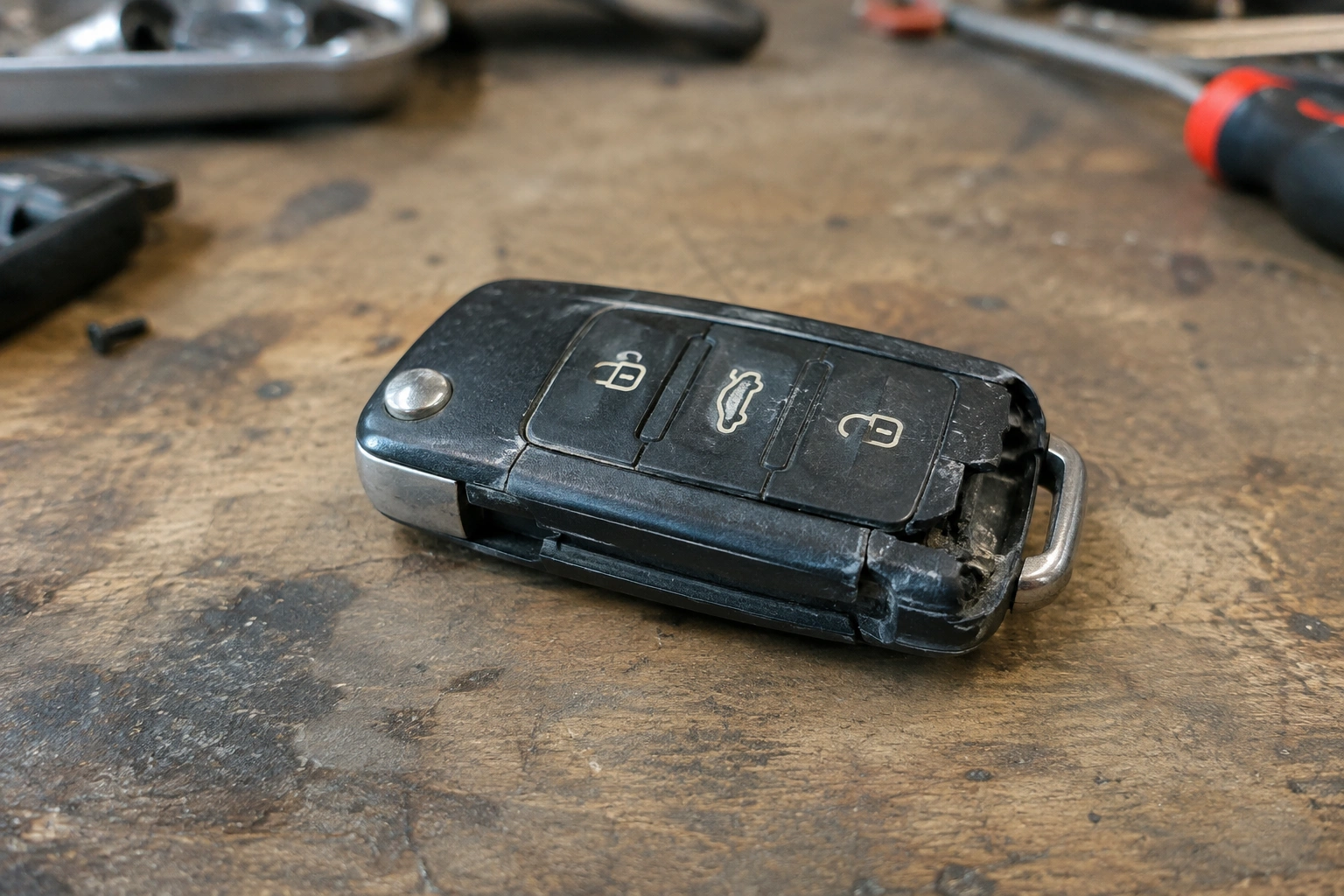
A cracked shell does not always mean the electronics are ruined. If the board and battery contacts are still intact, a shell replacement or case repair may bring the fob back to life.
New battery, same problem
If you already installed a fresh battery and the fob still fails, the battery was probably not the whole story. At that point, look harder at the contacts, the circuit board, or the programming.
Quick decision path if you have a spare fob
If you have a spare fob, use it before booking service:
1. Spare works normally — the problem is likely in the original fob, not the car.
2. Spare also fails the same way — the car, receiver, or programming may be the issue.
3. Spare works for unlocking but not starting — the battery or transponder/push-button system may need attention.
4. Neither fob works after a recent battery change or repair — reprogramming or a vehicle-side issue becomes more likely.
Most Likely Causes, Ranked by Probability
In everyday shop work, the most common causes are usually the simplest ones.
1. Battery depletion
This is the most common and least expensive fix. Batteries wear out, and many drivers wait until the fob is nearly useless before replacing one. If the fob has been acting weak for weeks, the battery is a logical first suspect.
2. Worn button contacts
Frequent use eventually wears down the internal pads or the rubber button surface. The fob may still send a signal, but only when you press in just the right spot.
3. Loose internal connection
A dropped fob can shift the battery, loosen the board, or crack a solder point. That kind of damage often creates an on-and-off failure that looks random from the driver’s seat.
4. Water or moisture damage
Moisture can corrode contacts and damage the circuit board. If the fob was exposed to water, avoid repeatedly pressing the buttons just to “see if it works.” That can make the internal damage worse.
5. Programming or syncing issue
If the fob battery is good and the hardware looks intact, the vehicle may no longer recognize the remote. This is more common after battery changes, repairs, or replacement fobs, and it often requires a locksmith or dealer tool to address.
Try These Basic Fixes First
A few safe checks can save you a service call.
1. Replace the battery
Open the fob carefully and note the battery type before removing it. Make sure the new battery is installed in the correct orientation. A reversed battery can make a good remote look dead.
2. Test the spare fob
If you have a second fob, use it. If the spare works normally, the problem is probably limited to the original remote rather than the car itself.
3. Inspect the battery contacts
Look for green corrosion, bent metal tabs, or a battery that sits loosely. Light corrosion can sometimes be cleaned, but severe corrosion usually means the fob needs professional attention.
4. Reassemble the shell firmly
A cracked or poorly seated case can prevent the battery from making solid contact. If the shell is broken, you may get temporary results by pressing the case together, which is a strong hint that the housing needs repair.
5. Try the vehicle’s manual-key backup if available
Some vehicles still let you use a hidden mechanical key in the fob. If that works, it confirms the car’s lock system is functional even if the remote electronics are not.
If your car starts only when the fob is held near the start button, our guide on why a car starts only when the key fob is held near the start button can help you narrow it down further.
Repair vs Replacement: How to Decide
The decision usually comes down to damage severity, part availability, and total cost.
Repair makes more sense when:
- The battery is the main issue.
- The shell is cracked but the circuit board still works.
- Buttons are worn, but the fob still transmits.
- A technician can clean contacts or repair a loose connection.
Replacement makes more sense when:
- The circuit board is badly corroded or water-damaged.
- The fob is physically shattered.
- The vehicle requires a specific fob that is not practical to repair economically.
- Repair plus programming ends up close to the cost of a replacement.
A useful rule: if the electronics still respond and the damage is mostly to the case, repair is often worth asking about. If the board is damaged or the fob has been submerged, replacement may be the better value.
Also remember that new cars often come with two fobs, and if you do not have a spare, you can usually buy one from a dealership or a third-party maker. OEM fobs are made to the vehicle maker’s specifications and are usually the safest bet for compatibility, but they tend to cost more. Aftermarket fobs are often cheaper and can work well, but compatibility can vary by trim, year, and feature set, so they may require more careful checking before purchase. If you are comparing options, it is worth asking whether the replacement is OEM or aftermarket and whether it has been verified for your exact vehicle.
If you want a broad price comparison, it is fair to say third-party replacements are often cheaper than dealer parts, but the exact savings vary too much by vehicle to quote a universal percentage. Compatibility still needs to be checked carefully. AARP’s key fob repair and replacement tips
Where to Get Car Key Fob Repair Near You
Not every local shop offers the same level of service. Some can diagnose, repair, and program; others only sell replacements or handle simple battery swaps.
| Local option | What they usually can do | What they usually cannot do | Programming support | Typical turnaround | Best for |
|---|---|---|---|---|---|
| Automotive locksmith | Diagnose, replace batteries, repair shells, reprogram many fobs, and supply replacements | May not repair every board-level electronic failure or support every vehicle | Often yes | Same day or next day in many cases | Fast diagnosis and a balance of price and convenience |
| Dealership service department | OEM replacement, vehicle-specific support, and model-matched programming | Usually not a true repair shop for internal fob electronics; may replace the whole unit instead | Yes | Often same day to several days | Vehicles with strict compatibility requirements |
| Mobile locksmith | On-site diagnosis, replacement, and programming for many vehicles | Same limits as other locksmiths on board-level electronic repair and some rare vehicles | Often yes | Often same day | If the car is stuck or you want service at home or work |
| Auto parts or hardware store | Battery replacement and, in some locations, selling remotes or offering limited key services | Often cannot repair internal components, circuit boards, or water damage | Sometimes, depending on the vehicle and store | While you wait, if supported | Simple battery changes or buying a compatible remote |
A practical example: if your fob only needs a battery and a new shell, a locksmith or hardware store may be enough. If the vehicle is picky about programming, or you want OEM parts, the dealership may be the safer route.
Some auto parts and hardware stores only replace batteries or sell remotes and may not repair internal electronics at all, so it is worth asking exactly what they handle before you go. If you need board-level repair, corrosion cleanup, or a full diagnosis, a locksmith or dealership is more likely to be the right fit.
Ace Hardware says it can program some keys while you shop, but availability depends on the vehicle and the store, so it is best treated as a location-by-location service rather than a universal option. Ace Hardware automotive key services
What Key Fob Repair Usually Costs and How Long It Takes
Prices vary by vehicle, part type, and whether programming is needed, so the safest way to shop is by service type rather than a single “average.”
Common cost buckets
- Battery replacement: often about $10 to $30 if you pay a shop; DIY battery cost is usually lower
- Shell or case replacement: often about $20 to $80, depending on the fob style and whether the shell is a simple snap-fit design
- Minor contact cleanup or simple internal repair: often about $50 to $150, but this depends heavily on labor and whether the board is still salvageable
- Reprogramming: often about $50 to $150 when charged separately
- Full replacement fob: often about $100 to $400+ at a locksmith or parts counter, and sometimes more at a dealership for newer or premium vehicles
These are broad ranges only. Push-button start systems, transponder keys, and luxury or newer vehicles can cost more, while simpler remote-entry-only fobs can cost less.
Common turnaround expectations
- Battery swap: often while you wait
- Shell replacement: often same day if parts are on hand
- Programming or syncing: may take a few minutes to an hour, depending on the vehicle
- Water-damaged or board-level repair: could take longer, especially if the shop needs to source parts or test the unit
When you compare quotes, ask whether the price includes diagnosis, parts, programming, and testing. A lower upfront quote can become more expensive if programming is extra.
Signs the Problem Is More Than a Battery
Some symptoms point to deeper damage that a battery change will not fix.
Water exposure
If the fob was washed, dropped in a puddle, or exposed to rain through a cracked shell, internal corrosion is a real concern. A battery swap may not change anything if the board is already damaged.
Corrosion around the battery area
White or green buildup on the metal contacts is a warning sign. Light corrosion can sometimes be cleaned, but heavy corrosion often means the fob needs more than a simple repair.
Buttons work inconsistently even with a new battery
That usually suggests worn contacts, a failing board, or a shell problem rather than a power issue.
The car still does not recognize the fob
If the remote battery is new and the buttons seem fine, the vehicle may need the fob reprogrammed or resynced. In some cases, the fob itself is not the only issue.
When repair is possible versus when replacement is more likely
- Often repairable: dead battery, worn shell, loose battery contact, dirty or corroded contacts, or a button issue with an otherwise working board
- Sometimes repairable, sometimes not: minor water exposure, depending on how quickly the fob was dried and whether corrosion reached the circuit board
- Usually replacement territory: heavy water damage, a cracked or burned circuit board, or a fob that has already failed multiple repair attempts
What to Ask Before You Hand Over the Fob
A few questions can save time and prevent surprise charges.
- Can you diagnose whether the issue is the battery, shell, contacts, or circuit board?
- Does the price include diagnosis?
- Does the price include programming and testing?
- Can you test the fob on-site before I leave?
- Can you repair my existing fob, or do you only sell replacements?
- Do you offer OEM or aftermarket options?
- Will the replacement be compatible with my exact year, make, model, and trim?
- Is there a warranty on the repair or the new fob?
- What is the final out-the-door price?
If a shop cannot answer those questions clearly, keep calling. A good provider should be able to explain what they can fix and what they cannot.
Before you call, gather this information:
– Year, make, and model
– Trim level, if you know it
– VIN
– Whether you have a spare fob
– Whether the fob is push-button start or remote entry only
– Whether the car uses a transponder key or a traditional mechanical key backup
That information helps the shop confirm compatibility and tell you whether they can diagnose, repair, reprogram, or only replace the fob.
When to Consult a Locksmith
Call a locksmith or mobile technician when the fob is still physically intact but not working after basic troubleshooting, when the shell is damaged but the electronics may still be usable, or when programming is the likely issue. A locksmith is often the best first call when you want a repair-first approach and need someone who can usually diagnose, test, and reprogram in one visit.
A dealership may still be the right choice for some vehicles, especially when the car requires OEM parts or model-specific programming. But if you want to compare options, an automotive locksmith is often the most practical place to start.
How to Prevent the Same Problem Again
A few habits can extend the life of a fob.
- Replace the battery before it dies completely if you notice range dropping.
- Keep the fob dry and avoid leaving it in places where it can get soaked.
- Don’t force worn buttons; that can worsen shell damage.
- Use a protective case if the fob gets tossed in a bag or pocket with coins and keys.
- Keep a spare fob accessible, not buried in a drawer.
If your current fob is still partly working, that is usually the best time to fix it. Waiting until it fails completely can turn a simple battery or shell issue into a more expensive replacement.
FAQ
Can a key fob be repaired, or does it always need replacement?
Often it can be repaired if the problem is the battery, shell, buttons, or contacts. Replacement is more likely when the circuit board is badly damaged, water-damaged, or no longer communicates with the car.
Does key fob repair include reprogramming?
Not always. Battery swaps and shell repairs usually do not require reprogramming unless the vehicle lost sync or the fob was replaced. If the fob was repaired after a board issue, or if the car no longer recognizes it, reprogramming may be necessary.
How do I know if the problem is the fob or the car?
The easiest test is a spare fob. If the spare works, the original fob is the likely problem. If both fobs fail, the issue may be with the vehicle, receiver, or programming.
Can an auto parts store repair my fob?
Some can replace batteries or sell compatible remotes, and some offer limited programming. Many cannot repair internal circuit boards, corrosion, or water damage.
Is OEM better than aftermarket for a replacement fob?
OEM is usually the safer choice for compatibility and reliability, but it costs more. Aftermarket can save money and work well when matched correctly, but fit and feature support can be less consistent.
How much does key fob repair near me usually cost?
Simple battery replacement is often the cheapest option, while shell replacement, programming, and full fob replacement cost more. For many common vehicles, a rough range is about $10 to $30 for battery replacement, $20 to $80 for a shell, $50 to $150 for programming, and $100 to $400+ for a full replacement, depending on the vehicle and location.
Should I call a locksmith or a dealership first?
If you want the most repair-first approach and faster local service, start with a locksmith. If your vehicle needs OEM parts or has strict programming requirements, the dealership may be the better fit.
