
Why a Car Starts Only When the Key Fob Is Held Near the Start Button

If your car starts only when the key fob is held near the start button, the system is usually telling you one thing: it can still detect the fob at very close range, but normal-range communication has become weak or unreliable. That often points to a weak key fob battery, a failing fob, or a vehicle-side smart key problem.
The good news is that this symptom is usually diagnosable without special tools. You can narrow it down with a few quick checks, and in many cases the fix is as simple as replacing the fob battery. But if the problem stays after that, don’t assume the fob is the only suspect. A weak car battery, a receiver issue, or an immobilizer fault can create the same behavior.
What this symptom usually means
Most push-button start systems use a smart key system that looks for an RF signal from the fob. If the car can’t read the fob at normal distance, it may still recognize it when the fob is placed right next to the start button or in a specific backup location.
That backup behavior can be a clue, but it is not a universal rule. In some vehicles it reflects a weak fob battery or limited fob signal; in others, a vehicle-side receiver, antenna, or battery issue can create a similar pattern. So if your car only starts when you “help” the fob by holding it close, treat that as a clue, not a diagnosis.
How push-button start systems read the fob
In plain terms, the car is checking for a valid smart-key signal before it allows the engine to start. In many systems, the fob broadcasts an RF signal and the vehicle authenticates it. The battery in the fob powers the electronics that send the signal, but some vehicles also have a backup method that works at very short range.
That is why a fob can seem half-dead: the lock and unlock range may be gone, but the car can still read it when the fob is almost touching the start button. Different vehicles use different terminology and different backup designs, so “transponder” is not always the best catch-all term.
Most likely causes, in the order I’d check them
Here’s the practical order I’d use as a former tech:
-
Weak key fob battery
This is the most common first suspect. A weak battery can still leave just enough power for close-range detection. -
Failing key fob electronics
If a new battery doesn’t help, the fob’s internal board, contacts, or smart-key circuitry may be failing. -
Weak car battery
A low vehicle battery can prevent the smart-key system from fully waking up, even if the fob is fine. -
Receiver or antenna issue in the vehicle
The car may not be hearing the fob well outside of emergency range. -
Immobilizer or smart-key fault
These systems can block starting even when the fob looks normal. -
Start button or related wiring problem
Less common, but still possible if the button only works inconsistently.
Quick checks to separate a fob problem from a car problem
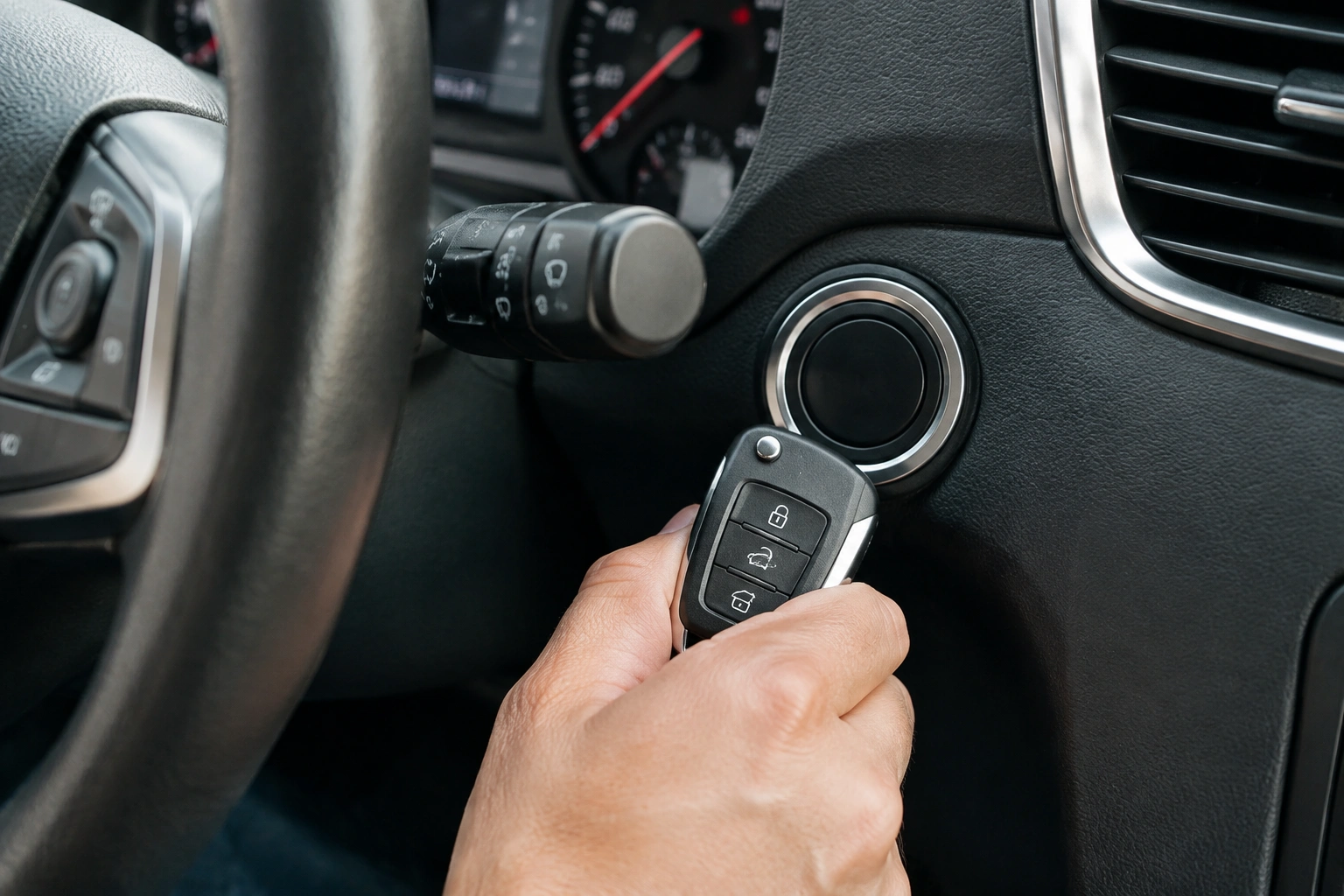
Use these checks before buying parts.
Try the spare key fob
If you have a spare, test it in the same parking spot. This is the fastest way to separate a one-fob issue from a vehicle-side issue.
- Spare works normally: the original fob is the likely problem.
- Spare has the same symptom: look at the car battery, receiver, antenna, or immobilizer system.
Check whether normal remote functions are weak too
If lock/unlock range has dropped at the same time, that points strongly toward the fob battery or fob electronics.
Look for other electrical symptoms
Dim dash lights, slow cranking, interior electronics acting strange, or a battery warning light suggest the vehicle battery may be part of the problem.
Test both fobs the same way
If both fobs need to be held near the start button, the odds shift away from a single bad fob and toward the car itself.
Weak key fob battery vs. weak car battery
These two get mixed up a lot because both can create a no-start or close-range-start symptom.
| Symptom | Weak key fob battery | Weak car battery |
|---|---|---|
| Remote lock/unlock range | Often reduced first | Usually still works, but vehicle electronics may act odd |
| Dash/interior power | Usually normal once the car is awake | Often dim, delayed, or inconsistent |
| Car starts only when fob is very close | Common | Possible |
| Both fobs affected | Not usually | More likely |
| Replacing fob battery helps | Often yes | No |
A weak car battery can mimic a bad fob because the smart-key system may not have enough voltage to recognize the key properly. If the car seems sluggish even before you try to start it, don’t focus only on the fob.
How to start the car when the fob battery is low
The exact emergency method is model-specific, so the owner’s manual is the authoritative source. Many vehicles have one of these backup designs:
- a specific spot near the start button
- a marked fob pocket or tray
- a “press and hold” start procedure
- a transponder reader hidden in the console, steering column, or cupholder area
Some vehicles require the fob to be placed against a marked area or in a dedicated backup location before the car will read it. Others use a different procedure entirely, which is why guessing can waste time.
If your manual shows a backup location, use that exact spot rather than assuming a universal method. That matters because the car may only read the fob in one place.
If you want a broader walkthrough of backup-start behavior, our guide on how to start a car when the key fob is not detected explains the typical methods without assuming one brand’s procedure. For a more emergency-focused version, see emergency start when key fob is not detected.
Step-by-step: replace the key fob battery first
If the fob is older, the range has dropped, or the car only starts when the fob is held very close, replacing the battery is the best low-cost first move.
What to do
- Open the fob carefully using the seam or release point in the shell.
- Note the battery type before removing it.
- Install the new battery with the correct polarity.
- Reassemble the fob fully so the contacts sit cleanly.
- Test lock/unlock range and normal starting distance.
What to watch for afterward
- If the car starts normally again, the battery was likely the issue.
- If the symptom improves only a little, the battery may not be the whole story.
- If nothing changes, move on to the car battery and vehicle-side checks.
A battery swap is worth trying first because it’s quick and inexpensive compared with diagnosing a receiver or immobilizer fault. But it is not proof that the fob is healthy.
If a new fob battery does not fix it
At that point, I’d branch the diagnosis like this:
Check the car battery
If the vehicle battery is weak, the car may still wake up just enough to allow a close-range start, but not enough for normal smart-key operation. Watch for slow crank, dim lights, or other electrical weirdness.
Compare both fobs again
If both fobs need to be held close, the problem is probably not a single fob battery. That points toward the vehicle’s receiver, antenna, or immobilizer system.
Consider fob electronics
A new battery does not rescue a damaged circuit board, worn contacts, or a failing smart-key transmitter.
Think vehicle-side, not just fob-side
If the car has intermittent no-start behavior, a bad antenna module, a smart-key receiver issue, or a start-button circuit fault can be involved.
If it starts only intermittently, even with a spare
If the car starts only sometimes even with a spare fob and a new fob battery, that is a stronger sign of a vehicle-side issue than a bad key fob. Intermittent recognition usually points toward the car battery, receiver, antenna, or related wiring rather than a single weak fob.
When a weak car battery can look like a key fob problem
This is the trap many owners fall into: the fob seems guilty because the car starts when the fob is held close, but the real issue is that the car itself is underpowered.
A weak vehicle battery can cause:
– intermittent dash power
– delayed accessory power-up
– failure to recognize the fob at normal range
– strange warning messages
– repeated start attempts that get worse over time
If your car has been sitting, has a battery older than you’d like, or shows any electrical hesitation, check it before replacing multiple fobs.
When to use a spare key fob
Use the spare when you need a clean yes-or-no test.
- Spare works normally: replace or repair the original fob.
- Spare behaves the same: focus on the vehicle battery, receiver, antenna, or immobilizer.
- Both fobs are weak but still usable only at close range: the car battery or vehicle-side system deserves attention.
That one test can save you from buying the wrong part.
When to contact a dealer, locksmith, or mechanic
If the problem continues after a new fob battery, or if both fobs act the same way, it’s time to get help from a dealer, locksmith, or mechanic who works on smart-key systems.
A locksmith is often a good fit when:
– the issue seems limited to the fob itself
– the fob shell, contacts, or battery compartment are damaged
– you need a replacement or spare fob checked
A dealer or advanced mechanic is often better when:
– both fobs fail the same way
– the car battery checks out
– the vehicle shows keyless or immobilizer warnings
– the issue looks like a receiver, antenna, or module fault
If you’re unsure whether the car is actually detecting the key at all, our guide on why your car says “key fob not detected” but still starts can help you sort out that in-between symptom.
How to keep the problem from coming back
A few habits make a difference:
- Replace the fob battery proactively when range starts dropping.
- Keep a spare battery in the glove box if your fob uses a common coin cell.
- Test your spare key fob occasionally so you know it works.
- Pay attention to weak car battery symptoms before they strand you.
- Don’t ignore intermittent start behavior just because the car eventually starts.
The key is to treat this as an early warning sign. If the car only starts when the fob is held near the button, something in the system is already losing margin. Catching it early usually keeps the repair simpler.
FAQ
Why does my car start only when the key fob is held near the start button?
Usually because the car can still detect the fob at very close range, but not at normal range. The most common cause is a weak fob battery, though the car battery or vehicle-side receiver can also be involved.
Can a dead key fob battery still let the car start?
Often yes, if the vehicle has a backup reader or emergency start method. That backup is usually meant for low-battery situations, not as a permanent workaround.
Will replacing the fob battery fix it?
Sometimes. If the battery is the real issue, replacing it may restore normal range and starting behavior. If the symptom stays, the fob electronics or the car’s smart-key system may be the problem.
Could my car battery be the cause?
Yes. A weak car battery can prevent the smart-key system from waking up properly, which can make the fob seem like the problem.
What if both key fobs do the same thing?
That usually points away from one bad fob and toward the vehicle battery, receiver, antenna, or immobilizer system.
Is it safe to drive after using the emergency start method?
If the car starts and runs normally, you can usually drive it to a repair shop or home, but don’t treat that method as a permanent fix. If the battery or starting system is weak, confirm the car will restart before heading far from help.
What should I do if a new battery doesn’t help?
Test the spare fob, check the car battery, and then get a professional diagnosis if the symptom remains. That’s the point where vehicle-side faults become much more likely.
