
Security Light Flashing and the Car Won’t Start? What Your Key Fob Is Trying to Tell You

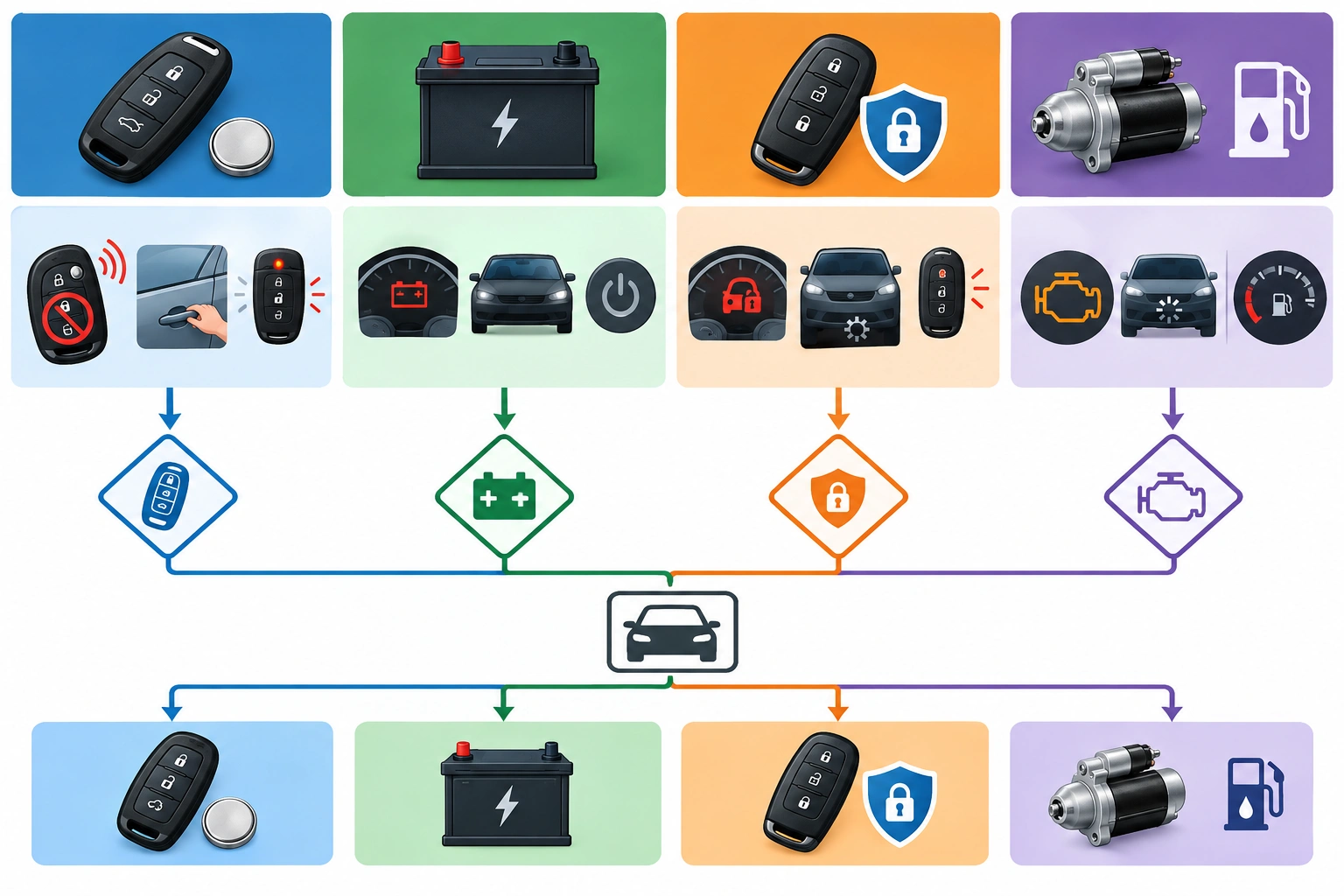
If your security light is flashing and the car won’t start with the key fob, the vehicle is usually telling you one thing: it does not think it has a valid key signal. That can happen because of a weak fob battery, a weak car battery, a damaged transponder chip, an immobilizer issue, or, less often, a starter or fuel problem that just happens to show up at the same time.
The good news is that you can narrow this down quickly without guessing. The fastest fix is usually the simplest test done in the right order.
What a flashing security light usually means
A flashing security or immobilizer light often means the anti-theft system is not recognizing the key. On many vehicles, that light is part of the immobilizer system, which is designed to prevent the engine from starting unless the car sees the right transponder signal.
That does not automatically mean the key fob battery is dead. On some cars, a dead fob battery only affects remote lock and unlock. On others, especially push-button start models, a weak fob battery can also prevent the car from detecting the key unless you use the backup start method.
It is also worth separating a true fault from normal behavior. Some vehicles flash a security light briefly during startup, bulb check, or a normal anti-theft sequence. That can be normal if the light goes out as expected and the car starts. A flashing light becomes more meaningful when it appears during a no-start attempt, stays on longer than usual, or matches other symptoms like “key not detected.”
A flashing light can also show up after a low car battery or a battery disconnect. That is why it helps to treat this as a no-start triage problem, not a one-part diagnosis.
Fast triage: check the most likely causes first
Use this order because it saves time and avoids replacing the wrong part.
| Symptom | Most likely cause | What to do first |
|---|---|---|
| Security light flashes, spare key works | Main fob battery, damaged fob, or transponder issue | Replace the main fob battery and inspect the key |
| Security light flashes, no key is recognized | Immobilizer or key-reading problem | Try the backup start method and check the car battery |
| Dash is dim, electronics are weak, car sat for a while | Weak car battery or loose terminals | Test or jump-start the battery |
| Engine cranks but will not fire | Immobilizer, fuel, or ignition issue | Watch the security light pattern and check for other clues |
| No crank, no start, security light flashing | Key recognition or starter circuit issue | Try a spare key, then check voltage and connections |
If you want a broader starting checklist, this guide on what to check when the key fob unlocks doors but the car won’t start is a useful companion read.
Step 1: Try the spare key or backup start method
The spare key test is the fastest way to separate a key problem from a vehicle problem.
If the spare key starts the car, that points to a problem with the main key itself, such as a weak fob battery, damaged transponder chip, worn key shell, or a key that may need reprogramming or replacement. If neither key works, the issue is more likely on the vehicle side, such as the immobilizer, antenna ring, wiring, or low voltage.
Before you keep trying to start the car, use the backup start method if your vehicle has one. Exact steps vary by make and model, but the common approaches are:
Push-button start: common emergency start steps
- Make sure the vehicle is fully in Park.
- Keep your foot on the brake.
- Hold the key fob directly against the start button, or place it in the designated backup slot if your vehicle has one.
- Press the start button normally while keeping the fob in that position.
- If the car starts, replace the fob battery as soon as possible and check the owner’s manual for the exact backup procedure for your model.
Keyed ignition: common emergency start steps
- Insert the key fully into the ignition.
- Turn it to the start position as usual.
- If the key is a transponder key and the car still does not recognize it, try the spare key if available.
- If your manual describes a specific emergency start position, key-insertion method, or immobilizer bypass step, follow only that procedure.
Do not assume every model uses the same backup method. Some vehicles need the fob held near the start button, some use a slot, and some have no user-accessible backup start at all.
If you need a quick overview of that situation, this related article on what to check when the key fob turns on but won’t start the engine covers the same decision path from a different angle.
Step 2: Check the key fob battery and fob condition
A weak fob battery is one of the easiest fixes, but only if the rest of the fob is healthy.
Look for these signs:
– The car unlocks inconsistently.
– The range got noticeably worse.
– The vehicle responds only when the fob is very close.
– The fob works one day and not the next.
If the battery is old or the fob has never been serviced, replacing the battery is a reasonable first move. Just keep in mind that a fresh battery will not fix a cracked circuit board, water damage, or a broken transponder chip.
That distinction matters. A dead battery can make the fob “quiet.” A damaged fob can still have power but fail to send the right signal. If the spare key works and the main one does not, the problem is usually in the main key itself, not the car.
If your fob battery is already dead, this article on starting a car when the key fob battery is dead explains the backup method in more detail.
Step 3: Test the car battery and electrical connections
A weak car battery can create security-system symptoms that look like a key problem. Low voltage may keep the immobilizer from waking up correctly, or it may make the dash behave erratically enough that the car never completes the start sequence.
Check the car battery first if the dash is dead or the vehicle has no electrical power at all. In that situation, a key fob issue is much less likely than a battery, terminal, or main power connection problem.
Check for:
– Dim interior lights or a slow dash wake-up
– Clicking instead of cranking
– Corrosion on the battery terminals
– Loose battery clamps that move by hand
– A battery that is several years old or has recently gone flat
If the battery is obviously weak, jump-starting may restore enough voltage to see whether the car recognizes the key. That said, a jump-start is a test, not a cure. If the vehicle starts after a jump but the security light behavior changes, the low-voltage event may have exposed a bigger battery issue.
For safety, make sure the cables are connected correctly and avoid repeated cranking if the car clearly is not recognizing the key. That can waste time and, on some vehicles, make the system more stubborn.
Step 4: Try the immobilizer or anti-theft reset procedure
Some vehicles recover after a simple reset or relearn. Others do not. The important part is following the manufacturer’s procedure, not a random internet sequence.
Use only the reset or relearn steps listed in the owner’s manual for your exact vehicle. A generic “reset” can help on one model and do nothing on another.
A basic owner-level procedure may involve:
– Locking the car and waiting a few minutes
– Unlocking with the correct key
– Cycling the ignition or start button in a specific order
– Using the spare key if the manual recommends it
This is most useful after:
– A weak or disconnected car battery
– A fob battery replacement
– A brief electronic glitch
If the car is still not recognizing the key after the manual procedure, stop repeating the same cycle over and over. Repeated lockout attempts can keep you from making progress and may extend the wait before the system will try again.
What the security light pattern can tell you
The exact meaning of the security light is vehicle-specific, but the pattern still gives you clues.
A light that flashes quickly during the no-start attempt often points to key recognition trouble on many vehicles. A light that stays on or changes behavior after a battery disconnect may point to a system fault or relearn issue. If the light behaves normally and the engine still will not start, the problem may be outside the immobilizer entirely.
That is why the light should be read as a clue, not a verdict. A flashing security light can point to the immobilizer, but it does not rule out a starter fault, blown fuse, or fuel delivery problem. If the engine cranks normally and never catches, the issue may be beyond the key system.
If the car still won’t start: likely causes by symptom pattern
Here is how I sort the leftovers.
Security light flashes and the engine does not crank
This usually keeps the immobilizer high on the list, but a weak battery, bad terminal connection, or starter circuit issue can still be involved. If the dash is weak too, voltage is the first thing to check.
Security light flashes and the engine cranks but will not fire
That can still be an immobilizer issue, but it can also mean fuel delivery or ignition is the real problem. The security system may be innocent, and the flashing light may just be a side clue from a low-voltage event.
Spare key works, main key does not
This strongly suggests the main key is the problem. Replace the fob battery first if it has one. If that does not help, the transponder or fob electronics may be damaged, and the key may need reprogramming or replacement.
Neither key works
Now you are looking at the vehicle side: low battery, immobilizer fault, antenna ring issue, fuse, or wiring problem.
When to consult a locksmith
Call a locksmith when the fob is damaged, the spare key is unavailable, or the vehicle needs a replacement and programming service you cannot do yourself. A locksmith is often the right call when the main key is clearly bad but the car itself seems fine.
Call a dealer if your make and model requires manufacturer-specific programming or if the locksmith cannot service your system. Call a mechanic if the key checks pass, the battery is healthy, and the car still shows a no-start condition that points to starter, fuse, or fuel issues.
If you are choosing between them, use this simple rule: locksmith for key cutting, fob replacement, and many programming jobs; dealer for brand-specific programming or security systems that require factory tools; mechanic for battery, starter, charging, fuse, or fuel diagnosis.
How to prevent this from happening again
A few habits make a big difference:
– Replace the fob battery before it gets weak.
– Keep a working spare key in a safe place.
– Clean battery terminals before corrosion becomes a no-start issue.
– Pay attention when the car starts acting strange after a battery replacement or jump-start.
– Check the owner’s manual for your vehicle’s emergency start method before you need it.
If your car is already showing warning signs, a small battery problem is easier to handle now than after it leaves you stranded in a parking lot.
FAQ
Can a dead key fob battery stop the car from starting?
Yes, on some vehicles it can. On others, the fob battery only affects remote functions. Push-button start systems often have a backup method that lets the car read the fob at very close range.
Why does the security light flash after a battery replacement?
A battery disconnect or low-voltage event can change how the system behaves on some vehicles. Follow the owner’s manual procedure for your model if a relearn is needed.
If my spare key works, is the car the problem?
Usually no. If the spare starts the car, the issue is more likely the main key, its battery, or the transponder inside that key.
Can a starter problem look like a security issue?
Yes. If the engine does not crank, the symptom can resemble an immobilizer fault. That is why battery voltage, key recognition, and starter behavior all need to be checked in order.
Do I need a dealer to reprogram the key fob?
Not always. Some vehicles can be serviced by a locksmith, while others need dealer-level programming. The owner’s manual or a vehicle-specific service source is the safest guide.
What if the security light is flashing but the car still cranks?
Then the car may be dealing with a key recognition issue, or the no-start may be caused by fuel or ignition instead. The light is a clue, not a complete diagnosis.
Where can I confirm what my security light means?
Your owner’s manual is the best starting point because security-light behavior varies by make and model.
