
When to Replace a Car Key Fob: Clear Signs It’s Time to Act

If your key fob is acting up, don’t guess. In most cases, the first move is a battery check. If a fresh battery does not fix weak range, intermittent locking, or push-button start problems, the fob may be failing internally and may need repair, reprogramming, or full replacement.
Here’s a simple way to sort it out:
– Try a battery first if the fob is weak, slow, or works only from close range.
– Consider repair if the shell, buttons, or battery contacts are the obvious problem.
– Consider replacement if the fob has water damage, repeated battery drain, a loose/rattling case, or an internal transmitter issue.
– Check reprogramming if the fob seems fine physically but the car no longer recognizes it.
A key fob battery often lasts about 1–2 years, but actual battery life can vary widely by vehicle, usage, and fob type.^1
Signs Your Key Fob Is Failing
The warning signs usually show up before the fob quits completely. That’s good news, because it gives you time to troubleshoot before you get locked out.
Weak range
If you used to unlock the car from across the driveway and now have to stand next to the door, the battery is the first suspect. But weak range can also point to a failing transmitter, dirty battery contacts, or damage inside the fob.
A useful comparison: if the range dropped suddenly after years of normal use, battery wear is more likely. If the range has been getting worse even after battery changes, the fob itself may be the problem.
Intermittent locking and unlocking
When the buttons only work sometimes, the issue may be worn button pads, loose internal contacts, or a cracked circuit board. A fob that works only when pressed hard is often showing mechanical wear, not just battery trouble.
Unresponsive buttons
If one button works and another does not, that often points to button wear or contamination inside the case. If none of the buttons respond, check the battery first, then look for corrosion, cracked housing, or a damaged circuit board.
Repeated battery drain
A fob that keeps killing batteries can be more than annoying. Frequent battery replacement may mean an internal short or another electrical issue, which is a strong sign that repair or replacement may be needed sooner rather than later.^1
Push-button start problems
If the car unlocks but refuses to start unless the fob is held very close to the start button, the battery may be weak. If that behavior continues after a battery change, the fob’s transponder or internal electronics may be failing.
For background on what to do when the vehicle does not recognize the fob, see our guide on how to start a car when the key fob is not detected.
Most Likely Causes, from Easiest to Most Serious
1. Dead or weak battery
This is still the most common and cheapest fix. A weak battery can cause reduced range, delayed response, and push-button start issues.
2. Worn buttons or loose battery contacts
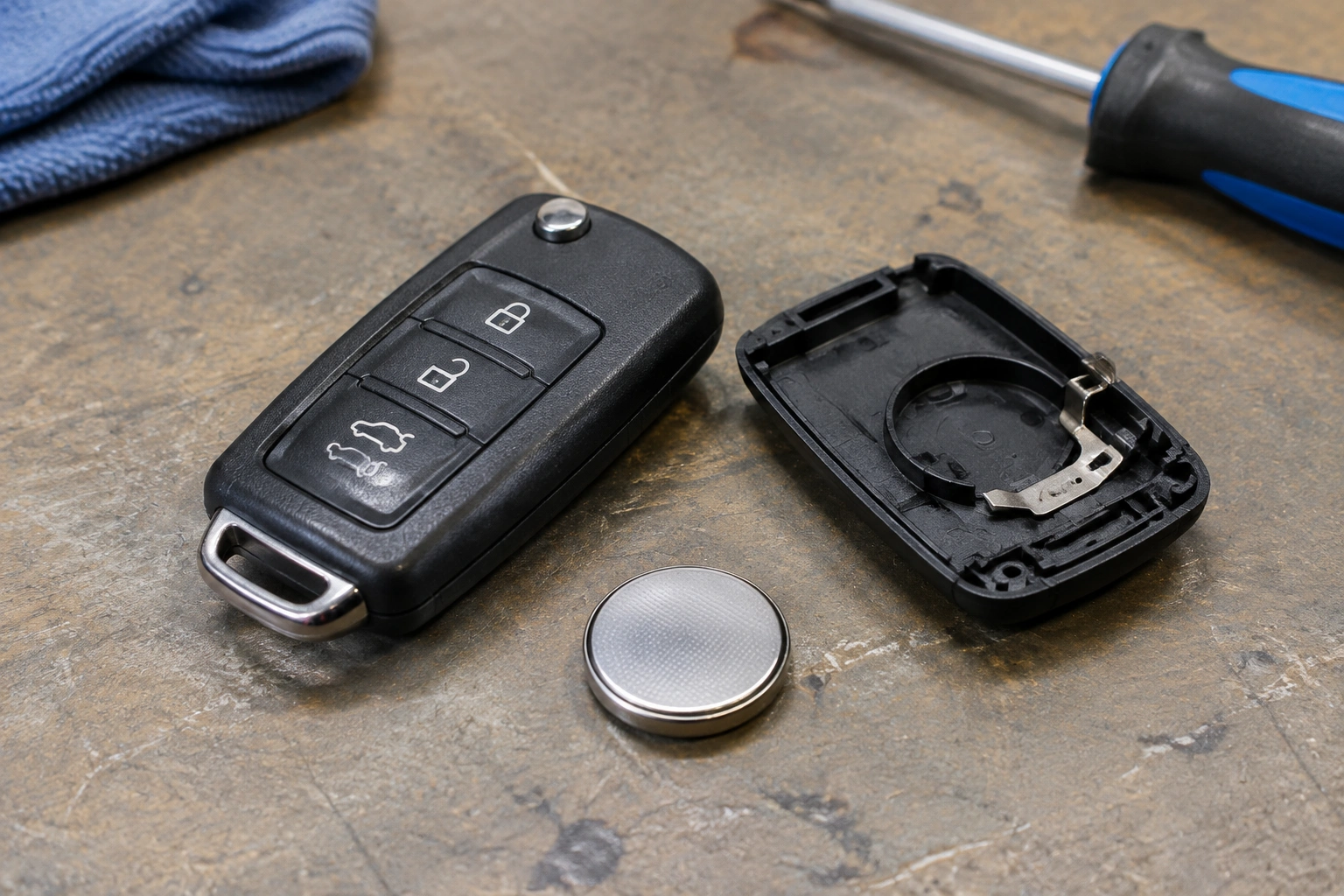
If the fob casing is cracked or the battery is not sitting firmly in place, the connection can break when the fob is moved or pressed. That creates the classic “works sometimes” complaint.
3. Dirty or corroded internals
Moisture, pocket lint, and battery leakage can create corrosion on the circuit board or contacts. In mild cases, cleaning and a shell replacement may help. In worse cases, the electronics are already damaged.
4. Water damage
A fob that was washed, dropped in a puddle, or exposed to heavy rain may work for a while and then fail later. Water damage is one of the clearest signs that replacement may be needed, especially if corrosion has started on the board. If that sounds familiar, our article on car key fob water damage repair walks through the next steps.
5. Faulty internal transmitter or transponder chip
If the transmitter is bad, the fob may still light up or look normal but not communicate with the vehicle. Depending on the vehicle and fob design, that issue may call for reprogramming, repair, or full replacement rather than a simple battery swap.
6. Vehicle-side issue
Sometimes the fob is innocent. A second key fob that works normally is a strong clue that the original fob is the issue. If neither fob works, the car’s receiver, antenna, or programming may be the real problem.
Troubleshooting Steps Before You Replace the Fob
Before spending money on a new fob, run through these checks in order.
Replace the battery first
Use the correct battery type for your vehicle and make sure it is installed with the right polarity. If the old battery was weak, this alone may restore normal operation.
Test the spare fob
If you have a second fob, use it. This is one of the fastest ways to separate a bad fob from a car-side issue. If the spare works and the original does not, the original fob is more likely the problem. If neither works, the issue may be in the vehicle’s receiver or programming instead of the fob itself.
Inspect the case and buttons
Look for cracks, loose seams, missing button covers, or buttons that feel mushy or stuck. A damaged shell can let the battery shift or allow dirt and moisture inside.
Shake it gently
A loose or rattling fob can mean internal parts have come loose or been damaged, often after repeated drops.^1 That does not automatically mean it is beyond saving, but it is a warning sign that the internals may be compromised.
Check for corrosion or residue
Open the fob carefully and look for white, green, or rusty buildup around the battery contacts or circuit board. Corrosion usually gets worse over time, not better.
Try the fob at different distances
If it only works right next to the car, that suggests a weak battery or weak transmitter. If it works inconsistently regardless of distance, the issue is more likely internal.
Quick Decision Tree: Battery, Shell, Corrosion, Programming, or Full Replacement
If you need the fast version, use this:
- Battery issue: weak range, delayed response, or push-button start works only when the fob is held close
- Try a fresh battery first.
- Shell/button issue: cracked case, stuck buttons, loose battery, or buttons that only work when pressed hard
- A shell repair or button repair may be enough.
- Water/corrosion issue: visible residue, battery leakage, or the fob was washed/dropped in water
- Clean only if the damage is minor; otherwise replacement is often more practical.
- Programming issue: replacement fob looks fine, but the car does not recognize it
- Reprogramming or syncing may be needed.
- Full replacement: repeated battery drain, damaged board, broken transponder, or multiple failed fixes
- A new fob is usually the next step.
If you only have one fob, a simple rule is: if the spare-test isn’t available, and the battery plus shell look fine but the car still won’t recognize the fob, treat it as a programming or vehicle-side issue before buying more parts.
When a Key Fob Can Be Repaired vs. When It Should Be Replaced
Some problems are worth repairing. Others are not.
Repair makes sense when:
- The outer shell is cracked but the circuit board is fine
- The battery contacts are bent but not heavily corroded
- Buttons are worn but the electronics still work
- The issue is a loose battery or damaged case
In these cases, a shell swap or minor repair can be a practical middle ground.
Replacement makes more sense when:
- The internal transmitter is faulty
- The circuit board has visible damage
- The fob keeps draining batteries quickly
- Water damage has reached the electronics
- The transponder chip is damaged
- The fob has failed after multiple troubleshooting attempts
A simple way to think about it: if the problem is on the outside, repair may be enough. If the problem is on the board, replacement is usually the smarter move.
When to Replace the Fob Urgently to Avoid a Lockout
Do not wait too long if any of these are happening:
- The fob works only intermittently
- The car sometimes refuses to detect it
- The push-button start is becoming unreliable
- The fob has been exposed to water
- You do not have a working spare
Intermittent failure is especially risky because it can turn into total failure without warning. That matters more on push-button start vehicles, where a dead fob can leave you stranded even if the car battery is fine.
If your vehicle has a hidden mechanical key inside the fob, learn how to use it now rather than later. If the fob fails completely and you have no spare, use the hidden key if available, then contact roadside assistance, an automotive locksmith, or the dealer so you are not stuck away from home.
Replacement Options: Dealer, Locksmith, DIY, or Aftermarket
| Option | Typical Upside | Typical Trade-Off |
|---|---|---|
| Dealer | Best fitment confidence, OEM parts, programming support | Usually the most expensive route |
| Automotive locksmith | Often faster and sometimes cheaper than dealer service | Availability and compatibility vary by vehicle |
| DIY replacement | Lowest labor cost if the vehicle supports home pairing | Not every vehicle allows it, and mistakes can be costly |
| Aftermarket fob | Lower upfront price | Quality, compatibility, and programming success can vary |
| OEM fob | Best compatibility path | Usually costs more |
Dealer replacement
This is usually the safest path when the vehicle uses proprietary programming or when compatibility is hard to confirm. It is often the most expensive, but it can save time if your car is picky about fobs.
Automotive locksmith
A good locksmith can be the sweet spot for many drivers: faster than a dealer, potentially less expensive, and often able to cut and program the replacement on site. This is especially useful if you are already down to one working fob.
DIY replacement
DIY can work on some vehicles, but not all. If your car allows self-pairing, you can save money. If it does not, you may end up buying the wrong part and still needing professional programming.
OEM vs. aftermarket
OEM is the conservative choice when you want the cleanest compatibility path. Aftermarket can save money, but only if the exact fob is verified for your make, model, year, and trim. Saving a little upfront is not worth it if the fob never pairs correctly.
Do You Need Reprogramming or Syncing?
Sometimes a replacement fob is fine, but the car simply does not know it yet.
Reprogramming is commonly needed when:
– You replace the fob shell and keep the original electronics, and the original board still works normally
– The battery was changed but the fob still will not communicate
– The vehicle lost sync after a dead battery, electrical reset, or fob replacement
– You are adding a new fob or replacing a lost one
DIY pairing is sometimes available on older or simpler vehicles, and some models let you follow an in-car sequence to sync a new remote. Push-button start vehicles are more likely to require professional programming, especially if the fob contains a transponder chip or proximity system.
Professional programming is usually necessary when:
– The vehicle uses an encrypted or dealer-limited system
– The fob is a smart/proximity fob
– The car requires diagnostic equipment to register the new fob
– The vehicle only accepts programming through a locksmith or dealer tool
If the fob is physically fine but the car still does not recognize it, a programming issue is more likely than a battery issue. If the shell is broken but the electronics still work, a shell repair usually does not require reprogramming.
How Much It Usually Costs to Replace a Car Key Fob
Replacement costs depend on the vehicle, the type of fob, and whether programming is needed.
Approximate U.S. cost ranges:
– Battery replacement: about $5–$20 for the battery itself, or $15–$50 if you have it replaced at a shop
– Shell repair / shell replacement: about $10–$40 for parts, or $25–$75 installed in many cases
– Programming / syncing: about $50–$150 for many vehicles, though some models can cost more
– Automotive locksmith replacement: often about $100–$250 total, depending on the fob and programming needs
– Dealer replacement: often about $150–$500+ total, and some smart keys or luxury vehicles can run higher
Here is what usually drives the price up:
– OEM vs. aftermarket parts
– Push-button start vs. basic remote entry
– Whether the fob includes a transponder chip
– Dealer programming requirements
– Whether you need a spare cut and programmed at the same time
In general, a simple battery change is the cheapest fix. A shell repair or button repair is usually next. Full replacement costs more, especially on newer vehicles with advanced proximity systems.
If you are deciding between repair and replacement, compare the total cost of parts plus programming, not just the price of the fob itself.
How Long Key Fobs Usually Last and How to Extend Their Life
A properly functioning key fob battery typically lasts about 1–2 years, though the real-world lifespan depends on the vehicle, how often the fob is used, and the type of battery it takes.^1 The fob itself can last much longer, but only if it avoids abuse.
A few habits help:
– Keep it dry
– Replace weak batteries promptly
– Avoid dropping it on hard surfaces
– Don’t force stuck buttons
– Keep a spare battery on hand if your vehicle uses a common coin cell
If the fob has already been dropped, soaked, or cracked, those habits matter even more because the internal electronics are more vulnerable once the shell is compromised.
When to Consult a Locksmith
A locksmith is usually the best next step when:
– You only have one working fob left and want a spare before the current one fails
– The fob needs cutting and programming, but the vehicle does not require dealer-only software
– The shell is damaged, but you want to confirm whether the electronics still work before buying a full replacement
– You need help after a battery swap, but the car still does not recognize the fob
– You want a faster or sometimes lower-cost alternative to the dealer
A dealer is usually the better choice when:
– Your vehicle uses a high-security or dealer-only programming system
– You have a smart/proximity fob that locksmith tools cannot program
– The car’s receiver, immobilizer, or software issue may need dealer diagnostics
– You need an OEM-only replacement to match the vehicle exactly
For many drivers, a locksmith is the practical middle ground between DIY and dealer service. If you want a second opinion before buying a new fob, that is often the best place to get one.
Bottom Line
If your key fob is weak, intermittent, or only working after repeated battery changes, do not ignore it. Start with the battery, check the spare, inspect the case, and look for water or corrosion. If the fob still acts up after those steps, replacement or reprogramming is probably the next move.
The goal is not just to get the buttons working again. It is to avoid the moment when the fob stops responding for good and leaves you locked out or unable to start the car.
FAQ
Can a key fob fail even if the battery is new?
Yes. If a new battery does not help, the issue may be the shell, contacts, transponder chip, transmitter, or the vehicle’s receiver system.
Does replacing the shell require reprogramming?
Usually not. If you move the original circuit board and battery into a new shell and the electronics are still good, reprogramming is often not needed.
Can I drive with a bad key fob battery?
Sometimes yes, but it depends on the vehicle. Many cars will still start if the fob is held close to the start button or backup reader, but you should not rely on that long-term.
Is a locksmith or dealer better for key fob replacement?
A locksmith is often a good first call for speed and convenience. A dealer is usually better if the vehicle needs OEM parts or dealer-only programming.
