
Why Key Fob Buttons Only Work When You Press Hard: A Practical Troubleshooting Guide

If your key fob only responds when you mash the buttons, don’t assume the whole fob is dead. In a lot of cases, that “hard press” symptom points to a worn button pad, dirty internal contacts, a weak battery, or a damaged case that’s no longer lining everything up correctly.
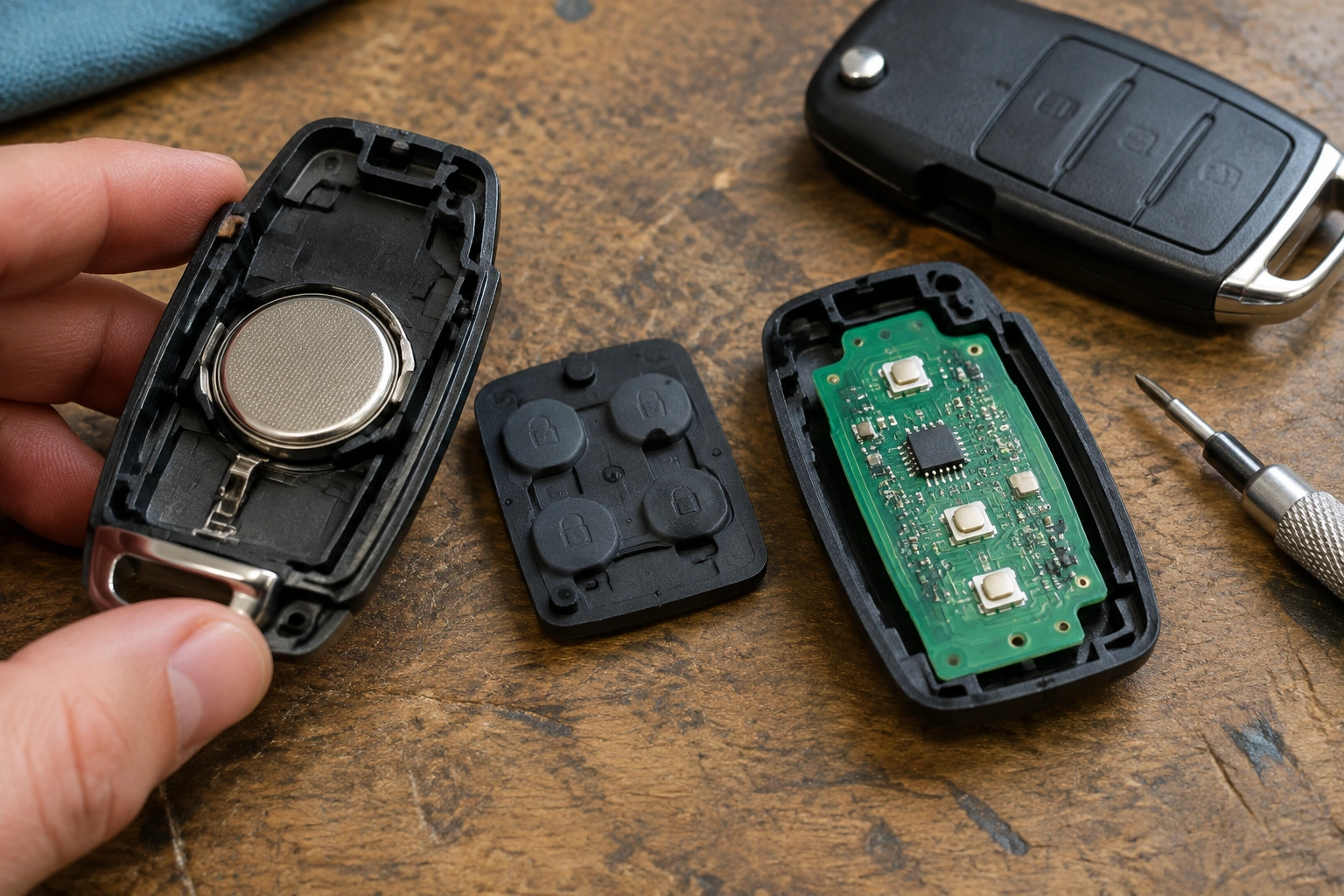
A common pattern is that the fob still has some life left, but the button press is no longer making clean contact inside. That’s why the remote may work once in a while, or only if you press in just the right spot.
A quick fix is sometimes all it takes. Other times, the fob is telling you it’s time for a new shell, a new battery, or a full replacement.
Quick Symptom Check: Battery Problem or Button Problem?
Before you open anything, pay attention to how the fob fails.
A weak battery often shows up as poor range, inconsistent response, or a fob that works better when you’re standing very close to the car. The buttons may still feel normal, but the signal is getting weaker.
A button or contact problem usually feels different. The fob may only work when you press hard, press at an angle, or press one corner of the button. That usually means the electrical contact inside the fob is not making reliable touch every time.
Here’s a simple way to separate the two:
| Symptom | More likely cause | Best first move |
|---|---|---|
| Works only when pressed hard | Worn button pad, dirty contacts, misalignment | Open the fob and inspect the button area |
| Works only very close to the car | Weak battery or signal issue | Replace the battery first |
| Button feels mushy, sticky, or uneven | Worn rubber membrane or damaged shell | Replace the shell or button pad |
| Fob stopped after getting wet | Water damage or corrosion | Inspect for corrosion before anything else |
| Battery is new but response is still poor | Internal contact or board issue | Clean and inspect the circuit board |
If your symptom is “it works, but only if I really press it,” the fob is usually not asking for reprogramming first. It’s more often a physical contact issue.
Most Likely Causes, Ranked From Easiest to Hardest
The most common causes of hard-press button behavior are usually:
- Weak or failing battery
- Worn rubber button pad
- Dirty, corroded, or misaligned contact pads
- Cracked case or loose internal parts
- Water damage or damaged circuit board
- Vehicle-side receiver or programming issue
That order matters because the first three are often cheap and simple to check at home. The last two are where repair starts to become less practical.
If you want a broader look at what happens when the fob signal itself gets unreliable, our guide on key fob range problems after battery replacement can help you compare signal issues versus button-contact issues. For no-detection problems right after a battery change, see key fob not detected after replacing the battery.
Step 1: Replace the Key Fob Battery
A weak battery can still let the fob work sometimes, so don’t rule it out just because the remote isn’t completely dead.
Replace the battery if:
– the fob is older and the battery hasn’t been changed recently
– the range has dropped along with the hard-press symptom
– the fob works inconsistently, even after a firm press
Use the battery type specified for your fob, and make sure the old battery and new battery are the same size and orientation. If the battery sits loosely or the contacts don’t touch it well, the fob can still act flaky.
When you reinstall the battery:
– check that the metal contacts are not bent away from the battery
– make sure the battery is seated flat
– close the case fully so the shell doesn’t pinch the internals
If nothing changes after a battery swap, move on to the button and contact inspection.
Step 2: Open the Fob and Inspect the Buttons and Contacts
Most key fobs can be opened carefully with a small plastic pry tool or a thin nonmetal tool. Avoid forcing the case apart with a screwdriver if you can help it, because slipping and gouging the circuit board is an easy way to turn a small problem into a bigger one.
Once open, look for these clues:
-
Flattened or shiny rubber button pads
That usually means the button surface has worn down from repeated use. -
Torn, sticky, or cracked rubber
If the membrane is damaged, the button may not push the internal contact evenly. -
Dirty contact pads
Dust, skin oils, and residue can interfere with the button’s electrical touch point. -
Corrosion or green/white buildup
That points to moisture exposure and can affect the board or contact surfaces. -
Misaligned parts
A battery, rubber pad, or circuit board that is slightly out of place can make the button work only when pressed hard.
A worn shell often shows its age in the button area first. If the outside buttons feel soft or collapsed, the inside membrane may be the real issue.
Step 3: Clean the Internal Contacts and Button Area
If the board and contacts look intact, a careful cleaning is worth trying.
Use:
– a dry, soft brush
– a lint-free cloth
– electronics-safe cleaner applied lightly
Avoid:
– soaking the board
– household cleaners that leave residue
– abrasive scrubbing
– metal tools on the contact pads
The goal is to remove grime, not flood the fob. A tiny amount of electronics-safe cleaner is usually enough. Let everything dry completely before reassembly.
Pay special attention to:
– the round contact pads on the circuit board
– the underside of the rubber button membrane
– the battery contacts
– any area that looks dull, dirty, or oxidized
If the button works better after cleaning but still needs extra force, that often means the wear is physical, not just dirty. Cleaning can improve the connection, but it can’t rebuild a flattened button pad.
Step 4: Check for Physical Damage, Water Damage, or Broken Solder Joints
If the fob has been dropped, stepped on, or exposed to moisture, inspect it closely for structural damage.
Look for:
– a cracked circuit board
– loose components
– bent battery tabs
– corrosion around the battery compartment
– a damaged solder joint near the button area
A cracked board or corrosion around the contacts can cause intermittent operation that feels like a button problem. In those cases, pressing hard may temporarily flex the board enough to make contact.
That’s a useful clue: if the fob only works when pressure changes the shape of the case or board slightly, the issue may be deeper than the rubber button itself.
Water damage is especially tricky. Even if the fob still works sometimes, corrosion can keep spreading. If you see heavy corrosion, replacement is often more realistic than trying to nurse the fob along.
When to Replace the Shell, Button Pad, or Full Key Fob
Not every bad fob needs a complete replacement.
A replacement shell makes sense when:
– the case is cracked
– the buttons are worn but the board still looks healthy
– the battery contacts and board are in decent shape
A new button pad is the better choice when:
– the rubber membrane is torn, flattened, or sticky
– the buttons no longer spring back properly
– the board is fine, but the button feel is clearly worn out
A full replacement fob is usually the better call when:
– the circuit board is cracked
– corrosion is extensive
– water damage has spread
– the transponder or electronics are unreliable
The trade-off is simple: a shell or button pad is cheaper and can save a working fob, but only if the electronics are still healthy. If the board itself is damaged, putting new plastic around it won’t solve much.
Could the Problem Be the Car Instead of the Fob?
Yes, but rule out the fob first.
If the battery is new, the buttons feel normal, and the fob still only works when pressed hard or only works inconsistently, the car’s receiver or the fob’s programming may be involved.
A few quick checks can help separate a vehicle issue from a fob issue:
- Try a spare fob, if you have one. If both remotes act up the same way, that points more toward the vehicle than the fob.
- See whether all remotes are affected. If central locking responds inconsistently to every remote, the receiver or vehicle-side system is more suspicious.
- Note the distance. If the fob only fails at certain ranges but works normally at close range, that leans more toward a weak signal or receiver issue than a worn button pad.
- Pay attention to the button feel. If the hard press is the thing that makes it work, that still points more toward a worn button pad, dirty contacts, or a misaligned contact area inside the fob.
A physical hard-press symptom still points more toward the fob itself than the car. Reprogramming can help when the fob and vehicle have lost sync, but it usually won’t fix a worn button membrane or dirty contact pad.
If your fob started acting up right after a battery change, it’s worth checking our guide on key fob not detected after a jump start as well, since power events can sometimes make an existing issue more noticeable.
For general keyless-entry troubleshooting, NHTSA’s vehicle safety and owner resources are a good place to confirm owner-manual guidance and safety-related information for your vehicle.
When to Consult a Locksmith
Call a locksmith, dealer, or repair shop if:
- the circuit board is visibly damaged
- corrosion is heavy or spreading
- the transponder area is damaged
- you lost small parts during disassembly
- the fob still fails after a battery replacement and careful cleaning
- the vehicle needs reprogramming and your model has a specific procedure you’d rather not risk
A locksmith is often the best middle ground when the fob is repairable but not worth trial-and-error guessing. Dealers can help too, especially when the fob needs programming or an OEM replacement, but they’re not always the cheapest route.
If you’re trying to decide whether to repair or replace, check the condition of the board first. Once the electronics are compromised, spending more on a shell usually becomes false economy. If the board or contact area is damaged, a shell replacement may not be worth it because the external case won’t restore reliable button contact.
How to Prevent the Problem From Coming Back
A repaired fob lasts longer when you treat it like a small electronic device, not just a plastic remote.
A few habits help:
– keep the fob dry
– don’t carry it where it gets crushed in a tight pocket
– replace the battery before it gets completely weak
– avoid pressing the buttons with excessive force
– replace a cracked shell before the internals start shifting
If the case is already loose, the buttons may wear unevenly because the parts inside are moving around every time you press them. Fixing the shell early can prevent that.
For a broader look at how battery condition affects keyless entry behavior, Edmunds has helpful owner-focused car advice at Edmunds, and Car and Driver also covers common car-tech troubleshooting topics at Car and Driver.
FAQ
Why does my key fob only work when I press hard?
That usually points to worn button pads, dirty contacts, or a misaligned internal part that only makes contact under extra pressure.
How do I know if it’s the battery or the button?
If the range is poor and the fob works better very close to the car, start with the battery. If the fob works only when you press hard or at an angle, the button/contact area is more likely.
Can cleaning fix a hard-press key fob?
Sometimes. Cleaning can remove dirt or residue from the contact pads, but it won’t fix a worn rubber pad or a cracked board.
Should I replace the shell or the whole fob?
Replace the shell if the case is cracked but the board is healthy. Replace the full fob if the board is corroded, cracked, or unreliable.
Bottom Line
When key fob buttons only work after pressing hard, the most likely cause is usually a physical contact problem inside the fob, not a mysterious vehicle fault. A weak battery is still worth checking first, but worn button pads, dirty contacts, cracked shells, and water damage are the real suspects when pressure changes the response.
The most useful takeaway is to test the simplest split first: try a spare fob if you have one, and look for button-area wear or dirty contacts if the problem follows the original remote. If the board is corroded or cracked, replacement is usually the smarter move.
