
Lost Car Key Programming: A Practical Guide to Getting Your Vehicle Started Again

Losing a car key is frustrating because the problem is rarely just “getting a new key.” In many vehicles, the replacement also has to be programmed so the car will recognize it and start. That programming step is what turns a cut key or replacement fob into a working one.
The good news: in some cases, you can handle lost car key programming yourself. In other cases, the vehicle’s security system will require an automotive locksmith, a dealer, or a mobile service with the right tools. The right path depends on your key type, whether you still have a working key, and whether your vehicle supports onboard programming or needs professional access.
Can You Program a Lost Car Key Yourself?
Sometimes, yes — but only on vehicles that support onboard or owner-programmable keys. These are usually the cases where the owner’s manual or manufacturer instructions provide a specific sequence for adding a key or remote.
DIY programming is more likely to work when:
– You still have at least one working key
– The vehicle supports onboard programming
– The replacement key or fob is confirmed compatible
– You are programming a simple spare, remote, or add-on key that the vehicle allows you to register yourself
DIY programming is usually not enough when:
– All keys are lost
– The vehicle requires a scan tool, security code, or dealer-level access
– The key is a smart key/proximity fob on a model that does not allow owner programming
– The vehicle will not enter programming mode without specialized equipment
Key type rule of thumb:
– Traditional transponder keys: sometimes DIY, sometimes professional, depending on the vehicle
– Remote fobs: often easier to add if the vehicle supports onboard programming
– Smart keys / proximity keys: more often require a locksmith, dealer, or mobile service with the right equipment
If the car is immobilized and you need the fastest way to regain access and start it, a mobile automotive locksmith is often the first call to make. If the vehicle is a dealer-only or highly restricted model, the dealer may be the only workable option.
What to Do First When You’ve Lost Your Car Key
Before you buy anything, confirm three things:
- What kind of key or fob your vehicle uses
- Whether you still have a working spare
- Whether the car can be programmed at home or needs professional equipment
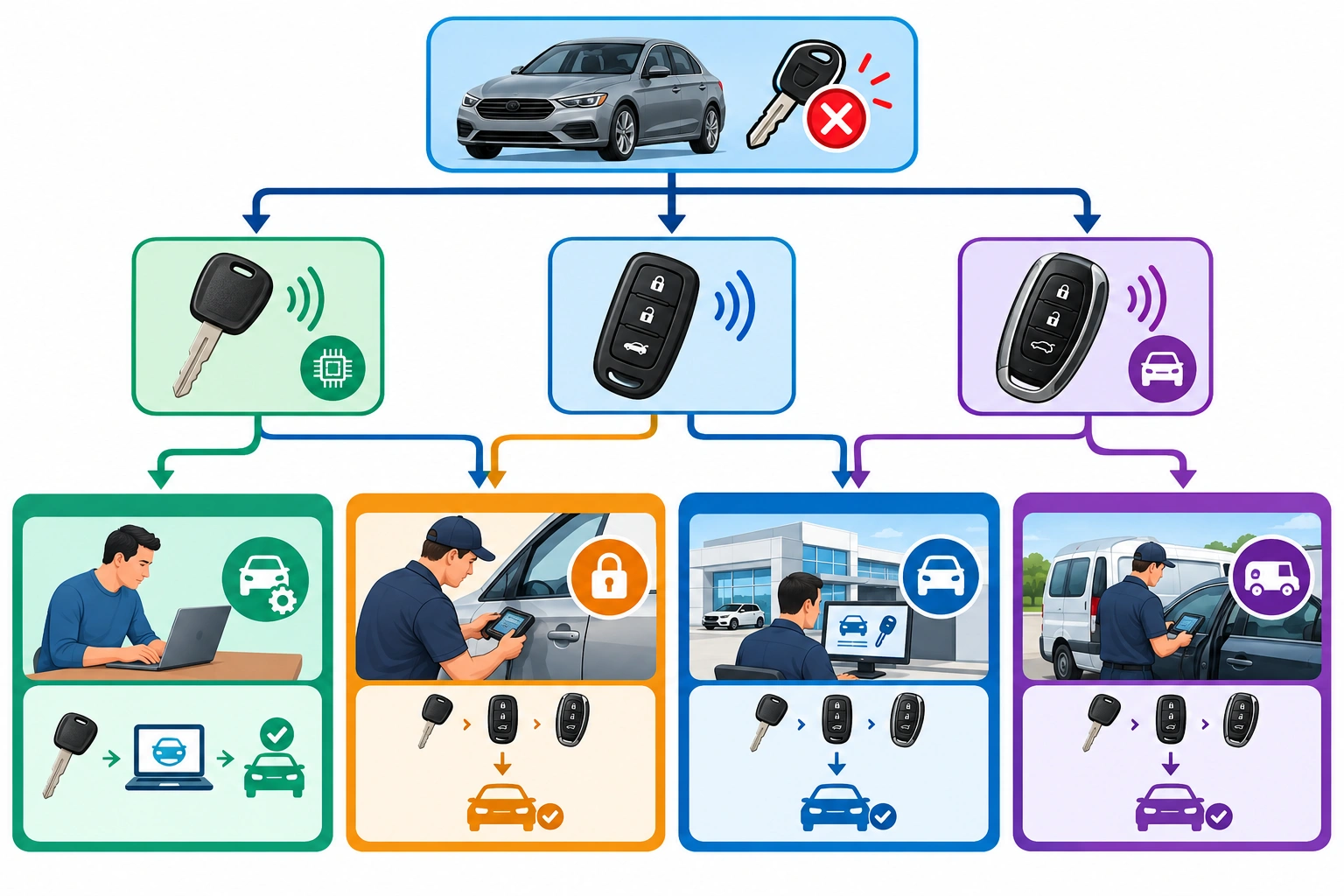
If the vehicle is parked somewhere unsafe or blocking access, arrange secure roadside help first. If it is at home, focus on identifying the key type, the exact programming method, and whether your vehicle allows onboard programming or requires a locksmith/dealer tool before ordering a replacement.
A helpful reality check: some replacement keys can be programmed at home, but the process varies by vehicle and often requires access to the car and ignition. CARFAX notes that the DIY process differs by brand and may involve starting and turning the car off while pressing buttons in order on the fob, with access to the vehicle required. CARFAX lost key fob guidance
Identify Your Key Type Before You Spend Money
A lot of replacement mistakes happen because drivers buy the wrong kind of key. The three main types behave differently.
Transponder key
A transponder key has a chip inside it. The blade may physically turn the ignition or door lock, but the chip is what tells the immobilizer system the key is authorized. If the chip is not programmed correctly, the key may turn in the lock and still fail to start the car.
Remote key fob
A remote fob usually handles lock, unlock, trunk release, or panic functions. Some vehicles separate remote functions from start authorization, so a fob may unlock doors but still not start the engine if the immobilizer pairing is incomplete.
Smart key
A smart key or proximity key is used for push-to-start vehicles. These are often more security-sensitive and are more likely to require professional programming equipment, especially if all keys are lost.
Decision rule:
– If your key only unlocks doors remotely, you may be dealing with a remote fob.
– If the car starts only when a chip is recognized, you likely have a transponder system.
– If the car has a push-button start and no traditional key blade, you likely have a smart key system.
What You Need Before Programming a Replacement Key
Gathering the right information first saves time and avoids ordering the wrong part.
Have this ready:
- Vehicle year, make, model, and trim
- VIN
- Proof of ownership
- Photo ID
- The exact key type your vehicle uses
- A replacement key or fob that matches the vehicle
- Fresh batteries, if the fob requires them
- Any programming tool or scan device required for your vehicle
The VIN matters because key compatibility is not just about the badge on the car. A replacement may need to match the exact model year, security system, and sometimes the trim level. AAA also notes that aftermarket key fobs are not always compatible and that some models require ordering directly from the dealer. AAA on lost car keys
For professional service, proof of ownership is not optional. That protects you and the vehicle, and reputable locksmiths and dealers will ask for it before cutting or programming a key.
Lost One Key vs. Lost All Keys: Why the Process Changes
This is one of the biggest decision points.
If you still have one working key
Programming is often simpler. In many vehicles, a working master key makes it easier to add another key because the car can verify the new key against an existing authorized key. That usually lowers labor time and reduces the chance of needing deeper security access.
If you lost all keys
The job becomes more complex because there is no existing key to “teach” the vehicle. Some systems require special procedures, and some vehicles need advanced programming tools or manufacturer-level access. In those cases, a locksmith or dealer may need to create and register a new key from scratch.
That difference affects price, timing, and who can do the job. A lost-all-keys case is much more likely to require an automotive locksmith or dealer than a simple spare-key addition.
How to Program a Replacement Car Key Step by Step
This section applies only when your vehicle supports onboard or DIY programming. Do not assume it does.
1. Confirm the replacement is compatible
Match the replacement to your exact vehicle. If the part number, chip type, or frequency is wrong, programming may fail even if the key physically fits.
2. Install a fresh battery if needed
A weak fob battery can cause confusing symptoms. The remote might partially work, or the vehicle may recognize the fob inconsistently.
3. Check whether your vehicle supports onboard programming
Look in the owner’s manual or the manufacturer’s instructions for an owner-programming or onboard-programming procedure. If the instructions mention a scan tool, security code, immobilizer reset, or dealer access, stop there and call a locksmith or dealer instead.
4. Follow the vehicle-specific programming sequence
If the vehicle does support DIY programming, follow the exact sequence for your make and model. That may involve:
– Locking and unlocking the doors in a set pattern
– Turning the ignition on and off in a timed sequence
– Pressing buttons on the fob in a specific order
– Waiting for a confirmation beep, flash, or lock cycle
CARFAX describes typical DIY programming as a sequence that may involve starting and turning the car off while pressing buttons in order, and it may require access to the vehicle and ignition. CARFAX lost key fob guidance
5. Stop if the vehicle does not enter programming mode
If the car never gives a confirmation signal, do not keep guessing. Recheck the exact steps once, then stop and call a locksmith or dealer if the vehicle still will not accept the key.
6. Test the remote functions separately from the start function
Unlocking doors is not the same as authorizing the engine start. Test lock, unlock, trunk, panic, and then the ignition or push-start function.
7. If the key still fails, move to professional programming
If the key works for the doors but not the engine, or if the vehicle refuses to recognize it at all, the issue may be compatibility, an incomplete immobilizer pairing, or a model that simply does not support DIY programming.
When You Need a Locksmith, Dealer, or Mobile Locksmith
If the vehicle does not support onboard programming, or if you have lost all keys, professional help is usually the practical route.
Automotive locksmith
An automotive locksmith is often the best balance of speed and convenience. AAA notes that if you need a traditional key replaced, a locksmith can come to you and make a car key on the spot. AAA on locksmith help
Choose a locksmith when:
– You need same-day help
– The car is not drivable
– You have lost all keys
– The vehicle needs cutting plus programming
– You want mobile service at home, work, or roadside
Dealer
A dealer may be necessary for some vehicles, especially where the replacement key must be OEM-specific or the security system is tightly restricted. The trade-off is usually higher cost and, in many cases, towing or a longer wait.
Choose the dealer when:
– The vehicle requires manufacturer-level access
– The replacement part must be OEM
– Your model has a restricted security system
– A locksmith confirms dealer-only coverage
Mobile locksmith
A mobile locksmith is often the fastest practical option when the car is immobilized. The benefit is simple: the work happens where the vehicle sits. That avoids towing in many cases and reduces downtime.
For many drivers, mobile service is the best compromise between dealer-level capability and convenience.
Quick decision framework
- Need the fastest emergency option and the car won’t start? Call a mobile locksmith first if your vehicle is commonly supported; otherwise call the dealer if the model is known to require dealer access.
- Have one working key and the vehicle supports onboard programming? DIY may be worth trying.
- All keys are lost? Expect professional programming, and choose mobile locksmith vs. dealer based on whether your model needs OEM or manufacturer-level access.
- Vehicle must be towed to the dealership for programming? Ask the dealer first whether towing is actually required, because some models can be handled by mobile service.
Cost, Time, and Difficulty: What to Expect
Exact pricing varies by vehicle, location, and key type, but the cost drivers are predictable:
- Key type: transponder, remote fob, or smart key
- Whether the key must be cut
- Whether all keys are lost
- Whether programming can be done onboard
- Whether the vehicle needs a dealer-level tool
- Whether towing is required
Here are realistic USD ranges by scenario. These are broad estimates, not guarantees:
- Simple spare key / onboard-programmable add-on: about $25 to $150 for the key or fob, plus 10 to 45 minutes if the vehicle supports DIY programming; professional help can raise the total.
- Lost-all-keys transponder key: often about $120 to $350 through a locksmith, and sometimes more if cutting, programming, or security access is complex; expect 30 minutes to a few hours, depending on access and vehicle setup.
- Remote fob replacement: often about $50 to $250 for the part and programming, with DIY time ranging from 10 to 30 minutes on supported vehicles.
- Smart key / proximity key: often about $150 to $500+, especially if OEM parts or advanced programming are required; time can range from 30 minutes to several hours depending on whether the work is done on-site or at a dealer.
A practical rule:
– DIY is best when the vehicle explicitly supports it and you still have a working key or a simple fob setup.
– Locksmith or mobile locksmith is usually best for lost-all-keys situations or when the car won’t start.
– Dealer is best when the vehicle’s security system or part compatibility makes other options impractical.
Common Mistakes That Cause Programming to Fail
A failed programming attempt is often caused by a preventable mismatch.
Buying the wrong key
The most common error is assuming any key with the right shape will work. It may fit the ignition or remote shell but still have the wrong chip or frequency.
Confusing remote setup with immobilizer pairing
Unlocking doors is not the same as authorizing the engine start. A key can appear “half working” if only the remote side is paired.
Skipping the compatibility check
Aftermarket fobs can be a cost saver, but AAA warns they may not be compatible with some models. If compatibility is uncertain, verify before ordering. AAA on lost car keys
Not using the right programming method
Some vehicles support onboard programming, while others require a scan tool or dealer-level access. Using the wrong method wastes time and can make troubleshooting harder.
Weak battery or poor installation
A fresh battery installed incorrectly can mimic a programming failure. Check polarity and fit before assuming the key itself is bad.
Troubleshooting: Why the New Key Works for Locks but Not for Starting
This is one of the most common complaints after replacement.
If the doors unlock but the engine will not start, check these in order:
- Battery in the new key/fob
- Whether the immobilizer pairing was completed
- Whether the replacement is truly compatible
- Whether the vehicle requires a different programming method
- Whether the system needs professional reset or reprogramming
If the key works inconsistently, the issue may be signal strength, battery quality, or a partial programming success. If the car recognizes no keys at all, you may be dealing with an all-keys-lost scenario that needs specialized equipment.
Practical Examples of Lost Key Programming Scenarios
Older car with a spare key still available
A driver with a traditional transponder key still has one working spare. In that case, a replacement may be easier to add, and the job may be handled without towing if the vehicle supports the right programming method.
Push-to-start vehicle with all keys lost
A driver loses every smart key for a push-button start vehicle. That usually pushes the job into professional territory because the immobilizer has no authorized key to reference. A mobile locksmith with the right equipment is often the most efficient option.
Aftermarket fob that unlocks but won’t start
A driver buys a cheaper online fob. The doors unlock, but the car will not start. That usually points to incomplete immobilizer pairing or a compatibility problem, not a dead battery alone.
Vehicle with restricted security
Some vehicles may require specialized programming methods when onboard or OBD-style programming is not available. In those cases, the dealer or a locksmith with the right tool coverage may be the only realistic path.
How to Choose the Fastest and Cheapest Working Option
Use this checklist:
- Does your vehicle support onboard programming?
- Do you still have one working key?
- Is the replacement key confirmed compatible?
- Does the car need a transponder, fob, or smart key?
- Can the vehicle be driven, or does it need mobile service?
- Is dealer-only programming likely based on the make/model/year?
- Do you need the key cut as well as programmed?
If you can answer “yes” to onboard programming and compatibility, DIY may be worth trying. If not, the time you save by calling a locksmith or mobile service often outweighs the extra cost. If the vehicle is highly restricted or OEM-only, the dealer may be the cleanest solution even if it is not the cheapest.
What to Have Ready Before You Call a Locksmith, Dealer, or Mobile Service
Before you make the call, gather these exact details:
- Vehicle year
- Vehicle make
- Vehicle model
- Trim level
- VIN
- License plate number, if available
- Proof of ownership
- Photo ID
- Current location of the vehicle
- Whether the car is locked, unlocked, or immobilized
- Whether you have any working key or fob left
- Whether the key is a transponder, remote fob, or smart key
- Whether the key needs cutting, programming, or both
If you have the original key or a spare, tell the provider that up front. If all keys are lost, say that clearly, because it changes the equipment and the quote.
When to Call an Automotive Locksmith
Call an automotive locksmith when you need a replacement that actually starts the vehicle, not just one that fits the lock. That is especially true if you’ve lost all keys, need mobile help, or want a faster alternative to towing the car to a dealer.
If you want the broader replacement process explained from start to finish, see our guide on how to replace a lost car key without the original and our breakdown of lost car key locksmith help. If you are still searching for the key itself, this step-by-step recovery plan can help before you commit to replacement.
The main goal is simple: choose the path that matches your vehicle’s security system, not just the cheapest part online. That is what gets you back on the road with the least delay.
FAQ
Can I program a replacement car key myself?
Sometimes. DIY programming is usually only possible if your vehicle supports onboard programming and you still have the right compatible key or fob.
Do I need the original key to program a replacement?
Not always. If you still have a working key, programming is often easier. If all keys are lost, many vehicles require professional equipment or dealer-level access.
What if my car is immobilized and I need the fastest option?
Call a mobile automotive locksmith first if your vehicle can be serviced on-site. If your model is dealer-only or requires manufacturer access, contact the dealer and ask whether towing is necessary.
Is a locksmith cheaper than a dealer?
Often, yes, but not always. The final price depends on the key type, whether all keys are lost, whether the key must be cut, and whether the vehicle needs OEM or dealer-level programming.
Why does my new key unlock the doors but not start the car?
That usually means the remote function works, but the immobilizer pairing is incomplete or the key is not fully compatible with your vehicle.
Can any vehicle be programmed at home?
No. Whether DIY programming is possible is vehicle-dependent. Some models allow onboard programming, while others require a scan tool, security access, or dealer programming.
What if I only need a spare?
If your vehicle supports onboard programming, a spare may be the easiest and cheapest scenario. If not, a locksmith can usually cut and program it for you.
