
Can You Track a Lost Car Key? What Actually Works, and What Doesn’t

If you’re asking, “can you track a lost car key?” the honest answer is: usually not by itself. Most car keys, key fobs, and transponder keys do not have built-in GPS or native tracking. But you may be able to find one if it has a separate Bluetooth tracker attached, or if your vehicle app has a limited locating feature tied to the car or key system.
That distinction matters. A lot of drivers waste time assuming the key itself is “smart” enough to show up on a map. In most cases, it isn’t. The good news is that there are still realistic ways to recover it quickly—or, if it’s gone for good, replace it without making the situation worse.
The short answer: can a lost car key be tracked?
Only in certain situations.
A plain mechanical key cannot be tracked. A transponder key can start the car because of the chip inside it, but that chip is not the same thing as a locator. A key fob or smart key may communicate with the vehicle, but that communication is for access and starting—not for tracking its location.
The two realistic ways a lost car key gets “tracked” are:
-
A separate Bluetooth tracker is attached to the key ring
Think AirTag, Tile, Chipolo, or a similar device. The tracker is what gets located, not the key itself. -
A vehicle app or connected-car feature gives a clue
Some car apps can help you locate the car, and in some setups that can indirectly help narrow down where the key might be. But that is not the same as tracking the key fob like a GPS device.
If your key does not have a tracker attached, your best path is usually a fast, methodical search followed by replacement if the key does not turn up.
Mini-FAQ: common tracking questions
Do AirTag/Tile trackers work on car keys?
Yes—if you attach one to the key ring. The tracker is what gets found, not the key itself.
Can my car app find the key fob?
Usually no. Most car apps can locate the vehicle or control certain functions, but they do not directly track the key fob.
Do car keys have GPS or Bluetooth built in?
Usually no. Most car keys and fobs are not true tracking devices. Some can communicate with the car, but that is not the same as GPS tracking.
What type of key do you have?
The type of key you lost changes the answer.
| Key type | What it does | Can it be tracked on its own? | What usually helps |
|---|---|---|---|
| Mechanical key | Opens doors manually | No | Search and replace |
| Transponder key | Starts the car with a chip | No | Search, then replacement and programming |
| Key fob | Remote lock/unlock; may include chip | No, unless a tracker is attached | Tracker app, search, replacement |
| Smart key | Keyless entry and push-button start | No, unless a tracker is attached | Tracker app, search, replacement |
Here’s the practical takeaway: the more electronic the key is, the more expensive it may be to replace—but not necessarily easier to track. A smart key can be more convenient, but convenience does not equal location tracking.
If you are not sure which one you lost, check whether your car starts with a physical blade, a chip key, or push-button start. That will tell you what replacement and reprogramming may involve later.
What tracking methods actually work
Bluetooth trackers: the most realistic option
This is the most practical way to find a lost car key.
A Bluetooth tracker is a small device attached to the key ring. Your phone app can usually show the tracker’s last known location, and in some cases you can make it play a sound. Audibility varies by tracker model, battery level, surroundings, and distance, so treat the sound feature as a helpful clue—not a guarantee.
If you lose the key, do this immediately:
-
Open the tracker app right away
Use the AirTag, Tile, Chipolo, or other app tied to the tracker.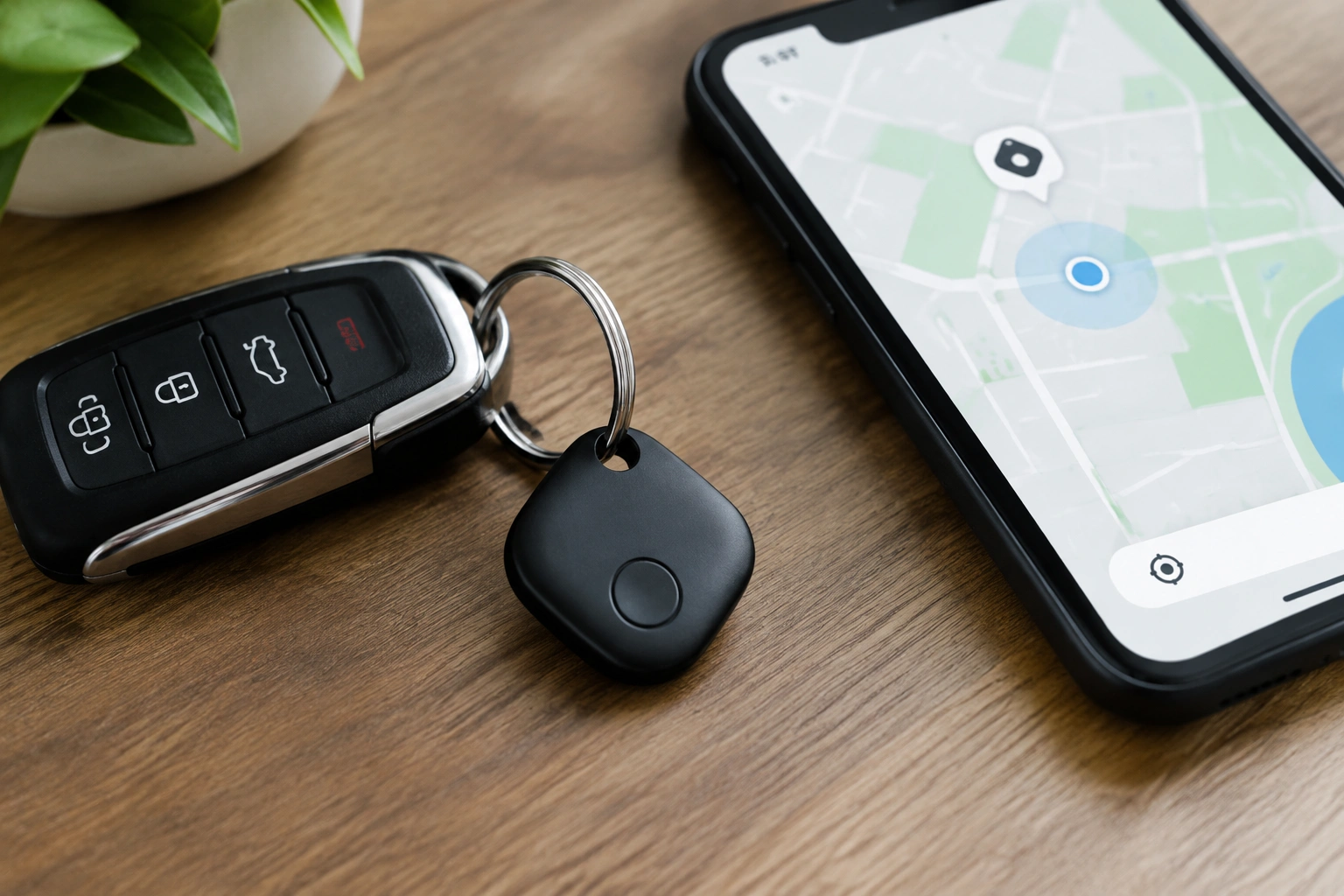
A separate Bluetooth tracker is what makes most car keys findable. -
Check the last known location first
That tells you where the tracker was last seen, which is often the best starting point. -
Play the sound if the app offers it
Use it to narrow down the room, bag, car seat area, or parking spot. -
Use precision finding or nearby search if available
Some trackers and phones can guide you more closely when you are in range. -
Search the exact area slowly and in sections
Look under seats, in bags, in coat pockets, and in car crevices.
That makes Bluetooth trackers best for keys lost nearby, such as:
- inside the house
- under a couch
- in a jacket pocket
- in a gym bag
- in a car trunk or seat crease
The limitation is range. Bluetooth is not a long-distance recovery tool. If the key is far away or the tracker battery is dead, the app may only show the last place it was seen.
GPS trackers: useful in theory, rarely built into keys
A GPS tracker can be very helpful on larger items, but it is not standard in ordinary car keys or fobs. GPS devices need power, hardware, and usually a subscription or app support. That makes them much more common on vehicles or assets than on a key ring.
So if someone tells you your key “has GPS,” ask one simple question: what tracker is actually attached to it? If there is no separate device, there is probably no real tracking happening.
Car apps: helpful for the car, not usually the key
Some vehicle apps can locate the car, lock or unlock doors, or show where the vehicle was parked. That can help if the key is likely in or near the car, or if you suspect you left it in a parking lot and want to narrow your search.
But a car app usually does not locate the key fob itself. It locates the vehicle or interacts with it.
That difference matters. If your car app shows the vehicle in your driveway, that doesn’t mean the fob is in the same spot. It may only mean the car is there.
Built-in tracking features: uncommon and model-specific
Some accessories and aftermarket systems have locating features, but they are not common across all vehicles. If your key setup came with a tracker or your dealership installed one, follow the manufacturer’s app or instructions. If not, assume there is no built-in tracking until you confirm otherwise.
A more specific limitation: some newer vehicles can help you find a key only when it is inside the car or within the vehicle’s proximity system. That is different from true GPS tracking and usually won’t help once the key is away from the vehicle.
For a practical comparison, Chipolo describes its keys finder as a small tracking tag that attaches to your keys, which is the kind of setup that actually makes tracking possible. The key point is that the tracker is separate from the car key itself. You can see Chipolo’s car key tracker approach here: Chipolo’s car key tracker page.
What to do first after losing a car key
The first 15 minutes matter more than most people realize. A rushed replacement can be unnecessary if the key is still nearby.
1. Retrace the last 3–5 places you used it
Think in order, not randomly. Home, car, office, store, gym, restaurant, gas station. Keys usually disappear in transitions: from pocket to counter, from hand to bag, from seat to floor.
2. Check the obvious hiding places
Look where keys commonly get trapped:
- jacket pockets
- laundry baskets
- purses and backpacks
- couch cushions
- car seats and floor mats
- between the driver’s seat and center console
- the trunk or cargo area
If you have a Bluetooth tracker, use the app now. Check the last known location first, then trigger the sound if the app allows it.
3. Call or revisit places you just left
If you were at a store, restaurant, gym, or office, ask whether a key was turned in. The sooner you call, the better your odds. A found key may not stay in lost-and-found for long before it’s moved or claimed.
4. Check whether the key has a tracker attached
People forget this all the time. If the key ring normally holds an AirTag, Tile, or similar tag, use that app before doing anything else. Good Sam recommends using the app to view the last known location and play a sound.
5. Decide whether this is a search problem or a security problem
If the key is probably at home, keep searching. If it may have fallen out of a bag, been taken from a workplace, or disappeared with identifying information, treat it differently. That changes what you should do next.
6. If you suspect the key is in the car but the car won’t unlock
If the key is likely inside the vehicle but the fob battery is dead, try the physical emergency key blade if your key has one. If your vehicle has a hidden key slot or backup start method, check the owner’s manual. If you still can’t get in, contact roadside assistance, a dealer, or a locksmith before forcing entry.
Common mistakes that waste time
Assuming every key has GPS
Most do not. A key fob can be electronic without being trackable.
Confusing the car’s location with the key’s location
Your car app may tell you where the vehicle is parked. That doesn’t locate the key.
Replacing the key before checking for a tracker
If there’s an AirTag or Tile attached, replacing immediately can be a waste of money.
Waiting too long to act
If the key might be stolen, the security risk grows with time. Don’t let a “maybe I’ll find it later” approach leave your car exposed.
Assuming a dealership is the only option
Dealerships can help, but an automotive locksmith may be faster and more convenient for many lost-key situations.
If the key might be stolen: security steps
If there’s any real chance someone else has your key, think beyond recovery.
A lost key is not just an inconvenience if it can open the vehicle. If the key was taken from a bag, left in a public place, or lost with identifying details, you may need to protect the car before replacing the key.
Start by deciding whether the missing key is likely just misplaced or truly compromised:
- If it is probably inside your home, office, or car: keep searching first.
- If it was lost in public, stolen, or lost with ID/address details: contact the dealer or a qualified automotive locksmith right away to ask how to disable that specific key and whether all keys need to be reprogrammed.
That usually means one of two things:
- reprogramming the vehicle so the missing key no longer works
- disabling the lost key and programming a new one
Whether that is necessary depends on the vehicle, the key type, and how likely it is that the key is in someone else’s hands. If the key is just missing inside your home, security action may not be urgent. If it was lost outside or stolen, it is.
For guidance on immobilizer and key security, the National Highway Traffic Safety Administration has helpful consumer information on vehicle theft prevention and security systems: NHTSA vehicle theft prevention resources.
If you can’t find it: replacement options
When the search is over, you have two main paths: dealership replacement or locksmith replacement.
Dealership replacement
A dealership can replace and program many keys, especially for newer vehicles and specialized smart keys. The upside is brand-specific parts and access to manufacturer systems. The trade-off is usually time and cost, plus the possibility of towing if you can’t start the car.
A dealer is often the safer first call if your vehicle uses a high-security or proprietary system, if all keys are lost, or if the key must be paired through manufacturer-only tools.
Automotive locksmith replacement
A qualified automotive locksmith can often replace and program many lost keys on-site, depending on the vehicle. That can save time and avoid towing. It may also be the more practical route if you need the car back quickly.
That said, not every locksmith can handle every encrypted or proprietary key system. Some newer or high-security vehicles still require a dealership.
If you want a deeper breakdown of what documents, programming steps, and service options are involved, this guide can help: Lost car key locksmith help and replacement options.
How to choose between them
Use this rule of thumb:
- Choose a locksmith if you want speed, mobile service, and help at your location.
- Choose a dealership if your vehicle is unusual, still under certain warranty/service arrangements, or the dealer is the only source for that exact key system.
The right answer often comes down to your car’s make, model, and year—not just price.
What to have ready
Before you call either one, be prepared to show:
- proof of ownership
- vehicle identification number, if available
- your driver’s license
- the car’s make, model, and year
Some providers may also ask whether the vehicle is accessible, whether it needs towing, and whether you still have a working key. That helps them tell you if they can cut and program a replacement on-site or if the car needs to come in.
Real-life examples of what usually works
Lost in the house
A driver loses a key fob after coming home. The car is useless for locating it, but a Tile on the key ring makes the search easy. The app shows the last seen location, and the sound leads straight to a couch cushion.
Dropped in a parking lot
A transponder key falls out while loading groceries. There is no built-in tracking, but a Bluetooth tracker attached to the ring shows the last known location near the store entrance. That gives the driver a place to check before ordering a replacement.
Missing after a trip
A smart key disappears after a hotel stay. The vehicle app can show where the car was parked, but not the key itself. Since the key may have been left behind in a public place, the owner decides to replace and reprogram it rather than wait.
Possibly stolen
A key is missing from a gym bag, and the bag also contained an address tag. That is a security issue. The owner treats the missing key as compromised and arranges reprogramming so the old key can no longer be used.
Troubleshooting: why your tracker or app isn’t helping
The tracker is out of range
Bluetooth is short-range by design. If the key left the area, the app may only show the last place it connected.
The tracker battery is dead
If the tracker battery failed, the app may stop updating. In that case, the last known location may be all you get.
The app only tracks the car
Many vehicle apps locate the car, not the key fob. That is normal, even if it’s frustrating.
The key is hidden in a dead zone
A key under thick cushions, in a trunk, or inside another bag can be hard to hear even if the tracker is working. Move slowly and search the area in sections.
The key never had a tracker attached
If there is no separate tracker, there may be nothing to “ping.” At that point, the search becomes physical, not digital.
When to call an automotive locksmith
Call a locksmith when the key is not turning up and you need a practical next step. That is especially true if:
- you lost all working keys
- the vehicle won’t start
- the missing key may be stolen
- you need on-site service
- you want to compare replacement options before going to a dealer
If the car is a daily driver, speed matters. A mobile locksmith can often help you move from “stuck” to “solved” without dragging the situation out.
Bottom line
So, can you track a lost car key? Usually not unless a separate tracker is attached. Most car keys, key fobs, and transponder keys are not inherently trackable. Your best chance is a Bluetooth tracker, a careful search, and quick action if theft is possible. If the key is gone for good, the next step is replacement and, when needed, reprogramming.
The key is to make the right decision early: search if it’s likely nearby, secure the car if it may be stolen, and replace it when recovery no longer makes sense.
FAQ
Can a phone’s Find My or Find My Device locate an AirTag/Tile on car keys?
Sometimes, but only if the tracker supports that ecosystem. AirTag works with Apple’s Find My network. Tile and other trackers use their own apps and networks, so check the specific device.
Can my car app find the key fob?
Usually no. Most car apps locate the vehicle or control vehicle functions, not the key fob itself.
Do car keys have GPS or Bluetooth built in?
Usually no. Most car keys and fobs are not true tracking devices. Some can communicate with the car, but that is not the same as GPS tracking.
