
7 Best Portable Jump Starters for Cars, Trucks and SUVs

We may earn a commission when you buy through links on this page, at no extra cost to you. How we pick products.
For most cars and small SUVs, the NOCO Boost GB40 is the safest all-round pick: 1000 peak amps for gas engines up to 6.0L, spark-proof clamps, and small enough for a glove box. If you drive a V8 truck or a diesel up to 6.0L, step up to the NOCO Boost GB70. If you also want a tire inflator in the same box, the GOOLOO A3 combines a 3000A jump pack with a 150 PSI compressor.
A dead car battery is one of the most common reasons a car “won’t start” even when the key fob still unlocks the doors. A portable lithium jump starter fixes that in a couple of minutes without a second car, and most of them double as a phone power bank and flashlight. This guide compares seven jump starters by engine size, safety features, recharge time and real-world practicality, so you can match one to your vehicle instead of buying the biggest number on the box.
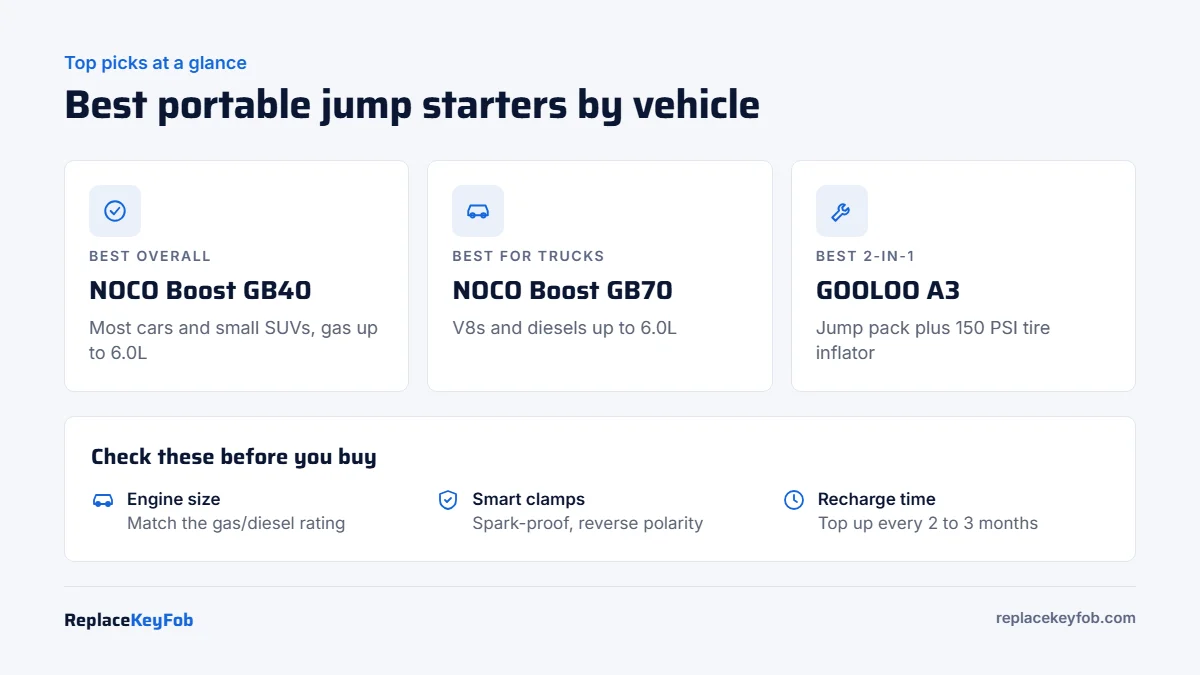
Our Top Picks at a Glance
| Jump starter | Best for | Rated engine size | Key extra |
|---|---|---|---|
| NOCO Boost GB40 | Most cars and small SUVs | 6.0L gas / 3.0L diesel | 2.5 lb, IP65 housing |
| NOCO Boost X GBX45 | Fast recharge | 6.5L gas / 4.0L diesel | 48-min USB-C recharge, 60W output |
| NOCO Boost GB70 | V8 trucks and mid-size diesels | 8.0L gas / 6.0L diesel | 400-lumen light, 40 starts per charge |
| GOOLOO A3 | Jump starter + air compressor | 9.0L gas / 6.5L diesel | 150 PSI auto-off inflator |
| LOKITHOR J400 | Clear on-screen guidance | 8.0L gas / 6.0L diesel | 5.75-inch status display |
| NOCO Boost GB150 | Heavy-duty trucks and fleets | 9.0L gas / 7.0L diesel | Up to 80 starts per charge |
| Clore Jump-N-Carry JNC660 | Shops and repeated daily jumps | 1700 peak amps (lead-acid) | 46-inch #2 AWG cables |
How We Chose These Jump Starters
We did not rank by peak amps alone, because peak amp ratings are not measured the same way by every brand. Instead we compared manufacturer specs, owner manuals and long-term owner feedback on five points:
- Rated engine size for gas and diesel, which is a more honest guide than peak amps.
- Clamp safety: spark-proof and reverse-polarity protection, so a wrong connection does nothing instead of damaging electronics.
- Recharge time and standby: a jump pack that is flat when you need it is useless.
- Size and weight: whether it actually fits under a seat or in a glove box.
- Brand support: warranty length and how easy it is to get help.
The Best Portable Jump Starters
1. NOCO Boost GB40: Best Overall for Most Cars

NOCO Boost GB40 1000A Lithium Jump Starter
Gas engines up to 6.0L, diesel up to 3.0L
Check Price on AmazonThe GB40 has been the default recommendation for compact jump packs for years, and the reason is simple: it covers almost every four- and six-cylinder car on the road, it weighs about 2.5 lb, and NOCO’s UltraSafe clamps will not send power until they detect a correctly connected battery. That last point matters more than amps for most owners, because a reversed clamp on a modern car can damage modules, including the immobilizer and keyless entry receiver.
NOCO rates it for up to 20 starts per charge, it recharges in about three hours, and the IP65 housing handles rain and dust. The built-in power bank and 100-lumen light are useful on a dark roadside.
Pros: very compact, proven spark-proof clamps, IP65 rated, easy to use.
Cons: not rated for V8s or larger diesels; slower power bank output than newer USB-C models.
Best for: sedans, hatchbacks, compact and mid-size SUVs, and anyone who wants a pack that lives in the glove box.
Skip it if: you drive a full-size V8 truck or a diesel above 3.0L.
2. NOCO Boost X GBX45: Best for Fast Recharge

NOCO Boost X GBX45 1250A Jump Starter
Gas up to 6.5L, diesel up to 4.0L
Check Price on AmazonThe GBX45 is NOCO’s newer “X” design. It is rated a little higher than the GB40 (6.5L gas, 4.0L diesel), but the real upgrade is charging: NOCO says it refills in about 48 minutes over USB-C Power Delivery, and five minutes of charge can be enough for one jump from a fully drained unit. It also works the other way as a 60W USB-C power bank, which is enough for many laptops.
NOCO quotes up to six jump starts per charge on this model, fewer than the GB40, so think of it as a quick-charging pack you top up often rather than one you forget in the trunk for a year.
Pros: fast USB-C charging, laptop-capable output, upgraded UltraSafe 2.0 protection.
Cons: fewer starts per charge than the GB40.
Best for: commuters who forget to charge gadgets and want a pack that is ready again within an hour.
Skip it if: the pack will sit unused in the trunk for months at a time.
3. NOCO Boost GB70: Best for V8 Trucks and Mid-Size Diesels

NOCO Boost GB70 2000A Jump Starter
Gas up to 8.0L, diesel up to 6.0L
Check Price on AmazonIf your vehicle has a V8 or a mid-size diesel, the GB70 is the safer size. It is rated for gas engines up to 8.0L and diesels up to 6.0L, with up to 40 starts per charge, and it has a brighter 400-lumen light. It weighs about 5 lb, so it is a trunk or under-seat item rather than a glove-box one.
Pros: covers most pickups and SUVs, lots of starts per charge, same spark-proof clamps.
Cons: about six hours to recharge; twice the weight of the GB40.
Best for: half-ton pickups, full-size SUVs and households with more than one vehicle.
Skip it if: you only drive a small four-cylinder car; the GB40 is lighter and cheaper to carry around.
4. GOOLOO A3: Best Jump Starter With Air Compressor

GOOLOO A3 3000A Jump Starter with Air Compressor
Gas up to 9.0L, diesel up to 6.5L, 150 PSI inflator
Check Price on AmazonThe A3 puts a 3000A jump pack and a cordless 150 PSI tire inflator in one unit. You set the target pressure on the screen and it shuts off automatically, which covers two of the most common roadside problems with one device. GOOLOO rates it for gas engines up to 9.0L and diesels up to 6.5L, and backs it with an 18-month warranty.
Pros: replaces two separate tools, auto-off inflator, longer warranty than most.
Cons: bulkier than a jump-only pack; the compressor drains the same battery you need for jumping.
Best for: drivers who want one emergency box for a dead battery and a low tire.
Skip it if: you already own a 12V tire inflator you like.
Tip: after inflating tires, recharge it before putting it back in the car.
5. LOKITHOR J400: Best for Clear On-Screen Guidance

LOKITHOR J400 2000A Jump Starter
Gas up to 8.0L, diesel up to 6.0L
Check Price on AmazonThe J400’s 5.75-inch display shows battery level, connection status and error alerts in plain view, which helps if you rarely jump a car and want the unit to tell you what is happening. It is rated for 8.0L gas and 6.0L diesel engines with up to 25 starts per charge, and includes reverse-polarity, short-circuit and over-current protection.
Pros: large, readable screen; good rated coverage for the size.
Cons: 12-month warranty; less long-term track record than NOCO.
Best for: first-time owners who want clear on-screen feedback during the jump.
6. NOCO Boost GB150: Best Heavy-Duty Option

NOCO Boost GB150 3000A Jump Starter
Gas up to 9.0L, diesel up to 7.0L
Check Price on AmazonThe GB150 is for large diesel pickups, work trucks, boats and anyone who jumps several vehicles a week. NOCO rates it for up to 80 starts per charge on engines up to 9.0L gas and 7.0L diesel. At about 7.5 lb it is still portable, but it is overkill for a sedan.
Pros: big reserve for repeated jumps, rugged IP65 build, 500-lumen light.
Cons: about seven hours to recharge; heavier and larger than most drivers need.
Best for: diesel trucks up to 7.0L, farm equipment, boats and small fleets.
7. Clore Jump-N-Carry JNC660: Best for Shops
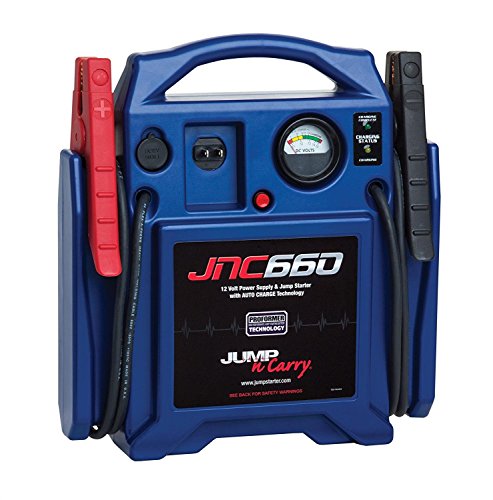
Clore Jump-N-Carry JNC660 1700A
22Ah lead-acid battery, 46-inch #2 AWG cables
Check Price on AmazonThe JNC660 is a traditional lead-acid booster, not a lithium pocket pack. It weighs about 18 lb, but it uses a 22Ah battery built for jump starting, long 46-inch #2 AWG cables, a voltmeter and a 12V outlet. Repair shops and dealerships keep units like this because they handle repeated daily jumps well.
Pros: heavy cables, long reach, built for frequent use.
Cons: heavy, no spark-proof smart clamps, needs regular charging to keep the lead-acid battery healthy.
How to Use a Portable Jump Starter Safely
- Turn everything off. Switch off the ignition, headlights, heater and radio, and put the car in Park or Neutral with the parking brake on.
- Check the battery first. Do not jump a battery that is cracked, leaking, swollen or frozen. Get it replaced instead.
- Connect red to positive (+). Clamp the red lead to the positive battery terminal.
- Connect black to ground. Clamp the black lead to the negative terminal or, if the manual says so, to a bare metal ground point on the engine.
- Switch the pack on and wait for the ready light. Smart packs show green or “ready” only when the connection is correct.
- Start the car. Crank for no more than about five seconds at a time and wait a minute or two between tries so the pack does not overheat.
- Disconnect in reverse order. Remove black first, then red, and let the engine run for at least 20 to 30 minutes to put some charge back in the battery.
Your vehicle’s owner’s manual has the final word. Some cars, especially hybrids and many European models, have a separate jump point under the hood instead of direct battery access. For a full walkthrough, see how to jump start a car.
Jump Starter vs Jumper Cables vs Battery Charger
| Tool | Needs a second car? | Best use | Main limit |
|---|---|---|---|
| Portable jump starter | No | Roadside starts, alone, at any hour | Must be kept charged |
| Jumper cables | Yes | Cheap backup that never runs flat | Easy to connect wrong; needs help |
| Battery charger or maintainer | No (needs a wall outlet) | Recharging a battery at home or in storage | Slow; useless on the roadside |
A jump starter gets you moving, but it does not recharge a weak battery. If you need a jump more than once in a few weeks, test the battery and charging system. A battery that is three to five years old is usually near the end of its life, and a failing alternator will drain even a new one.
Buying Guide: How to Pick the Right Size
Match the engine size, not the peak amps
Look for the “up to X.0L gas / X.0L diesel” rating. Diesels and cold weather need much more cranking power, so if you live somewhere with hard winters, choose one size above your engine.
Insist on spark-proof, reverse-polarity clamps
Modern cars are full of modules. Smart clamps that stay dead until they see a correct connection are the single most useful safety feature.
Plan for standby loss
Lithium packs slowly lose charge in a hot or cold car. Top yours up every two to three months, and check it before long winter trips.
Know when a jump starter will not help
If the car cranks normally but still will not start, or the dash says “key not detected”, the problem may be the key fob rather than the battery. See car won’t start but key fob unlocks doors and car won’t start because the key fob battery is dead.
Related Guides
- How to jump start a car safely
- Key fob not detected after a jump start
- Can a bad car battery cause key fob problems?
- Key fob not working after disconnecting the car battery
FAQ
What size jump starter do I need for my car?
Use the engine rating on the box. A pack rated for 6.0L gas covers most four- and six-cylinder cars. V8 trucks need one rated for 8.0L gas, and diesels need a pack rated for at least your engine’s displacement.
Can a jump starter damage my car’s electronics?
A modern lithium jump starter with spark-proof, reverse-polarity clamps is very unlikely to cause damage when used as the manual says. Most damage comes from reversed cables or connecting to a cracked or frozen battery.
How long does a portable jump starter hold its charge?
Most lithium units keep a usable charge for several months, but heat and cold speed up self-discharge. Recharging every two to three months is a safe habit.
Is a jump starter better than jumper cables?
For most drivers, yes, because you do not need a second car and smart clamps prevent wrong connections. Cables are cheaper and never need charging, so some people keep both.
Will jump starting my car reset my key fob?
No, a jump start does not erase key programming. Some cars briefly fail to detect the fob after a dead battery; see our guide on key fob not detected after a jump start.
Can I leave a jump starter in a hot car?
Check the storage range in the manual for your model. GOOLOO, for example, lists -4°F to 140°F for the A3. On very hot days, keep it out of direct sun or bring it inside.
