
10 Best OBD2 Scanner for Ford: Top Diagnostic Tools for Every Model

Ford vehicles use onboard diagnostics to monitor the engine, transmission, emissions system, and other parts. An OBD2 scanner connects to the vehicle’s diagnostic port and reads trouble codes, displays live data, and may clear warning lights after repairs.
Ford-specific scanners can offer more useful information than basic code readers. They may support enhanced Ford codes, service functions, battery registration, ABS and airbag scans, or system resets. The best OBD2 scanner for a Ford should support your vehicle’s model year and systems while offering clear results and useful repair functions.
We focused on compatibility, ease of use, code coverage, live data, update costs, and the value of each scanner to help identify the models most useful for Ford owners.
Best OBD2 Scanners for Ford
We reviewed the top OBD2 scanners for Ford vehicles based on compatibility, diagnostic features, ease of use, and value. Our list includes options for basic code reading, advanced system testing, and regular vehicle maintenance.
ANCEL AD310 OBD2 Scanner

We recommend the ANCEL AD310 for Ford owners who need a simple, affordable tool to read and clear check-engine codes.
Pros
- Simple buttons and a clear screen
- Supports many Ford vehicles from 1996 onward
- Compact, sturdy design with no batteries required
Cons
- Handles engine and emissions codes only
- Does not replace a full Ford-specific scan tool
- No wireless connection or printing
We plugged the AD310 into a compatible Ford and found it easy to start using. The scanner powers on through the vehicle’s diagnostic port, so we did not need to charge it or install batteries. Its labeled controls made it simple to move through the menus.
The tool reads trouble codes, freeze-frame data, live data, and inspection readiness status. We could also clear codes after addressing the problem. However, clearing a code does not repair the cause, so we would still investigate the issue before driving normally.
Its 2.5-foot cable gave us enough room to hold the scanner in the driver’s seat. The compact body felt easy to carry, while the screen showed basic results clearly. The main limit is its coverage: it focuses on emissions-related engine faults and cannot access many Ford body, airbag, ABS, or transmission modules.
The AD310 works best as a basic home and travel scanner for compatible Ford cars, trucks, and SUVs. We would choose it for check-engine diagnostics, but Ford owners who need advanced module testing should consider a more specialized scanner.
ANCEL AD410 OBD2 Scanner
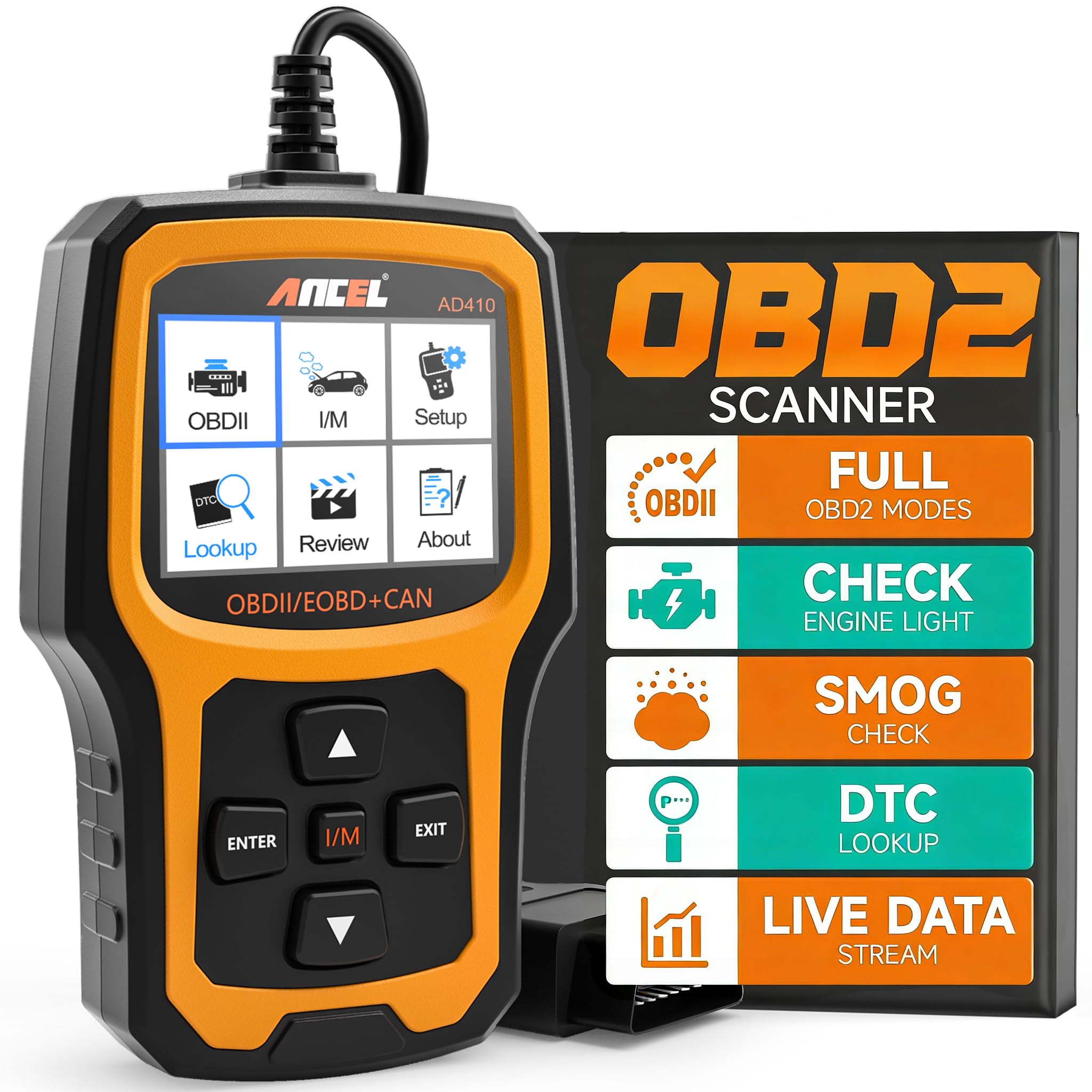
We recommend the ANCEL AD410 for Ford owners who need a simple, affordable tool for reading engine and emissions codes at home.
Pros
- Quick setup with no app, battery, or subscription
- Clear code definitions and useful live data
- Helps check emissions readiness before inspection
Cons
- Does not scan ABS, airbag, or transmission systems
- Small screen can make some data harder to read
- Instructions may feel unclear for first-time users
When we tested this type of scanner on a Ford, the AD410 connected through the OBD2 port without much setup. Its menu felt easy to follow, and we could read and clear check engine codes without using a phone.
The built-in code explanations helped us understand possible causes before starting repairs. We also found the live data useful for checking readings such as engine speed, coolant temperature, and fuel trim.
The I/M readiness test makes this a practical choice before an emissions inspection. It can show whether the vehicle’s monitors have completed their checks after a repair or battery reset.
This scanner covers engine and emissions diagnostics only. It will not replace a professional Ford scan tool for ABS, airbag, transmission, service resets, or advanced controls. For basic troubleshooting and routine checks, the ANCEL AD410 offers useful features at a reasonable price.
ANCEL FD500 Ford OBD2 Scanner

We recommend the FD500 for Ford owners who want broad system diagnostics and basic service resets without paying for a professional shop tool.
Pros
- Scans engine, ABS, SRS, transmission, HVAC, and other Ford systems
- Includes battery registration, EPB, oil, and throttle-related functions
- Offers lifetime updates and a simple color display
Cons
- Some functions may not work on every Ford model or year
- The small screen can make live data harder to review
- Setup and updates may require online activation
We found the FD500 easy to operate after connecting it to a Ford vehicle. Its menus make it simple to read and clear codes, view freeze-frame details, and check live data. The tool also supports common OBD2 checks, such as battery voltage and emissions readiness.
Its main advantage comes from Ford-focused coverage. We could access more systems than a basic engine-code reader, including ABS and airbag modules. The available service functions add value, especially when registering a new battery or placing an electronic parking brake into maintenance mode.
Compatibility still deserves attention. Owners reported mixed results with some newer Ford models and unsupported oil-reset functions. We would check the latest vehicle coverage before buying, since the scanner cannot perform every listed function on every Ford, Lincoln, or Mercury.
The 2.4-inch screen keeps the unit compact, but it limits the amount of data shown at once. Overall, we see the ANCEL FD500 as a practical choice for home repairs and routine Ford diagnostics, not as a replacement for advanced dealer equipment.
OBDLink MX+ for Ford

We recommend the OBDLink MX+ for Ford owners who want reliable code reading and broad support through apps such as FORScan.
Pros
- Works with iPhone, Android, and Windows devices
- Provides enhanced support for Ford systems
- Connects quickly and stays stable during use
Cons
- Advanced Ford functions may require paid software
- Compatibility and features vary by vehicle
- Costs more than basic code readers
We found setup simple: connect the adapter to the vehicle, open a compatible app, and pair the device. The MX+ worked well for reading engine codes and viewing live data without the bulky design of a handheld scanner.
Ford owners will get the most value when they use it with FORScan. The adapter can provide access to more vehicle systems than a basic reader, including selected ABS, SRS, and TPMS data. We still recommend checking the compatibility guide before buying.
The built-in protection against voltage problems and battery drain adds useful peace of mind. However, the scanner does not replace a full professional tool, and some resets, programming tasks, or advanced features may require separate software or paid functions.
FOXWELL NT301 OBD2 Scanner

We recommend the FOXWELL NT301 for Ford owners who want a simple, wired tool for checking engine codes and emissions readiness.
Pros
- Reads and clears basic engine fault codes quickly
- Shows live sensor data in graphs
- Needs no app, battery, or subscription
Cons
- Does not scan ABS, airbag, or other non-engine systems
- Vehicle support varies by year, model, and VIN
- Updates require a Windows computer
We found the NT301 easy to use. It powers on through the OBD2 port, and its 2.8-inch color screen stays readable in daylight. The dedicated readiness button also makes it convenient before an emissions test.
During basic checks, the scanner can display engine data such as RPM, coolant temperature, oxygen sensor readings, and fuel trims. Graphs help us notice changing values instead of relying only on stored codes.
The NT301 works best as a check-engine-light tool for compatible Ford vehicles. It can read and clear engine codes, but clearing a code does not fix the problem. The code may return if we do not repair the underlying issue.
We would not choose it for advanced Ford diagnostics. It does not support systems such as ABS, SRS, parking brakes, or air conditioning, and it lacks special functions such as bidirectional controls and advanced resets. Check compatibility for the specific Ford year and model before buying.
Innova 5210 OBD2 Scanner
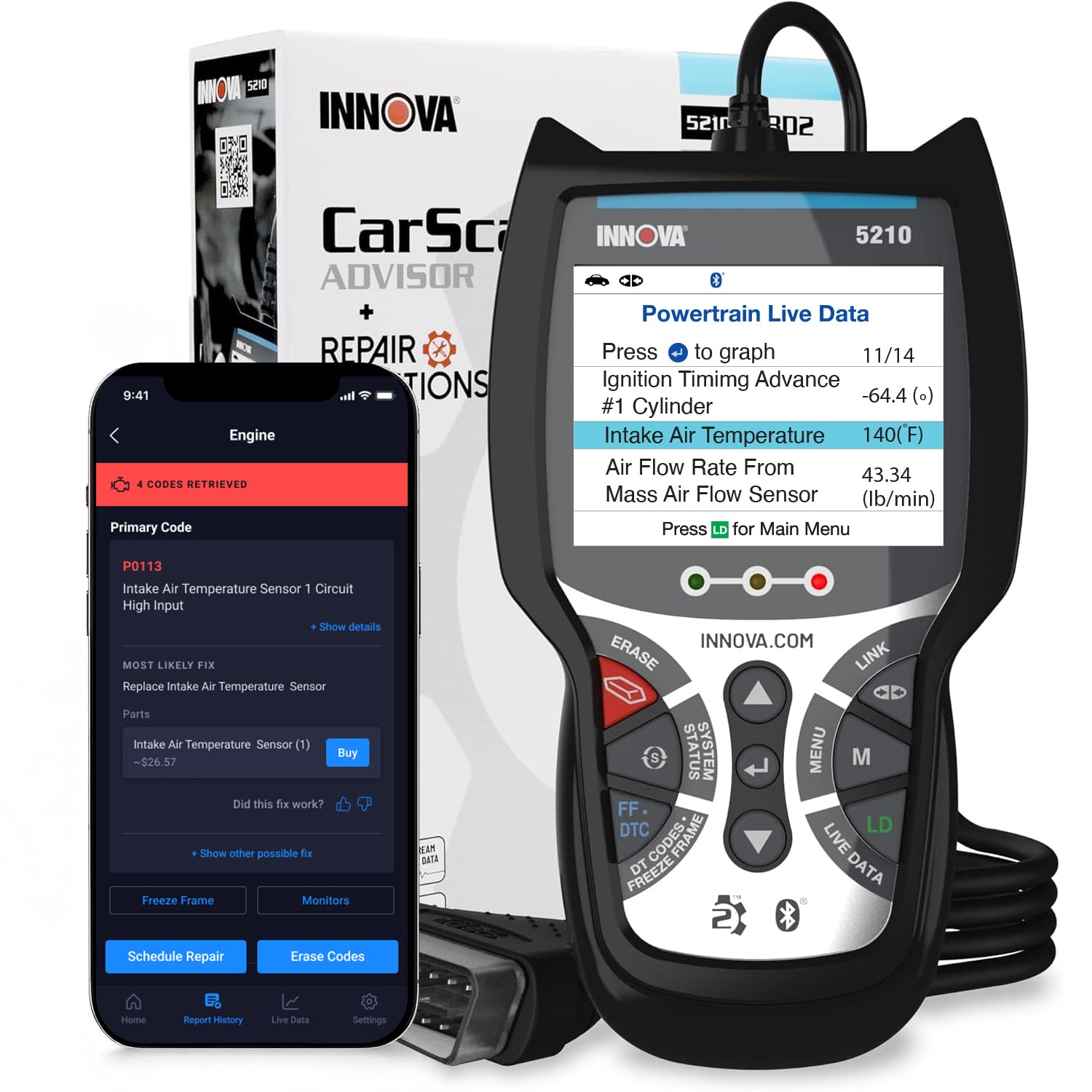
We recommend the Innova 5210 for Ford owners who want an easy-to-use scanner with code reading, live data, battery testing, and maintenance features.
Pros
- Reads engine and some ABS codes
- Shows live engine data and emissions readiness
- Includes battery testing and oil light reset
Cons
- Feature coverage varies by Ford model and year
- The attached cable limits portability
- Some setup steps may require the mobile app
We found the 5210 simple to connect and operate. It reads and clears check-engine codes, then displays useful information such as engine speed, temperature, fuel trims, and oxygen sensor readings. This helps us understand a problem before visiting a repair shop.
The battery test function adds value for Ford owners who want to check charging performance. We also used the readiness monitor screen to see whether a vehicle had completed its emissions checks after clearing a code.
ABS support and other advanced functions depend on the specific Ford model. We recommend checking Innova’s coverage tool before buying, since not every feature works on every vehicle. The RepairSolutions2 app can also provide repair suggestions, parts information, and estimated costs without a subscription.
Innova 5610 Bidirectional Scan Tool

We recommend the Innova 5610 for Ford owners who want advanced diagnostics, live data, and bidirectional testing without paying for a professional shop tool.
Pros
- Tests selected vehicle systems with active commands
- Reads enhanced data from engine, ABS, SRS, and transmission systems
- Includes updates and RepairSolutions2 access without a subscription
Cons
- Coverage varies by Ford model and year
- Some advanced functions take time to learn
- Instructions could explain certain steps more clearly
We found the 5610 easy to connect and useful for checking more than basic engine codes. Its live data made it easier to watch sensor readings while the vehicle ran, which helped narrow down problems instead of relying only on stored codes.
The bidirectional controls add real value for Ford owners. Depending on the vehicle, we could test components such as the fuel pump or electronic parking brake and perform supported reset or relearn procedures. These functions can reduce guesswork, but they do not work on every Ford.
The built-in screen keeps the tool practical when we do not want to use a phone. RepairSolutions2 can add repair information and reports, while the included case and protective boot make storage easier. We would check Innova’s coverage tool before buying because features change across Ford models and model years.
ANCEL FD700 Ford Scanner
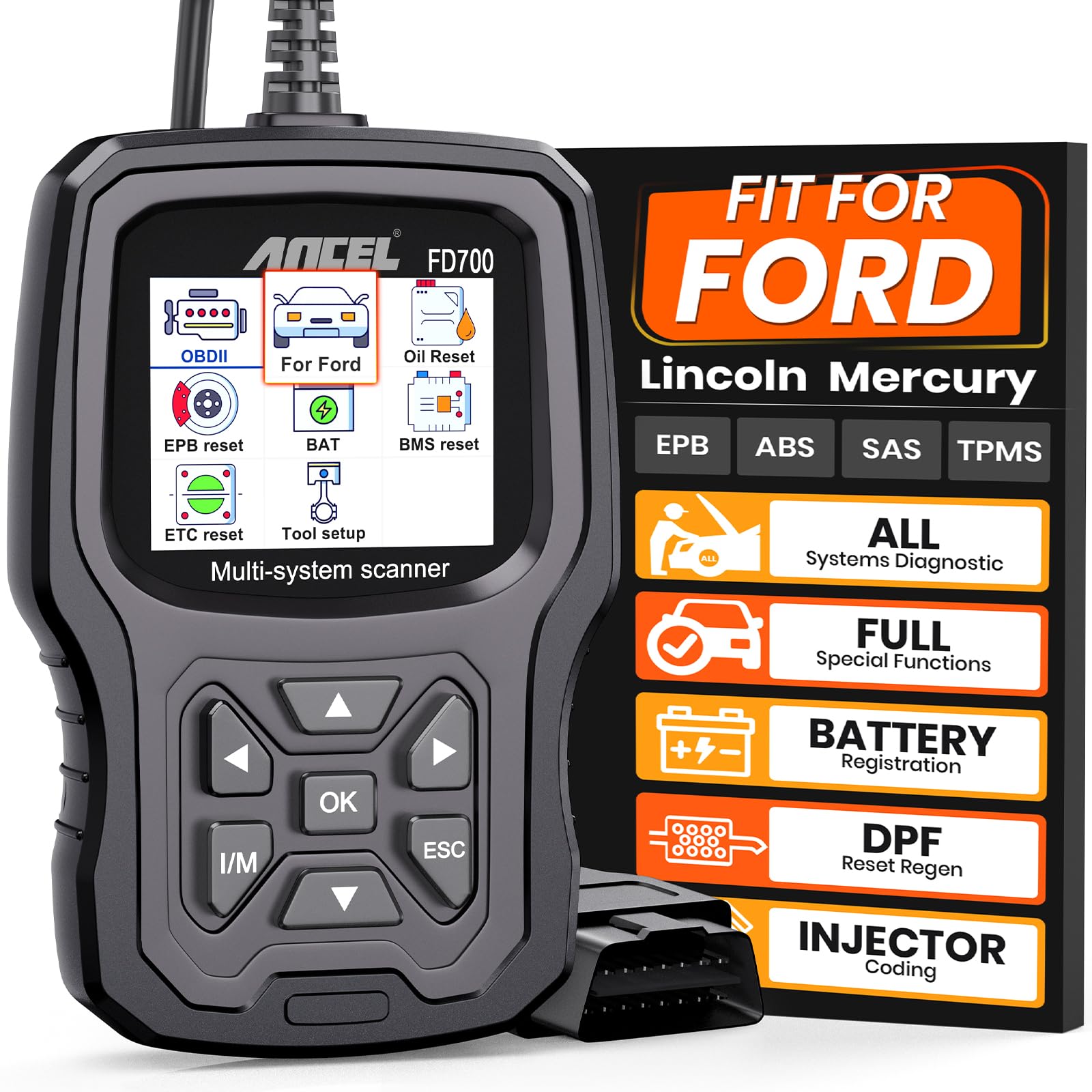
We recommend the ANCEL FD700 for Ford owners who want broad system access and useful service resets at a moderate price.
Pros
- Covers many Ford, Lincoln, and Mercury control systems
- Includes battery registration and several service functions
- Simple controls and lifetime software updates
Cons
- Vehicle coverage may vary by model and year
- Some users report update problems
- Several advanced functions may not work on every Ford
We used the FD700 to scan more than basic engine codes, and its full-system access made it more useful than a standard OBD2 reader. It can check systems such as ABS, SRS, TPMS, transmission, and battery management.
The service menu includes battery registration, oil resets, EPB service, steering angle calibration, and other Ford-focused tasks. We found the menus clear, while the small screen kept the tool compact and easy to hold.
It also works as a basic scanner on many other vehicles made after 1996. However, we would confirm compatibility before buying, especially for newer models or specific functions such as DPF regeneration.
Most users praise its simple operation and ability to clear Ford fault codes. Still, reports about failed updates and unsupported features show that coverage is not guaranteed for every vehicle.
OBDLink EX FORScan Adapter

We recommend this wired adapter for Ford owners who want fast, reliable access to advanced FORScan diagnostics.
Pros
- Supports all FORScan-compatible Ford modules and functions
- Connects quickly without a manual HS/MS switch
- Maintains a steady connection during scans and programming
Cons
- Requires a Windows computer
- Works best with FORScan, not as a general phone scanner
- Wired use limits convenience compared with Bluetooth adapters
We found setup straightforward after installing the required drivers on a Windows laptop. The cable connected to the vehicle without the connection drops or repeated switching that can affect cheaper adapters.
FORScan recognized the adapter quickly and gave us access to a wide range of Ford modules. We could read trouble codes, view system data, and use service functions that basic code readers often do not support.
The electronic bus switching also made the process easier. We did not need to stop and flip a physical switch while moving between vehicle systems. Its main drawback is the need for a laptop and a wired connection, but that tradeoff makes sense for deeper Ford diagnostics.
OHP FORScan USB Scanner
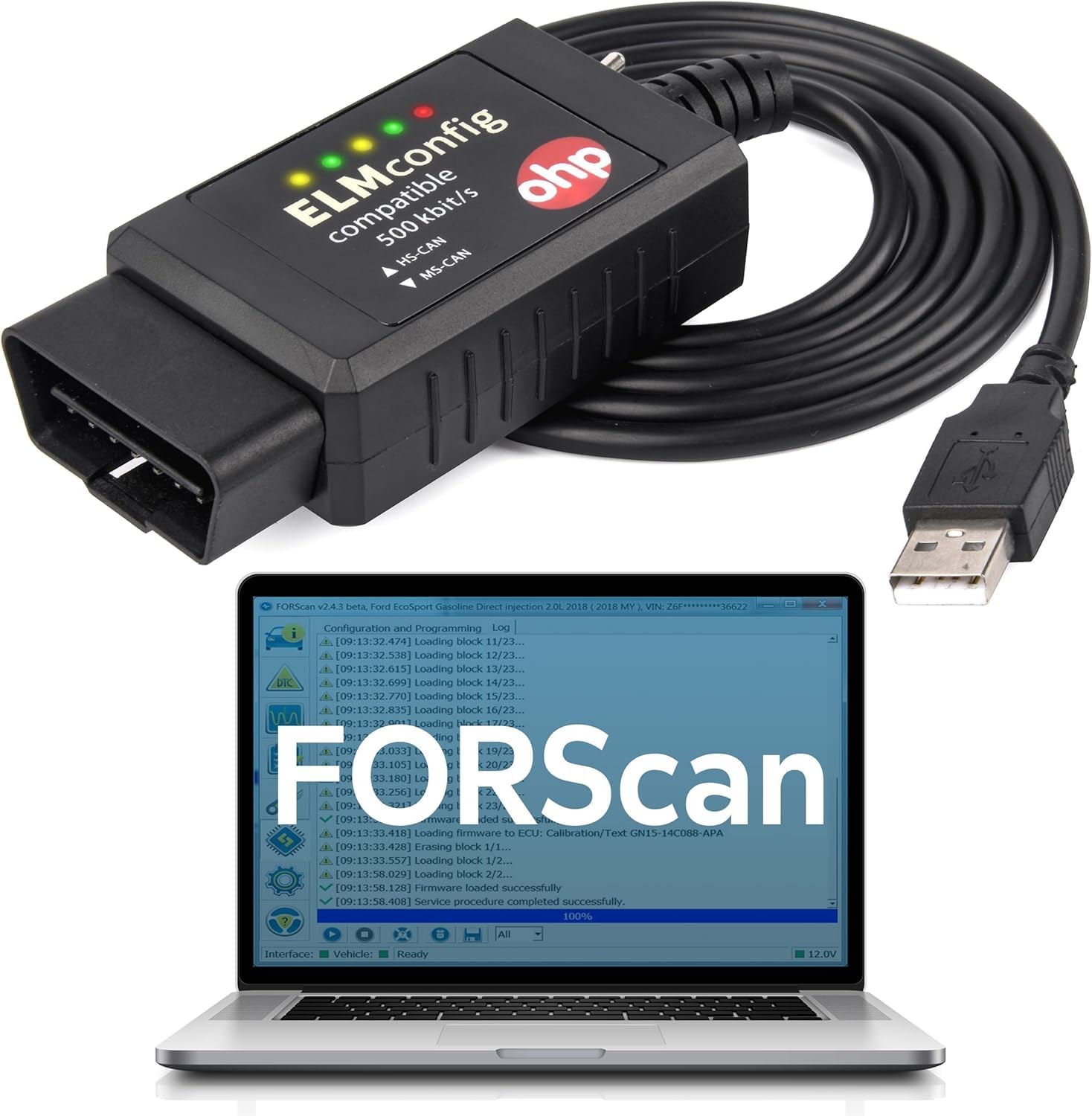
We recommend this scanner for Ford owners who want affordable DIY diagnostics through FORScan on a Windows computer.
Pros
- Reads and clears codes from several vehicle systems
- Supports Ford MS-CAN and HS-CAN networks
- Works well with many Ford, Lincoln, and Mercury models
Cons
- Requires a Windows computer and separate FORScan software
- Some advanced features need a FORScan license
- Vehicle support and functions vary by model and year
We found the OHP cable easy to connect after installing the needed driver and FORScan software. The switch lets us access different Ford networks, which helps with systems beyond the engine, such as the transmission and ABS.
During testing, the cable handled basic code reading and clearing without trouble. It also worked well for some Ford feature changes, but FORScan warned that compatibility can vary. We would check our exact vehicle before relying on advanced programming functions.
The USB connection feels better suited to a garage or driveway than roadside use. It does not work directly with phones, tablets, Chromebooks, or Mac computers, and some setups may require changing the COM port or installing the FTDI driver manually.
This is a practical choice for Ford owners who already have a Windows laptop and want more than a basic engine-code reader. We would avoid it if we need a wireless scanner or broad support for non-Ford vehicles.
Buying Guide
We should choose an OBD2 scanner based on our Ford’s model year, engine, and diagnostic needs. Confirm that the scanner supports the vehicle’s communication protocols and can read more than basic engine fault codes when needed.
Look for these features:
- Full-system access: Scans systems such as the engine, transmission, airbag, and ABS when supported.
- Ford-specific functions: Provides access to manufacturer-related data, tests, or service procedures.
- Live data: Displays sensor readings while the engine runs, which helps us check performance problems.
- Code details: Shows code definitions and freeze-frame data instead of displaying codes alone.
- Reset functions: Supports relevant service resets, such as oil-life or battery registration, if our vehicle requires them.
- Clear display: Uses readable menus and simple controls.
- Updates: Includes software updates and states how long they remain available.
- Connection type: Lets us choose between a wired tool and a wireless scanner that works with a phone or tablet.
We should also check the scanner’s coverage list before buying. Compatibility can vary by model year, engine, trim level, and installed equipment.
| Feature | What we should check |
|---|---|
| Vehicle coverage | Ford models and years supported |
| Diagnostic depth | Basic codes or full-system scanning |
| App or software | Device support, update policy, and ease of use |
| Power source | Vehicle-powered, rechargeable, or battery-powered |
| Support | Manual, warranty, and customer service |
We should match the scanner to our skill level. A simple code reader may suit basic checks, while advanced repairs require better data access and more testing functions.
Editor’s Choice
We recommend the FORScan-compatible OBD2 scanner for Ford owners who want more than basic code reading. FORScan can access Ford-specific modules, including systems that many standard scanners cannot reach.
| Feature | Why it matters |
|---|---|
| Ford module access | Reads codes from multiple vehicle systems |
| Live data | Helps us monitor sensors while the engine runs |
| Service functions | Supports tasks such as battery registration on some models |
| Broad compatibility | Works with many Ford, Lincoln, and Mazda vehicles |
We should choose a scanner that supports HS-CAN and MS-CAN when our Ford requires both networks. A compatible adapter, such as an OBDLink EX for Windows, can provide a stable connection for advanced FORScan functions.
Basic scanners still work well for checking the engine light and clearing common powertrain codes. However, we prefer the FORScan setup when we need deeper diagnostics, module access, or Ford-specific service features.
Before buying, we should confirm compatibility with our vehicle’s model year and operating system. Some advanced functions may also require a paid FORScan license or additional hardware.
Conclusion
We should choose an OBD2 scanner based on the Ford features we need to test. A basic model can read and clear engine codes, while an advanced scanner may access ABS, airbag, transmission, and body control systems.
For most Ford owners, we recommend a scanner that supports Ford-specific functions, live data, battery testing, and code definitions. Wireless models offer more convenience, but wired scanners often provide a simple and reliable connection.
Before buying, we should check the scanner’s compatibility with our Ford’s model year and engine. Regular software updates also help the tool support newer vehicles and provide accurate diagnostic information.
| Need | Best scanner type |
|---|---|
| Check engine light | Basic OBD2 scanner |
| Home repairs | Mid-range scanner |
| Ford module diagnostics | Advanced Ford-compatible scanner |
| Professional use | Full-featured diagnostic tool |
A scanner can help us identify problems, but it does not replace careful testing or professional repair advice. We should use the scan results as a starting point and confirm the cause before replacing parts.
FAQS
Will any OBD2 scanner work with a Ford?
Most scanners can read standard engine fault codes from Ford vehicles made after 1996. For systems such as ABS, air bags, body control, and manufacturer-specific data, we should choose a scanner that supports Ford-specific functions.
Do we need a special scanner for Ford?
We do not always need one, but a Ford-capable scanner gives us more information. Look for support for Ford protocols, enhanced codes, live data, and service resets.
Can an OBD2 scanner clear a warning light?
Yes, many scanners can clear check-engine codes after we record them. Clearing a code does not fix the cause, and the light may return if the problem remains.
Which Ford models can we scan?
Compatibility depends on the scanner and vehicle year. Most OBD2 tools support Ford cars, trucks, and SUVs sold in the United States from 1996 onward, but advanced features can vary by model.
Can we use a phone with a Ford OBD2 scanner?
Some scanners connect to a phone through Bluetooth or Wi-Fi. We should confirm that the app supports our Ford model and operating system before buying.
What features should we prioritize?
- Ford-specific diagnostics
- ABS and air-bag scanning
- Live data in real time
- Battery and charging tests
- Software updates
- Clear warranty and support terms
