
BMW Key Fob Not Working? A Practical Troubleshooting Guide for Drivers

If your BMW key fob suddenly stops unlocking the doors, starts acting intermittent, or won’t let the car start, don’t jump straight to replacement. In a lot of cases, the fix is simpler: a weak fob battery, a low vehicle battery, or a basic sync issue.
The quickest way to save time is to test the problem in the right order. Check the spare key first, then the car battery, then the fob battery, and only after that move into re-syncing, damage checks, or replacement.
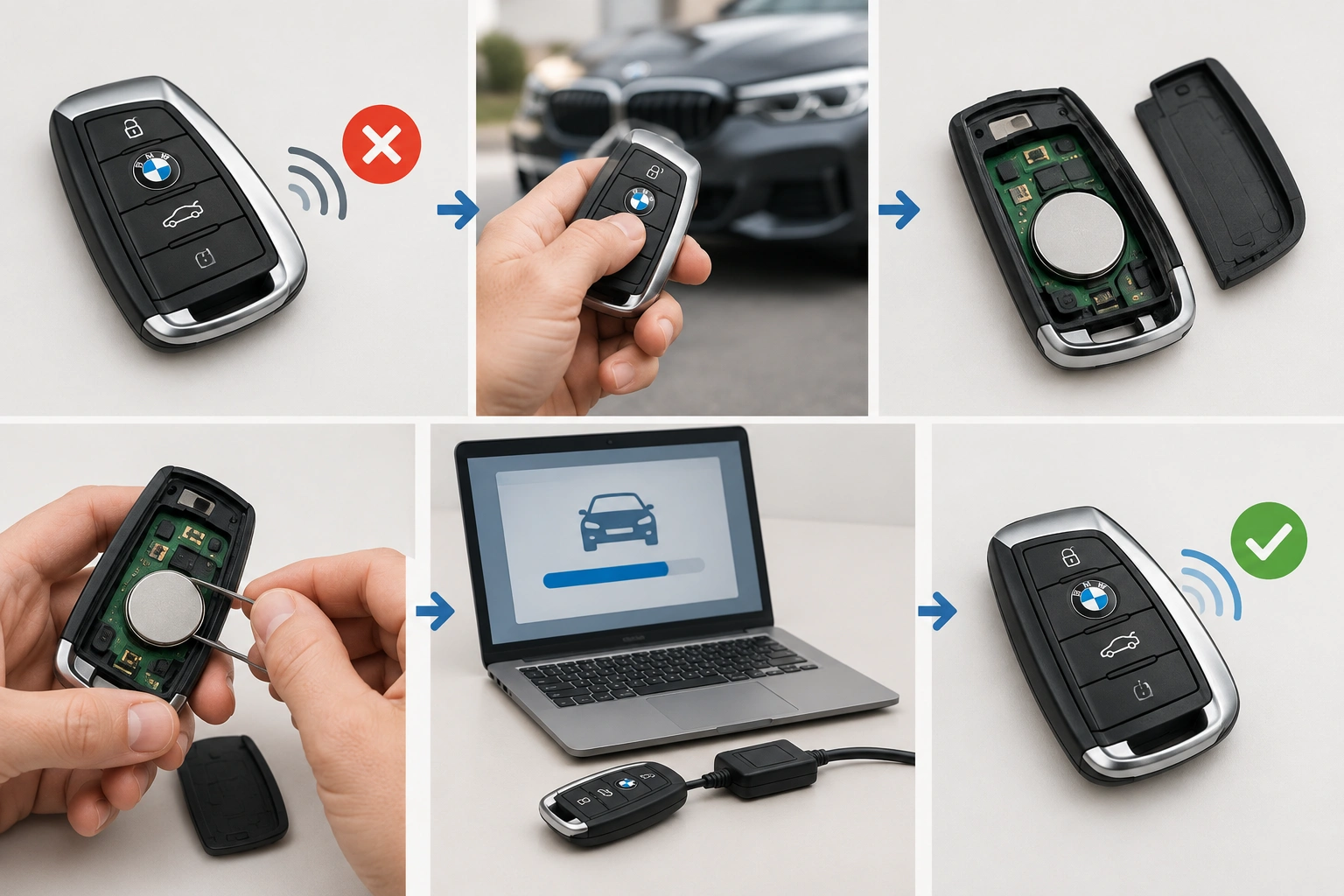
BMW Key Fob Not Working: What the Symptoms Usually Mean
The symptom pattern tells you a lot.
If the fob works only when you stand very close to the car, that often points to a weak battery in the key fob. If it works sometimes and fails other times, the battery may still be the culprit, but worn buttons or internal damage become more likely.
If the fob unlocks the doors but the car won’t start, the problem may be different from a full fob failure. That can point to a start authorization issue, a weak vehicle battery, or a BMW-specific emergency start procedure that needs to be used.
If both the unlock and lock buttons do nothing, and the spare key also fails, the issue may be on the vehicle side rather than in the fob itself. That’s when Comfort Access, the receiver, or the car battery move higher on the list.
Fastest Checks First: Spare Key and Vehicle Battery
Before you open the fob or order a replacement, isolate the problem.
1) Try the spare key fob
This is the fastest test you can do.
- If the spare works normally: the original key fob is likely the problem. Start with the fob battery if your key type uses one, then inspect the shell and buttons.
- If the spare also fails: stop assuming the fob is the issue. Check the car battery next, and if that looks fine, move toward a vehicle-side communication or immobilizer issue.
2) Check whether the car battery is weak
A low vehicle battery can mimic a dead key fob. BMWs can be affected by low voltage in ways that look like remote locking problems, Comfort Access issues, or trouble recognizing the key.
A common clue is that the car has been sitting for several days, or other electrical features act strange too. If the dashboard lights seem dim, the interior electronics act sluggish, or the car struggles to start, the vehicle battery deserves attention before you blame the fob.
3) Replace the fob battery only if your key type allows it
Many BMW key fobs use a replaceable coin-cell battery, often a CR2032, but not every BMW key design is the same. Some BMW keys are rechargeable, and some are not user-serviceable, so a battery swap is not universal. Check your owner’s manual or the battery type already in the fob before buying a replacement.
For a broader look at keyless-entry and battery-related symptoms, Edmunds’ car battery advice can be useful as a general reference, and NHTSA’s vehicle safety information is a solid place to check for broader electrical safety guidance.
What the results mean
- Spare works, original doesn’t: focus on the original fob.
- Neither key works, but the car battery is weak: charge or replace the vehicle battery first.
- Neither key works, and the car battery seems fine: look at the receiver, Comfort Access, immobilizer communication, or programming.
- One key works only near the car: the fob battery or internal fob damage is more likely.
Most Likely Causes, Ranked From Common to Less Common
Here’s the practical order I’d work through as a former tech:
-
Dead or weak key fob battery
Most common when range drops, buttons need multiple presses, or the fob works only close to the car. -
Weak vehicle battery
Very common when the car has been parked, the electronics are acting oddly, or both key fobs seem “dead.” -
Worn or damaged fob
Buttons, contacts, and the shell can wear out over time. Water exposure makes this more likely. -
Comfort Access or receiver issue
More likely when the car recognizes the key inconsistently or only certain functions fail. -
Programming or sync problem
Less common than battery issues, but it can happen after a battery replacement, electrical fault, or service event.
How to Replace the BMW Key Fob Battery
Many BMW key fobs use a replaceable coin-cell battery, often a CR2032, but not every BMW key design is the same. Some BMW keys are rechargeable or have a different internal layout, so check your owner’s manual or the battery type already in the fob before buying a replacement.
What to do
- Open the key fob carefully using the release or seam designed for battery access.
- Note the battery orientation before removing it.
- Install the new battery the same way the old one sat in the fob.
- Snap the case back together without forcing it.
- Test lock, unlock, and start functions from a few feet away.
What to watch for
- Don’t pry aggressively and crack the shell.
- Don’t mix up the battery polarity.
- Don’t assume every BMW uses the same battery type.
If the fob starts working again after a battery swap, the issue was likely power-related. If it still fails or only works intermittently, the battery was probably not the only problem.
How to Unlock and Start a BMW When the Fob Fails
If the key fob is completely unresponsive, you still may be able to get into the car and start it.
Emergency unlocking
BMW models typically include a mechanical key blade hidden inside the fob. Use that blade to unlock the driver’s door if the remote functions are dead.
Emergency starting
Many BMWs with push-button start have a backup method for recognizing a weak or dead key fob battery. On some models, that means placing the fob in a designated spot or holding it near the start area so the immobilizer can read the transponder.
Because BMW key layouts vary by model year, check your owner’s manual for the exact emergency start procedure for your car. That step matters because forcing the issue or repeatedly pressing the start button won’t help if the vehicle is waiting for the key to be read in the correct location.
When a BMW Key Fob Needs Re-Syncing or Reprogramming
A battery replacement and a sync issue are not the same thing.
A fresh battery helps when the fob is weak. Re-syncing is worth trying when the fob has a known-good battery and the problem looks like a communication mismatch rather than a dead power source.
Re-syncing may be worth trying if:
- The battery is new, but the fob still acts inconsistent.
- The car briefly recognizes the key, then stops.
- The issue started after a battery replacement or electrical event.
Reprogramming may be needed if:
- The fob no longer communicates with the vehicle at all.
- Both buttons and start recognition fail after confirming a good battery.
- A replacement fob has been added and needs to be matched to the car.
A simple reset is not a reliable fix for water damage, broken buttons, or a failed receiver. If the key is physically fine but the car still won’t recognize it, professional programming may be the next step.
When the Problem Is the Car, Not the Key Fob
This is the step many owners skip.
If both the main key and spare key fail, the car battery is a strong suspect. BMW electrical systems can behave unpredictably when voltage is low, and the symptoms can look exactly like a dead fob.
If the spare key also fails but the car battery checks out, the next suspects are the receiver, Comfort Access system, immobilizer communication, or a programming issue. That scenario is less common than a battery problem, but it matters because it changes the fix from fob service to vehicle diagnostics.
Comfort Access problems can also look like a key fob issue. For example, the car may still start when the key is placed in the correct backup location, but the touchless unlock feature won’t work. That points more toward the Comfort Access system or receiver side than the fob battery itself.
Physical Damage, Water Damage, and Worn Buttons
A fob can fail mechanically even when the battery is fine.
Look for:
– Cracked shell
– Loose buttons
– Sticky or mushy button feel
– Water exposure
– Corrosion around the battery contacts
– A fob that only works when pressed hard or twisted
If the buttons are worn through or the case is damaged, replacing the battery may buy you nothing. Water-damaged fobs are especially unpredictable: they may work for a day and fail again without warning.
Replacement Options: Dealer vs Locksmith vs Aftermarket
If the fob is beyond repair, you have three main paths.
BMW dealer
A dealer is the most direct option for OEM replacement and model-specific programming. It’s often the safest route when your BMW has a newer or more complex key system. The trade-off is cost and time.
Automotive locksmith
An automotive locksmith may be able to supply and program a BMW key fob faster and at a lower price, depending on the model. This is most realistic when the locksmith supports your exact BMW key type, has the correct programming equipment, and the issue is a standard replacement rather than a vehicle-side fault.
Aftermarket replacement
Aftermarket fobs can reduce cost, but compatibility and quality vary. They may be fine for some situations, but if you want the least guesswork, OEM or dealer-supported replacement is usually more predictable.
If you’re comparing options, the real question is not just price. It’s whether the replacement can be programmed for your exact BMW model and whether you need the car back the same day.
For a general view of how BMW owners are supported through official channels, BMW says it provides customer service from people who know BMW best on its BMW North America financial services page.
Typical Cost and Turnaround Time
Costs vary by model, key type, and VIN, so avoid anyone who promises a one-size-fits-all price without checking your vehicle.
Practical USD ranges are often along these lines:
– Battery replacement: usually the cheapest fix, often just the cost of the battery if you do it yourself.
– Dealer replacement and programming: commonly a few hundred dollars or more, and can be higher for newer or more complex BMW keys.
– Automotive locksmith replacement/programming: often less than dealer pricing, but still typically a significant service cost that varies by model and VIN.
Turnaround can be quick for a battery swap, same-day for some locksmith services, or longer if the dealer has to order and program a specific fob.
When to Consult a Locksmith
Call a professional if:
– Both the main key and spare key fail
– The car battery checks out, but the fob still won’t work
– The fob is water-damaged or physically broken
– Re-sync attempts do nothing
– You need the car unlocked or started quickly and safely
A locksmith is often the best middle ground when you want faster service than a dealer and your BMW model is supported. If the issue appears to be the receiver, Comfort Access system, or another vehicle-side fault, you may still need dealer diagnostics.
Quick Decision Guide
If your BMW key fob is not working, use this order:
-
Try the spare key.
If it works, the original key is the problem. -
Check the car battery.
If both keys fail and the vehicle battery is weak, fix the battery first. -
Replace the fob battery if your key type allows it.
This is only relevant for BMW fobs with a user-replaceable battery. -
Use the emergency unlock/start procedure.
This gets you into the car and may let you start it even when the fob battery is dead. -
Try re-syncing or reprogramming if the battery is good.
This makes sense when the key has power but the car is not recognizing it correctly. -
Replace the fob if it is damaged or no longer programmable.
That’s the point where repair usually stops being cost-effective.
The goal is to avoid buying parts you don’t need. Start with the spare key and the car battery, then move to the fob battery only when your BMW key type supports it, and escalate to programming or replacement when the evidence points there.
FAQ
Can I replace the battery in every BMW key fob?
No. Some BMW key fobs use a replaceable coin-cell battery, while others are rechargeable or not user-serviceable. Check your owner’s manual or the key design before trying to open it.
If my spare BMW key also doesn’t work, what does that mean?
If both keys fail and the car battery seems fine, the problem is more likely vehicle-side: Comfort Access, the receiver, immobilizer communication, or a programming issue.
Will re-syncing always fix a BMW key fob?
No. Re-syncing is only worth trying when the fob has a known-good battery and the symptoms suggest a communication problem. It will not fix damaged buttons, water damage, or a failed receiver.
Can a locksmith replace a BMW key fob?
Often yes, but only if they support your exact model and key type. Some BMW keys and newer systems still require dealer involvement.
How much does BMW key fob replacement cost?
Pricing varies by model and VIN. In general, dealer replacement is usually the most expensive, locksmith service is often less, and a battery swap is the least expensive fix.
What if my BMW unlocks but won’t start?
That can point to the emergency start procedure, a weak vehicle battery, or a start authorization issue rather than a dead fob battery alone.
