
How to Diagnose Misfire With an OBD2 Scanner

Quick Answer
To diagnose an engine misfire with an OBD2 scanner, read the stored and pending trouble codes, save freeze-frame data, and examine live engine data when available. Codes such as P0300, P0301, and P0302 help identify a random or cylinder-specific misfire, but they do not automatically identify the defective component. Use the results to narrow the possibilities, then confirm the cause through ignition, fuel, air-intake, and mechanical testing.
Steps to Diagnose an Engine Misfire
- Scan for codes: Look for P0300-series codes and any related engine faults.
- Save freeze-frame data: Record engine RPM, load, temperature, and other available readings.
- Check live data: Review cylinder misfire counters and fuel trims if supported.
- Identify the pattern: Determine whether one cylinder or multiple cylinders are affected.
- Confirm the fault: Test the likely ignition, fuel, intake, or mechanical cause before replacing parts.
Important Safety Warning
- Flashing check engine light: Reduce engine load and stop when safe. A severe misfire can damage the catalytic converter.
An engine misfire can make your car shake, idle roughly, hesitate during acceleration, or lose power. An OBD2 scanner helps narrow down the problem before you spend money replacing parts.
I’ll walk you through the diagnostic process, from reading trouble codes to checking live data and identifying likely causes. You’ll also learn what a basic scanner can reveal, when an advanced tool helps, and when a professional diagnosis makes more sense.
In This Guide
- What Can an OBD2 Scanner Tell You About an Engine Misfire?
- How Do You Read Misfire Codes With an OBD2 Scanner?
- How Do You Check Live Data and Misfire Counters?
- How Do You Find the Actual Cause of a Misfire?
- Which OBD2 Scanner Features Help Diagnose Misfires?
- When Should You Get Professional Help?
- Frequently Asked Questions
What Can an OBD2 Scanner Tell You About an Engine Misfire?
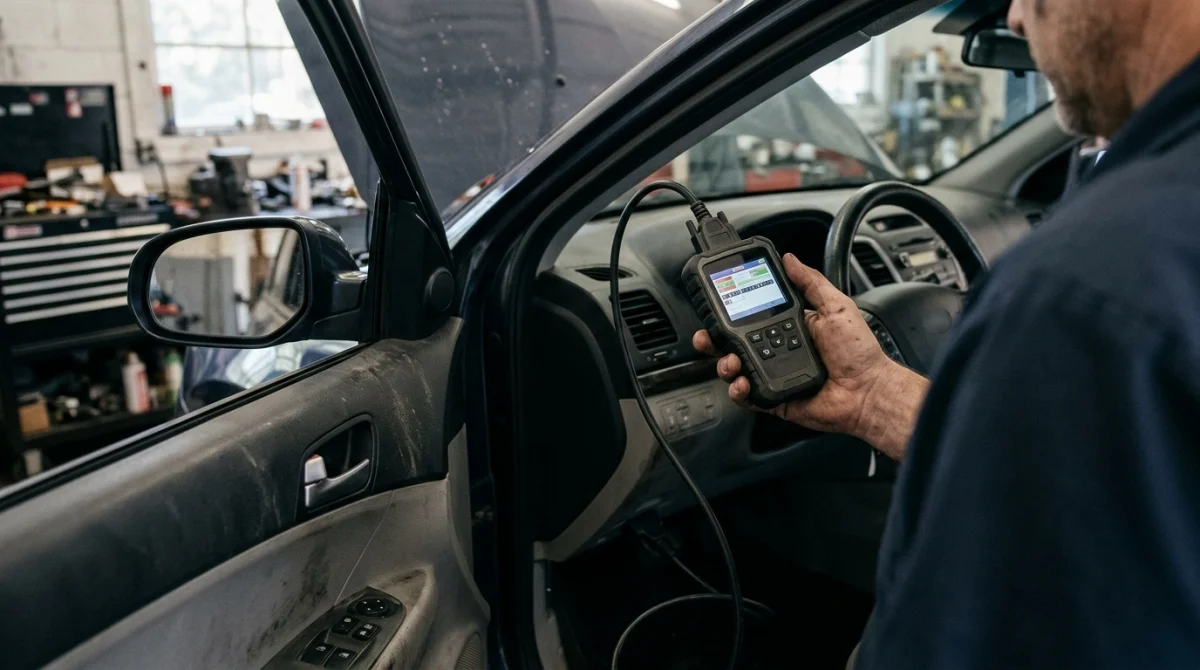
An OBD2 scanner can retrieve diagnostic trouble codes and, when supported, display engine operating data that helps identify a misfire pattern. However, a trouble code usually identifies a detected condition rather than proving which component has failed.
An engine misfire happens when a cylinder fails to burn its air-fuel mixture correctly or doesn’t produce the expected power during combustion. The underlying problem may involve ignition, fuel delivery, airflow, compression, or engine timing.
The vehicle’s engine control module, commonly called the ECM or PCM, monitors engine operation. Many vehicles detect misfires by evaluating changes in crankshaft speed and comparing those changes with expected combustion behavior.
What symptoms indicate a possible misfire?
Common symptoms include the following:
- Rough or uneven engine idling.
- Shaking or vibration from the engine.
- Hesitation when accelerating.
- Reduced engine power or poor fuel economy.
- A check engine light that stays illuminated or flashes.
- Unusual exhaust sounds or a strong fuel smell.
These symptoms don’t always mean the engine is misfiring. Faults involving engine mounts, airflow sensors, fuel delivery, or other systems can produce similar symptoms.
That’s why scanning the vehicle is a useful starting point. It adds diagnostic evidence instead of relying on symptoms alone.
Can every OBD2 scanner identify the misfiring cylinder?
No. A basic code reader may retrieve a P0300-series code but provide no individual cylinder counters or advanced live data.
More capable scanners may display manufacturer-specific data, supported misfire counters, fuel trims, and onboard monitor results. Availability depends on the vehicle, engine, control module, and scanner.
Start with the information your existing tool provides. You can decide whether you need more advanced diagnostics after reviewing the initial results.
Section takeaway: An OBD2 scanner helps narrow down a misfire, but additional testing is usually needed to confirm its cause.
How Do You Read Misfire Codes With an OBD2 Scanner?
Read all available engine codes before clearing anything or disconnecting the battery. Stored codes, pending codes, and freeze-frame information can preserve clues about when the misfire occurred.
Step 1: Connect your OBD2 scanner
- Park the vehicle in a safe location and apply the parking brake.
- Locate the diagnostic connector, commonly beneath the dashboard.
- Connect the scanner according to its instructions.
- Switch on the ignition as directed by the scanner manufacturer.
- Select the engine control module or diagnostic menu.
- Run a scan and record all available trouble codes.
Some scanners communicate with the vehicle when the ignition is on and the engine is off. Others may require a different setup, so follow the instructions for your specific tool.
Keep the vehicle stationary while navigating the scanner. Never handle the device while driving to reproduce a fault.
Step 2: Understand the common P0300-series codes
The P0300 series contains codes associated with detected engine misfires. The final digit or digits help distinguish a random or multiple-cylinder misfire from a fault associated with a particular cylinder.
| Trouble code | Meaning | Diagnostic direction |
|---|---|---|
| P0300 | Random or multiple-cylinder misfire detected | Investigate shared ignition, fuel-delivery, intake, and mechanical problems. |
| P0301 | Cylinder 1 misfire detected | Investigate cylinder 1’s ignition, fuel delivery, and compression. |
| P0302 | Cylinder 2 misfire detected | Check the evidence associated with cylinder 2. |
| P0303 | Cylinder 3 misfire detected | Investigate cylinder 3 using the manufacturer’s test procedures. |
| P0304 | Cylinder 4 misfire detected | Check ignition, fuel delivery, and mechanical condition. |
These are common generic code descriptions, not a complete list of possible misfire codes. The same pattern continues for other cylinder-specific codes on engines with more cylinders.
A code such as P0301 doesn’t prove that the spark plug or ignition coil has failed. It indicates that the engine computer detected a misfire associated with cylinder 1.
Step 3: Check stored, pending, and permanent codes
These code categories provide different information about the vehicle’s diagnostic history.
- Stored codes: Faults recorded by the diagnostic system that may have triggered a warning light.
- Pending codes: Fault conditions detected but not yet confirmed under the system’s criteria.
- Permanent codes: Certain emissions-related faults that remain recorded until the vehicle’s monitoring system verifies that the problem has been resolved.
Not every scanner or vehicle displays all three categories. A permanent code generally cannot be removed simply by using the scanner’s clear-code command.
Step 4: Save freeze-frame data
Freeze-frame data is a snapshot of selected operating conditions recorded when a fault was detected. Depending on the vehicle, it may include engine RPM, engine load, coolant temperature, and fuel-trim readings.
Record these readings before clearing codes. They may help you distinguish a misfire that happens during cold startup from one that appears after the engine warms up or under heavier load.
Step 5: Check for related trouble codes
Read all relevant powertrain codes rather than focusing only on P0300 or a cylinder-specific misfire code.
Pay attention to related faults involving:
- Fuel mixture or fuel-system performance.
- Mass airflow or manifold pressure readings.
- Ignition-system operation.
- Injector circuits or other engine electrical faults.
- Camshaft or crankshaft position signals.
A related code may point toward a shared cause, but it still needs confirmation. Follow the manufacturer’s diagnostic information when several faults appear together.
Section takeaway: Record the complete code list and freeze-frame information before resetting anything.
How Do You Check Live Data and Misfire Counters?
Live data lets you observe the engine computer’s reported readings while the engine operates. When supported, cylinder-specific misfire counters can show which cylinders are accumulating misfires under particular conditions.
Step 1: Open the live data menu
Look for a menu called Live Data, Engine Data, Misfire Data, Cylinder Misfire, or Onboard Monitor Results. Names vary by scanner and vehicle.
Useful parameters may include:
- Misfire counters: Reported misfire activity for individual cylinders.
- Engine RPM: The engine’s rotational speed.
- Short-term fuel trim (STFT): Immediate fuel correction reported by the engine computer.
- Long-term fuel trim (LTFT): Longer-term learned fuel correction.
- Coolant temperature: Helps establish whether the engine is cold or warm.
- Mass airflow or manifold pressure: Readings that help evaluate engine airflow.
Your scanner may not expose every parameter. Missing live data doesn’t automatically mean a sensor or component has failed.
Step 2: Identify which cylinder’s misfire counter increases
Compare the available cylinder counters during a consistent observation period. Note the operating conditions and whether the counts increase when the reported symptoms occur.
For example, imagine a four-cylinder engine that shakes at idle while the counter for cylinder 2 increases repeatedly. That pattern makes cylinder 2 a sensible starting point for further testing.
However, the result doesn’t prove that cylinder 2’s ignition coil is faulty. A spark plug, injector, wiring issue, compression problem, or other condition could produce a similar pattern.
If the counters remain unchanged, the fault may be intermittent or absent during the test. Some vehicles also restrict access to individual cylinder counts.
Step 3: Review Mode $06 results when available
Mode $06 provides results from supported onboard diagnostic monitor tests. Depending on the vehicle and scanner, it may provide useful information about misfire monitoring or other emissions-related tests.
Some scanners translate the results into readable descriptions. Others display test identifiers, measured values, and limits that require vehicle-specific interpretation.
Don’t assume every Mode $06 result represents a direct misfire count. Check the scanner documentation and applicable service information before drawing conclusions.
Step 4: Interpret fuel trims carefully
Fuel trims help explain how the engine computer adjusts fuel delivery to maintain the intended air-fuel mixture. They can provide clues about a possible lean or rich condition.
- Positive fuel trim: The computer is adding fuel to compensate for a perceived lean condition.
- Negative fuel trim: The computer is removing fuel to compensate for a perceived rich condition.
- Different readings between banks: On applicable engines, a consistent difference may help narrow the affected area.
Fuel trims must be interpreted under appropriate operating conditions. A misfire can also affect oxygen readings, so unusual fuel trims don’t automatically prove an intake leak or fuel-delivery fault.
Compare the readings with the manufacturer’s specifications and the complete symptom pattern. Avoid relying on a single universal threshold for every engine.
Section takeaway: Live misfire counters help narrow down the affected cylinder, while fuel trims and operating conditions provide supporting evidence.
How Do You Find the Actual Cause of a Misfire?
Once you’ve identified the likely cylinder or cylinders, investigate ignition, fuel delivery, air intake, and mechanical condition. Choose tests that separate the remaining possibilities instead of replacing parts based on the code alone.
1. Inspect the ignition system
On gasoline engines, ignition faults are common causes of misfires. Depending on the engine design, the system may use individual ignition coils, coil packs, spark plugs, or other arrangements.
Look for evidence of:
- Worn, damaged, or incorrectly specified spark plugs.
- Faulty ignition coils or loose electrical connections.
- Damaged ignition wiring, where applicable.
- Moisture, oil, or contamination around ignition components.
If the manufacturer permits it, a controlled coil-swap test may help determine whether a misfire follows the coil to another cylinder. A change in the fault pattern strengthens the suspicion, but further confirmation may still be appropriate.
Expert note: Follow the vehicle manufacturer’s procedures when testing ignition components. Ignition systems can produce dangerous voltages, and some vehicles require special precautions.
2. Investigate fuel delivery
A cylinder can misfire if its injector doesn’t deliver fuel correctly. Low fuel pressure or a broader fuel-supply problem can also affect multiple cylinders.
Depending on the evidence, further checks may include:
- Reviewing injector-related trouble codes.
- Testing fuel pressure against the correct specification.
- Checking injector wiring and electrical connections.
- Performing suitable injector balance or flow tests.
Don’t replace an injector solely because its cylinder has a misfire code. Ignition faults and mechanical problems can create the same diagnostic pattern.
Expert note: Fuel systems may remain pressurized after shutdown, and direct-injection systems can operate at extremely high pressure. Leave hazardous pressure testing to a suitably equipped technician.
3. Check for intake leaks and mixture problems
Unmetered air entering the engine can create a lean mixture and contribute to misfires. Vacuum leaks, intake leaks, and airflow-measurement problems are possible causes.
Compare the fuel-trim readings with the symptoms and engine operating conditions. A lean pattern affecting multiple cylinders may suggest a shared intake or fuel-supply problem rather than one isolated ignition component.
Further investigation may involve inspecting intake connections, checking relevant sensors, or conducting a smoke test. Don’t spray flammable chemicals around a running engine to search for leaks.
4. Investigate compression and mechanical timing
If ignition, fuel delivery, and airflow checks don’t explain the misfire, investigate the affected cylinder’s mechanical condition. Valve problems, worn piston rings, head-gasket faults, or incorrect valve timing may prevent normal combustion.
Depending on the engine and symptoms, a technician may perform:
- Compression testing: Compares cylinder pressure under specified test conditions.
- Leak-down testing: Helps identify where a cylinder loses pressure.
- Mechanical timing checks: Investigate suspected camshaft or crankshaft timing problems.
- Electrical waveform testing: Evaluates relevant signals when ordinary scan data doesn’t explain the fault.
These tests go beyond the capabilities of a basic code reader. They’re particularly useful when the misfire persists despite apparently normal ignition and fuel-system checks.
5. Use the code and symptoms together
Different code patterns suggest different diagnostic directions. Use them to prioritize testing, not to make a final diagnosis without evidence.
| Observed pattern | Possible causes | Recommended direction |
|---|---|---|
| One cylinder repeatedly misfires | Spark plug, ignition coil, injector, wiring, compression | Test the affected cylinder’s ignition and fuel delivery, then assess mechanical condition if necessary. |
| Several cylinders misfire | Fuel-supply problem, intake leak, shared ignition fault, timing issue | Look for shared causes and compare related codes and live data. |
| Misfire mainly at idle | Intake leak, ignition problem, injector fault, mechanical issue | Compare idle readings with appropriate operating-condition data and targeted tests. |
| Misfire under acceleration | Ignition breakdown under load, fuel-delivery limitation, other engine faults | Review saved operating conditions and test relevant systems safely. |
| Misfire mainly during cold startup | Ignition, fueling, injector leakage, deposits, mechanical issues | Record cold-start data and follow the vehicle-specific diagnostic procedure. |
These patterns are diagnostic clues, not universal rules. A fault can behave differently depending on the engine design, temperature, load, and maintenance history.
Example: A P0301 code returns after a spark plug replacement
Suppose a vehicle shakes at idle and stores P0301 even after its spark plug has been replaced. The next step isn’t automatically to buy another plug or install a new coil.
A more useful diagnostic sequence is to:
- Review the original and current codes, along with freeze-frame data.
- Verify that the correct spark plug was installed and connected properly.
- Check the ignition coil and its electrical connections.
- Investigate injector operation if the ignition system doesn’t explain the fault.
- Check compression if the misfire remains unexplained.
This approach reduces unnecessary parts replacement and helps identify the underlying problem. The correct sequence depends on the vehicle and the evidence gathered.
Section takeaway: Use the scan results to select the next test, then confirm the suspected component before replacing it.
Which OBD2 Scanner Features Help Diagnose Misfires?
The right scanner depends on how much diagnostic information your vehicle provides. A basic code reader may be enough to identify a P0300-series fault, while advanced troubleshooting can benefit from live data and enhanced diagnostic access.
| Scanner type | Useful capabilities | Limitation |
|---|---|---|
| Basic code reader | Reads supported stored and pending codes. | May not show detailed live data or individual cylinder counters. |
| Live-data scanner | Displays supported engine readings and may graph changing values. | Available parameters vary by vehicle. |
| Enhanced diagnostic scanner | May access manufacturer-specific information and additional control modules. | Coverage depends on the vehicle, software, and tool. |
| Professional diagnostic equipment | May combine scan data, supported active tests, and specialized measurements. | Requires suitable training and correct test procedures. |
What features should you look for?
If you’re buying a scanner specifically for misfire diagnosis, prioritize these features:
- Stored, pending, and permanent code access where supported.
- Freeze-frame data retrieval.
- Live engine data with graphing capabilities.
- Individual cylinder misfire counters or relevant Mode $06 results where supported.
- Enhanced diagnostic coverage for your specific vehicle.
- Clear descriptions of supported makes, models, years, and functions.
Don’t assume a scanner supports every advanced feature simply because its listing says OBD2 compatible. Verify the exact capabilities with the manufacturer before purchasing.
As of 2026, compatibility remains an important consideration. A tool that provides the specific data your vehicle supports is more useful than one with a long feature list that doesn’t match your diagnostic needs.
Section takeaway: Check confirmed vehicle compatibility and supported misfire data before choosing a scanner.
When Should You Get Professional Help?
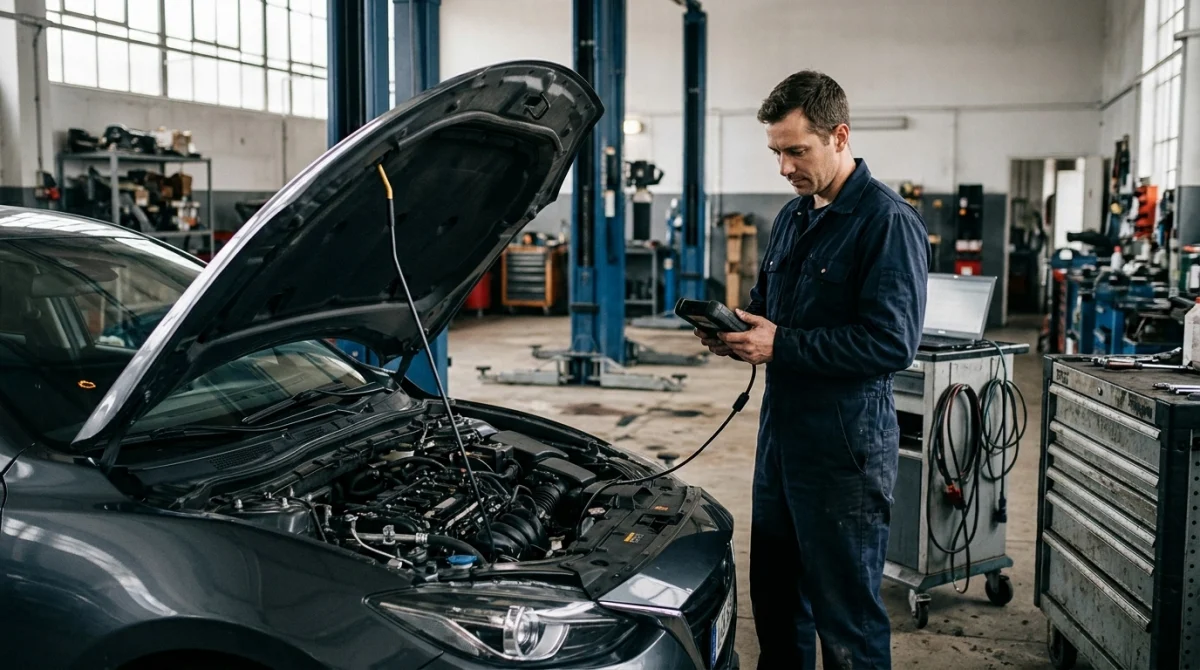
Professional diagnosis is appropriate when a misfire is severe, keeps returning, or requires testing beyond your equipment and experience. A trouble code alone cannot establish that the vehicle is safe to drive.
What does a flashing check engine light mean?
A flashing check engine light can indicate a severe misfire capable of damaging the catalytic converter. Reduce engine load, pull over when safe, and shut off the engine if the warning continues or the vehicle runs severely rough.
Don’t keep driving just to collect more scanner readings. Consult the owner’s manual and arrange roadside assistance or towing when appropriate.
The U.S. Environmental Protection Agency explains the role of onboard diagnostics in detecting emissions-related malfunctions in its overview of onboard diagnostic systems.
When should you stop DIY troubleshooting?
Arrange professional diagnosis when:
- The check engine light flashes or the engine shakes severely.
- The vehicle loses significant power or develops unusual engine noises.
- The misfire returns after a reasonable repair.
- Several cylinders misfire and the cause remains unclear.
- Fuel-pressure, injector, compression, or complex electrical testing is necessary.
A technician can combine scan data with hands-on inspection and specialized equipment. This can identify faults that a generic code reader cannot isolate.
What information should you bring to a repair shop?
Save the scanner results and describe when the symptoms occur. Include the following details:
- All stored, pending, and permanent codes displayed by the scanner.
- Available freeze-frame readings and misfire counters.
- Whether the fault occurs during cold startup, idle, acceleration, or engine load.
- Recent repairs, maintenance, or changes in fuel use.
- Any flashing warning light, unusual noise, or loss of power.
This information gives the technician a useful starting point and may prevent repeated diagnostic checks.
Section takeaway: Stop driving when a severe misfire creates a safety risk, and give the technician your recorded diagnostic information.
Frequently Asked Questions
Can an OBD2 scanner tell me exactly which part is causing a misfire?
No. An OBD2 scanner identifies detected faults and may help isolate a cylinder, but it usually cannot prove which component has failed. Additional ignition, fuel, airflow, electrical, or mechanical testing may be necessary to confirm the cause.
What is the difference between P0300 and P0301?
P0300 indicates a random or multiple-cylinder misfire, while P0301 indicates a misfire detected on cylinder 1. Neither code identifies the failed part, so use other codes, freeze-frame data, and targeted diagnostic tests to investigate the cause.
Can I diagnose a misfire without live data?
Yes. You can begin by reading stored and pending codes and recording freeze-frame information. However, live data and cylinder-specific counters can improve diagnosis when your scanner and vehicle support those features.
Why does my scanner show a misfire code when the engine feels normal?
A misfire can occur intermittently or only under certain operating conditions. The fault may not be active during your inspection, so review freeze-frame information, check pending codes, and investigate the conditions associated with the original event.
Should I clear the misfire code before testing the engine?
No. Record all codes and available freeze-frame data first. Clearing codes can remove useful diagnostic information and reset emissions-monitor readiness, making it harder to understand the original problem.
Can a bad spark plug cause a P0300 code?
Yes. A faulty spark plug can contribute to a misfire, but P0300 can also result from ignition-coil faults, fuel-delivery problems, air leaks, or mechanical issues affecting multiple cylinders. Test the likely causes before replacing parts.
Is it safe to drive with a misfire code?
It depends on the severity and symptoms. A flashing check engine light, severe shaking, major power loss, or unusual engine noises warrants stopping when safe and seeking assistance. Even with a steady light, arrange prompt diagnosis rather than assuming continued driving is harmless.
Final Takeaway: Diagnose the Evidence Before Replacing Parts
The best way to diagnose a misfire with an OBD2 scanner is to combine trouble codes, freeze-frame data, supported live readings, and targeted physical tests. Start with the information the vehicle has already recorded.
Use the results to narrow down the affected cylinder or system, then confirm the suspected fault before buying replacement components. If the warning light flashes or the engine runs severely rough, prioritize safety and professional diagnosis.
