
Does a Metal Key Fob Case Block Signal? What Car Owners Need to Know

If your key fob works fine in your hand but acts up once you slide it into a metal case, the case is very likely the problem. A full metal shell can weaken or block the radio-frequency signal your fob uses to lock, unlock, and sometimes start the car. A decorative case with a little metal trim may not cause trouble at all.
The practical rule is simple: if the fob’s range drops, passive entry becomes unreliable, or push-button start stops recognizing the fob after you put it in the case, treat the case as the first suspect. That does not mean the fob is bad. It means the signal may not be getting out of the case well enough for the car to hear it.
Quick Answer: Can a Metal Key Fob Case Block the Signal?
Yes, it can.
A full metal or signal-blocking case may reduce the fob’s transmission enough that the car no longer detects it reliably. That matters most on vehicles with passive entry and push-to-start systems, because those systems expect a strong enough signal exchange between the fob and the car.
A partial metal accent is different. A case with a metal logo, edge trim, or decorative plate may still allow normal operation. The difference is whether the fob is wrapped in conductive material all around or just dressed up with a small metal piece.
If you want the short version:
– Full metal enclosure: more likely to cause problems
– Decorative metal trim: often fine
– Non-metal case: usually the safest choice for signal reliability
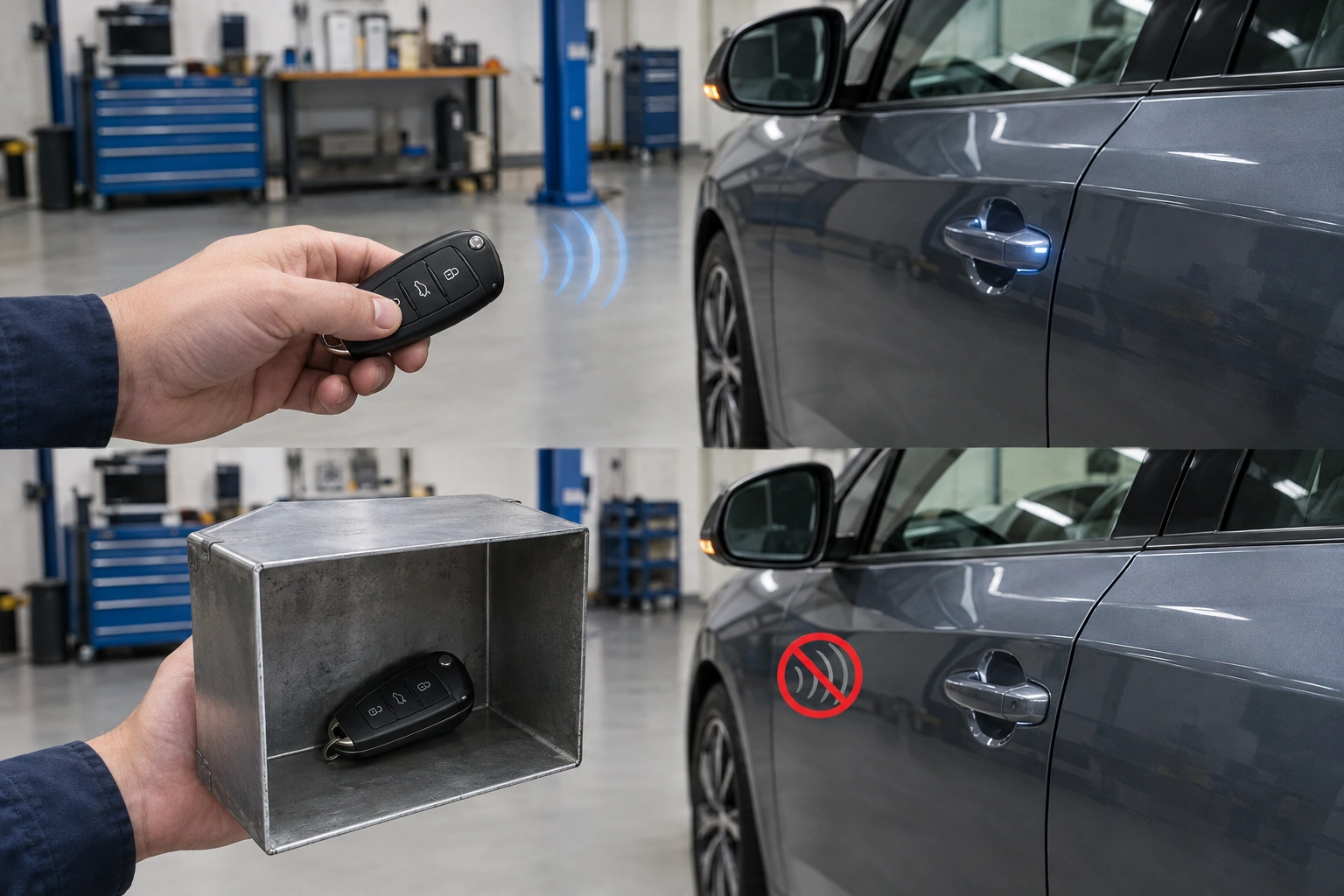
[Image: metal key fob case signal test]
How to Tell the Case Is the Problem
The easiest clue is behavior.
If the fob works normally outside the case but becomes weak or unreliable inside it, the case is probably interfering with the signal. Common symptoms include:
- You have to stand much closer to the car than usual
- The doors unlock only sometimes
- Remote start stops working
- Push-button start says it cannot detect the key
- The car works only when you remove the fob from the case first
That pattern points to signal attenuation, not a random electrical failure. A battery issue can cause similar symptoms, but a case-related problem often shows up immediately after the fob goes into the metal shell. On passive entry systems, the change can be intermittent at first, so the fob may still seem to work sometimes even though the case is already weakening detection.
Here’s a simple example. If your sedan unlocks from across the driveway with the fob bare, but only unlocks when you press it right against the door handle inside the case, the case is cutting the range enough to matter.
Why Metal Can Interfere with a Key Fob Signal
Key fobs send radio-frequency signals. Your car listens for those signals through antennas placed around the vehicle. In many vehicles, the system uses low-frequency antennas in areas like the door handles, trunk, or center console to “wake” the key, and then the fob answers back with a higher-frequency response.
Metal can get in the way because it conducts electricity and can act like a shield around the fob. In effect, the case may trap or weaken the radio waves instead of letting them escape cleanly.
A useful comparison is a phone in a metal box. The phone may still be on, but the box can stop the signal from reaching the outside world. The same idea applies here. A metal key fob case can behave a bit like a small Faraday-style shield, especially if it fully encloses the fob.
That shielding effect can also disrupt the car’s wake-up and response sequence, which is why a metal case can cause both unlocking and start issues, not just reduced range.
Most Likely Causes, in Order of Probability
When a key fob starts acting up after you add a new case, I’d look at the causes in this order:
1. The case is a full metal or signal-blocking design
This is the most obvious fit if the problem started right after the case went on. A full enclosure can interfere with both remote unlock and passive entry.
2. The key fob battery is weak
A weak battery can make the fob borderline even before the case goes on. Once the metal shell reduces the signal further, the car may stop detecting it consistently.
3. The fob is not seated well in the case
If the shell pinches the buttons, shifts the circuit board, or covers part of the antenna area, signal performance can change. A bad fit can be just as annoying as a full shield.
4. The vehicle-side detection system has a problem
If the fob still behaves badly outside the case, the issue may be with the fob battery, the fob itself, or the car’s receiver/antenna system.
That order saves time. Too many owners replace the fob or blame the car before doing the simplest test: removing the case.
Step-by-Step Test to Confirm the Case Is Causing the Issue
Use this quick isolation test before buying parts.
1. Test the fob outside the case
Stand at your normal unlocking distance and try lock, unlock, and remote start if your vehicle has it. If the fob works normally in your hand, keep going.
2. Put the fob back in the case and repeat
If the range drops sharply or a push-to-start vehicle stops recognizing it, the case is likely interfering.
3. Try the fob in a different orientation
Sometimes a case blocks one side more than another. Rotate the fob in the case and test again. If one direction works better, the enclosure is affecting signal transmission unevenly.
4. Remove the case and test again
If the problem disappears immediately, you have your answer. That is the simplest confirmation.
5. If you have a spare fob, compare the two
A spare fob that works normally outside the case but not inside it points strongly to the case. If both fobs fail the same way, the vehicle or battery may be involved.
This test matters because it separates “signal blocked by the case” from “fob is failing.” Those are not the same problem, and they do not get fixed the same way.
How to Rule Out a Weak Battery or Fob Problem
A weak battery can mimic case interference, so check it before you declare the shell guilty.
A battery-related issue usually shows up as:
– Shorter range than usual, even with no case
– Intermittent operation
– The need to hold the fob very close to the start button
– More than one button acting sluggishly
Some push-to-start vehicles have an emergency detection spot or backup method that still lets the car start when the fob battery is low. If your car only starts when the fob is placed in that special location, that points more toward battery weakness than a case problem.
A good practical test is this: replace the battery or try a known-good spare battery, then repeat your case test. If the fob works normally outside the case but not inside it after the battery swap, the case is still the issue.
For a broader look at weak-signal causes beyond the case itself, see why a key fob signal feels weak and what to check first.
Comparison: Full Metal Case vs. Decorative Metal Trim vs. Non-Metal Case
| Case Type | Likely Effect on Signal | Remote Unlock | Passive Entry | Push-to-Start Reliability |
|---|---|---|---|---|
| Full metal enclosure | Highest chance of blocking or weakening signal | Often reduced | Often unreliable | May fail unless fob is removed |
| Decorative metal trim | Usually minimal effect | Usually normal | Usually normal | Usually normal |
| Silicone/plastic/leather case | Lowest chance of interference | Best for everyday use | Best for everyday use | Best for everyday use |
The trade-off is straightforward. Metal can feel sturdier and may protect the fob from cosmetic wear, but it can also cost you convenience. Non-metal cases usually preserve signal better, which is why they’re the safer everyday choice for most drivers.
If your top priority is reliability, go with silicone, plastic, or leather. If you care more about the look of a metal shell, make sure it is not a full enclosure and test it carefully before depending on it.
What to Use Instead of a Metal Case
If the metal case is causing trouble, switch to a material that does not shield the signal as much.
Good options include:
– Silicone: flexible, grippy, and usually signal-friendly
– Plastic: lightweight and simple
– Leather: protective without surrounding the fob in metal
– Hybrid cases with non-metal sides: often a better compromise than a full metal shell
If you want protection from scratches and drops without losing range, a soft silicone case is usually the easiest fix. It may not feel as “premium” as metal, but it is much less likely to leave you standing by the car wondering why the doors won’t open.
For readers dealing with shell fit or button alignment issues too, this guide on key fob case replacement problems is worth a look.
When a Metal Case Is Okay and When It Is Not
A metal case is okay only if it does not interfere with the fob’s normal operation.
That usually means:
– The case is not a full enclosure
– The fob still unlocks the car from normal distance
– Passive entry still works consistently
– Push-button start recognizes the fob every time
A decorative metal case is not the same thing as a signal-blocking or Faraday-style case. A true blocking case is designed to reduce or stop radio signals on purpose, which can be useful for storage or theft prevention, but it is not meant to stay on during normal driving. A decorative or partially metal case, by contrast, may only add trim or surface protection and still let the signal pass.
A metal case is not okay if you have to remove the fob to use it. Once you are doing that regularly, the case has stopped being protective and started being a nuisance.
When to Consult a Locksmith
If the fob still misbehaves after you remove the case and replace the battery, the problem may be deeper than the shell.
Call a locksmith or dealer service department when:
– The fob fails even with no case on it
– A spare fob shows the same symptoms
– The car does not detect the fob at all
– Push-to-start only works in a specific emergency location
– Locking and unlocking are inconsistent across multiple fobs
That pattern can point to a failing fob, a vehicle antenna issue, or a receiver problem. At that stage, it makes sense to stop guessing and get the system tested.
If your car only starts when the fob is held right near the button, this article on why a car starts only when the key fob is held near the start button can help you separate case interference from a low-battery backup mode.
FAQ
Will my car still detect the fob inside a metal case?
Sometimes, but not always. A partial metal trim case may work fine, while a full metal shell can weaken the signal enough to cause range or start issues.
Why does the fob work outside the case but not inside it?
That usually means the case is shielding the signal. The fob itself may be fine.
Can I still use a metal case with push-button start?
Only if the car reliably detects the fob with the case on. If you need to remove the fob to start the car, the case is not a good fit for daily use.
Is it the case or the battery?
A weak battery and a metal case can both cause similar symptoms. Test the fob outside the case first, then try a fresh battery if the problem continues.
What kind of case should I use instead?
Silicone, plastic, or leather cases are usually the safest choices if you want protection without cutting signal range.
Bottom Line
So, does a metal key fob case block signal? It can, especially if it fully encloses the fob or is made from a highly conductive material. If your unlock range drops or push-to-start becomes unreliable only after you add the case, the case is the first thing to remove and test.
If the fob works normally outside the case, switch to a non-metal cover and move on. If it still acts up with no case and a fresh battery, the problem is likely in the fob or the vehicle system, not the shell.
