
How to Check and Add Water to a Car Battery

To add water to a car battery, first make sure it is a flooded battery with removable caps. Wear eye protection, pry off the caps, and fill each cell with distilled water up to the bottom of the fill well, about 1/4 to 1/2 inch above the plates. Add water after charging. Never open an AGM or sealed battery.
Water in a lead-acid battery is part of the electrolyte. As the battery charges, a small amount of that water splits into hydrogen and oxygen and escapes, and heat speeds up evaporation. In older and heavy-duty flooded batteries, the level slowly drops. If the lead plates are exposed to air, that part of the plate stops working and starts to sulfate, which shortens battery life.
Most cars today come with “maintenance free” batteries that never need water. The first step is knowing which kind you have. If you are unsure, our guide on AGM vs flooded car batteries explains how to tell the types apart.
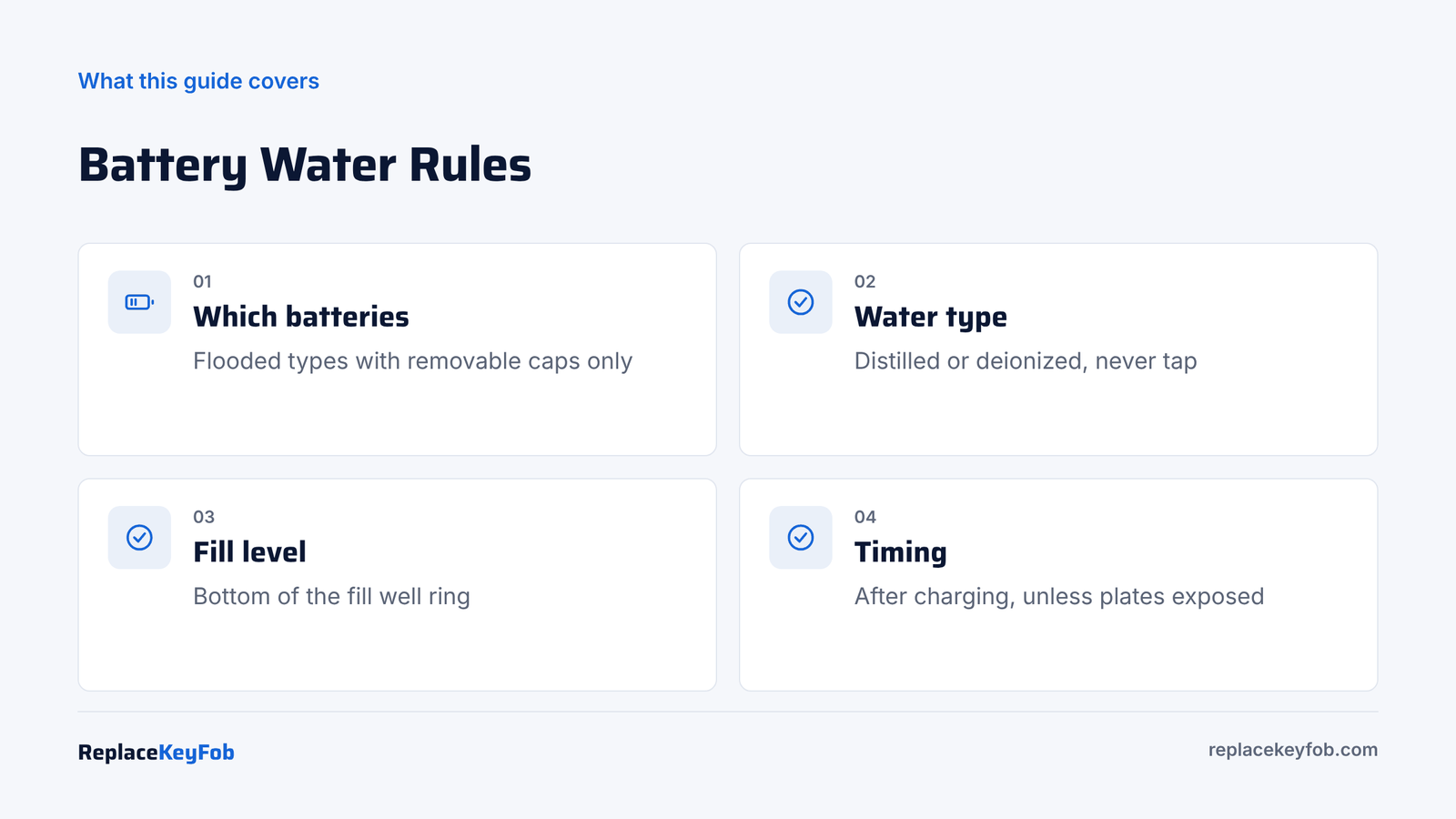
Can You Add Water to Your Car Battery?
| Battery type | How to recognize it | Add water? |
|---|---|---|
| Serviceable flooded | Removable round caps or two rectangular strip covers on top | Yes, distilled only |
| Sealed “maintenance free” flooded | Flat top, sometimes a charge eye, no visible caps | Usually no; some hide caps under a label |
| AGM | Labeled AGM, often sealed with a pressure valve | Never |
| EFB (enhanced flooded) | Labeled EFB, common on start-stop cars | Usually sealed; do not open |
| Gel or lithium | Labeled clearly | Never |
Some sealed flooded batteries do have caps under a sticker or a snap-off panel, but if the manufacturer calls it sealed, prying it open usually voids the warranty and may not be safe. If a sealed battery is losing fluid, it is overcharging or failing. Have the charging system tested and plan on replacing the battery.
When to Add Water to a Car Battery
- Every 3 to 6 months on serviceable batteries, more often in hot climates
- When the plate tops are visible or nearly visible in any cell
- After a long period on a basic charger without float mode
- Before winter storage, once the battery is fully charged
Heat is the biggest factor. A car in Arizona may need topping up twice as often as one in Michigan. If one cell drops much faster than the others, that cell is likely failing.
What You Need
- Distilled or deionized water. Tap and bottled drinking water carry minerals that coat the plates and reduce capacity.
- Safety glasses and acid-resistant gloves. Battery acid can blind and burn.
- A flashlight to see into the cells
- A flat screwdriver or plastic pry tool for stubborn caps
- A small funnel or battery filler bottle to avoid overfilling
- Baking soda and water to neutralize spills, plus a rag
Battery Water Filler Bottle With Auto Shutoff
A filler bottle that stops at the correct level keeps you from overfilling and splashing acid. Check that the nozzle fits your cap openings.
As an Amazon Associate, ReplaceKeyFob earns from qualifying purchases.
How to Add Water to a Car Battery Step by Step
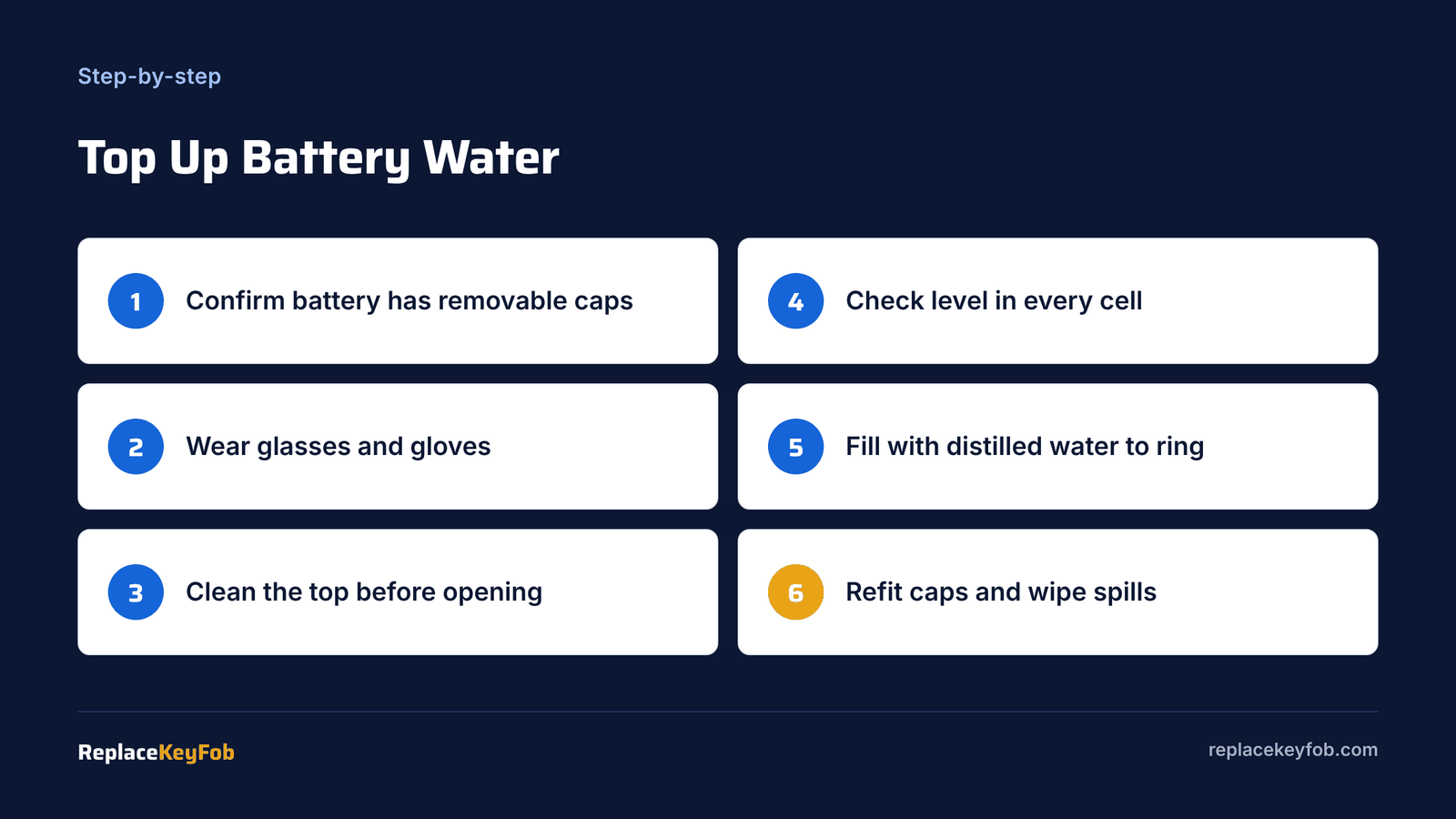
- Turn the car off and let it cool. Work on a battery that is not hot from driving.
- Put on glasses and gloves. Keep sparks and flames away; hydrogen can collect under the caps.
- Clean the top of the battery. Wipe off dirt so nothing falls into the cells when you open them. A little baking soda solution takes care of acid residue.
- Remove the caps. Twist off round caps or pry up strip covers evenly. Set them on a clean rag, top down.
- Check every cell with a flashlight. You will see the plates and the fill well, often a split ring or tube that extends down into the cell.
- If plates are exposed, add just enough water to cover them. Exposed plates should not be charged dry.
- Charge the battery fully. Electrolyte expands as it charges, so filling to the top before charging can cause overflow. See how to charge a car battery at home.
- Top up to the correct level after charging. Fill to the bottom of the split ring or about 1/4 to 1/2 inch above the plates, whichever the battery marks.
- Refit the caps firmly and wipe away any spills.
- Check the terminals while you are there. Corrosion often shows up on batteries that are overfilled.
Why you add water after charging
Charging warms the electrolyte and raises its level. A battery filled to the brim when it is low will push acid out through the vents as it charges. That acid corrodes the tray, cables and nearby metal. Filling after charging gives you a true level reading.
What Not to Do
- Do not add acid. The acid in the electrolyte does not evaporate; only water is lost. Adding acid changes the concentration and damages the battery.
- Do not overfill. Overflow spills acid and corrodes terminals. Learn how to clean it up in our guide to battery terminal corrosion.
- Do not use tap water. Minerals build up on the plates.
- Do not open sealed or AGM batteries. They are designed to recombine gases internally.
- Do not smoke or use a phone flashlight near open cells without care; any spark is a risk.
Signs Your Battery Needs More Than Water
| Sign | What it suggests | Next step |
|---|---|---|
| One cell always lower than others | Failing cell or crack | Load test; replace if weak |
| Water disappears quickly in all cells | Overcharging, often a bad voltage regulator | Check charging voltage, typically about 13.8 to 14.7 V running |
| Brown or cloudy electrolyte | Plate shedding, end of life | Replace the battery |
| Low water plus slow cranking | Sulfation from exposed plates | Charge fully, then test |
| Swollen case | Heat or overcharging | Stop using; replace |
Our battery test guide for flooded lead-acid batteries shows how to check health after topping up. If the battery is past its date, check how to read a car battery date code before spending more on it.
Check Strength With a Hydrometer While the Caps Are Off
A serviceable battery gives you a bonus: you can measure each cell directly. A battery hydrometer draws up a little electrolyte and shows its specific gravity, which tracks state of charge cell by cell.
| Specific gravity (about 80°F) | Approximate charge |
|---|---|
| 1.265 to 1.280 | Full |
| About 1.225 | About 75 percent |
| About 1.190 | About 50 percent |
| 1.120 or lower | Discharged |
Take readings after a full charge and before adding water, because fresh water dilutes the sample. A difference of more than about 0.050 between the strongest and weakest cell usually points to a failing cell. Return every drop of electrolyte to the cell it came from, rinse the hydrometer with water afterward, and keep it for battery use only.
If Acid Spills or Splashes
Acid spills happen even to careful people. Keep a box of baking soda nearby when you work on open cells.
- On the battery or tray: sprinkle baking soda or pour a mix of about one tablespoon per cup of water over the spill. It will fizz. Rinse with clean water once the fizzing stops and dry the area.
- On skin: rinse with plenty of cool running water for several minutes. Remove contaminated clothing.
- In the eyes: flush with clean water for at least 15 minutes and get medical help right away.
- On paint: neutralize and rinse quickly; battery acid etches clear coat within minutes.
Do not let baking soda solution get inside the cells. It neutralizes the acid that the battery needs to work, which is why the caps stay on while you clean the top.
How to Make the Water Last Longer
- Keep the battery cool. Heat shields and intact hold-downs matter. Some cars ship with an insulating blanket around the battery; refit it after service.
- Use a smart charger. A charger with float mode stops gassing once the battery is full.
- Fix overcharging fast. If the running voltage stays above about 14.7 volts, the regulator or alternator needs attention.
- Avoid deep drains. Each deep discharge and recharge cycle costs water and plate life.
When to Replace Instead
A battery that keeps losing water, has a cracked case or cannot hold 12.4 volts overnight after a full charge is near the end. Replacement typically costs about $150 to $400 installed. If the battery is still under warranty, car battery warranty explains how to claim it.
Frequently Asked Questions
Only to flooded batteries with removable caps. Use distilled water, fill to the bottom of the fill well, and do it after charging. Never open an AGM or sealed battery.
Distilled or deionized water. Tap water and spring water contain minerals that coat the plates and shorten battery life.
Generally you should not. Some batteries hide caps under a label, but if the maker calls it sealed, opening it can void the warranty. A sealed battery losing fluid points to overcharging or failure.
Every 3 to 6 months on serviceable batteries, more often in hot weather or if the car sits on a basic charger.
After charging, unless the plates are exposed. In that case add just enough to cover the plates, charge, then top up to the correct level.