
How to Charge a Car Battery With a Solar Panel

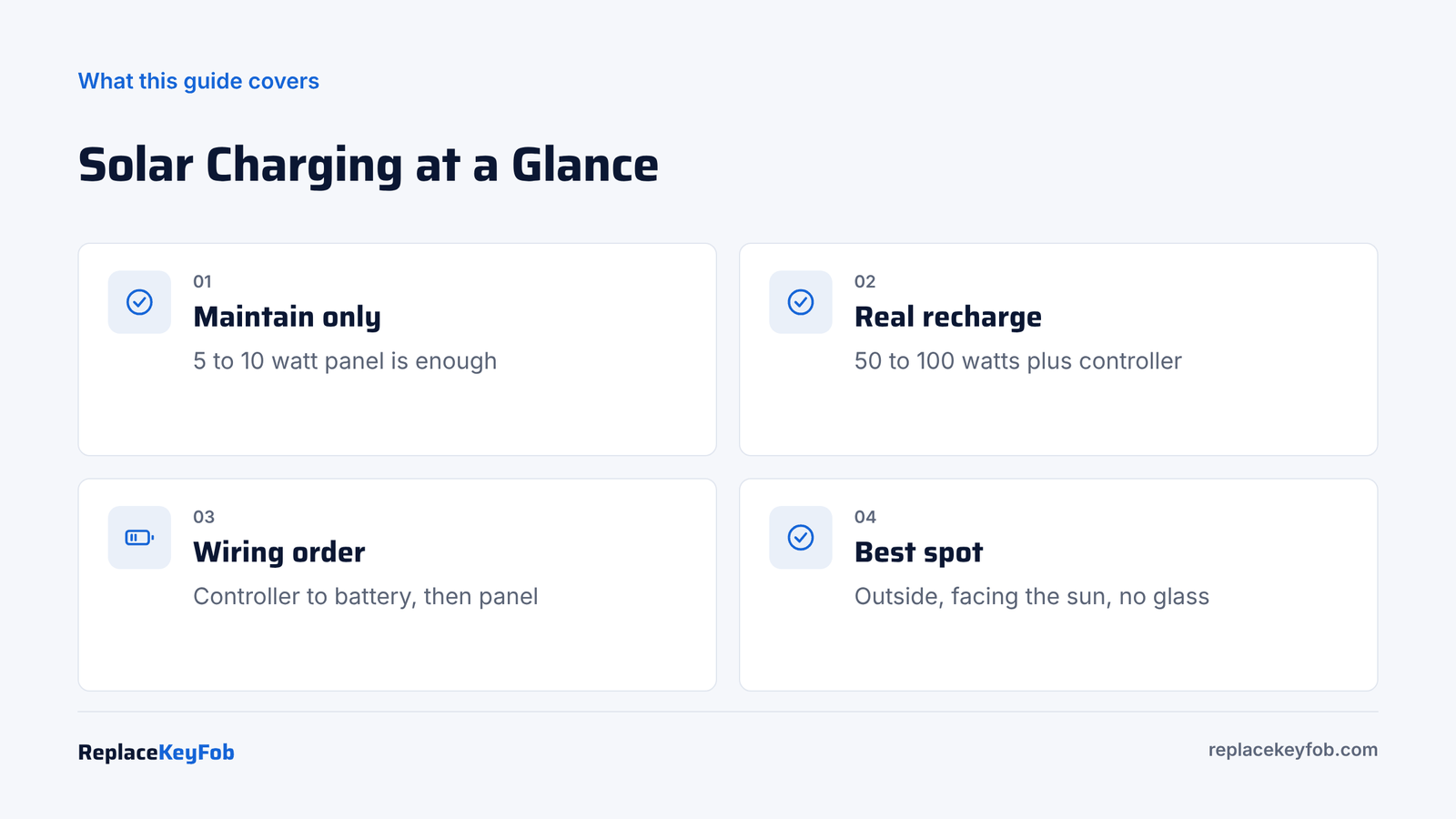
To charge a car battery with a solar panel, connect a charge controller to the battery first, then connect the panel to the controller, with a fuse on the positive wire. A 5 to 10 watt panel only maintains a parked car. To actually recharge a low battery in a few days, you need roughly 50 to 100 watts in full sun.
Solar charging sounds simple: point a panel at the sky and the battery fills up. In practice, the result depends almost entirely on panel size and sunlight. A small dashboard panel will offset the slow drain from a car’s clock and alarm, which is useful for a vehicle parked at an airport or a farm truck that sits all week. It will not bring a dead battery back by lunchtime.
This guide covers both jobs: keeping a battery topped up and recharging a weak one. If you just want a ready-made kit, our roundup of the best solar battery maintainers lists compact options that plug straight in.
Decide What You Want the Panel to Do
Start with the goal, because it sets the size.
| Goal | Typical panel size | Charge controller | Realistic result |
|---|---|---|---|
| Offset parasitic drain on a parked car | 5 to 10 watts | Built-in or small | Keeps a healthy battery near full |
| Keep a boat, RV or tractor battery topped | 10 to 30 watts | Yes | Maintains, slowly recovers small losses |
| Recharge a half-empty car battery | 50 to 100 watts | Yes, PWM or MPPT | About 1 to 3 sunny days |
| Recharge a flat battery quickly | Over 100 watts | MPPT preferred | Possible, but a plug-in charger is faster |
A rough way to estimate: daily amp-hours equals panel watts times peak sun hours, divided by about 14 volts, minus around 25 percent for losses. A 10 watt panel in 5 hours of good sun gives about 2.5 amp-hours a day. A car battery half empty might be missing 25 to 35 amp-hours, so that small panel would need well over a week.
What a charge controller does
A charge controller sits between the panel and the battery. It stops the battery from being overcharged on long sunny days and stops the battery from leaking current back into the panel at night. Very small maintainer panels often have a blocking diode and sometimes a built-in regulator. Once you move past about 5 to 10 watts on a car battery, use a proper controller. Set it to the right battery type: flooded, AGM or lithium.
- PWM controllers are cheap and fine for small panels.
- MPPT controllers cost more but harvest noticeably more energy from larger panels, especially in cold or cloudy weather.
12V Solar Panel With Charge Controller
Match the watts to your goal and confirm the controller has a setting for your battery type, plus battery clamps or ring terminals and an inline fuse.
As an Amazon Associate, ReplaceKeyFob earns from qualifying purchases.
What You Need
- Solar panel sized for your goal
- Charge controller rated above the panel’s maximum current
- Inline fuse holder and fuse on the positive lead, mounted close to the battery
- Battery clamps or ring terminals, plus 12 to 16 gauge wire depending on run length and current
- Multimeter to check voltage before and after
- Safety glasses and gloves
How to Charge a Car Battery With a Solar Panel
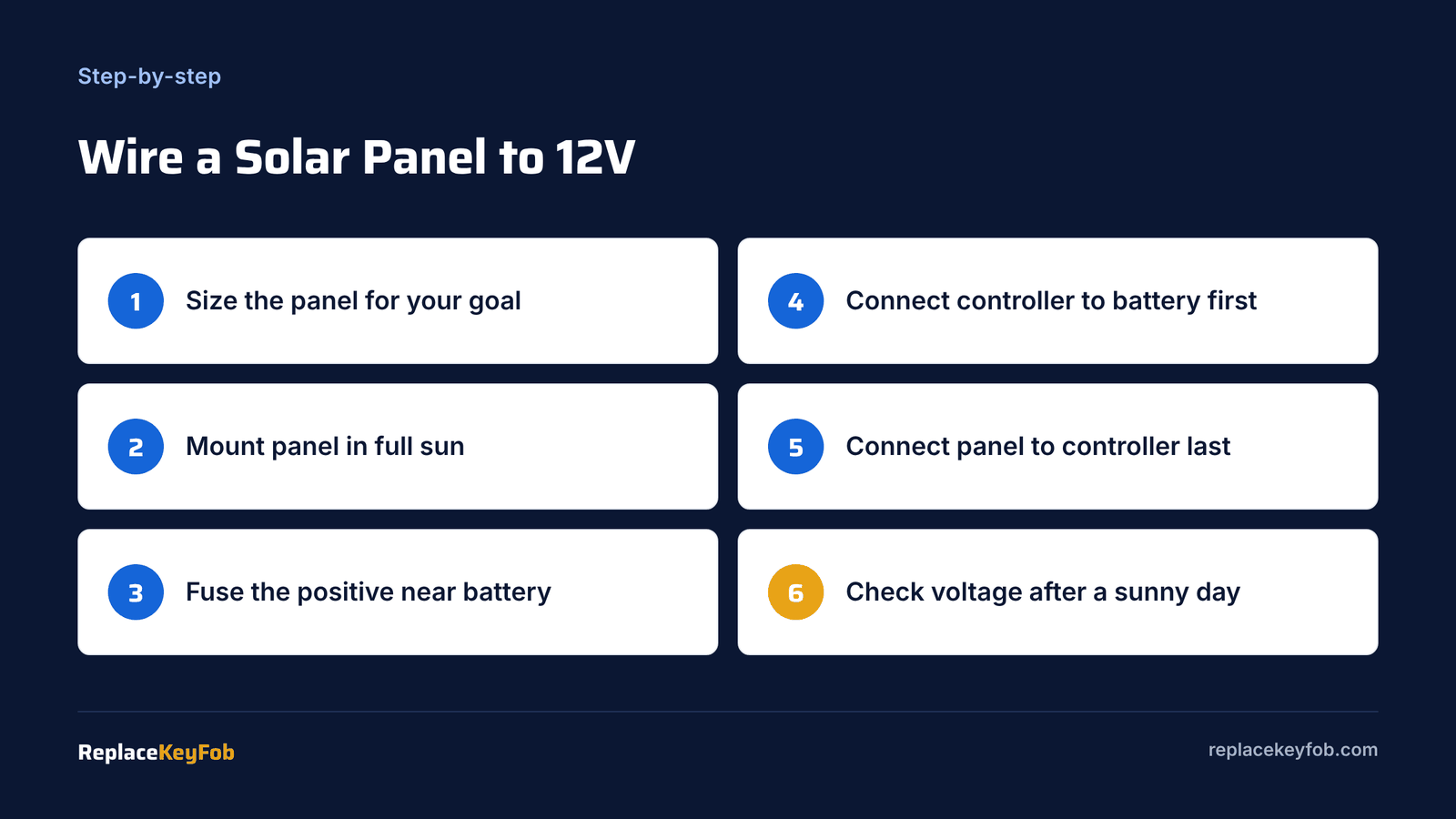
- Check the battery. Measure resting voltage. A reading near 12.6 volts is full; 12.2 volts is about half; under about 11.8 volts the battery is deeply discharged and may not recover fully. See how to test a car battery with a multimeter.
- Mount the panel outside in full sun. Face it roughly south in the US and tilt it toward the sun. Shade on even one corner can cut output sharply.
- Install the fuse. Put the fuse holder on the positive wire, as close to the battery as practical. This protects the wiring if it ever shorts against metal.
- Connect the controller to the battery first. Red to positive, black to negative. Most controllers need to see battery voltage to set themselves up correctly.
- Connect the panel to the controller last. Many manufacturers specify this order because connecting the panel first can confuse or damage some controllers.
- Confirm it is charging. The controller display or LED should show charge current in daylight.
- Check results. After a full sunny day, measure resting voltage early the next morning before the sun hits the panel.
Why dashboard panels underperform
Windshield glass, tint and the steep angle of a dashboard can cut a small panel’s output a great deal. If you must use the dash, place the panel flat against the glass and park facing the sun. For real charging, mount it on the roof, the hood or a stand outside the car.
A Worked Example: How Long Will It Take?
Say your car sat for three weeks and the battery now reads 12.2 volts, about half charged. It is a common 60 amp-hour battery, so it is missing around 30 amp-hours.
- 10 watt panel: about 2.5 amp-hours on a good day. Minus the car’s own parked drain of roughly 0.5 to 1 amp-hour per day, the net gain is closer to 1.5 to 2 amp-hours. That is two weeks or more of sunny weather.
- 50 watt panel with a PWM controller: about 10 to 12 amp-hours on a good day. Roughly three sunny days.
- 100 watt panel with an MPPT controller: about 25 amp-hours on a good day. One to two days.
If you need the car tomorrow, a plug-in charger or a jump start is the practical answer. Solar shines when the car is far from an outlet and time is on your side.
Wire, Fuse and Connector Sizing
Small panels push small current, but wiring still matters. A 100 watt panel can deliver around 5 to 6 amps, and a controller output wire to the battery should be sized for that with room to spare.
| Panel size | Typical max current | Wire gauge (short run) | Fuse near battery |
|---|---|---|---|
| 5 to 10 W | Under 1 A | 18 to 16 AWG | 2 to 5 A |
| 20 to 30 W | About 1.5 to 2 A | 16 AWG | 5 A |
| 50 W | About 3 A | 14 AWG | 5 to 10 A |
| 100 W | About 5 to 6 A | 12 AWG | 10 A |
Treat these as starting points and follow the controller manual. For runs longer than about 10 feet, go one size heavier to limit voltage drop. Use weatherproof connectors outdoors and keep wires away from hot exhaust parts and moving hood hinges.
Plug-In Options: Lighter Socket and OBD2
Many solar maintainers plug into the 12-volt accessory socket. That only works if the socket stays powered with the car off. Many newer vehicles cut power to that socket a few minutes after shutdown. Test it: plug in a phone charger with a light, switch the car off, lock it, and check after 15 minutes.
Some kits plug into the OBD2 port, which has constant battery power on pin 16. That works on most cars, but keep the current low and unplug the panel before any diagnostic work. For larger panels, connect directly at the battery with ring terminals instead.
Solar Charging for Different Vehicles
- Daily drivers: rarely need solar. Driving does the job; see how long to drive a car to charge the battery.
- Stored cars: a 5 to 10 watt panel outside, or a plug-in maintainer if you have an outlet.
- Trucks and tractors at remote sites: a 20 to 30 watt panel with a controller handles alarms, GPS trackers and cold-weather drain well.
- RVs and boats: these often have deep-cycle house batteries; size the panel to the daily load, not just the starting battery.
- Hybrids and EVs: the small 12-volt battery can be solar-maintained through the manual’s charging points, but keep panels small.
If the Battery Still Is Not Charging
| Symptom | Likely cause | Fix |
|---|---|---|
| Controller shows no input | Panel shaded, bad connector, or night | Check sun, plugs and panel voltage with a meter |
| Voltage never rises | Panel too small for the drain | Use a bigger panel or find the drain |
| Battery full by evening, low by morning | No blocking diode or controller, or parasitic drain | Add a controller; test for drain |
| Lighter-socket kit does nothing | Socket switches off with the car | Use OBD2 or direct battery hookup |
| Battery hot or bubbling | Overcharging without regulation | Add or correct the controller setting |
Safety and Mistakes to Avoid
- Skipping the fuse. An unfused wire on a car battery can melt insulation and start a fire if it shorts.
- Wrong battery setting. AGM and lithium need the correct controller profile.
- Thin wire on long runs. Voltage drop eats into an already small charge.
- Charging a frozen or swollen battery. Do not. Replace it.
- Expecting miracles in winter. Short days and low sun can cut output by half or more.
If the battery reaches full in the sun but cannot start the car, it is worn out. A replacement typically runs about $150 to $400 installed; see car battery replacement cost.
Related guides: How to Use a Trickle Charger on a Car Battery; How to Use a Battery Tender (Connect, Leave On, Remove); How to Charge a Car Battery at Home (Settings and Time).
Frequently Asked Questions
About 5 to 10 watts to maintain a parked car, and roughly 50 to 100 watts with a charge controller to recharge a half-empty battery in one to three sunny days.
A small maintainer panel rarely will, but anything larger can. Use a charge controller set to your battery type once you go above about 5 to 10 watts.
It works, but glass and the steep dash angle cut output a lot. Mount the panel outside in direct sun for real charging.
Only a very small panel with a built-in blocking diode. Larger panels need a charge controller between the panel and the battery, plus a fuse on the positive lead.
Yes, but output can drop to a small fraction of the rated watts. Plan for slower charging in winter and on overcast days.