
How to Clear Permanent OBD2 Codes (Why a Scanner Cannot)

This post contains affiliate links. As an Amazon Associate, ReplaceKeyFob earns from qualifying purchases, at no extra cost to you.
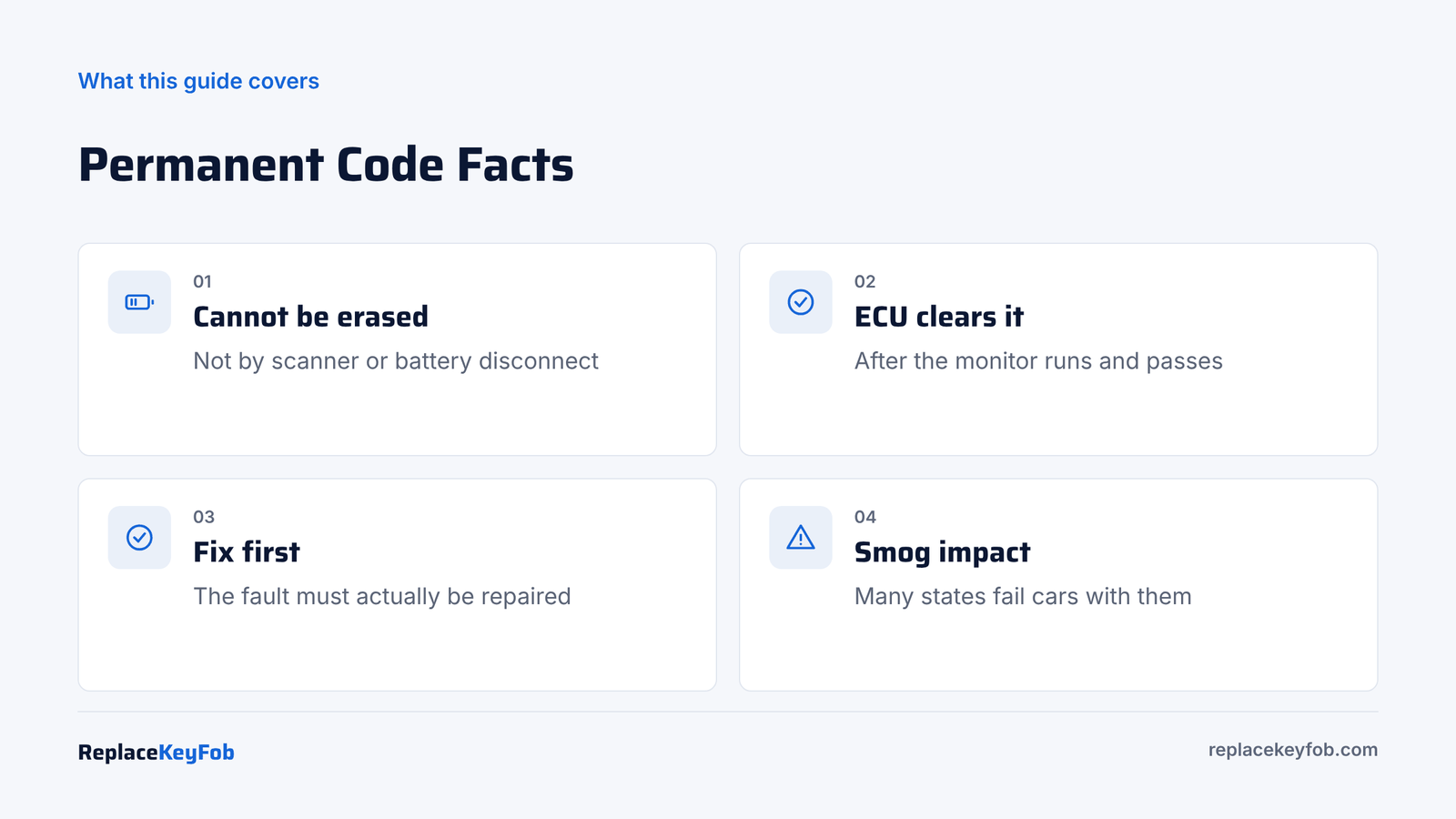
To clear permanent codes, fix the fault that set them, then drive the car until the related monitor runs and passes. Only the engine computer can erase a permanent code. A scan tool clear or a battery disconnect will not remove it. Depending on the fault, it often takes one to several drive cycles with a mix of idle, city and steady highway driving.
Permanent diagnostic trouble codes were added to OBD2 for 2010 and newer vehicles, mainly so emissions inspections could not be passed by simply clearing codes the morning of the test. When a fault turns on the check engine light, the computer stores a permanent copy of that code in memory that a scanner cannot erase.
That is a feature, not a bug. It means the car has to prove it is fixed. For the full difference between pending, stored and permanent codes, see pending, stored and permanent OBD2 codes. This guide focuses on what to do to make a permanent code go away.
How Permanent Codes Work
| Event | What happens to the permanent code |
|---|---|
| Fault detected, light turns on | Permanent code stored |
| You clear codes with a scanner | Stored code and light cleared; permanent code stays |
| You disconnect the battery | Permanent code stays |
| Fault is repaired, monitor runs and passes | Computer erases the permanent code |
| Fault still present | Light returns; permanent code stays |
The key idea: the computer only erases a permanent code after it has watched the related system pass its self-test under the right conditions.
What You Need
- An OBD2 scanner that shows permanent codes (often labeled “Mode 0A” or “Permanent”) and readiness monitor status
- The repair for the actual fault
- Time for one or more full drive cycles
OBD2 scanner with permanent codes and readiness
Choose a scanner that displays permanent DTCs and live readiness monitor status, so you can see exactly when the computer clears the code.
As an Amazon Associate, ReplaceKeyFob earns from qualifying purchases.
Step 1: Read the Code and Identify Its Monitor
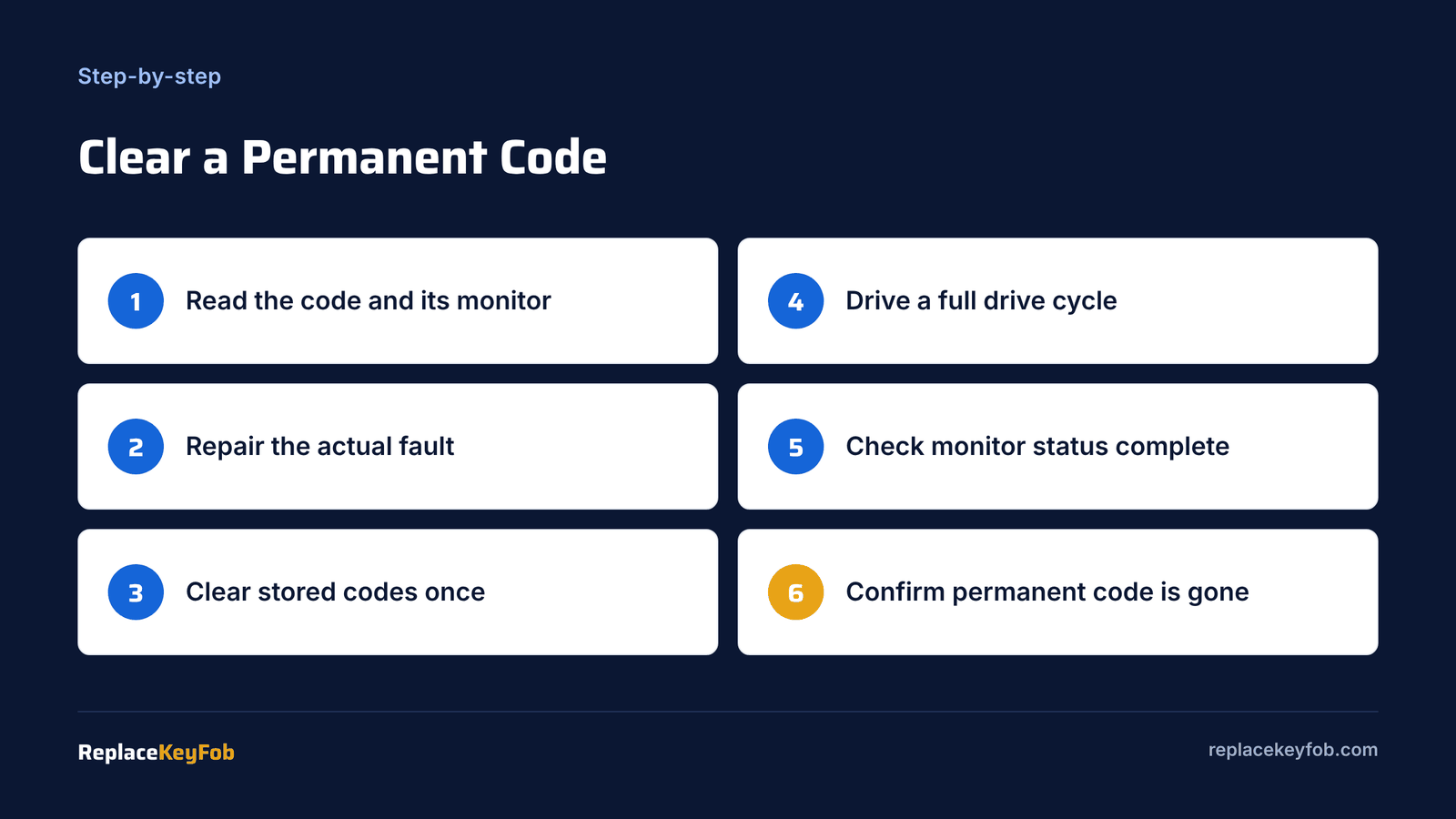
- Connect the scanner and read stored, pending and permanent codes.
- Note which monitor each code belongs to. Examples: misfire codes (P0300 to P0308) use the misfire monitor; P0420 uses the catalyst monitor; P0455 uses the EVAP monitor; P0171 uses the fuel system monitor; P0133 uses the oxygen sensor monitor.
- Check readiness status for that monitor.
Why it matters: the drive you need depends on which monitor must pass. A misfire code can clear quickly. An EVAP code can take days.
Step 2: Fix the Fault
Repair what set the code. Replace the sensor, fix the leak, change the coil. If the fault is still there, nothing below will work.
Step 3: Clear the Stored Code Once
Use your scanner to clear codes after the repair. This turns off the light and resets monitors to “not ready”. The permanent code remains for now.
Some technicians skip this step and let the light go off on its own after a few good trips, because clearing resets every monitor. Either way works; just do not clear codes again and again, which restarts the process each time.
Step 4: Drive the Right Cycle
Each monitor has its own conditions. A typical drive cycle that runs most monitors looks like this:
- Cold start: let the car sit for at least 8 hours, ideally overnight, with the fuel tank between about a quarter and three quarters full.
- Idle: start the engine and idle for about 2 to 3 minutes with the A/C and rear defroster on.
- Steady city driving: drive at about 25 to 35 mph for 5 minutes with gentle throttle.
- Steady highway driving: cruise at about 50 to 60 mph for 10 to 15 minutes, holding a steady speed.
- Decelerate: coast down from 55 mph to 20 mph without braking, a few times, where safe.
- Idle again: stop and idle for about 1 to 2 minutes before turning off.
Many permanent codes also need a minimum amount of total driving time, including some time above about 25 mph and a period of continuous idle, before the computer will count the trip. Our guide on the drive cycle after clearing codes covers this in more detail.
Step 5: Check the Monitor and the Permanent Code
After the drive, reconnect the scanner:
- Look at readiness. The related monitor should show “complete” or “ready”.
- Check the permanent codes list. Once the monitor passes, the code should be gone. On some cars it disappears on the next key cycle.
- If it is still there and the monitor is complete, drive another full cycle. Some monitors need two passing trips.
For background on each monitor, see what are OBD2 readiness monitors and how to check emissions readiness.
How to Clear Permanent Codes on GM and Chevy
On many GM and Chevrolet vehicles, permanent codes clear once the relevant monitor runs and passes after a repair. GM’s general drive cycle includes a cold start with idle, steady cruise around 55 mph, and decelerations without braking. EVAP monitors on many GM vehicles need a cold soak (often overnight), a fuel level within a set range and a moderate outside temperature, so EVAP permanent codes may take several days. A GM-capable scanner can also show “test passed this ignition” status for the specific code, which tells you when it is safe to stop driving the pattern.
How to Clear Permanent Codes on Ford
Ford vehicles follow the same rule: only a passing monitor clears the code. Ford’s drive cycle typically includes a cold start, several minutes of idle, steady cruising at moderate and highway speed, and coast-downs. For EVAP faults, fuel level and ambient temperature limits apply. A Ford-capable scanner, or FORScan with a compatible adapter, can show monitor status in more detail.
How Fast Common Permanent Codes Clear
| Code | Monitor | Typical time to clear after repair |
|---|---|---|
| P0300 to P0308 misfire | Misfire (continuous) | Often one or two normal drives |
| P0171 / P0174 lean | Fuel system (continuous) | Often one or two drives once trims are normal |
| P0133 / P0135 O2 sensor | O2 sensor and heater | One to a few drive cycles |
| P0420 / P0430 catalyst | Catalyst | A few drive cycles with steady highway cruise |
| P0442 / P0455 / P0456 EVAP | EVAP | Several days; needs cold soak and fuel level window |
| P0401 EGR flow | EGR | One to several cycles with decelerations |
Continuous monitors, such as misfire and fuel system, run all the time, so their codes tend to clear fastest. Non-continuous monitors need specific conditions and take longer. If an O2 sensor code is present, the catalyst monitor often waits for it, so fix sensor faults first.
Why Permanent Codes Matter for Emissions
In many states with OBD2 emissions inspections, a vehicle with a permanent code fails even if the light is off and monitors look ready. If you have an inspection coming up, give yourself time. See how to pass emissions with the check engine light off.
If the Permanent Code Will Not Clear
| Situation | Likely reason |
|---|---|
| Monitor still “not ready” after a week | Drive conditions not met (fuel level, temperature, speed) |
| Monitor complete but code remains | Needs another passing trip or key cycle |
| Code returns as pending | Fault still present or intermittent |
| Several monitors stuck incomplete | A related fault blocks them, such as an O2 sensor code blocking the catalyst monitor |
| Code from a module other than the engine | Some permanent codes are in the transmission module and follow its own tests |
Mistakes to Avoid
- Clearing codes repeatedly. Each clear resets the monitors and starts the wait over.
- Disconnecting the battery to “reset” it. It does not erase permanent codes and resets other settings.
- Short trips only. Many monitors need steady highway speed and a long enough drive.
- Driving with the fuel tank nearly empty or full. EVAP monitors often refuse to run outside a fuel level window.
Cost
Clearing a permanent code itself costs nothing once the repair is done. A shop can verify monitor status and permanent codes, typically for about $50 to $150 in 2026. Some shops use a dynamometer or road test to run monitors faster.
Frequently Asked Questions
No. A scanner can clear stored codes and turn off the light, but permanent codes can only be erased by the engine computer after the related monitor runs and passes.
No. Permanent codes are kept in memory that survives a battery disconnect. Disconnecting only resets readiness monitors and other settings.
Often one to several drive cycles after the repair. Misfire and fuel system codes can clear quickly, while EVAP and catalyst codes may take several days of the right driving conditions.
Fix the fault, then drive a full GM drive cycle with a cold start, idle, steady highway cruise and coast-downs. The permanent code clears once the related monitor passes.
In many states, no. A permanent code shows the computer has not yet confirmed the repair, so the car can fail even if the check engine light is off.