
How to Fix a Car Door That Won’t Open From the Outside

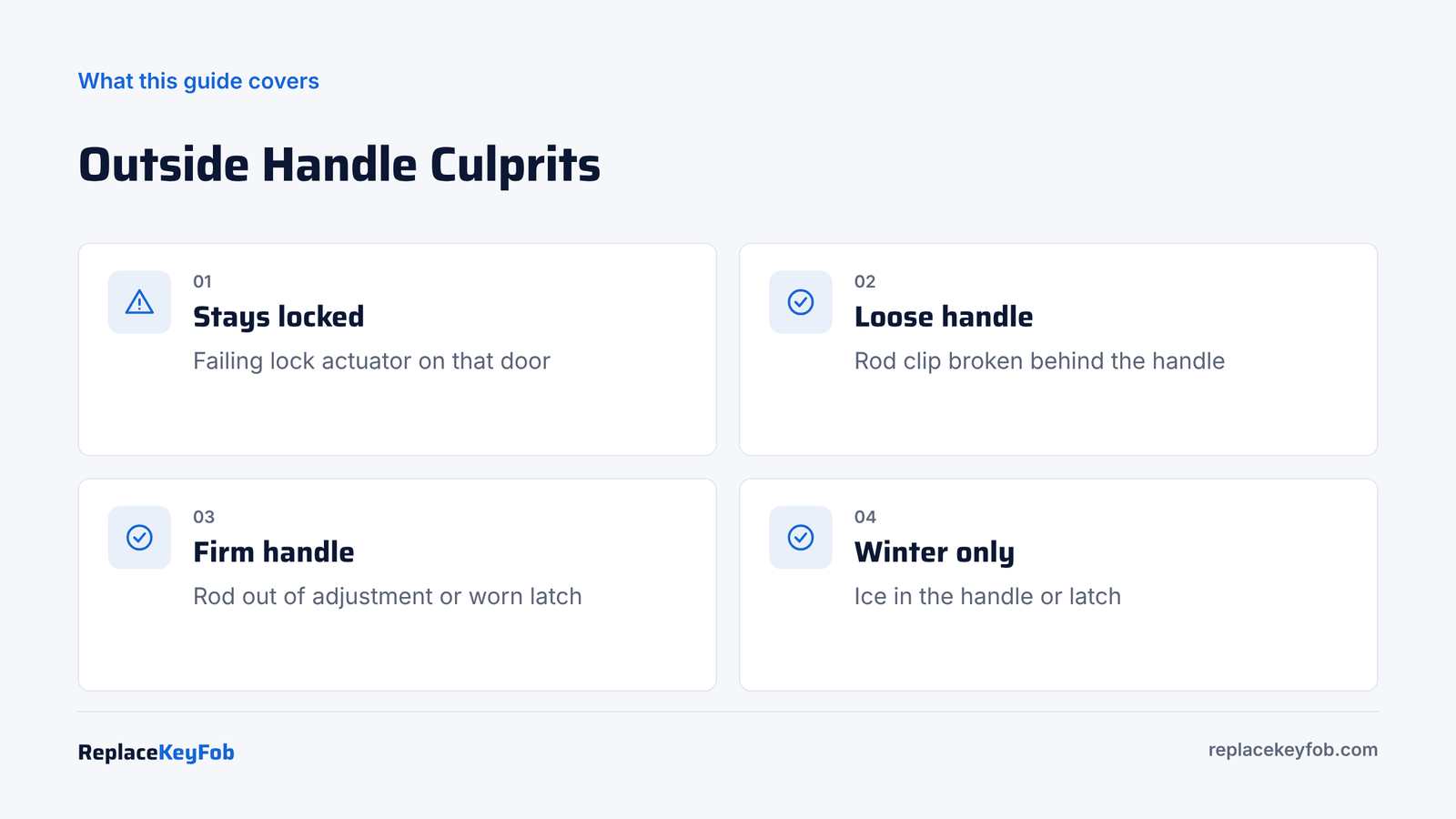
To fix a car door that won’t open from outside, first check that it unlocks. If the lock pin does not move, the lock actuator is failing. If it unlocks but the handle feels loose, the rod clip broke. If the handle feels normal, the rod needs adjusting or the latch is worn.
This is one of the most common door faults. You press unlock, pull the outside handle, and nothing happens. Then you open it from inside and it works perfectly. It is tempting to live with it, but it gets old fast, especially on the driver door.
Because the door opens from inside, the latch can release and the door is not jammed. That narrows the fault to three areas: the lock (still holding the door locked), the outside handle and its rod, or the part of the latch that the outside rod moves.
Quick Diagnosis
| What you notice | Likely cause | Repair |
|---|---|---|
| Lock pin or indicator does not move on unlock | Lock actuator failing on that door | Replace actuator or latch unit |
| Unlocks sometimes, fails sometimes | Actuator wearing out or wiring break in the hinge | Replace actuator, repair wiring |
| Outside handle pulls with no tension | Rod clip broken or rod off | Replace clip, reconnect rod |
| Handle tension normal, door stays shut | Rod out of adjustment or latch outside lever worn | Adjust rod or replace latch |
| Smart key touch unlock fails, button works | Handle sensor or antenna | Diagnose passive entry |
| Only in freezing weather | Ice in handle or latch | Thaw, dry, lubricate |
| Opens from outside after unlocking with the key only | Actuator weak, key moves lock manually | Replace actuator |
Step 1: Check the Lock
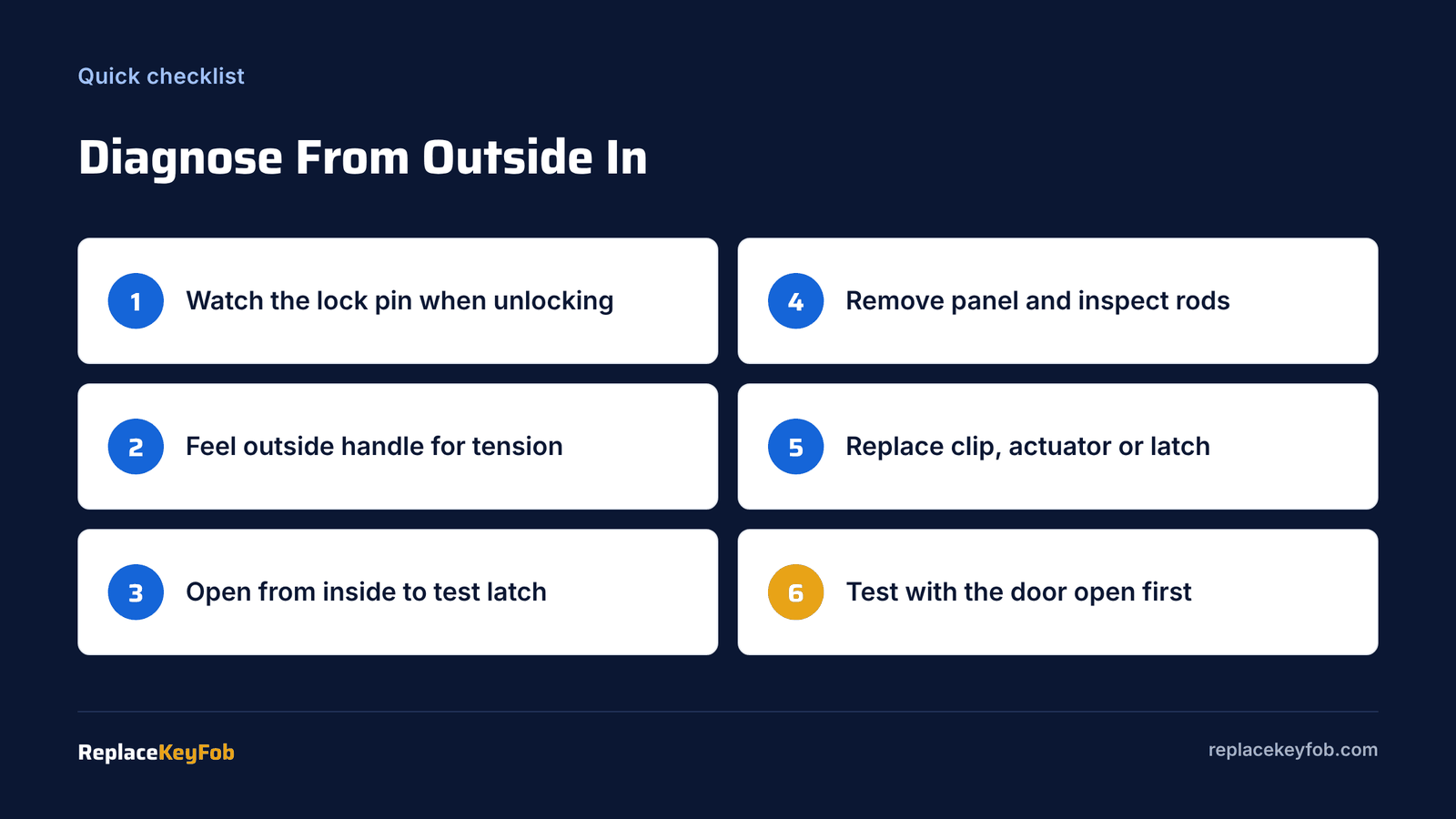
Watch the door’s lock pin, tab or indicator while a helper presses unlock on the fob and then the master switch.
- It does not move: the actuator on that door is not unlocking it. The outside handle is blocked by the lock lever, so it cannot open the door. From inside, many cars override the lock when you pull the handle, which is why it opens from inside.
- It moves slowly or only part way: the actuator motor is weak. It may work in warm weather and fail in the cold.
- It moves fully: the lock is fine. Go to Step 2.
If only one door fails to unlock with the fob, our guide on why a key fob unlocks the passenger door only explains actuator and wiring faults in detail. If the problem is the remote itself, start with key fob locks but won’t unlock.
Wiring in the door jamb
Wires run from the body to the door through a rubber boot between the hinges. Thousands of openings can break wires inside it, especially on driver doors. If the actuator works when you wiggle the door or flex the boot, a broken wire is the cause. Peel back the boot and look for cracked insulation or a broken conductor.
Step 2: Feel the Outside Handle
- No tension: the rod or cable from the handle to the latch is disconnected. Almost always a broken plastic clip.
- Normal tension, door does not open: the rod is out of adjustment (often after a previous repair) or the latch’s outside lever is worn.
- Handle stuck solid: ice, or a broken handle pivot.
In winter, start with how to unfreeze frozen car door handles.
Automotive test light
A 12V test light or a basic digital multimeter helps you check whether the lock actuator receives power when you press unlock, so you replace the right part.
As an Amazon Associate, ReplaceKeyFob earns from qualifying purchases.
Step 3: Open the Panel and Inspect
Open the door from inside and remove the inner panel. See how to fix a car door handle for the full panel removal steps. Then peel back the moisture barrier near the rear of the door.
- Find the outside handle rod running from the handle down to the latch.
- Check both ends. A clip should hold the rod at the handle and at the latch.
- Have a helper pull the outside handle while you watch the rod. It should move and push the latch release lever.
- Watch the lock rod or lever on the latch while someone presses lock and unlock.
Step 4: Make the Repair
Broken rod clip
Replace the clip with a new one of the same style. Clips are inexpensive and often sold in assortments. Snap the rod into the clip and close it until it locks.
Rod out of adjustment
Some rods have a threaded adjuster or a clip that grips the rod at a chosen point. If the handle moves fully but the latch lever only moves partly, shorten the effective length so the latch releases earlier in the handle travel. Adjust in small steps and test each time.
Failing actuator
On most cars made in the last 15 to 20 years, the actuator is built into the latch assembly. Replacing it means:
- Disconnect the actuator connector and the handle and lock rods.
- Remove the latch screws on the door edge.
- Remove the latch through the door shell.
- Fit the new latch, reconnect everything and test.
On some older cars, the actuator is a separate unit bolted to the door shell and connected to the latch with a rod, which is a cheaper and quicker swap.
Worn latch
If the outside rod moves correctly but the latch does not release, replace the latch. Always test a new latch with the door open: push the claw closed with a screwdriver and release it with both handles.
Smart Key Cars: Touch Unlock Fails
If the door unlocks with the fob button but not by touching the handle, the problem is the passive entry system, not the mechanical linkage. Causes include a weak fob battery, a failed sensor in the handle, or an antenna problem. Read how passive keyless entry works for background and check the fob battery first if range seems short.
Variations by Vehicle Type
- Pickup trucks: driver doors on high-mileage trucks are the classic case for broken jamb wiring and worn actuators, because they are opened many times a day on job sites. Check the wiring boot first.
- Minivans: a sliding door that will not open from outside usually has a problem at the rear latch, the remote control unit in the middle of the door, or the power door motor. Turn off the power door switch and try opening it by hand to narrow it down.
- Compact cars with rod linkage: rod clips are the usual failure, and the repair is cheap.
- Cars with cable linkage on the outside handle: a stretched cable acts like a rod out of adjustment. The handle moves but does not pull far enough.
- Smart key models: a handle that holds the sensor and antenna may need to be replaced as a unit if the sensor fails.
- Rear doors: the child lock does not affect the outside handle, so do not chase it for this fault.
Mistakes to Avoid
- Replacing the handle when the actuator is the problem. Check the lock first.
- Pulling harder. A disconnected rod will not reconnect itself, and you may break the handle.
- Ignoring intermittent faults. A weak actuator usually fails completely in the first cold snap.
- Tearing the moisture barrier. Water entering the panel can kill window switches.
- Closing the door before testing a new latch. You could lock it shut.
Repair Costs in 2026
| Repair | Typical shop total |
|---|---|
| Rod clip or rod reconnect | About $80 to $180 |
| Rod adjustment | About $60 to $150 |
| Door jamb wiring repair | About $100 to $300 |
| Separate actuator (older cars) | About $150 to $350 |
| Latch with built-in actuator | About $200 to $600 |
| Outside handle replacement | About $150 to $400 |
A DIY repair usually costs only the part: about $5 to $15 for a clip, about $40 to $250 for a latch and actuator, depending on the model.
When to Call a Pro
Call a shop or locksmith if the door will not open from either side, if lock problems affect several doors at once (which suggests a body control module or wiring problem), or if your car has electronic or flush handles. If the door will not open from inside either, see how to fix a car door that won’t open from inside.
Frequently Asked Questions
Most often the lock actuator on that door is not unlocking it, or the rod between the outside handle and the latch has come loose because its plastic clip broke.
The lock pin does not move, moves slowly, or works only sometimes when you press unlock, and you may hear buzzing or grinding in the door. Other doors work normally.
Often, yes. A broken rod clip is a cheap DIY fix. An actuator or latch replacement takes one to two hours with basic tools and trim tools.
Typically about $80 to $180 for a rod or clip repair and about $200 to $600 for a latch with built-in actuator, at 2026 US shop rates.
Cold slows a weak actuator motor and can freeze water inside the handle or latch. If it only fails below freezing, thaw and lubricate first, then watch whether the actuator stays reliable.