
How to Fix P0201: Diagnose and Repair the Cylinder 1 Injector Circuit

Your check engine light is on, the engine is running rough, and your OBD2 scanner shows code P0201. It is easy to assume that the cylinder 1 fuel injector has failed. However, replacing the injector without testing the circuit can waste money.
Learning how to fix P0201 starts with understanding what the code actually means. The problem may be the injector, but it can also come from a damaged connector, broken wire, poor electrical connection, blown fuse, or engine computer fault.
This guide explains how to diagnose P0201 safely, which repairs may solve it, how much repairs may cost, and when professional help is the smarter choice.
Quick Answer
To fix P0201, confirm the code with an OBD2 scanner, inspect the cylinder 1 injector connector and wiring, test injector resistance, and check for power and a computer-controlled ground pulse. Repair damaged wiring or replace the injector only after testing. Direct-injection systems usually require professional diagnosis because of high fuel pressure.
What Does the P0201 Code Mean?
P0201 means:
Injector Circuit Malfunction – Cylinder 1
Your vehicle’s powertrain control module, commonly called the PCM or engine computer, controls each fuel injector through an electrical circuit. The injector opens for a carefully measured amount of time so fuel can enter the engine.
When the PCM detects an unexpected electrical condition in the cylinder 1 injector circuit, it stores P0201 and may turn on the check engine light.
The problem could involve:
- The cylinder 1 fuel injector
- The injector’s electrical connector
- A damaged power or control wire
- Corrosion or loose terminals
- A blown injector or engine-control fuse
- A poor engine ground
- The PCM injector driver
An OBD2 code identifies the circuit where the PCM detected a problem. It does not automatically identify the failed part. The EPA’s information about onboard diagnostics explains how OBD systems monitor vehicle components and alert drivers when a malfunction is detected. (EPA NPDES)
Is P0201 Related to the Key Fob or Immobilizer?
Usually, no.
A weak key fob battery, damaged remote, or lost key programming will not normally cause P0201. Key and immobilizer problems generally prevent the engine from starting or cause a security warning light.
P0201 points to the engine’s cylinder 1 fuel injector circuit. However, a car can have both an immobilizer problem and an injector problem at the same time. Do not assume one code explains every symptom.
Common Symptoms of P0201
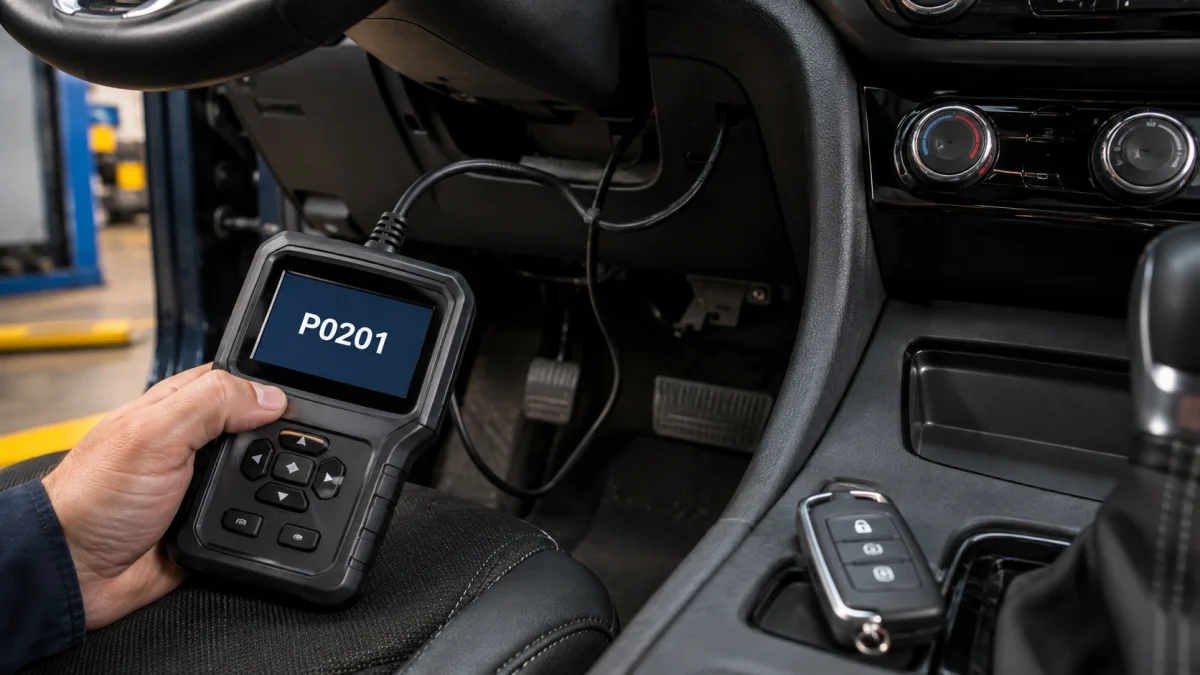
The exact symptoms depend on whether the injector circuit fails continuously or only occasionally.
Common warning signs include:
- Check engine light
- Rough or uneven idle
- Engine vibration
- Cylinder 1 misfire
- Weak acceleration
- Reduced fuel economy
- Hard starting
- Engine stalling
- Fuel smell from the exhaust
- Loss of power
- Limp mode on some vehicles
Related codes may also appear, including P0301 for a cylinder 1 misfire or additional injector circuit codes.
Can You Drive With P0201?
Driving a short distance may be possible if the engine still runs reasonably well and the check engine light is steady. However, continued driving is not recommended.
An inactive injector can make the engine run poorly. An injector that remains electrically or mechanically open may deliver too much fuel. Either condition can increase emissions and potentially damage the catalytic converter.
Stop driving and arrange professional help if:
- The check engine light is flashing
- The engine is shaking severely
- You smell strong raw fuel
- The vehicle is losing power in traffic
- The engine repeatedly stalls
- Fuel is visibly leaking
A flashing check engine light often indicates a severe misfire that could overheat the catalytic converter.
What Causes Code P0201?
Failed Cylinder 1 Fuel Injector
The injector contains an internal electrical coil. If that coil develops an open circuit, short circuit, or excessive resistance, the PCM may set P0201.
An injector can also become mechanically clogged. However, a clogged injector is more likely to cause a misfire or fuel-delivery problem than a circuit-specific code unless an electrical fault is also present.
Loose or Corroded Injector Connector
Injector connectors are exposed to heat, vibration, oil, moisture, and cleaning chemicals. Their plastic locks can break, and the metal terminals inside can loosen or corrode.
A connector may look attached while making poor electrical contact.
Damaged Wiring
The injector harness may rub against an engine cover, bracket, intake component, or cylinder head. Heat can also make insulation brittle.
Look for:
- Melted insulation
- Cracked wiring
- Exposed copper
- Pinched sections
- Previous repairs
- Oil-soaked connectors
- Rodent damage
Blown Fuse or Power-Supply Problem
Many engines supply battery voltage to several injectors through a shared fuse or relay. If the power supply fails, several injector codes may appear.
When only P0201 is stored, a cylinder-specific connector, injector, or control wire is generally more likely. Even so, the fuse and shared power circuit should still be checked.
PCM Driver Failure
The PCM switches the injector circuit on and off, often by controlling the ground side. The internal electronic component performing this job is sometimes called an injector driver.
PCM failure is possible, but it is much less common than injector, connector, or wiring damage. Never replace or reprogram the PCM before the complete circuit has been tested.
Tools You May Need
Basic diagnosis may require:
- OBD2 scanner with live data
- Digital multimeter
- Vehicle-specific wiring diagram
- Injector noid light
- Mechanic’s stethoscope
- Back-probe pins
- Basic hand tools
- Electrical contact cleaner
- Proper terminal repair tools
A basic code reader can confirm P0201 and clear the code. A more capable scanner may show freeze-frame information, misfire counts, injector data, and other useful readings.
Do not pierce wire insulation unless the repair procedure specifically requires it. Piercing insulation creates an opening where moisture and corrosion can enter.
How to Fix P0201 Step by Step
1. Scan the Vehicle for Every Stored Code
Connect the OBD2 scanner and record:
- Stored codes
- Pending codes
- Freeze-frame data
- Engine temperature
- Engine speed
- Vehicle speed
- Battery voltage
Freeze-frame data shows the operating conditions when the fault was detected. This may help determine whether the problem happens during startup, idle, acceleration, or normal cruising.
Do not immediately clear the codes. Save the information first.
2. Confirm Which Cylinder Is Number 1
Cylinder numbering differs by engine design and manufacturer. Cylinder 1 is not always the cylinder closest to the front bumper.
Use reliable service information for your vehicle’s exact:
- Year
- Make
- Model
- Engine size
- Engine code
Testing the wrong injector can lead to incorrect repairs.
3. Perform a Visual Inspection
Turn off the ignition and inspect the cylinder 1 injector connector and nearby harness.
Check for:
- A connector that is not fully seated
- A broken locking tab
- Bent or pushed-back terminals
- Green or white corrosion
- Melted plastic
- Damaged insulation
- Harness sections rubbing against metal
- Fuel, oil, or water inside the connector
Gently move the harness while looking for hidden breaks. Do not pull directly on the wires.
If the connector is dirty, use an electrical contact cleaner approved for automotive connectors. Allow it to dry before reconnecting it.
4. Check the Injector Fuse and Power Supply
Locate the injector, engine-control, or PCM fuse using the owner’s manual or fuse-box diagram.
A fuse should be tested with a multimeter or test light rather than judged only by appearance. A cracked fuse element can be difficult to see.
If the fuse is blown, do not simply install another one and assume the repair is complete. A shorted injector or damaged wire may cause the new fuse to fail again.
5. Listen for Injector Operation
With the engine running, place a mechanic’s stethoscope against the cylinder 1 injector. A long screwdriver can sometimes be used carefully as a listening tool.
A working port fuel injector usually creates a steady clicking sound.
Compare cylinder 1 with another injector:
- Similar clicking: The injector is receiving some form of command, but further testing is still needed.
- No clicking: The injector may lack power, lack a control pulse, or have an internal failure.
- Irregular clicking: The connector or circuit may have an intermittent problem.
Keep clothing, hair, tools, and hands away from belts, fans, and hot components.
6. Test Injector Resistance
Turn off the ignition and disconnect the cylinder 1 injector. Set the digital multimeter to resistance, measured in ohms, and test across the injector terminals.
Compare the result with:
- Manufacturer specifications
- Another injector of the same type
- Reliable vehicle-specific service information
A reading far outside specification may indicate an open or shorted injector coil.
Do not assume every injector should have the same universal resistance. Low-impedance, high-impedance, port-injection, and direct-injection systems can have different specifications.
7. Check for Injector Power
Depending on the vehicle, one injector terminal may receive battery voltage with the ignition on or while the engine is cranking. The PCM commonly controls the other side of the circuit.
Use the correct wiring diagram to identify the power and control terminals.
If power is missing, inspect:
- Injector fuse
- Main relay
- Shared power wire
- Harness connectors
- Corroded terminals
If several injectors lack power, focus on the shared fuse, relay, or supply circuit instead of replacing cylinder 1’s injector.
8. Check the PCM Control Pulse
An injector noid light can be connected to the injector harness to show whether the PCM is pulsing the circuit while the engine cranks or runs.
Results may indicate:
- Flashing normally: The PCM is commanding the injector.
- No flash: The control wire may be open, shorted, or not being switched by the PCM.
- Constant illumination: The control circuit may be shorted to ground.
Use a noid light or electronic test equipment designed for injector circuits. Do not use a heavy incandescent test light on a PCM control circuit. It may draw too much current and damage sensitive electronics.
9. Test Wiring Continuity and Shorts
With the battery disconnected and the PCM connector handled according to manufacturer procedures, test the injector control wire for:
- Excessive resistance
- Open circuit
- Short to ground
- Short to battery voltage
- Short to another wire
A wire can appear undamaged outside while being broken under the insulation.
Pay close attention to areas near:
- The valve cover
- Intake manifold
- Engine brackets
- Harness bends
- Previous repair splices
- Hot exhaust components
10. Replace or Service the Injector When Testing Confirms Failure
If the injector fails its electrical test and the wiring is good, replacement may be necessary.
On some port-injected engines, an experienced DIY owner can replace an injector with the correct procedure. New seals or O-rings are normally required.
Direct-injection systems are different. They can operate at extremely high fuel pressure and may require special tools, new high-pressure lines, calibrated seals, coding, or adaptation procedures. Do not loosen direct-injection fuel components without the correct service information and safety equipment.
11. Clear the Code and Verify the Repair
After completing the repair:
- Reconnect all components.
- Confirm that no fuel is leaking.
- Clear the codes.
- Start the engine.
- Check the idle quality.
- Rescan for pending codes.
- Complete a careful road test.
- Scan the vehicle again.
A repair is not confirmed simply because the check engine light turns off. The vehicle should complete enough operating time for the PCM to retest the circuit.
Expert Tip: Before replacing the cylinder 1 injector, compare its resistance, power supply, and control pulse with a known-good injector on the same engine. Side-by-side testing often reveals the problem faster than relying on a generic specification.
P0201 Repair Options and Estimated Costs
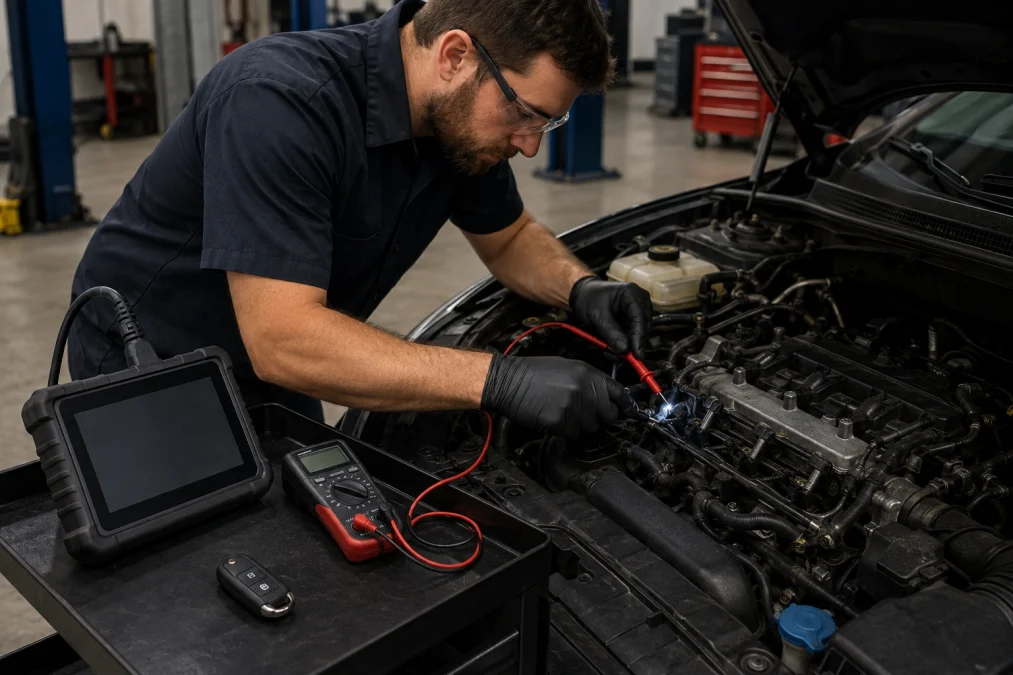
Repair costs vary by vehicle, engine design, labor rate, and the cause of the fault. Direct-injection engines are generally more expensive to repair than basic port-injection systems.
| Repair | Typical U.S. Cost Range | When It May Be Needed |
|---|---|---|
| Diagnostic testing | $100–$220 | The cause is not visible or basic testing is inconclusive |
| Injector connector repair | $100–$300 | Terminals are loose, corroded, melted, or damaged |
| Wiring repair | $120–$450 | A wire is open, shorted, rubbed through, or heat-damaged |
| Port fuel injector replacement | $250–$700 | Injector fails electrical or functional testing |
| Direct fuel injector replacement | $500–$1,200+ | High-pressure injector is faulty |
| PCM repair or replacement | $800–$2,000+ | Wiring and injector test correctly but the driver does not operate |
These are broad estimates, not guaranteed prices. Ask for a written estimate showing diagnostic labor, parts, programming, taxes, and additional recommended work.
The FTC’s auto repair guidance recommends understanding the repair estimate, labor charges, warranty terms, and authorization process before work begins. (Consumer Advice)
Should You Replace All Fuel Injectors?
Not automatically.
Replacing only the failed injector is often reasonable when:
- The other injectors test correctly
- The vehicle has moderate mileage
- There are no fuel-contamination problems
- The replacement injector matches the original specifications
Replacing a full set may make more sense when:
- Several injectors have failed
- Multiple cylinders show injector-related problems
- The engine has very high mileage
- Labor requires removing major components
- The manufacturer recommends matched or calibrated injectors
Ask the technician to explain why a full set is recommended before approving the additional cost.
DIY Repair vs. Professional Diagnosis
| Factor | DIY Diagnosis | Professional Diagnosis |
|---|---|---|
| Initial cost | Lower if tools are already available | Includes diagnostic labor |
| Equipment | Scanner and multimeter may be enough for basic tests | Advanced scanner, scope, noid lights, pressure tools, and service data |
| Wiring diagnosis | Can be difficult without diagrams | Usually faster with proper information |
| Direct-injection safety | Not recommended for most owners | Appropriate equipment and training available |
| PCM testing | High risk of misdiagnosis | Better ability to verify driver operation |
| Repair warranty | Depends on purchased parts | Shop may provide parts and labor coverage |
A confident DIY owner may be able to inspect connectors, check fuses, scan codes, and perform basic resistance tests. Advanced circuit testing is better left to a trained technician when the wiring diagram or correct test equipment is unavailable.
When to Call a Professional Locksmith or Dealership
P0201 is normally an engine-performance problem, so an automotive repair technician is usually more appropriate than a locksmith. However, a locksmith or dealership may still be relevant when starting or security symptoms are present.
Call an Automotive Repair Shop When:
- The engine runs rough or misfires
- P0201 returns after clearing
- Injector power or control pulse is missing
- Wiring damage is hidden inside the harness
- The vehicle uses direct injection
- PCM testing may be required
- Fuel-system disassembly is necessary
You can use the ASE resources for drivers to learn about technician certification and locate recognized repair facilities. ASE-certified technicians are required to demonstrate technical knowledge and periodically recertify. (ASE)
Call an Automotive Locksmith When:
- The engine does not crank because the key is not recognized
- The security light remains on
- A replacement transponder key needs programming
- The smart key is lost or damaged
- The ignition cylinder or key blade is damaged
- You are locked out of the vehicle
A locksmith cannot normally repair an injector circuit unless the business also provides mechanical automotive diagnostics.
Call the Dealership When:
- The vehicle is under factory warranty
- The injector has a manufacturer warranty extension
- Injector coding requires factory-level equipment
- The PCM needs replacement or security programming
- A technical service campaign may apply
- Other shops lack information for the vehicle
Before paying for a repair, use the NHTSA recall lookup tool to check the vehicle identification number for open safety recalls. The tool displays unrepaired recalls reported for the entered VIN. (NHTSA)
Common Mistakes Car Owners Should Avoid
- Replacing the injector based only on the code. P0201 can be caused by wiring or connector damage.
- Testing the wrong cylinder. Verify the manufacturer’s cylinder numbering.
- Clearing freeze-frame data too early. Record the conditions before erasing codes.
- Ignoring a flashing check engine light. A severe misfire can damage the catalytic converter.
- Installing a larger fuse. This can overheat the wiring and create a fire risk.
- Using the wrong test light. A high-current test light may damage the PCM circuit.
- Probing terminals with oversized tools. This can spread the terminals and create a loose connection.
- Replacing the PCM before testing the circuit. PCM failure is possible but uncommon.
- Opening a direct-injection system without depressurizing it correctly. High-pressure fuel can cause serious injury.
- Assuming a key fob problem caused P0201. Immobilizer and injector faults involve different systems.
- Skipping the final road test. The code may return after the PCM reruns its monitor.
How to Prevent Another Injector Circuit Problem
Not every injector failure can be prevented, but a few habits may reduce avoidable problems:
- Repair oil or coolant leaks that contaminate the wiring harness.
- Keep engine covers and harness retainers installed correctly.
- Avoid pressure-washing electrical connectors.
- Investigate rodent activity near the vehicle.
- Fix engine vibration that strains connectors and wiring.
- Use correct replacement connectors and sealed automotive splices.
- Address battery and charging-system problems that create unstable voltage.
- Follow the recommended fuel and maintenance requirements.
When replacing an injector connector, avoid twisting wires together and covering them with household electrical tape. Use automotive-grade terminals, sealed heat-shrink material, and proper crimping tools.
FAQs
Can a bad fuel injector cause P0201?
Yes. A cylinder 1 injector with an open or shorted internal coil can trigger P0201. However, the same code can also come from its connector, wiring, power supply, or PCM control circuit.
Will injector cleaner fix P0201?
Usually not. Injector cleaner may help a mechanically restricted injector, but P0201 is an electrical circuit code. Cleaner cannot repair a broken wire, loose terminal, failed coil, or computer driver.
Can a bad spark plug cause P0201?
A bad spark plug can cause a cylinder 1 misfire, but it normally does not cause an injector circuit code. You may see P0301 instead. Both codes can appear together when more than one problem exists.
Can a weak battery trigger P0201?
Low system voltage can sometimes create unusual electrical faults, especially during starting. Check battery and charging voltage if several unrelated circuit codes appear. A repeatable P0201 affecting only one injector usually requires circuit-specific testing.
Does P0201 always mean cylinder 1 is not receiving fuel?
No. The PCM detected an electrical problem in the injector circuit. The injector may be inactive, intermittent, or operating incorrectly. Mechanical fuel delivery still needs to be verified when electrical tests pass.
Can I replace the cylinder 1 injector myself?
It may be possible on a simple port-injected engine if you have the correct tools and repair procedure. Direct-injection systems should usually be serviced professionally because of high pressure, special seals, and possible calibration requirements.
Will P0201 clear itself after the repair?
The check engine light may turn off after several successful drive cycles, but clearing the code with a scanner allows quicker verification. Always rescan after the road test to check for pending or returning codes.
Conclusion
Knowing how to fix P0201 means testing the complete cylinder 1 injector circuit instead of guessing. Start by recording the scan data, confirming cylinder numbering, and inspecting the injector connector and wiring. Then test injector resistance, power, and the PCM control pulse.
Replace the injector only when the test results support that decision. Repair damaged wiring with proper automotive materials, and treat direct-injection fuel systems with extra caution.
When the diagnosis requires advanced electrical testing, high-pressure fuel work, or PCM programming, choose a qualified repair shop or dealership. If the vehicle also has a security light, unrecognized key, or no-crank condition, have the key and immobilizer system checked separately by a reputable automotive locksmith.
Use your diagnostic results to request a clear written estimate, compare the recommended repair with the actual test findings, and approve only the work needed to correct the fault safely.
