
How to Fix a Power Window That Won’t Go Up

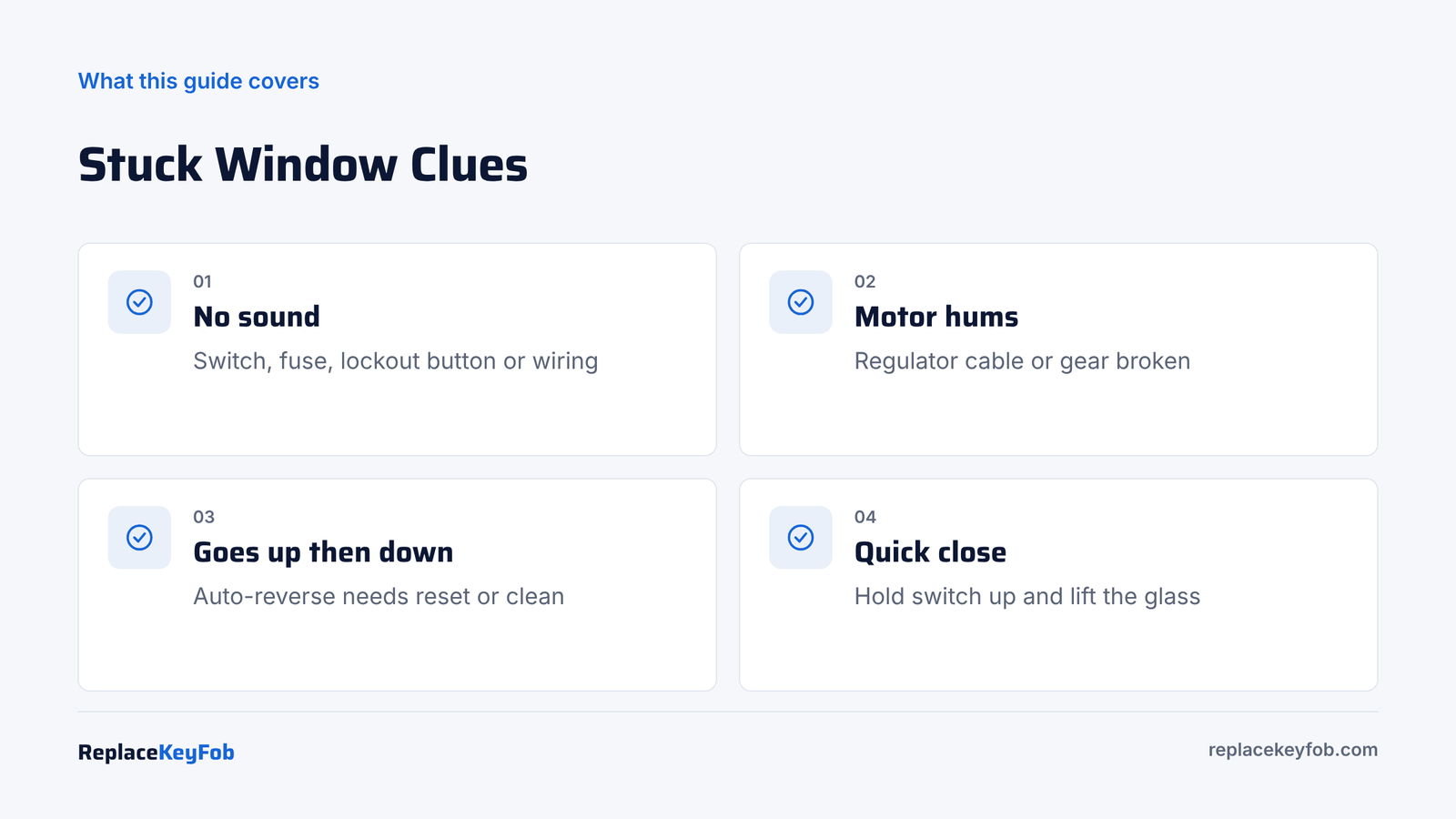
If your power window won’t go up, check the window lock button and try both the master switch and the door switch. No sound points to a switch, fuse or wiring fault. A hum with no movement means a broken regulator. To close it now, hold the switch up while lifting the glass by hand.
A window stuck open is urgent. Rain gets in, the car cannot be left safely, and highway driving with an open window is loud and tiring. The good news is that you can usually get the glass up today, even if the repair has to wait a few days.
Power windows have a short chain of parts: switch, fuse (sometimes a relay), wiring through the door hinge area, the window motor and the regulator that moves the glass. Your job is to find which link broke. Sound is the best clue.
Quick Checks First (Two Minutes)
- Window lock button. Most cars have a lockout button on the driver door that disables the passenger windows. Press it once and try again. It is the most common “fault” on passenger windows.
- Try both switches. Use the driver’s master switch and then the switch on the stuck door. If one works, the other switch is faulty.
- Ignition on. Windows need the ignition or accessory mode on. Some cars allow windows to work for a short time after shutdown, then stop.
- Try other windows. If none work, suspect the fuse, a main relay, the master switch or low battery voltage.
- Hold the switch up firmly. On auto-up windows, a light press may only start the move.
Listen: What the Sound Tells You
| What you hear when pressing up | Likely cause | Fix |
|---|---|---|
| Nothing, no click | Switch, fuse, wiring or lockout | Check lockout, fuse, test switch |
| Click from the switch only | No power to motor, or dead motor | Test for voltage at the motor |
| Motor hums or whirs, glass does not move | Broken regulator cable or gear | Replace regulator |
| Grinding or crunching | Stripped regulator gear or broken pulley | Replace regulator |
| Glass moves slowly, then stops | Weak motor or dry channels | Clean and lube channels, then motor |
| Goes up, then reverses down | Auto-reverse or pinch protection triggered | Clean channels, reset the window |
| Glass tilted or crooked | Glass off a regulator clip | Re-seat glass, replace clip |
Silicone spray for window channels
A silicone spray with a straw cleans and lubricates the rubber window channels, which reduces drag on a tired motor and helps windows that stop or reverse.
As an Amazon Associate, ReplaceKeyFob earns from qualifying purchases.
Power Window Won’t Go Up: Quick Fixes to Close It Now
The palm lift
- Have a helper hold the switch in the up position.
- Place both palms flat on each side of the glass from inside and outside if possible.
- Lift gently while the switch is held.
A weak motor or a slipping regulator often gets just enough help to close the window. Once it is up, leave it up until you repair it.
The door slam trick
If the motor is silent but you suspect it has a dead spot, hold the switch up and open and close the door firmly, or tap the door panel near the motor with your palm. The jolt can move the motor off its dead spot. If the window then moves, the motor is failing and should be replaced soon.
Remove the panel and push it up
If nothing moves, remove the inner door panel (screws in the handle cup and armrest, then pop the clips), peel back the moisture barrier and push the glass up by hand. Wedge it in place with a rubber door stop or tape it to the frame with painter’s tape over the top edge. On some regulators, unplugging the motor first makes the glass easier to move.
Temporary weather cover
If the glass is broken or will not stay up, cover the opening with heavy plastic sheeting and painter’s tape on the inside of the frame. Avoid duct tape on paint; it can lift the clear coat.
Step-by-Step Diagnosis
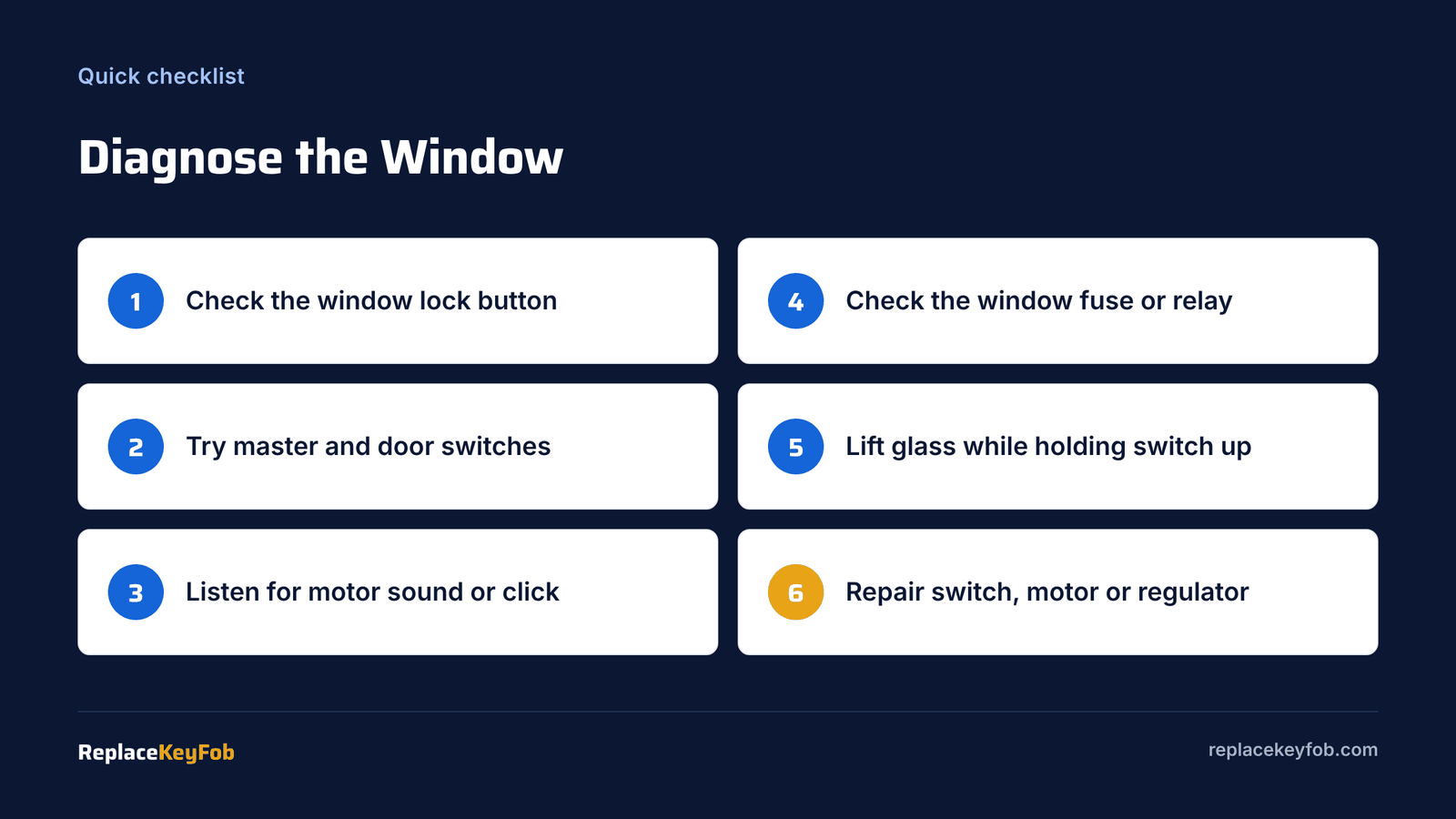
- Check the fuse. Find the power window fuse in the owner’s manual fuse chart. Pull it and look for a broken strip. Replace with the same amperage only. If it blows again, there is a short or the motor is jammed.
- Check battery voltage. Low voltage makes windows slow or dead. A healthy battery reads about 12.4 to 12.7 volts at rest. Our guide to testing a car battery with a multimeter shows how.
- Test the switch. With the panel off, back-probe the motor connector with a test light or multimeter while pressing up. If you see 12V at the motor and it does not run, the motor is bad. If you do not, the switch or wiring is the problem.
- Check the door jamb wiring. Wires running through the rubber boot between the door and body break with age, especially on driver doors. Flex the boot while pressing the switch and see if the window responds.
- Inspect the regulator. With the panel off, look for snapped cables, cables off their pulleys, broken plastic glass clips or a stripped gear.
Why the regulator fails
Many cars use a cable-type regulator, where the motor winds a steel cable around a drum and pulleys. Plastic pulleys and clips crack with age and heat, and the cable can fray or jump off. A hum with no movement almost always means this.
Auto-Up Window Goes Up, Then Comes Back Down
Windows with one-touch auto-up have pinch protection. If the motor senses resistance, it reverses to protect fingers. Dirty, dry channels or a weak motor can trigger it. Clean the channels with a cloth and silicone spray, then try holding the switch up continuously rather than tapping it.
If this started after a battery change or jump start, the window has lost its learned limits. It needs to be reset by fully opening and closing it while holding the switch. Many cars also lose fob or radio settings at the same time; see key fob not working after disconnecting the car battery.
Variations by Vehicle
- Global open and close: some cars can raise or lower windows with the fob. If the switch fails, try holding lock on the fob; see how to roll down windows with your key fob.
- Frameless windows: the glass drops slightly when the door opens. A failed short-drop function can stop the window closing against the seal.
- Older cars: may use a gear-type regulator with a sector gear. Teeth wear and strip.
- Trucks with sliding rear windows: power rear slider motors and cables fail in a similar way.
- Cold weather: ice in the channel can block the window and blow the fuse. Thaw first; see how to unfreeze a car door.
Mistakes to Avoid
- Holding the switch for a long time with a jammed window. You can burn out the motor or blow the fuse.
- Fitting a larger fuse. It removes protection and can cause a wiring fire.
- Prying the glass. It can shatter tempered glass.
- Leaving the panel off for long. Water can damage the switches and speakers.
- Replacing the motor when the regulator is the problem. Listen first; a humming motor is usually fine.
Repair Costs in 2026
| Repair | Parts | Shop total |
|---|---|---|
| Window switch | About $20 to $120 | About $80 to $250 |
| Fuse or relay | About $1 to $20 | About $30 to $100 |
| Door jamb wiring repair | About $10 to $30 | About $100 to $300 |
| Window motor | About $40 to $150 | About $200 to $450 |
| Regulator with motor | About $60 to $250 | About $250 to $600 |
| Regulator only | About $40 to $150 | About $200 to $450 |
Luxury models and frameless windows cost more. If the door panel is already off, removing it again for the regulator is half the work, so diagnose carefully before buying parts. Our guide on how to fix a car door handle shows panel removal in detail.
Frequently Asked Questions
Check the window lock button, try both switches, then hold the switch up while lifting the glass with your palms. If it closes, leave it up until repaired.
The motor is running but the regulator cable, pulley or gear has broken, so the motor cannot move the glass. The regulator needs replacing.
Usually a fuse feeds several windows, so a blown fuse stops more than one. If only one window is dead, suspect its switch, wiring or motor.
The auto-reverse safety system detects resistance from dirty channels or a weak motor, or it lost its settings after a battery change. Clean the channels and reset the window.
Typically about $80 to $250 for a switch and about $250 to $600 for a regulator and motor at a shop in 2026, depending on the car.