
How to Jump Start a Tesla (Frunk Access With a Dead 12V)

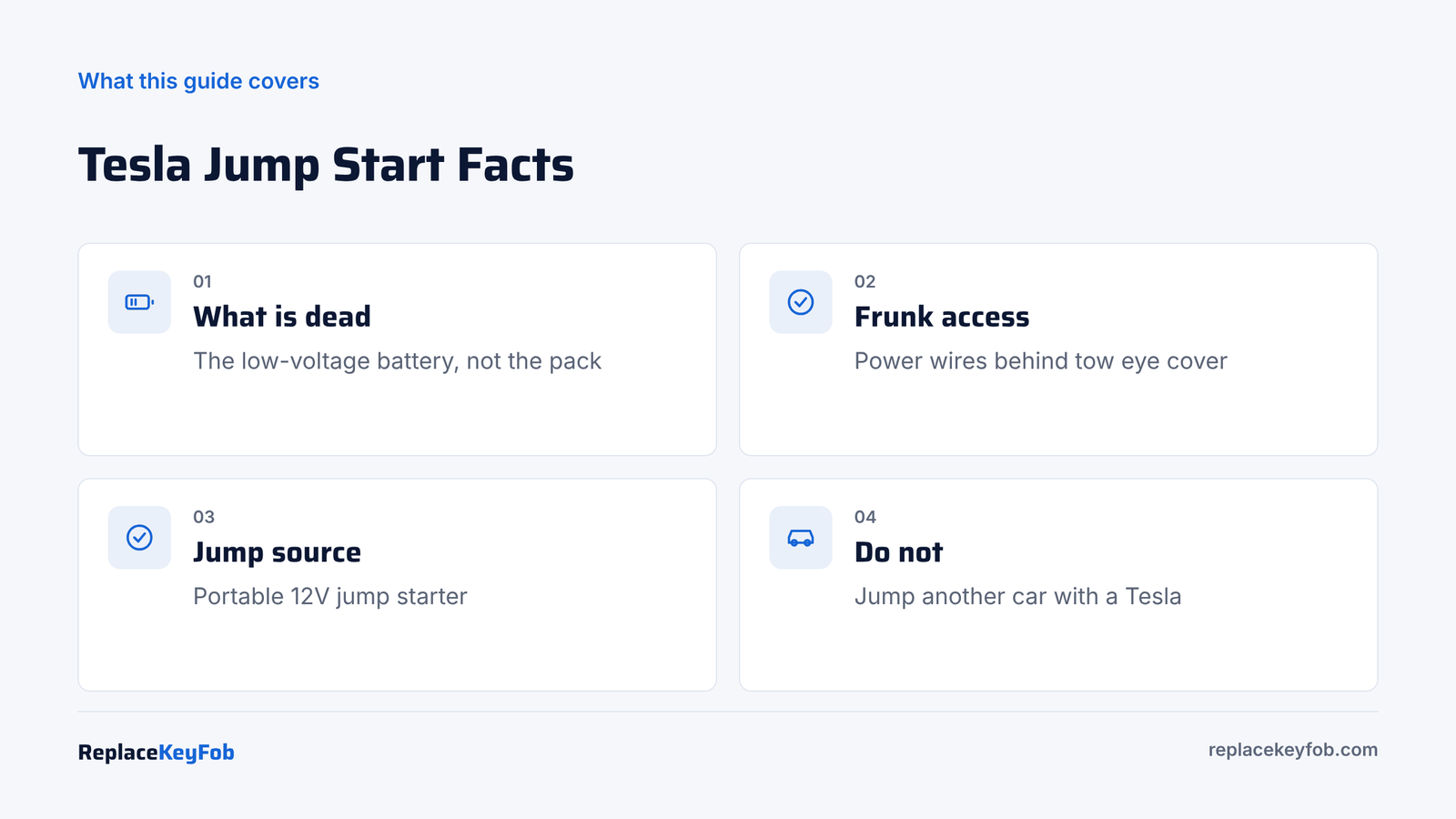
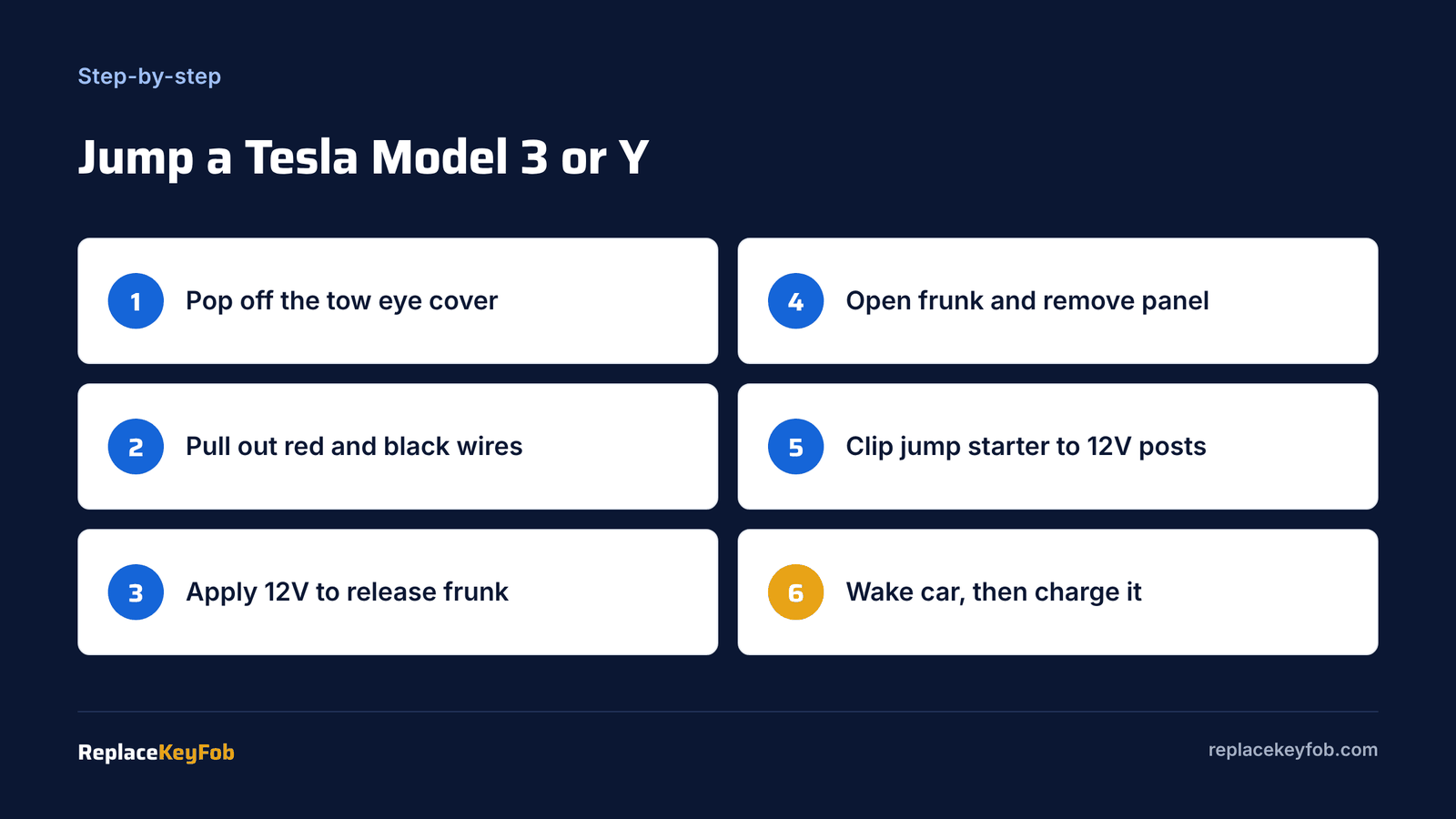
To jump start a Tesla Model 3 or Model Y with a dead low-voltage battery, pop off the tow eye cover on the front bumper, pull out the two wires, and connect a 12V jump starter (red to red, black to black) to release the frunk. Open the frunk, remove the access panel, and connect the jump starter to the low-voltage battery terminals to wake the car.
A Tesla does not need a jump to turn an engine; it has none. What it needs is power for its low-voltage system, which runs the computers, door handles, screen and the contactors that connect the big high-voltage battery. When the low-voltage battery dies, the car may not respond to the phone key or key card, the door handles will not present, and the frunk will not open with the button.
The good news is that Tesla designed a way in. Model 3 and Model Y have frunk release wires behind the front tow eye cover. Supplying 12 volts to them pops the frunk, which gives you access to the low-voltage battery. Once it has some power, the car can wake and start charging its own low-voltage battery from the main pack. For lockout options beyond a jump, see Tesla lost car key.
What You Need
- A portable 12V jump starter or a 12V power supply. A jump starter is the easiest and safest option.
- A small flat trim tool or a plastic card to pop off the tow eye cover
- Gloves and safety glasses
- Your phone with the Tesla app or key card
- Optional jumper cables if you are using another car’s battery as the power source (with that car’s engine off)
Portable 12V Lithium Jump Starter
Choose a compact jump starter with spark-proof smart clamps, reverse-polarity protection and a full charge indicator; a Tesla needs little current to wake.
As an Amazon Associate, ReplaceKeyFob earns from qualifying purchases.
Step 1: Release the Frunk on a Model 3 or Model Y
- Find the tow eye cover on the front bumper. It is a small round or oval panel, usually on the right side of the front fascia.
- Press firmly on the edge of the cover or use a trim tool to pop it out. Do not pry hard with metal tools; the bumper paint scratches easily.
- Pull out the two wires tucked inside the opening. They are usually red (positive) and black (negative) with small terminals.
- Connect the jump starter’s red clamp to the red wire and the black clamp to the black wire. Keep the clamps from touching each other.
- Turn on the jump starter. The frunk latch should release within a few seconds. If nothing happens, check the connections and try again.
- Disconnect the jump starter from the wires and tuck the wires back in.
- Open the frunk fully.
Why this works
The frunk latch is electric. Tesla routes a dedicated pair of wires to the tow eye opening so that first responders and owners can power the latch even when the low-voltage battery is dead. It does not power the rest of the car, only the latch.
Step 2: Reach the Low-Voltage Battery
- Remove the frunk access panel. On Model 3 and Model Y, the low-voltage battery sits beneath panels at the back of the frunk, under the windshield cowl. Pull the trim up carefully; it uses clips.
- Locate the positive terminal under a red cover, and the negative terminal.
- Check the battery type. Earlier cars use a 12V lead-acid battery; many later cars use a lithium-ion low-voltage battery with designated jump posts. Follow the manual for your build.
Step 3: Jump the Tesla
- With the jump starter off, connect the red clamp to the positive terminal of the low-voltage battery or the designated positive jump post.
- Connect the black clamp to the negative terminal or the designated ground point.
- Turn on the jump starter.
- Wait a minute or two. The car should wake: the screen boots, lights come on and the doors respond.
- Open a door with the key card or phone and sit in the car with the brake pressed.
- Leave the jump starter connected for a few minutes while the car finishes booting.
- Turn the jump starter off and remove black, then red.
- Refit the panels and close the frunk.
- Plug the car into a charger or drive it so the high-voltage system can recharge the low-voltage battery through the DC-DC converter.
If the car shows a “12V battery needs service” or “Low voltage battery needs service” alert, book service. A low-voltage battery that went completely flat is often near the end of its life. For replacement steps, see how to replace a Tesla 12V battery.
Model S and Model X
Older Model S and Model X layouts differ from Model 3 and Y. On many versions, the low-voltage battery is under panels near the cowl in the frunk area, and frunk release with a dead battery uses a different external power point or method depending on year. Check the owner’s manual or the Tesla app’s roadside section for your exact car. The principle is the same: supply 12 volts to release access, then supply 12 volts to the low-voltage system.
Can a Tesla Jump Start Another Car?
Tesla’s owner’s manuals state that the car should not be used to jump start another vehicle. The low-voltage system and DC-DC converter are not designed to supply the high current a gasoline car’s starter draws. If you need to help another driver, use a portable jump starter.
Tesla Model 3 vs Model Y Notes
| Item | Model 3 | Model Y |
|---|---|---|
| Tow eye wires | Behind front bumper tow eye cover | Behind front bumper tow eye cover |
| Low-voltage battery location | Rear of frunk area, under panels | Rear of frunk area, under panels |
| Battery type | Lead-acid on earlier builds, lithium on many later ones | Lead-acid on earlier builds, lithium on many later ones |
| Interior door release | Front: manual lever near window switches | Front: manual lever near window switches |
If you are already inside and the car dies, front doors on Model 3 and Model Y have a manual release lever near the window switches. Rear door releases differ by model and year.
Troubleshooting
| Problem | Likely cause | Fix |
|---|---|---|
| Frunk does not release | Jump starter low or wires reversed | Charge the pack; check red to red, black to black |
| Car does not wake after jump | Clamps on wrong points or pack too weak | Recheck terminals; let pack connect longer |
| Car wakes, then dies again | Low-voltage battery cannot hold charge | Plug in to charge; schedule service |
| Doors still will not open | Phone key not connecting | Use key card on the B-pillar |
| Many alerts after power loss | Normal after full power loss | Drive or charge; most clear; book service if they stay |
Safety and Mistakes to Avoid
- Never touch high-voltage components or orange cables.
- Do not jump start another car with a Tesla.
- Do not connect jumper cables to a running gas car to power the frunk wires; use a pack or a car with its engine off.
- Do not force the tow eye cover with metal tools.
- Do not leave the jump starter connected for long periods; once the car wakes, let its own system take over.
How to Avoid a Dead Low-Voltage Battery
- Respond to the low-voltage battery alert quickly.
- Limit Sentry Mode and cabin overheat protection during long parking periods.
- Avoid third-party apps that wake the car constantly.
- Keep the main battery above a reasonable level when parking for weeks.
- Carry a compact jump starter. Even a small one releases the frunk and wakes the car; see the best compact jump starters that fit in a glove box.
Cost if You Need Help
Tesla Roadside can help with a dead low-voltage battery, and coverage depends on warranty status. Independent roadside services typically charge about $50 to $150 for a call-out. Low-voltage battery replacement for lead-acid models typically costs about $150 to $350 through Tesla service.
Frequently Asked Questions
Pop off the tow eye cover, connect a 12V jump starter to the red and black wires to release the frunk, then connect the jump starter to the low-voltage battery terminals under the frunk panels.
The same way as a Model 3: power the tow eye wires to release the frunk, remove the access panel, and connect a jump starter to the low-voltage battery.
No. Tesla’s manuals say not to use the car to jump start another vehicle. Use a portable jump starter instead.
No. It only powers the low-voltage system so the car can wake. Once awake, the car recharges the low-voltage battery from the main pack.
The car may not unlock, the screen stays dark, and the frunk will not open normally. Power the frunk release wires and jump the low-voltage battery to regain access.