
How to Replace a Tesla 12V Low-Voltage Battery

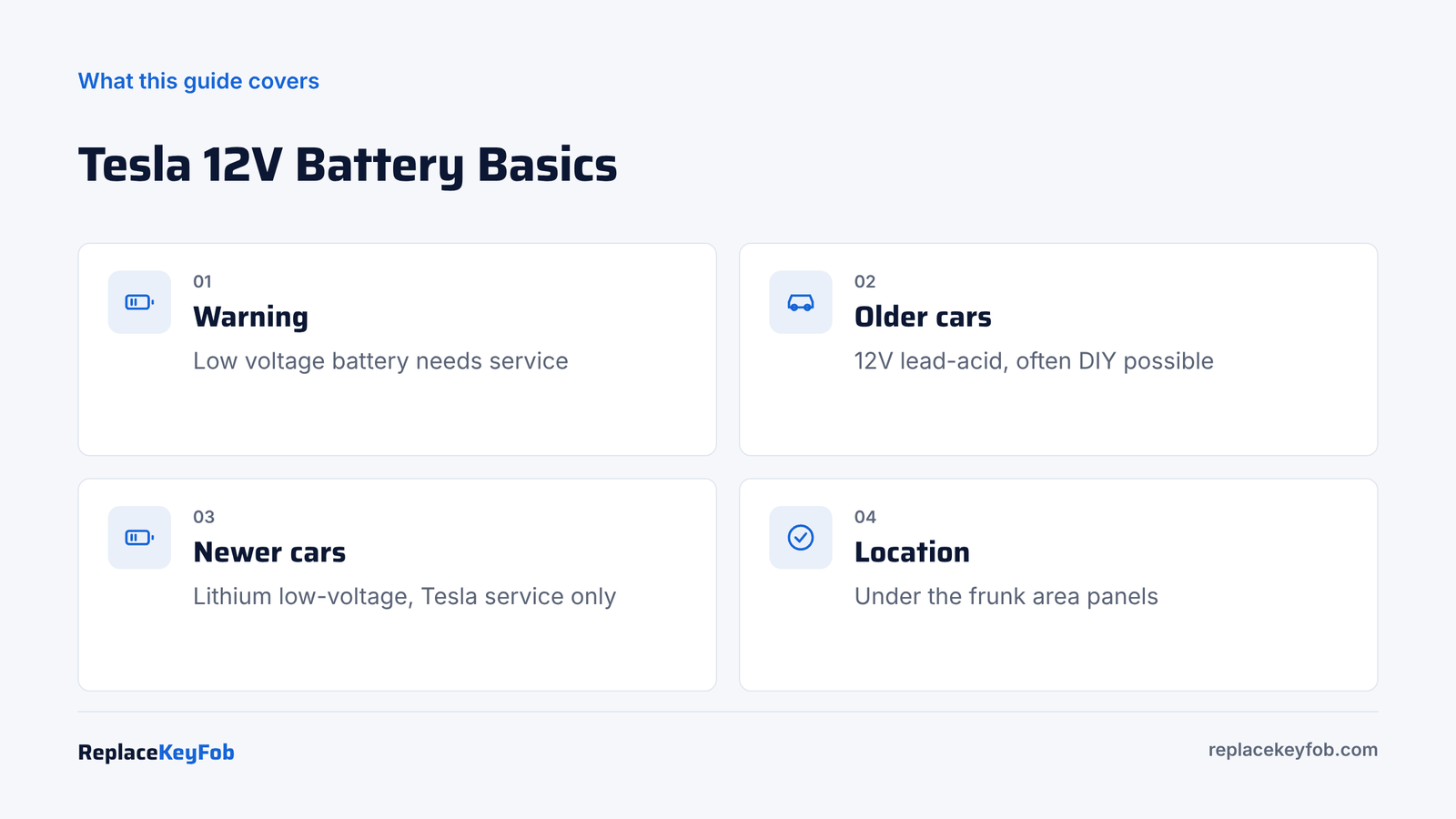
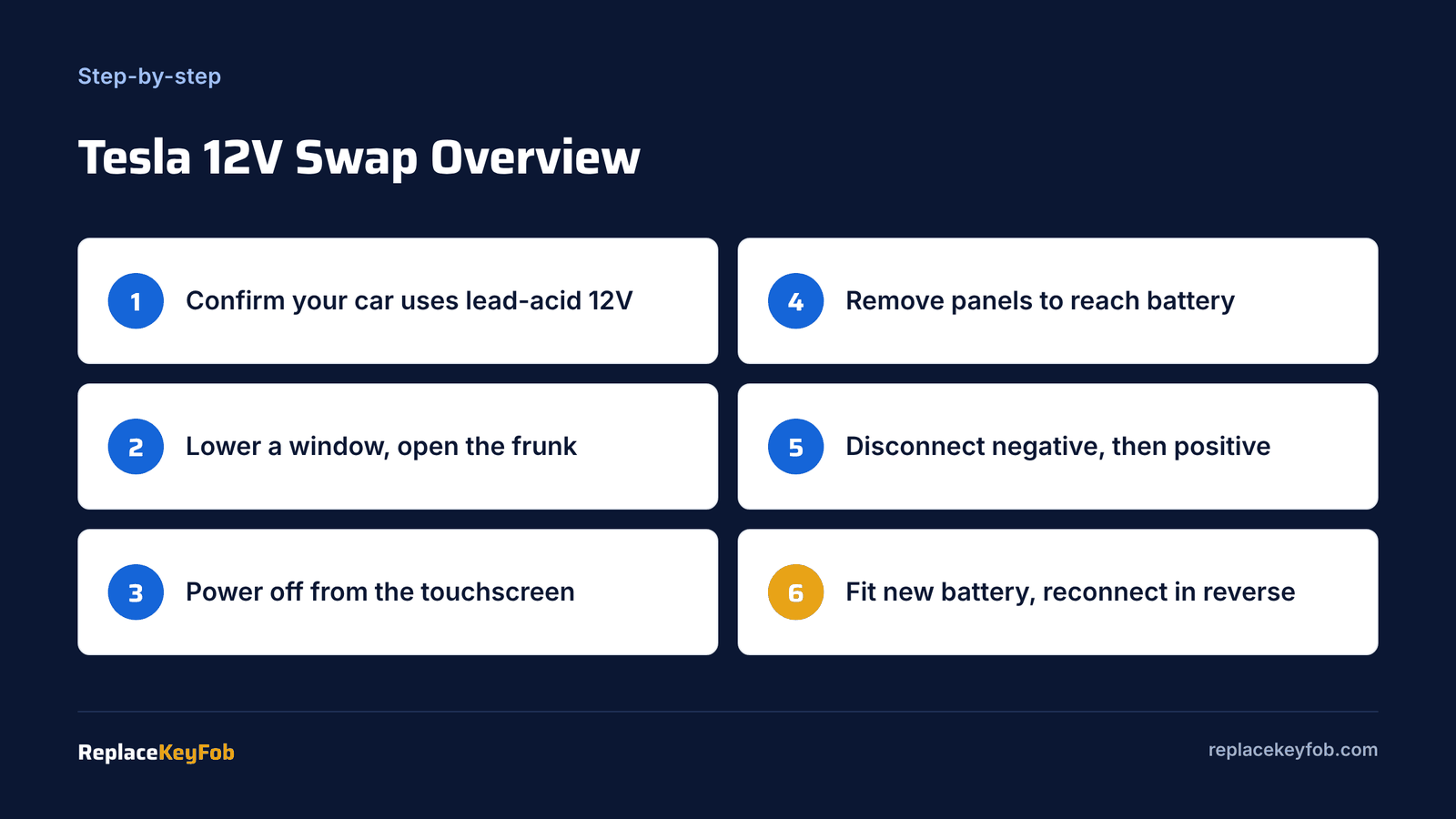
To replace a Tesla 12V battery, first confirm your car has a 12V lead-acid battery, not the newer lithium low-voltage battery, which Tesla service should replace. Lower a window, open the frunk, power the car off from the touchscreen, remove the access panels, and disconnect the negative terminal first. Fit the new battery, reconnect positive then negative, and close the panels.
A Tesla does not use its 12-volt battery to crank an engine, but the car still depends on it. The low-voltage battery powers the computers, door handles, touchscreen and the contactors that connect the big high-voltage pack. When it fails, the car may not unlock, the screen may stay dark, or you may see a “12V battery needs service” or “Low voltage battery needs service” alert.
Tesla changed this battery over the years. Older Model S, Model X, and early Model 3 and Model Y cars use a 12-volt lead-acid battery. Many newer cars use a lithium-ion low-voltage battery, which is longer lasting and designed to be replaced by Tesla. Knowing which one you have is the first step. If you are locked out because of a dead low-voltage battery, our guide to Tesla lost car key and lockout options explains other ways back in.
Lead-Acid or Lithium: Which Tesla Do You Have?
| Vehicle | Typical low-voltage battery | DIY replacement? |
|---|---|---|
| Model S and X, before the 2021 refresh | 12V lead-acid | Possible but involved; many owners use Tesla mobile service |
| Model S and X, 2021 refresh and newer | Lithium-ion low-voltage battery | Tesla service |
| Model 3 and Y, earlier builds (roughly to 2021) | 12V lead-acid | Yes, with care |
| Model 3 and Y, later builds (roughly 2021 to 2022 onward) | Lithium-ion low-voltage battery | Tesla service |
| Cybertruck | 48V low-voltage architecture | Tesla service |
The exact switch date depends on factory and build date. To check, look at the battery once the access panel is off: lead-acid batteries are marked like ordinary car batteries, while lithium units look like a sealed module. The Tesla app or your service history may also list it.
Signs the Tesla Low-Voltage Battery Is Failing
- A “12V battery needs service” or “Low voltage battery needs service” alert
- The car will not wake, the screen stays black, or door handles do not respond
- The phone key and key card stop working, but the high-voltage battery still shows charge
- Climate, Sentry Mode or other features shut off unexpectedly
- Battery age over about 3 to 4 years on lead-acid units
Tesla often warns you weeks before failure. Take the alert seriously, because a dead low-voltage battery can leave the car impossible to open normally.
What You Need for a Lead-Acid Swap
- The correct replacement 12-volt battery for your model and year, often an AGM unit of a specific size
- 10 mm socket with an extension
- Trim tool for clips and panels
- Safety glasses and gloves
- A phone key or key card that works, and a window left open in case of lockout
Replacement 12V AGM Battery for Tesla
Buy by exact model and year, and confirm the terminal layout and size match the original lead-acid battery. Do not use this for cars with lithium low-voltage batteries.
As an Amazon Associate, ReplaceKeyFob earns from qualifying purchases.
How to Replace a Tesla 12V Lead-Acid Battery (Model 3 and Y)
Follow Tesla’s own instructions for your exact car, because panel layouts differ by year. The general sequence on lead-acid Model 3 and Model Y is:
- Lower a window a few inches. If the car locks itself with the battery disconnected, you can still get in.
- Open the frunk using the touchscreen or app while the car still has power.
- Power off the car from the touchscreen (on many versions, Controls, then Safety, then Power Off). Do not touch anything inside the car for a few minutes so it stays asleep.
- Remove the access panels. On Model 3 and Y, the battery sits beneath panels at the back of the frunk area under the windshield cowl. Pull the trim and covers off carefully; they use clips.
- Disconnect the negative terminal first and move the cable away from the post.
- Disconnect the positive terminal under its red cover.
- Release the hold-down and lift the battery out.
- Install the new battery in the same orientation and secure it.
- Reconnect positive first, then negative. Tighten firmly.
- Refit the panels, close the frunk, and wake the car by pressing the brake.
- Check for alerts. The warning should clear after the car runs its checks. It may take a drive.
Why you power off first
A Tesla stays partly awake almost all the time. Powering it off from the screen reduces the chance of a module waking up, sparking or logging faults while the terminals are disconnected. It also helps the car come back up cleanly when power returns.
Model S and X Lead-Acid Batteries
On older Model S and X cars, the 12-volt battery sits under the frunk area behind several panels near the cowl. The job involves removing more trim than on Model 3 and Y. Many owners use Tesla mobile service or an independent EV shop. If you do it yourself, the same rules apply: lower a window, power off, disconnect negative first, and reconnect positive first.
Lithium Low-Voltage Batteries: Leave It to Tesla
The lithium-ion low-voltage battery is designed to last much longer than lead-acid and has its own management electronics. It is not meant to be replaced with an aftermarket lead-acid battery. If you see a low-voltage battery alert on a car with a lithium unit, schedule service in the Tesla app. Warranty coverage is common on these, so check before paying.
How Much to Replace a Tesla 12V Battery
| Option | Typical 2026 cost | Notes |
|---|---|---|
| DIY lead-acid replacement | About $100 to $250 for the battery | Model-specific AGM battery |
| Tesla mobile service, lead-acid | Often about $150 to $350 total | Varies by region and model |
| Tesla service, lithium low-voltage | Often covered by warranty; otherwise varies | Tesla parts only |
| Independent EV shop | About $200 to $400 | Less common; call ahead |
Prices change often. Check the estimate in the Tesla app before booking.
If the Car Is Dead and You Cannot Open It
A Tesla with a completely flat low-voltage battery may not open with your phone or key card. You can usually supply 12 volts from an external source to release the frunk, then charge or replace the battery from there. A portable jump starter is the most common tool for this. Always follow the Tesla manual steps for your model.
After the Replacement
- Check that the phone key and key card work. Rarely, you may need to re-pair; see how to program a Tesla key fob.
- Watch for new alerts. A few may appear briefly after power loss and then clear.
- Reset preferences such as seat positions if lost; most come back from your driver profile.
- Avoid leaving the car parked for weeks with Sentry Mode on, which works the low-voltage system harder.
How to Keep the Tesla Low-Voltage Battery Healthy
The low-voltage battery in a Tesla is charged from the high-voltage pack through a DC-DC converter, so it never needs an external charger in normal use. What wears it out is constant cycling while the car sits awake. A few habits help it last:
- Limit Sentry Mode and Cabin Overheat Protection when parked for long periods, especially at airports or in storage.
- Avoid apps that wake the car constantly. Third-party apps that poll the car every few minutes keep modules awake.
- Keep the high-voltage battery above a sensible level when parking for weeks, so the car can keep the low-voltage battery topped up.
- Watch for the alert. Tesla usually warns well before failure; book service when you see it rather than waiting.
- Check the battery age on older lead-acid cars. If it is past about four years, replacing it before a long trip is cheap insurance.
Tesla vs ordinary cars
Unlike a gas car, a Tesla cannot be “push started” or kept running without its low-voltage system. That is why a weak 12-volt battery in a Tesla is more urgent than in a car with an alternator. It is also why Tesla generally advises against using the car to jump start another vehicle; check your manual.
Mistakes to Avoid
- Swapping a lithium low-voltage battery for lead-acid
- Disconnecting positive first, which risks sparking against the body
- Closing all the windows before disconnecting, which can lock you out
- Prying panels with metal tools and breaking clips
- Ignoring the alert until the car will not open
Frequently Asked Questions
A lead-acid replacement battery typically costs about $100 to $250 if you do it yourself. Tesla mobile service often charges about $150 to $350 total. Lithium low-voltage batteries are serviced by Tesla and often covered by warranty.
Yes, if your car has a lead-acid 12V battery. Follow Tesla’s steps: lower a window, power off, remove the panels, and disconnect negative first. Cars with lithium low-voltage batteries should go to Tesla.
Newer builds, roughly 2021 onward depending on model, use lithium units. You can check visually under the access panels or ask Tesla service through the app.
Lead-acid units often last about 3 to 4 years. Lithium low-voltage batteries are designed to last much longer.
Under panels at the back of the frunk area, below the windshield cowl. You need to remove trim to reach it.