
How to Load Test a Car Battery

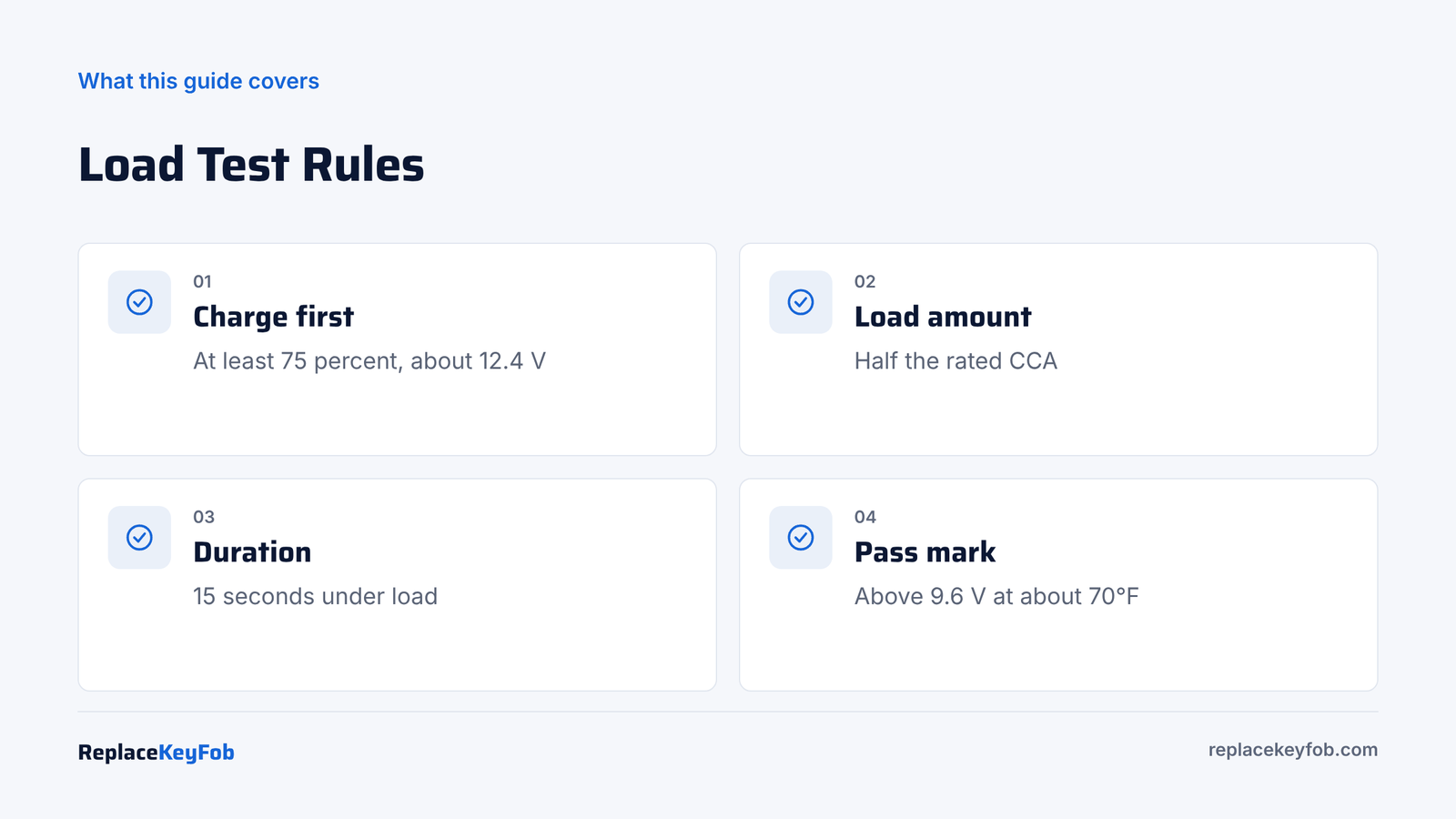
To load test a car battery, charge it to at least 12.4 volts, then use a load tester to draw half the battery’s rated CCA for 15 seconds. A good battery stays above 9.6 volts at about 70°F. Lower readings mean it is weak. At home without a tester, measure voltage while cranking; it should stay above about 9.6 to 10 volts.
A resting voltage reading tells you how full a battery is. It does not tell you whether the battery can still deliver hundreds of amps to the starter on a cold morning. A battery can show 12.6 volts and still collapse the moment you turn the key. That is why mechanics load test.
A load test puts the battery under strain that is similar to starting the engine, and measures how far the voltage sags. A healthy battery holds up. A worn one drops sharply. You can do a proper test with a load tester, a reasonable check with a multimeter at home, or get a free test at most parts stores. If you only have a multimeter, start with our guide on how to test a car battery with a multimeter, then add the cranking test below.
Load Test Methods Compared
| Method | Equipment | Accuracy | Best for |
|---|---|---|---|
| Carbon pile load test | Adjustable carbon pile tester | High | Shops, serious DIY |
| Fixed load tester | Handheld 100 to 125 amp tester | Good for small batteries, fair for cars | Quick checks, motorcycles |
| Cranking voltage test | Multimeter | Fair | Home checks with no tester |
| Headlight test | Headlights and a voltmeter | Low | Rough check only |
| Conductance test | Digital battery tester | Good, no real load | Fast checks, warranty claims |
A digital tester estimates health without loading the battery. It is useful and fast, but a true load test is still the reference when results are unclear. Our guide on how to use a car battery tester covers the digital method.
Before You Load Test
- Charge the battery first. A load test on a partly charged battery is meaningless. Charge to at least 75 percent, about 12.4 volts at rest, and ideally to full. See how to charge a car battery at home.
- Remove surface charge. After charging, let it rest a few hours, or switch the headlights on for a minute, then off, and wait a few minutes.
- Find the CCA rating. It is printed on the label. You need it to set the load.
- Check the temperature. Cold batteries give lower readings, and the pass mark is adjusted for that.
- Inspect the case. Do not load test a cracked, swollen, leaking or frozen battery.
- Wear safety glasses. A load test can make a weak battery gas, and testers get hot.
Battery Load Tester
Look for an adjustable or fixed load suited to car batteries, an analog or digital voltmeter, heavy clamps, and clear instructions on load time.
As an Amazon Associate, ReplaceKeyFob earns from qualifying purchases.
How to Load Test a Car Battery With a Load Tester
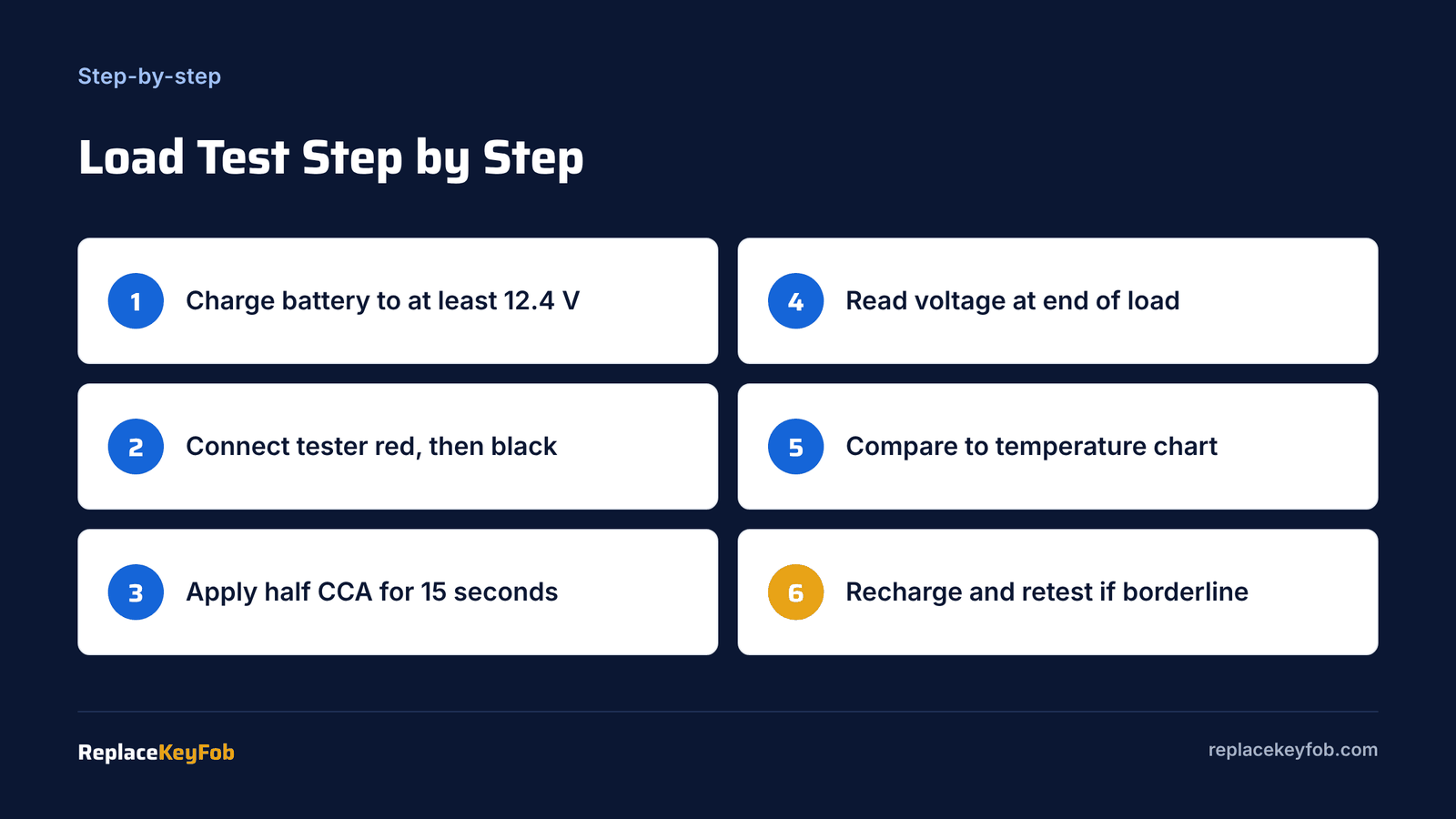
- Connect the tester. With the tester off, clip red to the battery positive post and black to the negative post. Clip onto the lead posts, not the bolts.
- Check resting voltage on the tester’s meter. Under about 12.4 volts, stop and charge first.
- Set the load. For an adjustable carbon pile, set the load to half the rated CCA. A 600 CCA battery gets a 300 amp load.
- Apply the load for 15 seconds. Watch the voltage. Do not hold the load longer; the tester and battery heat up quickly.
- Read the voltage at the end of the 15 seconds, just before releasing the load.
- Release the load and watch recovery. A good battery bounces back toward 12.4 volts or more within a few minutes.
- Compare the reading to the temperature chart below.
Why half CCA for 15 seconds
The CCA rating is the current a battery can supply for 30 seconds at 0°F while staying above 7.2 volts. Half that current for 15 seconds is a standard test that places real stress on the plates, similar to a long start, without damaging a healthy battery. It also gives repeatable results so you can compare batteries.
Minimum Voltage by Temperature
Batteries deliver less power in cold weather, so the pass mark drops as the temperature falls.
| Battery temperature | Minimum voltage after 15 seconds |
|---|---|
| 70°F and above | 9.6 V |
| 60°F | 9.5 V |
| 50°F | 9.4 V |
| 40°F | 9.3 V |
| 30°F | 9.1 V |
| 20°F | 8.9 V |
| 10°F | 8.7 V |
| 0°F | 8.5 V |
Use the battery’s temperature, not the air temperature, if the car has been running or parked in a heated garage.
How to Load Test a Car Battery at Home With a Multimeter
No load tester? The starter motor is a load. This test is less precise but very useful.
- Charge the battery and let it rest.
- Set your multimeter to DC volts and connect it to the battery posts.
- Disable the engine from starting if possible, by pulling the fuel pump fuse or relay, so you can crank for a few seconds. On many cars, you can simply watch the reading during a normal start.
- Crank the engine for 5 to 10 seconds while a helper watches the meter. Use min/max hold if your meter has it.
- A healthy battery usually stays above about 9.6 to 10 volts. Readings well below 9.6 volts at normal temperatures point to a weak battery, a bad cable, or a starter drawing too much current.
If the reading is low, do a voltage drop test on the battery cables before buying a battery. Corroded cables can mimic a weak battery.
The headlight check
As a rough check, switch on the headlights with the engine off and watch them while a helper cranks. If they dim heavily or go out, the battery or connections are weak. This test tells you something is wrong, not what.
Handheld 100 Amp Load Testers
Many affordable handheld load testers apply a fixed load of about 100 to 125 amps. For a motorcycle or small battery, that is close to half CCA. For a car battery with 600 CCA or more, it is a lighter test. Apply the load for about 10 seconds and watch that the needle stays in the “good” zone, usually above about 9.6 volts. Hold it no longer than the instructions say; these testers get very hot.
Reading the Results
| Result | Meaning | Next step |
|---|---|---|
| Above the chart minimum, quick recovery | Battery is healthy | Look elsewhere if starting is a problem |
| Slightly below minimum | Weak or not fully charged | Recharge fully and retest |
| Far below minimum | Battery has lost capacity | Replace the battery |
| Voltage drops fast to under 5 V | Bad cell or internal short | Replace the battery |
| Good result, but car still dies overnight | Parasitic drain or charging fault | Test the alternator and check for drain |
If the battery passes and the car still has trouble, see car clicks but won’t start for starter and connection problems, or how to test an alternator with an OBD2 scanner for charging issues.
Load Testing AGM and Start-Stop Batteries
AGM batteries can be load tested the same way, with the same half-CCA rule and temperature chart. They tend to hold voltage more steadily under load than flooded batteries, so a sharp drop on an AGM is a strong sign of trouble. On start-stop cars, a battery sensor on the negative terminal tracks health; the car may disable start-stop when the battery is weak even before it fails a load test.
Safety and Mistakes to Avoid
- Load testing a discharged battery. The battery will fail even if healthy.
- Holding the load too long. More than 15 seconds can overheat the tester and the battery.
- Testing a frozen battery. Never. Let it thaw and inspect it first.
- Sparks near the battery. Connect and disconnect with the tester off.
- Ignoring temperature. A cold battery can fail the 70°F mark and still be fine.
When to Replace and What It Costs
If the battery fails a load test after a full charge, replace it. A new battery typically costs about $150 to $400 installed in 2026, depending on type and vehicle; see car battery replacement cost. If the battery is still under warranty, a failed test printout from a store can support your claim; see car battery warranty.
Frequently Asked Questions
Charge the battery, connect a multimeter, and watch voltage while cranking. It should stay above about 9.6 to 10 volts. For a true load test, use a load tester set to half the CCA for 15 seconds.
At about 70°F, at least 9.6 volts after 15 seconds at half the CCA rating. The minimum drops in cold weather, to about 8.5 volts at 0°F.
A voltmeter alone cannot apply a load, but you can use the starter as the load and watch the voltmeter while cranking. It is a useful home check.
Yes. The battery should be at least 75 percent charged, about 12.4 volts, and ideally full. Testing a low battery gives a false fail.
No. A 15 second test at half CCA is a standard procedure. Holding the load much longer can overheat the tester and stress the battery.