
How to Put an Electronic Parking Brake in Service Mode

This post contains affiliate links. As an Amazon Associate, ReplaceKeyFob earns from qualifying purchases, at no extra cost to you.
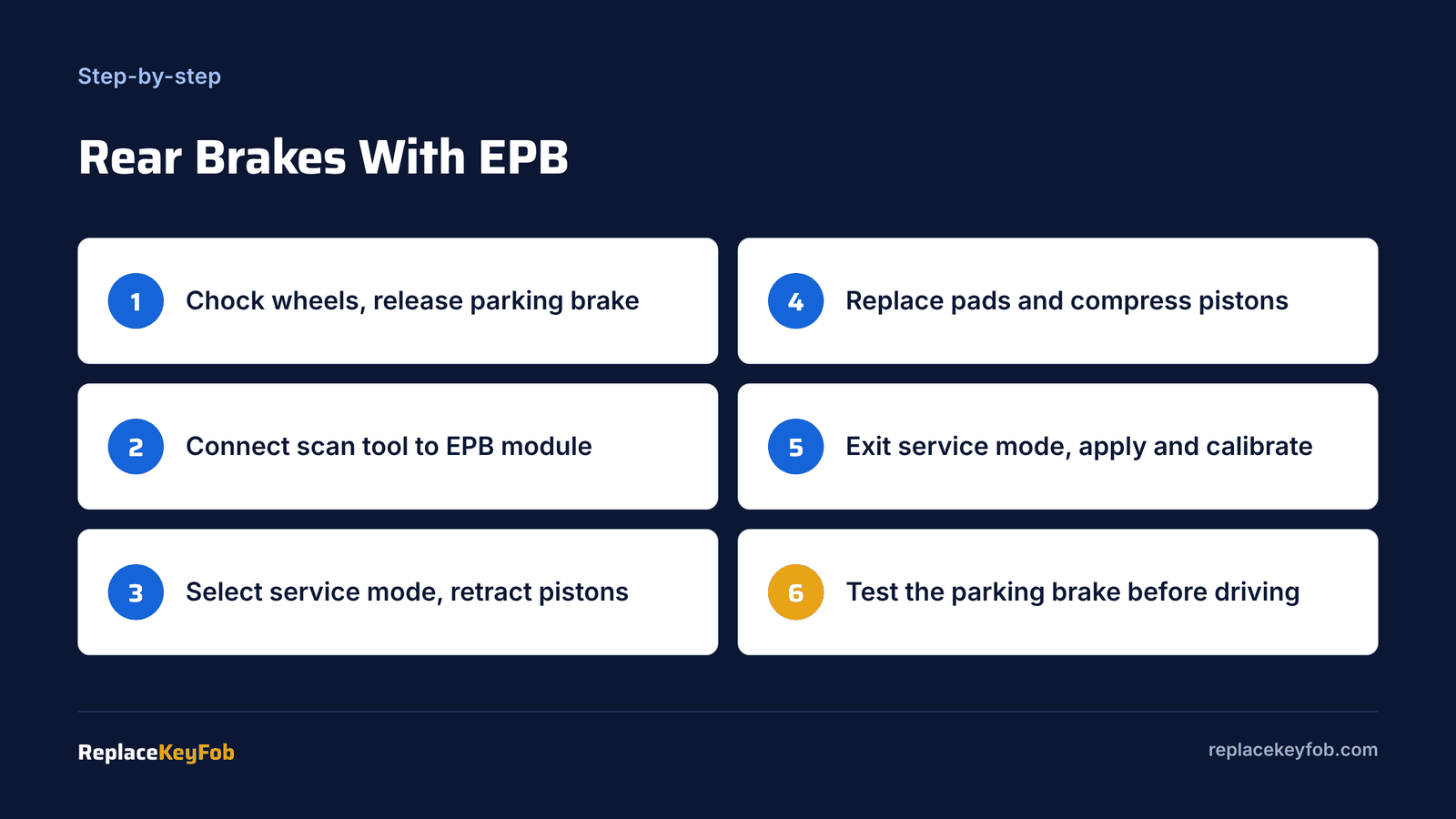
To put an electronic parking brake in service mode, chock the wheels, release the parking brake, and use a scan tool with an EPB function to select service or maintenance mode, which retracts the rear caliper motors. Some models offer a button and ignition sequence in the service manual instead. After the brake job, exit service mode so the system re-applies and calibrates.
On a car with an electronic parking brake (EPB), the parking brake is applied by small electric motors bolted to the rear calipers. Those motors drive a spindle that pushes the brake piston out. If you try to push the piston back to fit new pads without retracting the motor first, it will not move, and forcing it can break the motor or the spindle.
Service mode, also called maintenance mode or retract mode, tells the EPB module to wind the spindles fully back and stop applying until you are done. This guide covers the scan tool method, what to do when your car has a manual sequence, how to do the brake job itself and how to exit service mode correctly.
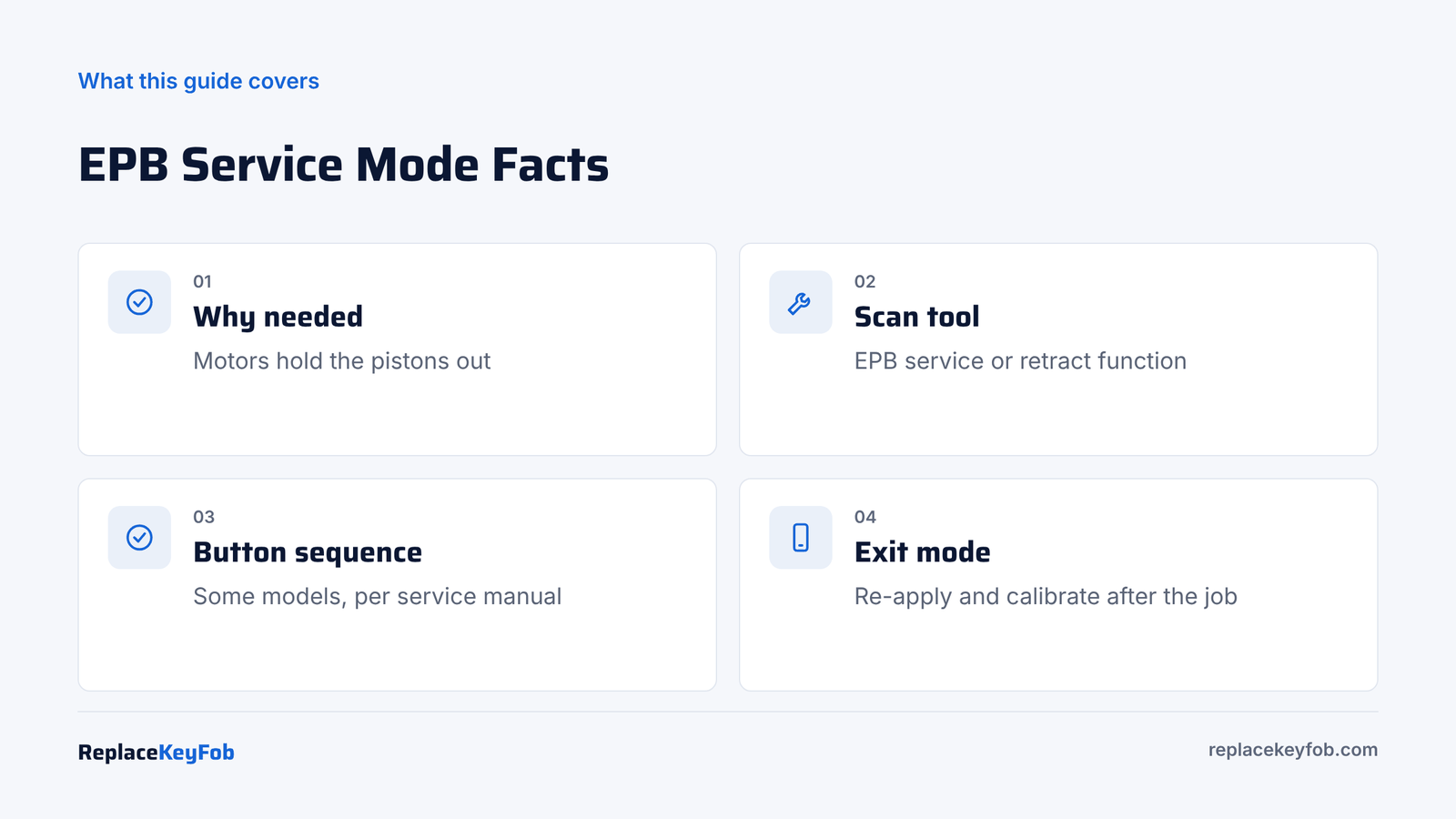
Why EPB Service Mode Matters
| Without service mode | With service mode |
|---|---|
| Piston will not compress | Spindle is fully retracted, piston compresses |
| Motor or spindle can strip | No load on the motor |
| EPB may apply while you work | System is locked out until you exit |
| Calibration lost, warning lights | Clean exit and calibration afterward |
Cars that use an EPB include many models from Volkswagen, Audi, BMW, Mercedes-Benz, Volvo, Ford, GM, Honda, Hyundai, Kia, Nissan, Subaru and Toyota, especially from the mid-2010s onward. If your car has a parking brake switch instead of a lever or pedal, it has an EPB.
What You Need
- A scan tool with EPB or electronic parking brake functions for your make
- Wheel chocks, a floor jack and jack stands
- A brake caliper piston tool (straight-push type for most EPB calipers)
- New pads and, if needed, rotors
- Brake cleaner, high-temperature brake grease
- A torque wrench and the caliper bolt specs from service data
- A battery maintainer if your scan tool session will be long
Scan tool with EPB service function
Choose a scanner that lists EPB service or electronic parking brake retract for your make and model. Many mid-range scanners include EPB, oil reset and SAS functions together.
As an Amazon Associate, ReplaceKeyFob earns from qualifying purchases.
See our guide to the best OBD2 scanner with EPB reset. Many of these tools work through bidirectional control; what is bidirectional control on a scan tool explains how.
Step 1: Prepare the Car
- Park on level ground and put the transmission in Park.
- Chock both front wheels securely. Once the EPB is in service mode, it will not hold the car.
- Release the electronic parking brake with the switch.
- Turn off auto-hold and any automatic parking brake setting if your car has one.
- Make sure the battery is healthy. Low voltage can cause the EPB motors to stop part way. Connect a maintainer if needed.
Step 2: Enter Service Mode With a Scan Tool
- Plug the scan tool into the OBD2 port and turn the ignition on (engine off unless the tool says otherwise).
- Select your vehicle, then open the EPB, parking brake or brake module. On some cars it sits under ABS.
- Choose “Service mode”, “Maintenance mode”, “Brake pad replacement” or “Retract”.
- Follow the prompts. You will usually hear the rear motors run for a few seconds as they wind back.
- Confirm the tool reports service mode is active. Many cars show a flashing parking brake light or a message.
Why the ignition must stay on for some tools: some systems exit service mode on their own if power is cycled. Follow your tool’s instructions about keeping the key on.
Without a Scan Tool: Manual Sequences
Some vehicles have a built-in maintenance mode that you enter with a combination of the ignition, brake pedal, accelerator and parking brake switch. The exact sequence and timing vary by model and year and are listed in the owner’s manual or service manual. Do not guess, because a wrong sequence may do nothing or may apply the brake.
On some caliper designs, the EPB motor can be unbolted from the caliper and the spindle turned back by hand. This is a last resort, applies only to certain designs and still usually requires a calibration afterward. If your car does not list a manual method, use a scan tool or a shop.
Step 3: Do the Rear Brake Job
- Loosen the rear lug nuts, raise the car and support it on jack stands.
- Remove the wheels.
- Unplug the EPB motor connector only if your service procedure says to; on many cars you leave it connected.
- Remove the caliper guide bolts and swing or lift the caliper off.
- Push the piston straight back with a piston tool. On most EPB calipers, the piston pushes straight in. Some designs need to be turned while pushed; check before forcing anything.
- Replace the pads and rotors if needed, clean and lubricate the slide pins, and fit the caliper.
- Torque the bolts to the specification in your service data.
- Repeat on the other side.
- Refit the wheels and lower the car.
Why check piston style: older rear calipers with a mechanical cable often had screw-in pistons. Most EPB calipers use a straight-push piston, and turning it can damage the seal.
Step 4: Exit Service Mode
- Turn the ignition on and reconnect the scan tool if needed.
- Choose “Exit service mode”, “Apply” or “Close” in the EPB menu.
- The motors run out until the pads contact the rotor.
- Run any calibration or “pad replacement” step the tool offers so the system learns the new pad thickness.
- Press the brake pedal firmly several times to seat the pistons before driving.
- Apply and release the parking brake with the switch a few times. The warning light should go out.
Step 5: Test the Parking Brake
- On a gentle slope, apply the EPB and confirm it holds the car.
- Release it and drive slowly, checking for drag or noise.
- Bed in the new pads with several moderate stops from about 30 to 40 mph.
If Something Goes Wrong
| Problem | Likely cause | Fix |
|---|---|---|
| Motors will not retract | Low battery voltage or wrong module | Charge battery, select the right module |
| EPB warning light after the job | Service mode not exited or calibration skipped | Exit service mode and calibrate |
| Piston will not compress | Spindle not retracted, or seized caliper | Re-enter service mode; inspect caliper |
| Parking brake does not hold | Not calibrated, contaminated pads | Calibrate, clean or replace pads |
| Grinding noise from rear motor | Motor gear stripped | Replace the EPB motor |
If the ABS light also came on during the job, see how to reset the ABS light.
Safety and Mistakes to Avoid
- Never rely on the EPB while in service mode. Chock the wheels.
- Never force a piston back with a C-clamp while the EPB is still applied or the motor is not retracted.
- Do not apply the parking brake with a caliper removed. The piston can pop out.
- Do not disconnect the battery mid-procedure unless the procedure tells you to.
- Check brake fluid level after compressing pistons. Fluid rises in the reservoir.
Cost
| Job | Typical 2026 US cost |
|---|---|
| Rear pads only, shop, EPB car | About $200 to $400 |
| Rear pads and rotors, EPB car | About $350 to $700 |
| EPB caliper motor replacement | About $250 to $700 per side |
| EPB service mode only (if you do the job) | Often about $30 to $80 at a shop |
A scanner with EPB functions often costs less than one shop visit and also covers oil reset and battery registration; see how to register a car battery with a scan tool.
Frequently Asked Questions
Chock the wheels, release the parking brake, then use a scan tool with an EPB function to select service or maintenance mode. The rear motors wind back so the pistons can be compressed. Some models also have a manual sequence listed in the service manual.
Sometimes. Some models offer a built-in maintenance mode or allow the motor to be removed and the spindle turned back by hand. Many cars need a scan tool, and forcing the piston without retracting can break the motor.
On many cars, yes. Exiting service mode and running the calibration lets the system learn the new pad thickness and clears warning lights.
Service mode was not exited, the calibration was skipped, or a motor connector was left unplugged. Reconnect everything, exit service mode with the scan tool and calibrate.
Yes, as long as the wheels are chocked and the car is securely supported on jack stands, because the parking brake will not hold the car while in service mode.