
How to Recycle an Old Car Battery (and Get the Core Charge)

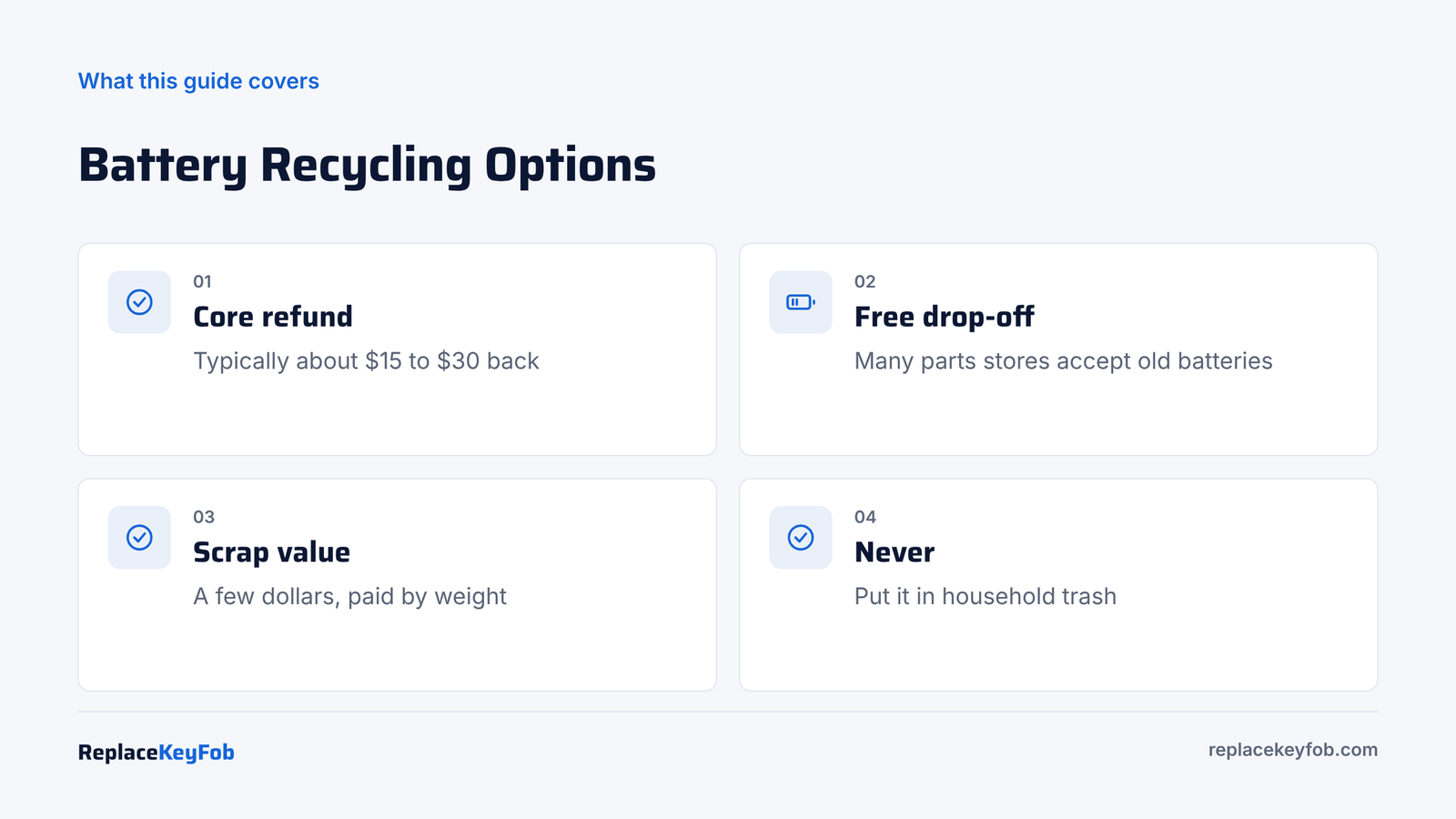
To recycle a car battery, take it back to the store where you bought the new one to get your core charge refunded, usually about $15 to $30. You can also drop it off free at most auto parts stores, a municipal hazardous waste site or a scrap yard, which may pay a few dollars by weight. Carry it upright in a plastic tub and never put it in the trash.
A dead car battery is not trash. Lead-acid batteries contain lead, sulfuric acid and plastic, and all three can be recovered. In the US they are among the most recycled consumer products, with an industry-reported rate of about 99 percent. That success is mostly thanks to the core charge system and state laws that require stores to take old batteries back.
Recycling is easy, often free, and can put money back in your pocket. This guide covers every option, how the core charge works, how much scrap yards pay, and how to move a heavy, acid-filled battery safely. If you are replacing your battery yourself, our guide on how to install a new car battery covers the swap itself.
Where to Recycle a Car Battery
| Option | What you get | Notes |
|---|---|---|
| Return to the store where you bought the new one | Core charge refund, typically about $15 to $30 | Bring the receipt; time limits may apply |
| Any major auto parts store | Free drop-off; some offer a store credit or gift card | Call ahead for current policy |
| Big-box stores and warehouse clubs that sell batteries | Usually accept old batteries, often with a purchase | Policies vary |
| Municipal household hazardous waste site | Free disposal | Hours and rules vary by city |
| Scrap metal yard or battery recycler | Cash by weight | Usually a few dollars to about $15 per battery |
| Repair shop or dealer | Usually free when they install the new battery | They handle the core for you |
Many states require retailers that sell lead-acid batteries to accept used ones and to charge a core fee if you do not bring one back. Even if you did not buy from that store, most will take your old battery.
How the Core Charge Works
When you buy a new car battery, the store adds a refundable core charge to the price, commonly about $15 to $30. It exists to make sure the old battery comes back for recycling.
- Bring the old battery with you when you buy. The store waives the core charge immediately.
- Return it later. Bring the old battery and the receipt back within the store’s time limit, often 30 to 90 days, to get the refund.
- Lost receipt? Some stores look up purchases by phone number or card. Others will still take the battery free but may not refund the core.
- Shop installed it? They usually keep the old battery and you pay no core charge.
If you are still shopping for a battery, compare prices with the core charge included. Our guide to car battery replacement cost shows typical totals.
Car Battery Recycle Price: What Scrap Yards Pay
Scrap yards and battery recyclers pay by weight, based on lead prices. A typical car battery weighs about 30 to 50 pounds, so payouts are usually a few dollars to about $15. Truck and commercial batteries are heavier and pay more. Prices move with the lead market, so call first.
A store core refund almost always pays more than scrap for a single battery. Scrap makes sense if you have several old batteries and no receipts.
Battery Carrier Strap or Lifting Clamp
A carrier strap or lifting clamp makes a 40 pound battery easier to lift without tipping, and keeps your hands away from the case and posts.
As an Amazon Associate, ReplaceKeyFob earns from qualifying purchases.
How to Recycle a Car Battery Safely
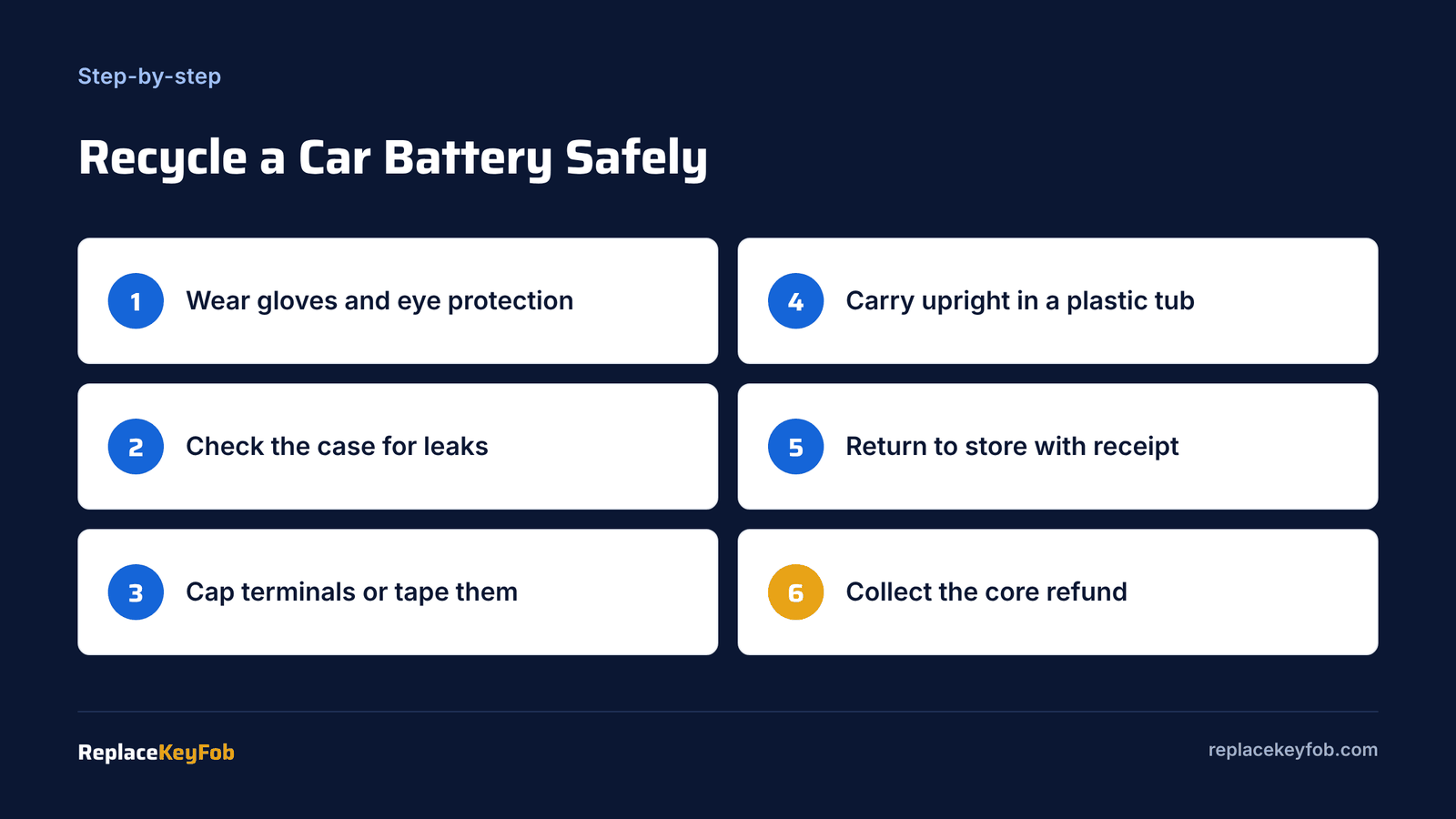
- Wear gloves and safety glasses. Old batteries often have acid residue on the case and terminals.
- Remove the battery properly. Disconnect the negative cable first, then the positive. See how to disconnect a car battery safely.
- Inspect the case. Look for cracks, bulges or leaks.
- Neutralize any residue. Wipe the top with a baking soda and water mix, then dry it.
- Cover the terminals. Use plastic caps or tape so the posts cannot touch metal or each other.
- Keep it upright. Place it in a sturdy plastic tub or a heavy plastic bag inside a box.
- Secure it in the car. Put it on the floor of the trunk or cargo area where it cannot slide or tip. Do not carry it on a seat.
- Take it to the drop-off point and bring the receipt if you want a core refund.
Why terminals get covered
A battery can still deliver a dangerous short-circuit current even when it is too weak to start a car. If the posts touch a wrench, a jack or another battery, they can spark and get very hot. Taped or capped posts prevent that.
Leaking, Cracked or Swollen Batteries
- Do not try to transport an actively leaking battery in an open box. Put it in a heavy plastic tub or acid-resistant container.
- Neutralize spills on the ground or tray with baking soda before cleaning.
- Swollen batteries may have been overcharged; handle them gently and keep them away from heat and sparks.
- Call ahead. Some stores prefer you bring damaged batteries to a hazardous waste site instead.
If you find corrosion on the terminals of the car after removal, clean it before fitting the new battery; see battery terminal corrosion.
Recycling Other Vehicle Batteries
| Battery | Where it goes | Notes |
|---|---|---|
| Motorcycle, ATV, lawn tractor lead-acid | Same as car batteries | Often a smaller core charge |
| AGM and EFB | Same as car batteries | They are lead-acid inside |
| 12V lithium (LiFePO4) | Battery recycler or retailer that sells lithium | Not accepted everywhere; tape terminals |
| Hybrid high-voltage battery | Dealer or specialist recycler | Often has a large core value; never DIY |
| EV traction battery | Dealer or manufacturer program | High voltage; handled by trained staff |
| Key fob coin cells | Electronics or battery drop-off bins | Tape the cell before dropping off |
For small coin cells from key fobs, our lithium coin battery guide explains safe storage and disposal.
What Happens to Your Old Battery
Recyclers break the battery apart. The lead is melted and refined into new battery plates. The plastic case is ground up and turned into new cases. The acid is neutralized into water or converted into sodium sulfate for use in products like detergent. Most new lead-acid batteries contain a large share of recycled material.
Recycling When Someone Else Replaces the Battery
- Mobile battery service: the technician usually takes the old battery with them. Ask whether the core credit is included in the price.
- Roadside assistance: many services that sell and install batteries on the spot handle the old one too.
- Dealer or independent shop: they keep the core and recycle it. The core charge is usually already netted out of your bill.
- Buying online: if you order a battery for home delivery, the core charge may be added, and you will need to return the old battery to a partner store or ship it according to the seller’s rules. Read the policy before ordering, because shipping a lead-acid battery yourself is not simple.
How Many Old Batteries Can You Drop Off?
Most stores accept one or two household batteries at a time without question. If you are clearing out a garage with several old batteries, call ahead. Some stores limit the number, and a scrap yard or battery recycler is often a better fit for larger loads. Keep each battery upright, separated so terminals cannot touch, and secured during the trip.
Mistakes to Avoid
- Throwing it in the trash or dumpster. It is illegal in many states and harmful to the environment.
- Storing it on a concrete floor for years. Old batteries can leak; recycle them promptly.
- Carrying it by the posts. You can crack the seal. Use the handle or a carrier.
- Laying it on its side. Even “sealed” batteries can leak through vents.
- Throwing away the receipt. That is your core refund.
Do You Need a New Battery at All?
Before recycling, make sure the battery is actually dead. A battery that just ran flat can often be charged and reused. Test it first; see how to test a car battery with a multimeter. If it is under warranty, check car battery warranty before turning it in, since the store may need it for the claim.
Frequently Asked Questions
Most auto parts stores, many big-box stores that sell batteries, and municipal hazardous waste sites accept old car batteries free.
A store core refund is typically about $15 to $30. Scrap yards pay by weight, usually a few dollars to about $15 per car battery, depending on lead prices.
Usually yes. Some stores can look up your purchase, but without proof you may only get free disposal.
No. Lead-acid batteries are hazardous waste, and trash disposal is illegal in many states. Recycle it instead.
Keep it upright in a plastic tub, cover the terminals, and secure it on the trunk or cargo floor so it cannot tip or slide.