
How to Remove a Broken Key From a Car Door Lock

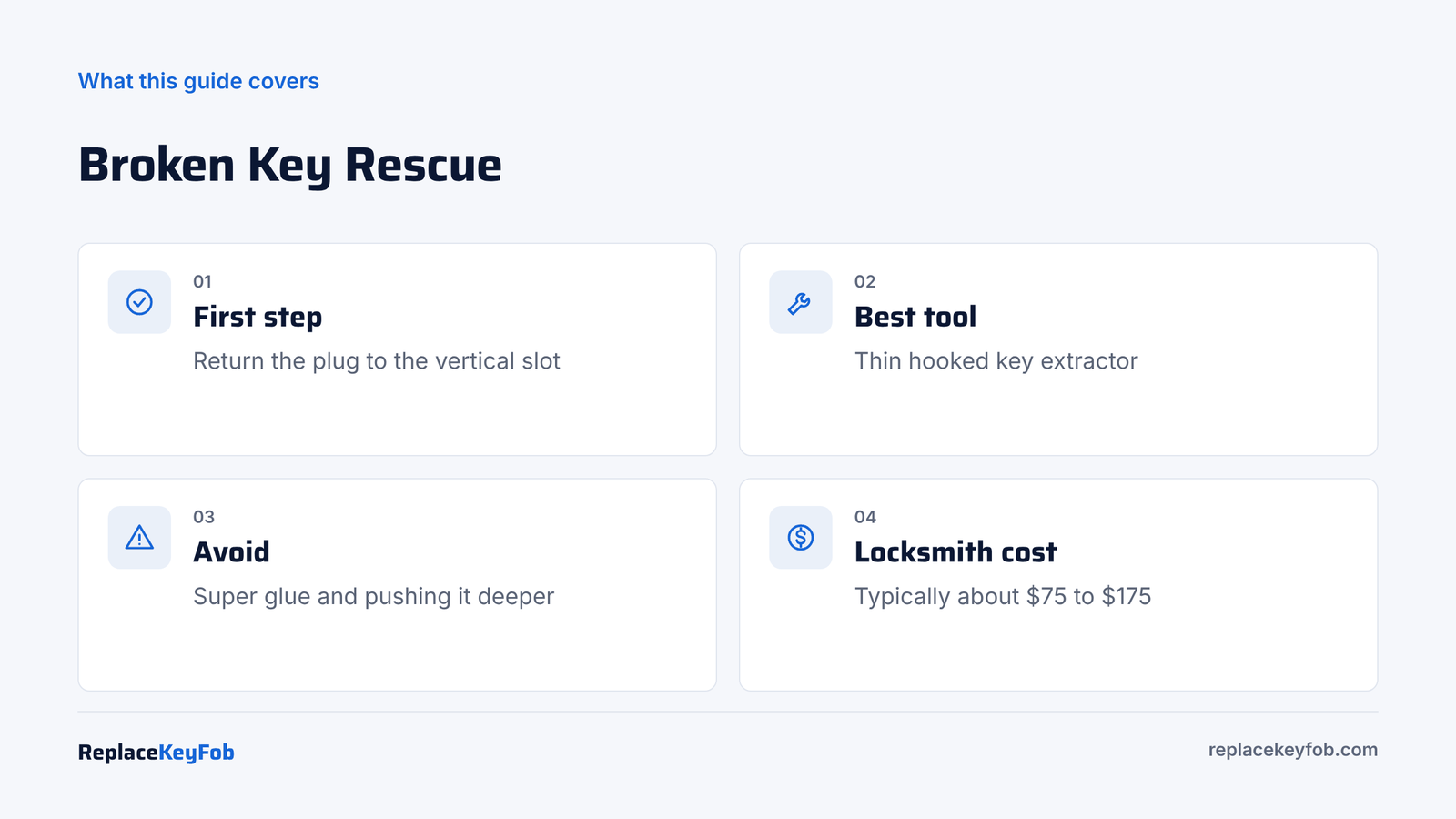
To remove a broken key from a car door lock, turn the lock plug back to its vertical insert position, spray dry lube into the keyway, then slide a thin hooked extractor along the cut side of the blade, hook a cut and pull straight out. Never push it deeper or use super glue.
A key snapping off in a car door lock usually happens at the worst time: in the cold, in a hurry, while forcing a frozen or worn lock. The good news is that most broken pieces come out cleanly with the right tool, and the lock is often fine afterward.
The way you start matters. Pushing the broken piece deeper, prying at it with a screwdriver or filling the keyhole with glue turns a 10-minute job into a cylinder replacement. Take a breath, and remember that if your car has a working remote, you can still get in while you deal with the lock.
First: Check Your Situation
| Situation | What to do first |
|---|---|
| Remote or smart key still works | Unlock with the fob; the broken key can wait |
| Piece sticks out of the lock | Tweezers or needle-nose pliers |
| Piece flush or recessed | Key extractor tool |
| Plug turned partway when it snapped | Turn plug back to vertical first |
| Key snapped in a frozen lock | Thaw the lock before extracting |
| Both pieces in hand, key worn | Get a new key cut by code, not copied |
If the lock was frozen when the key broke, thaw it with lock de-icer first, as explained in how to unfreeze car door locks. Extracting a key from frozen wafers will not work and can break the extractor.
Why Car Keys Snap in Door Locks
Knowing why it happened helps you stop it happening again:
- Forcing a frozen lock. Ice holds the wafers, and turning hard puts all the force on the thin blade.
- A worn key. Years of use thin the blade at the shoulder, right where it enters the lock.
- A bent key. A key that has been bent and straightened has a weak spot that cracks later.
- A sticky cylinder. Dirt and old grease make the plug hard to turn, so you twist harder.
- Heavy keychains. On older cars where the same key fits the ignition, a heavy bunch of keys stresses the blade every time you drive.
- Using the key as a tool. Prying open boxes or packages leaves small cracks in the blade.
If two or more of these apply to you, replace the spare key too, and clean and lube the lock before you use it again.
Why the Plug Position Matters
Car door locks only let the key in and out when the plug is in its straight, insert position. If the key snapped while you were turning it, the plug may be rotated. The wafers then clamp the broken piece and nothing will pull it out.
To turn it back, use the stub of the broken key if a little sticks out, or insert a thin flat screwdriver or a tension tool into the keyway beside the piece and gently rotate the plug back to vertical. Do not force it; if it will not move, the wafers are holding it and a locksmith can help.
Tools That Work
- Broken key extractor set: thin steel blades with small hooks or barbs. The best tool for this job.
- Fine jigsaw blade: a thin, fine-tooth blade, snapped short, works as an improvised extractor. The teeth must point outward so they grab the key on the way out.
- Tweezers or needle-nose pliers: only if part of the key sticks out.
- Dry lube or lock spray: helps the piece slide.
- Flashlight and magnifier: to see the key’s cut side.
Broken key extractor set
A small set of thin steel broken key extractors with hooked and spiral tips handles most car door and house locks. Pick a set that includes very thin blades for wafer locks.
As an Amazon Associate, ReplaceKeyFob earns from qualifying purchases.
Step-by-Step: Remove the Broken Key
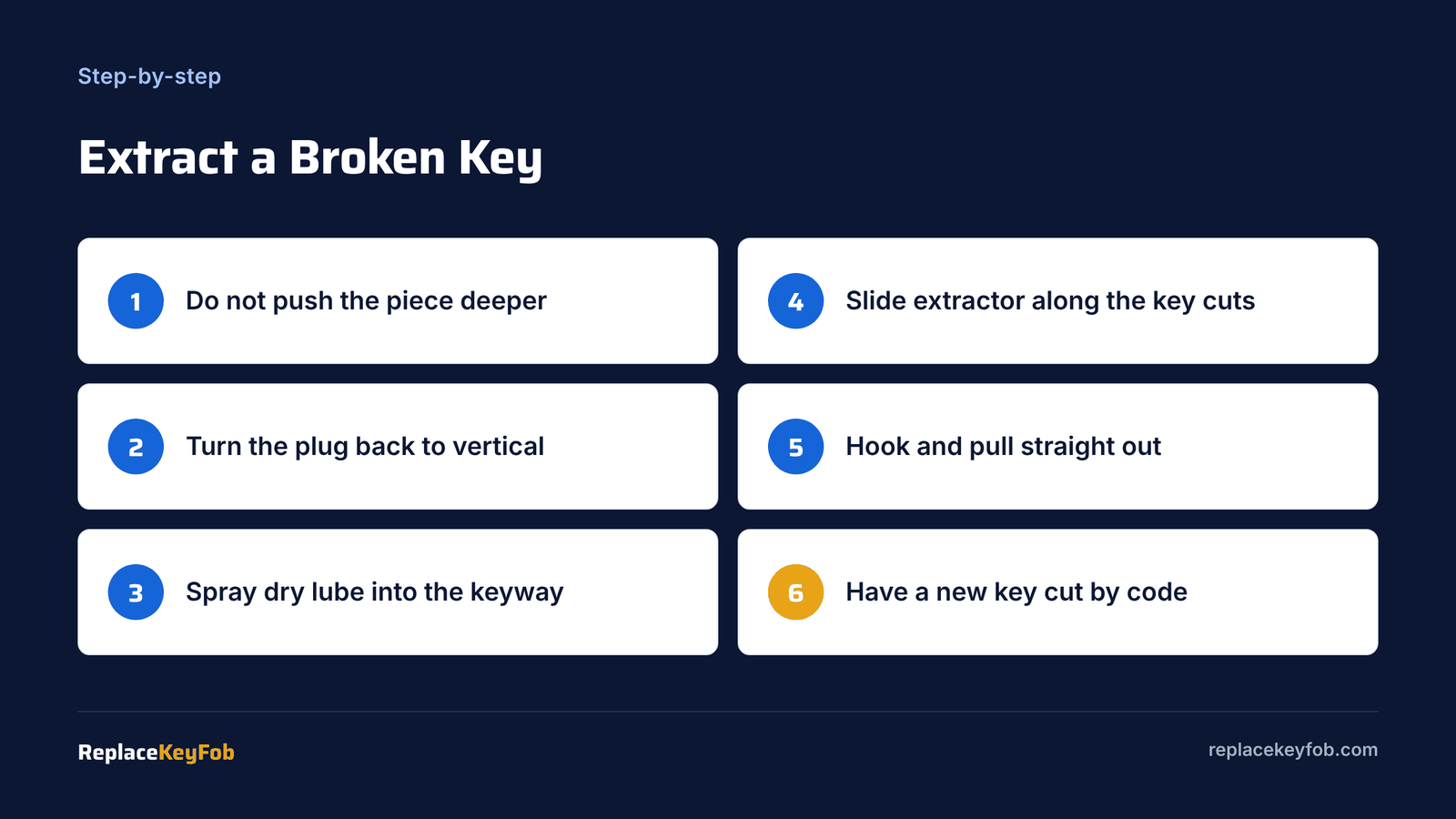
- Stop pushing. Do not try to insert the other half of the key or any tool straight into the center. That pushes the piece deeper.
- Line up the plug. Turn the plug back to the vertical insert position as explained above.
- Lubricate. Spray a short burst of dry PTFE or lock spray into the keyway. It reduces friction on the wafers.
- Find the cut side. Look into the keyway with a flashlight. On a traditional edge-cut key, the cuts face up or down. On a laser-cut (sidewinder) key, the cuts run along a groove in the flat face of the blade.
- Insert the extractor along the cuts. Slide the extractor in along the cut edge of the broken piece, with the hook facing the key. Go past one or two cuts.
- Rotate slightly and hook. Turn the extractor a little so the hook catches a cut on the broken blade.
- Pull straight out. Pull slowly. The piece should move out a few millimeters at a time. Repeat as needed.
- Use two extractors if needed. One on each side of the blade can pinch the piece and pull it out evenly.
- Finish with tweezers. Once enough sticks out, grab it with tweezers or pliers and pull straight.
Why go along the cuts
The cuts on the key give the hook something to grab. Sliding along the smooth side of the blade just slips. On sidewinder keys, the groove serves the same purpose.
After the Key Is Out
- Test the lock with a spare key. Turn it gently both ways.
- Lube it with dry graphite and work the spare key in and out.
- Inspect the broken key. If it broke because it was worn or bent, the lock may also be worn.
- Get a new key. A worn key that snapped will have a worn copy too.
Getting a replacement key
- Cut by code: a dealer or automotive locksmith can often look up your key code by VIN with proof of ownership and cut a fresh key. This is the best option for a worn key.
- Duplicate from pieces: a locksmith can often duplicate from both broken halves held together, if they are not badly worn.
- Transponder or remote keys: if the broken key contained a chip or remote, the new one will need programming for the ignition. See how to get a spare key fob.
- Smart key emergency blades: if the hidden blade from a smart key snapped, the fob still works. Order a new blade by code from the dealer or a locksmith.
Variations by Vehicle and Key Type
- Older edge-cut keys: easiest to extract, with clear cuts on top and bottom.
- Laser-cut keys: harder; the extractor must follow the groove. A locksmith may be faster.
- Hidden keyhole under a handle cap: you may be able to remove the cap and cylinder from the door to work on it at a bench. See how to replace a car door lock cylinder.
- Broken key in the ignition: a different job with different risks, especially on cars with steering locks. Our ignition lock cylinder guide covers that.
Troubleshooting
| Problem | Likely cause | What to do |
|---|---|---|
| Extractor slips every time | Hooking the smooth side | Rotate to the cut side |
| Piece moves, then stops | Plug not fully vertical | Re-center the plug |
| Piece will not move at all | Wafers clamping it, or lock frozen | Lube, thaw, or call a locksmith |
| Key out but spare will not turn | Wafer damaged or debris inside | Flush lock; may need rekey or new cylinder |
| Extractor broke in the lock | Too much force | Locksmith needed |
Mistakes to Avoid
- Super glue. It can bond the key to the wafers and ruin the cylinder.
- Pushing the other half in. It shoves the broken piece deeper.
- Prying with a screwdriver. You will damage the keyway and shutter.
- Forcing a frozen lock. Thaw first.
- Copying the worn key. The new copy will break the same way.
When to Call a Locksmith
Call an automotive locksmith if the piece is deep and flush, if the key is laser-cut, if the plug is stuck rotated, or if you need a new transponder key on the spot. Typical 2026 US costs are about $75 to $175 for key extraction, often less if a new key is cut on the same visit, and about $10 to $90 for a new mechanical key cut by code. See our locksmith guide for what to ask before booking. If the lock was sticking before the key broke, read how to fix a sticky car door key lock so it does not happen again.
Frequently Asked Questions
Yes. In most cases a thin hooked extractor pulls it out without damaging the lock, as long as the plug is in the vertical insert position.
A thin, fine-tooth jigsaw blade with the teeth pointing outward can work. Tweezers or needle-nose pliers work if part of the key sticks out.
No. Glue often runs into the wafers and bonds the key to the lock, which can force you to replace the cylinder.
Typically about $75 to $175 in 2026, depending on time of day and key type. Many will cut a new key during the same visit.
If the ignition key is separate or you have a working spare or smart key, yes. Remove the broken piece soon, so the door lock still works when you need it.