
How to Reset the Battery Warning Light (and When You Should Not)

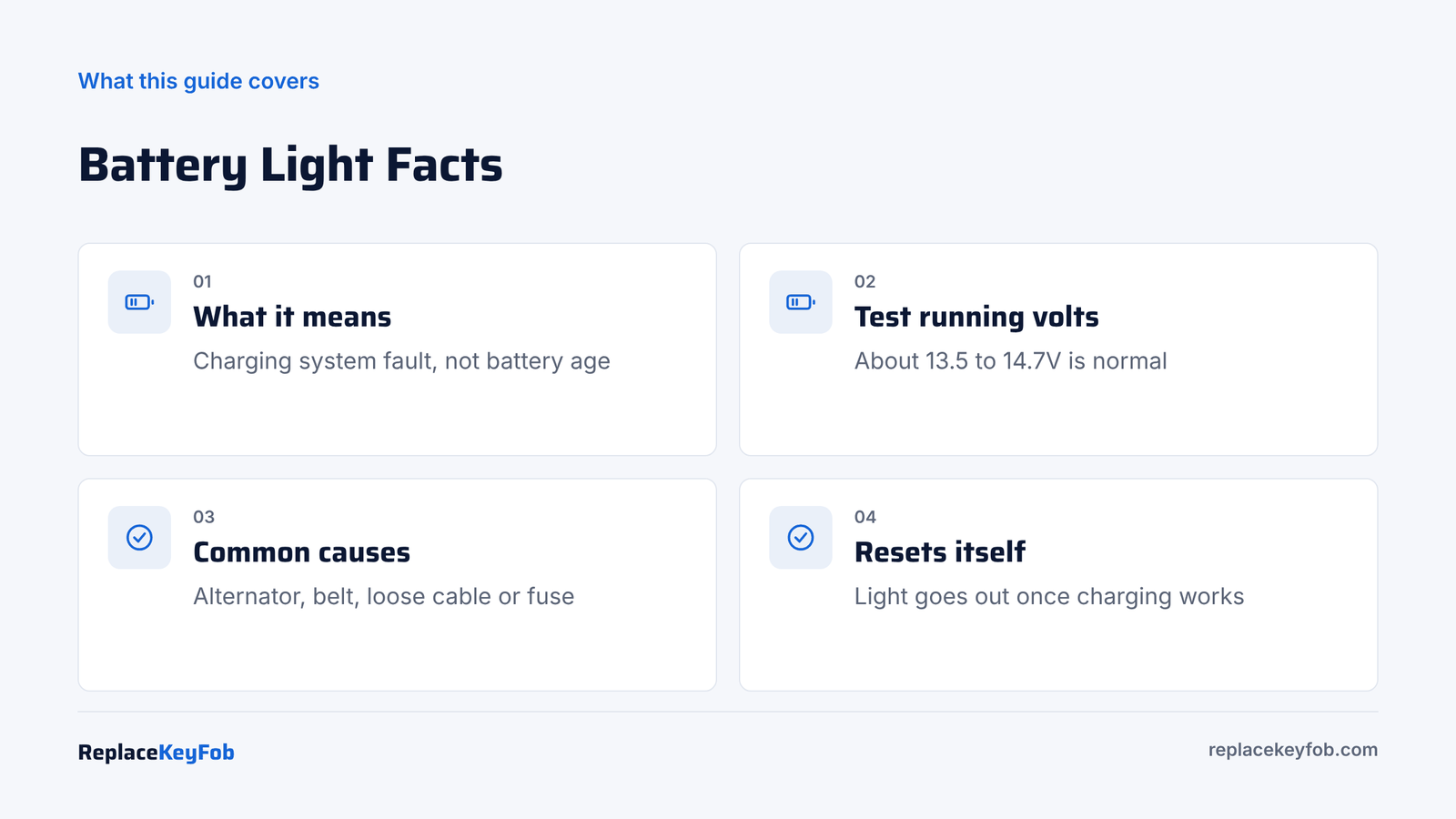
To reset the battery light, fix the charging fault that triggered it. The light means the alternator is not charging properly, so check the drive belt, battery cables and alternator. With the engine running, a healthy system reads about 13.5 to 14.7 volts. Once charging is restored, the light goes out on its own after a restart; there is usually nothing to reset.
The red battery-shaped light on the dashboard is one of the most misread warnings. It does not mean “your battery is getting old”. On almost every car, it means the charging system has a problem: the alternator is not producing enough voltage, the belt that drives it is slipping or broken, or a wire between them has failed.
If you keep driving, the car runs on the battery alone until it goes flat, usually within 30 minutes to a couple of hours depending on what is switched on. This guide shows how to find the cause quickly, what the light means on different cars, and when a true “reset” is needed.
What the Battery Light Means
When you turn the key to ON, the battery light should come on as a bulb check, then go out once the engine starts and the alternator begins charging. If it stays on, flickers, or comes on while driving, the car’s computer has seen a charging problem.
| Light behavior | Likely cause |
|---|---|
| On steadily while driving | Alternator not charging, broken belt, blown alternator fuse |
| Flickers at idle, goes out with revs | Worn alternator, slipping belt, loose connection |
| On with a squeal from the engine | Slipping serpentine belt |
| On with dim lights and warning chimes | Battery voltage falling fast; alternator failed |
| On after a battery replacement | Loose clamp, wrong battery, or battery not registered |
| On with steering suddenly heavy or engine hot | Belt broken: stop safely |
On cars where one belt drives the water pump and power steering, a broken belt can also overheat the engine. If the temperature gauge climbs, pull over.
What You Need
- A digital multimeter or an OBD2 scanner with voltage data
- A flashlight
- A 10mm or 13mm wrench for battery clamps
- Optional: a battery and alternator tester
Battery and alternator tester
A 12V tester that checks battery health, cranking and charging voltage in one plug-in takes the guesswork out of a battery light.
As an Amazon Associate, ReplaceKeyFob earns from qualifying purchases.
You can also read battery voltage through the OBD2 port; see how to check battery voltage with an OBD2 scanner.
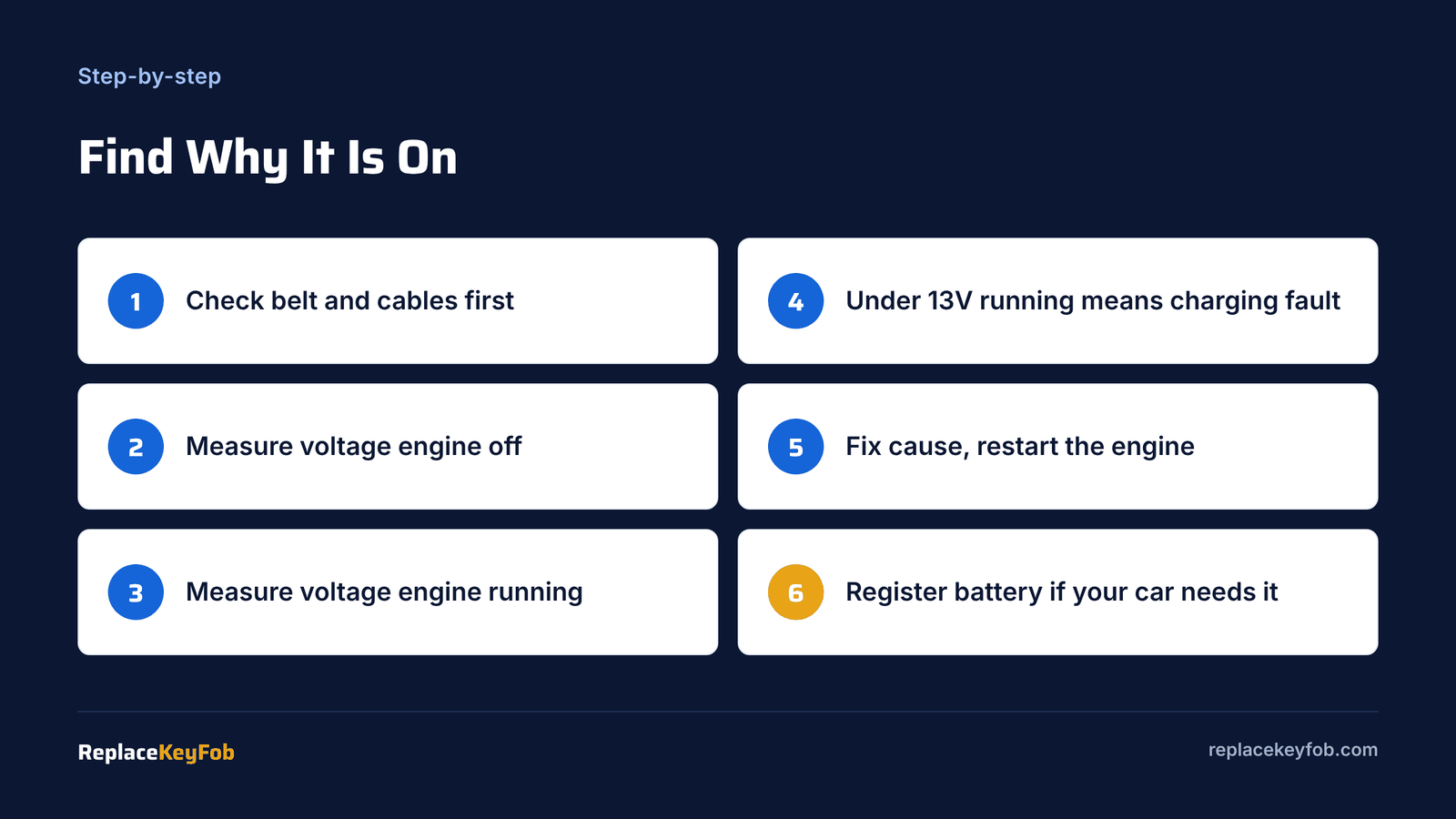
Step 1: Look Before You Test
- Open the hood with the engine off.
- Check the serpentine belt. Is it there, tight and free of cracks, shiny glazing or fraying?
- Twist both battery clamps by hand. Any movement means they need tightening.
- Look for white or green corrosion on the terminals; clean it as shown in battery terminal corrosion.
- Follow the thick wire from the alternator’s output stud. It should be tight with no melted insulation.
A surprising number of battery lights come from a loose clamp or a corroded ground strap.
Step 2: Measure the Voltage
- Engine off, lights off: put the multimeter on DC volts across the battery posts. About 12.4 to 12.7V is a charged battery. Under 12.2V means it is low.
- Start the engine. With everything off, read again. A working alternator usually shows about 13.5 to 14.7V.
- Turn on the headlights, blower and rear defroster. The voltage should stay above about 13V.
Why the numbers matter: if the running voltage is no higher than the engine-off voltage, the alternator is not charging. If it is over about 15V, the regulator is overcharging, which can damage the battery and electronics.
Some newer cars use “smart charging” and may let voltage drop to about 12.5 to 13V at times to save fuel. If your readings are borderline and the light is on, a proper alternator test is the next step; see how to test an alternator with a multimeter or test an alternator with an OBD2 scanner.
Step 3: Fix the Cause
| Finding | Fix |
|---|---|
| Loose or corroded battery clamp | Clean and tighten; light often goes out at once |
| Broken or slipping belt | Replace belt and check the tensioner |
| Low running voltage, belt fine | Check alternator fuse, then the alternator itself |
| Corroded alternator plug or ground | Clean, reconnect, retest |
| Alternator tests bad | Replace alternator |
| Battery fails a load test | Replace battery, then recheck charging |
Once the fault is fixed, turn the engine off, wait a few seconds and restart. On almost every car, the battery light goes out by itself as soon as the computer sees normal charging voltage. There is no button or menu to reset it.
How to Reset Battery Light on Dashboard After a New Battery
If the light came on right after a battery change, check these:
- Clamps: a clamp that looks tight but turns by hand is the most common cause.
- Battery type: fitting a flooded battery where the car needs AGM (most start-stop cars) can trigger warnings.
- Battery registration: many BMW, Mini, Audi, Volkswagen, Mercedes and some Ford, GM and Volvo models use a battery management system. After a new battery, the car should be told so it adjusts charging. Some show a warning until it is done. Follow how to register a car battery with a scan tool.
- Start-stop warnings: some cars disable start-stop and show a battery message until the new battery has been registered or the car has completed several drive cycles.
After the battery is reconnected, you may also need to reset the radio code, power windows and clock; see radio code after battery change.
Porsche 996 and Other Older European Cars
On older Porsche models such as the 996-generation 911 (built around 1998 to 2005), the red battery or charge light behaves like on other cars: it means the alternator or its voltage regulator is not charging, or the alternator belt has a problem. It goes out once charging is restored. Many owners of these cars also use a battery maintainer when the car sits, since a weak battery makes charging faults harder to diagnose.
Disconnecting the Battery to Reset Lights
Disconnecting the battery for 15 minutes or more clears many engine codes on older cars and turns off the check engine light until the fault returns. It does not fix a battery light, because the charging fault is still there. On newer cars, it can also wipe learned idle and window settings. If you do disconnect it, follow how to disconnect a car battery safely: negative cable off first, on last.
Can You Keep Driving?
Only as far as you must. With the battery light on:
- Turn off the radio, A/C, heated seats and other loads.
- Drive directly home or to a shop. A healthy battery may last 30 minutes to a couple of hours at night with the headlights on, often less.
- Avoid turning the engine off if you are unsure it will restart.
- Stop at once if the temperature gauge rises or steering becomes heavy, since the belt may have broken.
Mistakes to Avoid
- Replacing the battery first. A new battery goes flat just as fast if the alternator is dead.
- Disconnecting the battery with the engine running to “test” the alternator. This old trick can damage modern electronics.
- Ignoring a squeal. A slipping belt is cheap to fix before it breaks.
- Overtightening battery clamps and cracking the post.
When to Call a Pro and What It Costs
| Repair | Typical 2026 US cost |
|---|---|
| Charging system test | Free at many parts stores, about $50 to $100 at a shop |
| Serpentine belt | About $100 to $250 installed |
| Belt tensioner | About $150 to $400 installed |
| Alternator replacement | About $400 to $1,000 installed |
| New battery installed | About $150 to $400 |
| Battery registration | About $50 to $150 at a shop |
Frequently Asked Questions
Fix the charging fault, such as a loose clamp, broken belt or failed alternator, then restart the engine. The light goes out on its own once the alternator charges normally. There is no reset button on most cars.
Usually not. The battery light on most cars means the charging system has a problem, most often the alternator, belt or a connection. A weak battery rarely turns it on by itself.
Check that both clamps are tight and clean, that the battery type matches (AGM if the car came with one), and whether your car needs the new battery registered with a scan tool.
On many older cars, disconnecting the battery for 15 minutes or more clears engine codes and the check engine light, but the light returns if the fault is still there. It does not fix a battery light.
Often 30 minutes to a couple of hours, depending on battery condition and electrical load. Turn off accessories and drive directly to a safe place or a shop.