
How to Diagnose a Faulty Key Fob: A Practical Troubleshooting Guide

When a key fob stops working, it’s easy to assume the fob is dead. In practice, the problem could be as simple as a weak battery, or it could be the car’s receiver, the vehicle battery, or a damaged circuit board inside the fob. The fastest way to save time and money is to test the likely causes in a logical order instead of guessing.
What a Faulty Key Fob Usually Looks Like
A failing key fob usually gives warning signs before it quits completely. The most common ones are weak range, intermittent response, buttons that only work when pressed hard, or a fob that unlocks the car only after several tries.
A simple example: if your fob used to work from across the driveway but now only works when you’re standing beside the driver’s door, that often points to a weak battery or reduced signal strength. If one button works and another does not, the issue may be worn button contacts rather than a dead battery.
Here’s a quick way to think about the symptoms:
| Symptom | More likely cause | What to try first |
|---|---|---|
| Shorter range than usual | Weak fob battery, interference, or aging electronics | Replace the battery and test nearby |
| Works only sometimes | Loose battery contact, worn buttons, internal damage | Inspect inside the fob and test a spare |
| No response at all | Dead battery, damaged fob, or vehicle-side issue | Replace battery, then test spare fob |
| Buttons need repeated presses | Worn contacts or failing circuit board | Open the fob and inspect for wear |
| Car won’t recognize push-button start | Fob battery, reprogramming issue, immobilizer problem | Try the spare fob and check the car battery |
If you want a broader repair-vs-replacement decision path after diagnosis, this guide on car key fob repair near me can help you compare your next steps.
Check the Easiest Cause First: Replace the Key Fob Battery
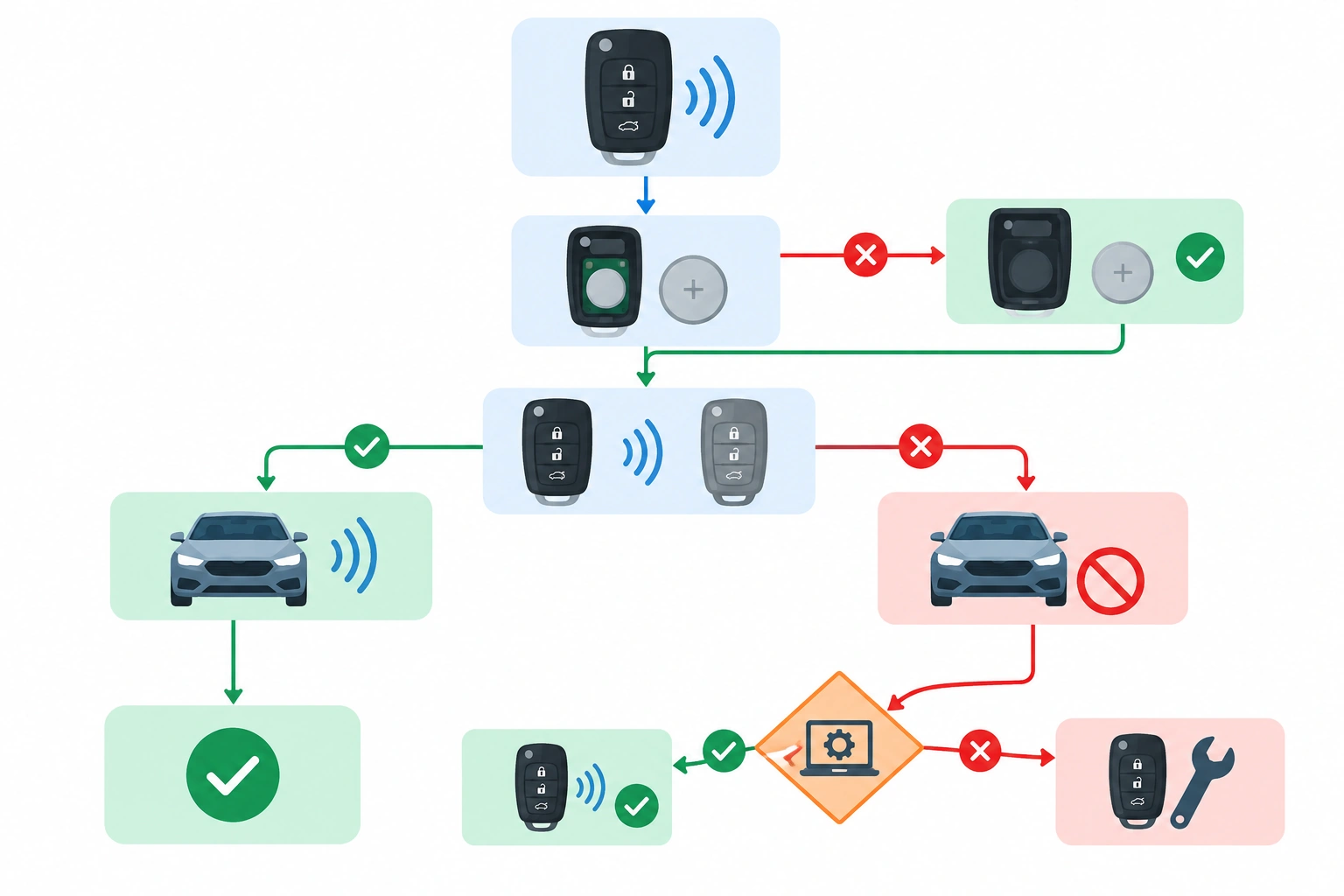
Replacing the battery is the simplest fix for most key fob issues. It’s also the best first test because a weak battery can mimic a broken fob.
Here’s the practical order I’d use:
- Open the fob carefully using the seam or release point designed for that model.
- Remove the battery and check for corrosion, leakage, or a loose fit.
- Match the replacement battery type exactly to the old one.
- Install the new battery with the correct polarity.
- Test the fob from a normal standing distance, not just right next to the car.
If the fob wakes up immediately after the battery change, that’s a strong sign the battery was the issue. If it still acts erratic, the battery may not have been the only problem.
One detail worth checking: if the battery contacts inside the fob are bent, dirty, or not pressing firmly against the battery, the fob can act dead even with a fresh battery. That’s why battery replacement and contact inspection should go together.
For a deeper look at contact-related problems, see our guides on key fob battery contacts not touching and key fob battery contact corrosion.
Inspect the Fob for Physical Damage and Worn Button Contacts
Once the battery is ruled out, inspect the fob itself. Visible damage matters because moisture, cracks, and corrosion can interrupt the signal or damage the internal board.
Look for:
- Cracked housing
- Water intrusion or fogging
- Green or white corrosion around the battery area
- Loose battery clips
- Buttons that feel mushy, sticky, or sunken
- Missing rubber pads or worn button labels
A fob that was dropped in water and now works only occasionally is a different case from a fob that simply needs a battery. Water exposure often causes unpredictable behavior because the internal board may be partially damaged, not fully dead.
Worn buttons are another common clue. If one button works better than the others, the issue may be the contact pad or button dome rather than the battery. That kind of failure often starts as “works if I press it hard enough” and gets worse over time.
Use a Spare Key Fob to Isolate the Problem
Testing a spare key fob is one of the fastest ways to separate a fob problem from a vehicle problem.
If the spare works normally and the main fob does not, the problem is likely in the original fob. If both fobs fail in the same way, the issue is more likely with the car, the receiver, the vehicle battery, or the immobilizer system.
A useful rule of thumb:
- One fob fails, one works: suspect the bad fob
- Both fobs fail: suspect the vehicle
- Both fobs work poorly only in one location: suspect interference
This test matters because it keeps you from replacing a perfectly good fob when the vehicle is the real source of the problem.
Is the Fob Transmitting, or Is the Car Not Receiving It?
Before you assume the fob is dead, try to separate “no transmission” from “no reception.”
A simple way to do that is by watching how the car responds at different distances. If the fob works only when you are very close to the car, it may still be transmitting but with a weak signal. If it never triggers any response at any distance, the fob may not be transmitting at all, or the car may not be receiving it.
On some fobs, a phone camera can sometimes help you check an infrared transmitter if the model uses one. If you can see a light blink on the camera when you press the button, that suggests the fob is sending a signal. If there’s no visible blink and the battery is fresh, the fob itself may have an internal fault. Not all fobs use an infrared signal, so this test is only useful where applicable.
This distinction matters because a “dead” feeling can come from either side of the system: the fob may not be sending, or the car may not be reading what it receives.
Rule Out the Car Battery, Receiver, or Immobilizer System
If both fobs are acting up, don’t stop at the fobs. The vehicle itself may be the problem.
A weak car battery can cause strange remote entry behavior, especially on push-button start vehicles. Low voltage can interfere with the remote entry system and the immobilizer’s ability to recognize the fob correctly. If the dash lights are dim, the starter sounds sluggish, or other electrical systems are acting odd, the car battery deserves attention. In some cases, a dead 12V battery or low-voltage symptoms can make the car seem unresponsive even when the fob is fine.
The receiver or immobilizer can also be involved. If the car does not respond to either fob but the batteries inside both fobs are fresh, the issue may be on the vehicle side rather than the remote itself. In that case, the fob may be transmitting, but the car is not receiving or accepting the signal.
A practical way to read the symptoms is this:
- Fob works at close range but not normally: weak fob battery, interference, or reduced signal
- Neither fob works and the car has low-voltage symptoms: suspect the car battery or vehicle electronics
- Neither fob works but the car battery is healthy: suspect the receiver, immobilizer, or related vehicle-side fault
If the car still doesn’t recognize either fob after a fresh battery check on both sides, that’s a good point to stop guessing and get a proper diagnosis.
Check for Signal Interference or Temporary Environmental Issues
Sometimes the fob isn’t faulty at all — it’s just fighting interference.
If the fob works in one location but not another, think about nearby electronics, large metal structures, parking garages, or dense urban areas. Signal interference can make a healthy fob seem broken.
A real-world example: if your fob works in the driveway but not in an underground parking structure, the issue may be environmental rather than mechanical. That’s why it helps to test in an open area away from other electronics and see whether the behavior changes.
Temporary interference usually shows up as inconsistent range, not complete and permanent failure. If the problem disappears when you move the car or step away from the building, the fob may be fine.
Decide Whether the Fob Needs Reprogramming or Resyncing
If the battery is good, the fob has no obvious damage, and the car still doesn’t recognize it, reprogramming or resyncing may be the next step.
This is a reasonable next step when the fob still appears to transmit, but the car no longer accepts it after a battery change, a long period of inactivity, or an electrical event. It can also make sense if one fob stopped working while other fobs for the same car still operate normally.
Reprogramming is usually less likely to help when:
- The fob is cracked, corroded, or water-damaged
- The fob has intermittent button failure from worn contacts or a damaged board
- The car battery is weak or the vehicle has low-voltage symptoms
- Both fobs fail and the vehicle-side system seems to be the real issue
In other words, programming is worth trying when the fob seems structurally sound and the problem looks like a recognition issue. It is usually not the answer for physical damage or a vehicle electrical fault.
If you’re trying to figure out whether the problem is the fob or the vehicle-side system, compare your symptoms to the guidance in this key fob repair troubleshooting guide.
Signs the Fob’s Internal Circuit Board Is Failing
Once you’ve ruled out the battery, the contacts, the spare fob, and obvious interference, internal failure becomes more likely.
Common clues include:
- The fob works only after repeated button presses
- It behaves differently after being dropped
- It fails after water exposure
- A fresh battery makes no difference
- One function works while others fail unpredictably
These symptoms often point to a failing circuit board, worn button contacts, or cracked solder joints inside the fob. That kind of problem is usually not something you fix with a battery swap alone.
A board-level failure can be intermittent, which makes it tricky. The fob may work for a day and then fail again. That inconsistency is often what pushes the diagnosis away from simple battery trouble and toward internal damage.
Repair, Replace, or Get Professional Help: How to Choose the Next Step
At this point, the decision usually comes down to three questions:
-
Did the battery fix it?
If yes, you’re done. -
Does the spare fob work?
If yes, the original fob is the likely problem. -
Does the vehicle fail with both fobs?
If yes, the issue is probably in the car, not the remote.
Choose repair when the problem is limited to contacts, a loose battery fit, or minor shell damage and the circuit board still looks healthy.
Choose replacement when the fob is water-damaged, cracked, corroded, or still dead after a proper battery change and a reasonable resync attempt.
Choose professional diagnosis when both fobs fail, the car battery is suspect, or the vehicle’s immobilizer or receiver system may be involved. A locksmith, dealer, or auto repair shop can confirm whether the problem is in the fob, the car, or both.
If the fob is lost or stolen, replacement and programming are usually required. At that point, the focus shifts from troubleshooting to securing and restoring access to the vehicle.
A Simple Diagnosis Order You Can Follow
If you want the shortest practical checklist, use this order:
- Replace the key fob battery.
- Inspect the fob for damage, corrosion, or worn buttons.
- Test the spare key fob.
- Check whether the car battery or vehicle electronics are acting weak.
- Try the fob in a different location to rule out interference.
- Check the owner’s manual for resync or reprogramming steps.
- If it still fails, assume deeper internal or vehicle-side trouble.
That order saves time because it moves from cheapest and most likely fixes to the more complex ones. It also helps you avoid replacing parts blindly.
When to Consult a Locksmith
If you’ve already tested the battery, spare fob, and vehicle battery and the problem still isn’t clear, a locksmith is often the most efficient next call. A good automotive locksmith can usually tell whether the fob needs repair, replacement, or programming without making you guess.
That’s especially useful when the car starts inconsistently, the immobilizer seems involved, or the fob works just enough to be confusing. A locksmith can also confirm whether the issue is a transponder or immobilizer communication problem, which is harder for most owners to verify on their own.
At that point, a clean diagnosis is worth more than another round of random parts swapping.
