
How to Use a NOCO Boost Jump Starter (GB40, GB70 and Boost X)

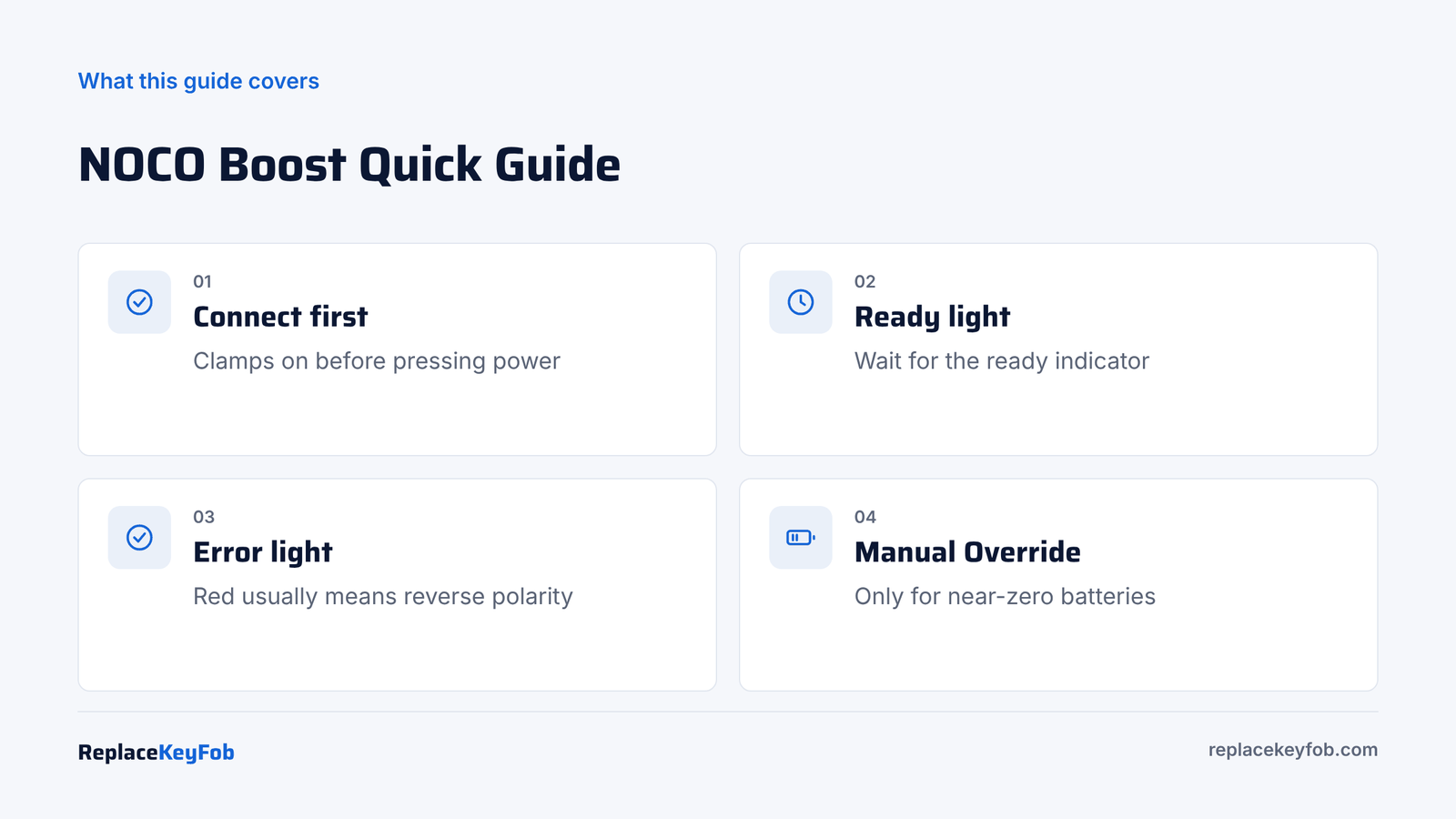
To use a NOCO jump starter, connect the red clamp to the battery positive and the black clamp to the negative or bare metal ground, then press the power button. When the ready light comes on, crank the engine for up to about 5 seconds. Turn the pack off and remove the clamps. Use Manual Override only if the battery is nearly 0 volts.
NOCO Boost packs are among the most common lithium jump starters in the US, from the compact GB40 to the large GB150 and the newer Boost X line (GBX45, GBX55, GBX75 and up). They all use the same core idea: spark-proof clamps that stay dead until the pack senses a correct connection to a battery.
That safety design is also the reason people get stuck. If the battery is so flat the pack cannot detect it, nothing happens. This guide explains the normal steps, what the lights mean, and how Manual Override works.
NOCO Boost Models at a Glance
| Model | Peak rating | Typical use | Charge port |
|---|---|---|---|
| GB40 | 1000A | Gas engines up to about 6.0L, diesel up to about 3.0L | Micro-USB |
| GB50 | 1500A | Gas up to about 7.0L, diesel up to about 4.0L | Micro-USB |
| GB70 | 2000A | Gas up to about 8.0L, diesel up to about 6.0L | Micro-USB |
| GB150 | 3000A | Large gas and diesel trucks | Micro-USB on many versions |
| Boost X (GBX45, GBX55, GBX75) | 1250A to 2500A | Same range, newer design | USB-C |
Engine size guidance comes from NOCO’s own ratings. Cold weather and a very old battery reduce what any pack can do, so pick a size above your engine if you live where winters are hard. For a direct comparison with another big brand, see NOCO vs GOOLOO jump starters.
Before You Start
- Charge the pack. Press the power button: the white LEDs (usually four) show charge level. Two or fewer and you may not get a strong jump.
- Turn the vehicle off, including headlights, HVAC and radio.
- Check the battery. Do not jump a cracked, leaking or frozen battery.
- Wear safety glasses.
NOCO Boost lithium jump starter
Match the pack to your engine size and fuel type using NOCO’s ratings, and choose a size up if you see sub-freezing winters or drive a diesel.
As an Amazon Associate, ReplaceKeyFob earns from qualifying purchases.
How to Use a NOCO Jump Starter Step by Step
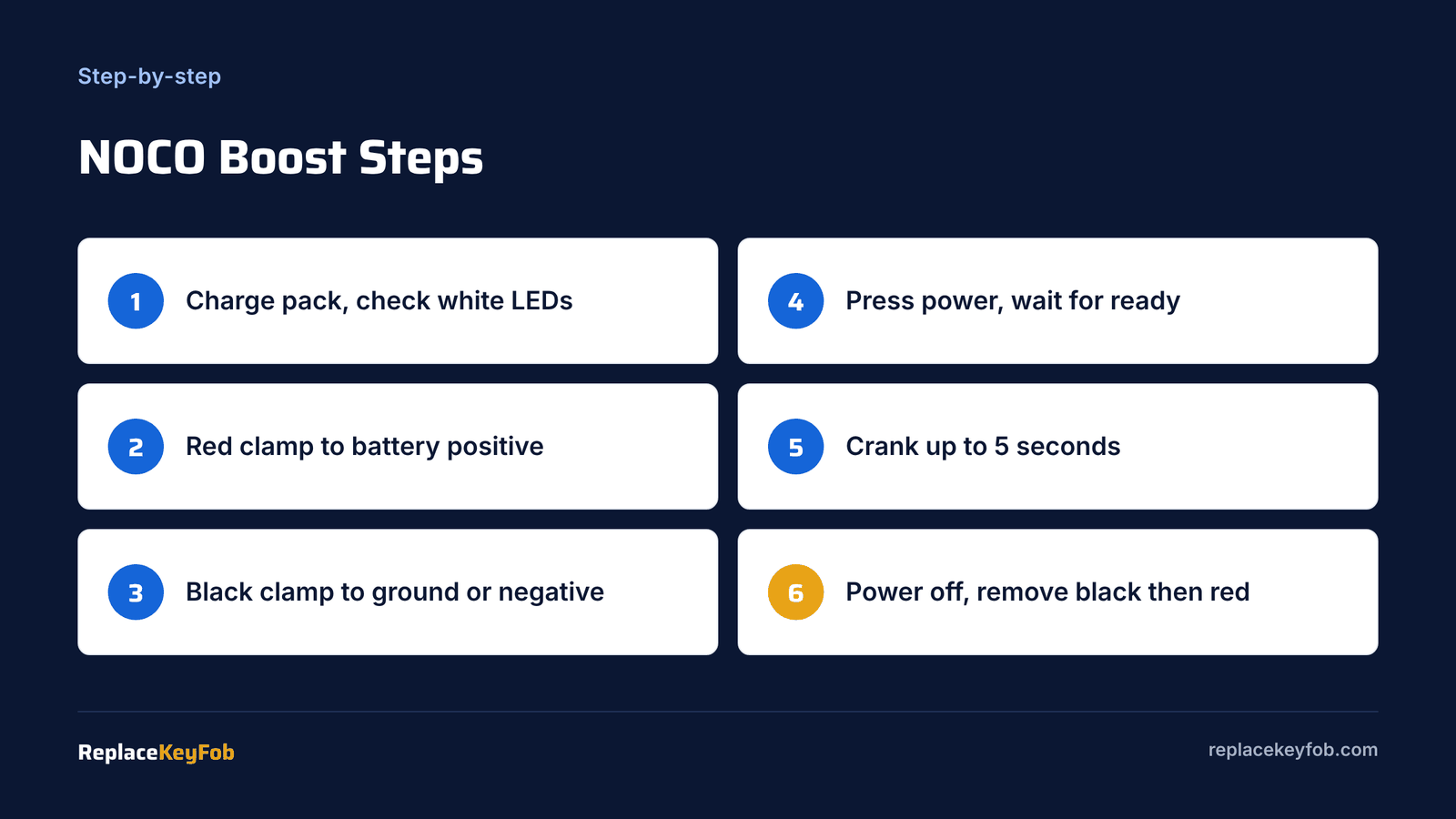
- Connect the red clamp to the positive (+) battery terminal or the vehicle’s remote positive jump post.
- Connect the black clamp to the negative (-) terminal or a solid, unpainted ground on the engine or chassis.
- Press the power button. The pack checks the connection.
- Wait for the ready signal. On most Boost models a white boost or ready light comes on when the clamps are live. A red error or warning light usually means reverse polarity or a fault.
- Crank the engine for up to about 5 seconds.
- If it does not start, wait at least 30 seconds before the next try. This lets the pack and your starter cool.
- Once the engine runs, press the power button to turn the pack off.
- Remove the black clamp first, then the red clamp.
- Recharge the pack as soon as you can.
The pack turns off by itself after a period of inactivity on most models, which is a safety feature, not a fault.
How to Use the NOCO GB40
The GB40 is the small 1000A model most people keep in a glove box. Use it exactly like the steps above with a few model notes:
- The GB40 charges over micro-USB. A full charge from empty with a 2A adapter takes a few hours.
- It is rated for gas engines up to about 6 liters. On a cold V8 or a diesel, give the engine two or three short attempts with 30-second rests rather than one long crank.
- The built-in LED flashlight and USB output drain the same battery. Recharge after using them.
How to Use the NOCO GB70
The GB70 is the 2000A model, sized for full-size trucks and diesels up to about 6 liters. It has a 12V output port as well as USB, and its clamps are larger.
- On a dual-battery diesel truck, clamp to the battery or jump point the vehicle manual names.
- Cycle the key to warm glow plugs (until the wait light goes out) before cranking.
- Its heavier cables carry more current, so make sure the black clamp bites into clean metal, not a painted bracket.
For the full truck procedure, see how to jump start a truck.
What the NOCO Lights Mean
The exact LEDs differ between generations, so treat this as a general guide and check your model’s quick-start card.
| Indicator | What it usually means | What to do |
|---|---|---|
| White charge LEDs (1 to 4) | Pack charge level | Recharge below 2 LEDs |
| Ready or boost light on | Correct connection, clamps live | Crank now |
| Red error light | Reverse polarity or fault | Swap clamps; check connection |
| No ready light, no error | Battery too low to detect | Check clamps, then consider Manual Override |
| Lights flash and pack shuts off | Overheat or timeout | Let it cool, start again |
When and How to Use Manual Override
NOCO Boost packs will not send power if they cannot detect a battery. If the vehicle battery is below a very low voltage (around 2 volts on many models), the pack will not activate on its own.
Manual Override forces the clamps live. It turns off the spark and reverse-polarity protection, so you must be sure the clamps are on the correct terminals.
- Double-check red is on positive and black on negative or ground.
- Press and hold the Manual Override button for the time listed in your guide (usually a few seconds) until the override light comes on.
- Crank the engine immediately.
- Turn the pack off right after.
Never use Manual Override to power a loose battery with nothing attached, and never use it on a battery that is damaged. A battery that has dropped to near zero has often been damaged by sitting flat and will likely need replacing after the jump.
Using a Used NOCO Jump Starter
A used NOCO can be a good buy, but check it first:
- Charge it fully and leave it for a week. It should still show 4 LEDs.
- Look for swelling, cracked case or damaged clamp wires.
- Make sure the clamps and cables are the original NOCO set; aftermarket clamps may not work with the pack’s safety circuit.
- Ask how old it is. Lithium packs lose capacity over time even when unused.
If the NOCO Won’t Start the Car
| Problem | Likely cause | Fix |
|---|---|---|
| Pack turns on, nothing happens | Battery too low to detect | Reseat clamps; use Manual Override carefully |
| Engine cranks slowly | Pack low or too small for engine | Charge pack; wait 30 seconds and retry |
| Clicking from the starter | Poor clamp contact | Clean terminals; move black clamp to engine metal |
| Starts then dies | Battery or alternator problem | Test charging voltage after it runs |
| Pack will not turn on | Pack fully drained | Charge for several hours, then try |
If you keep needing the pack, the real problem is the battery or alternator. Our guide on how to test a car battery with a multimeter will tell you which.
Care Tips
- Recharge after every jump and every 3 months in storage. A pack that reads 4 LEDs today can drop to 2 after a long hot summer in the trunk.
- Store it in the cabin or trunk organizer rather than loose, where clamps can rattle against metal.
- Wipe battery acid residue off the clamps after jumping a corroded battery, because it eats the copper teeth over time.
- Avoid charging below freezing or storing it in a hot car all summer.
- Keep the clamps clipped apart so they cannot short.
- For the general jump procedure with any brand, see how to use a jump starter.
When to Get Help
If the pack shows a ready light, the clamps are solid and the engine still only clicks, the starter or a main cable may be the issue. A roadside jump or mobile mechanic test typically costs about $50 to $150 in 2026. Replacement NOCO packs typically cost about $90 to $400 depending on size.
Frequently Asked Questions
Connect red to battery positive and black to negative or ground, press the power button, wait for the ready light, then crank for up to about 5 seconds. Turn it off and remove black first, then red.
The pack cannot detect a battery that is below a very low voltage. Check the clamp connections first, then use Manual Override carefully if the battery is nearly 0 volts.
On most models it signals an error, most often reverse polarity or a fault. Swap the clamps to the correct terminals or recheck the connection.
NOCO rates it for multiple jumps on a full charge, but the real number depends on engine size, temperature and battery state. Recharge it after each use to be safe.
No. Turn it off and disconnect it once the engine is running. It is a starter, not a charger, and it will not recharge the car battery.