
How to Use a DeWalt Jump Starter (Jump, Charge and Turn Off)

To use a DeWalt jump starter, check the charge on the display, turn the vehicle off, clamp red to positive and black to a bare engine ground, then press the power button and crank for up to 5 seconds. Press power again to turn it off, remove black then red, and recharge the unit fully.
DeWalt sells jump starters under license, from heavy lead-acid “power stations” rated around 1400 or 1600 peak amps (many with a digital air compressor, USB ports and an AC inverter) to compact lithium packs. If you are used to DeWalt power tools, note that most of these units do not run on DeWalt tool batteries. They have their own built-in battery and their own charging method.
Here is how to use one safely, what the display is telling you, how to charge it, and how to make sure it is fully off before you put it away.
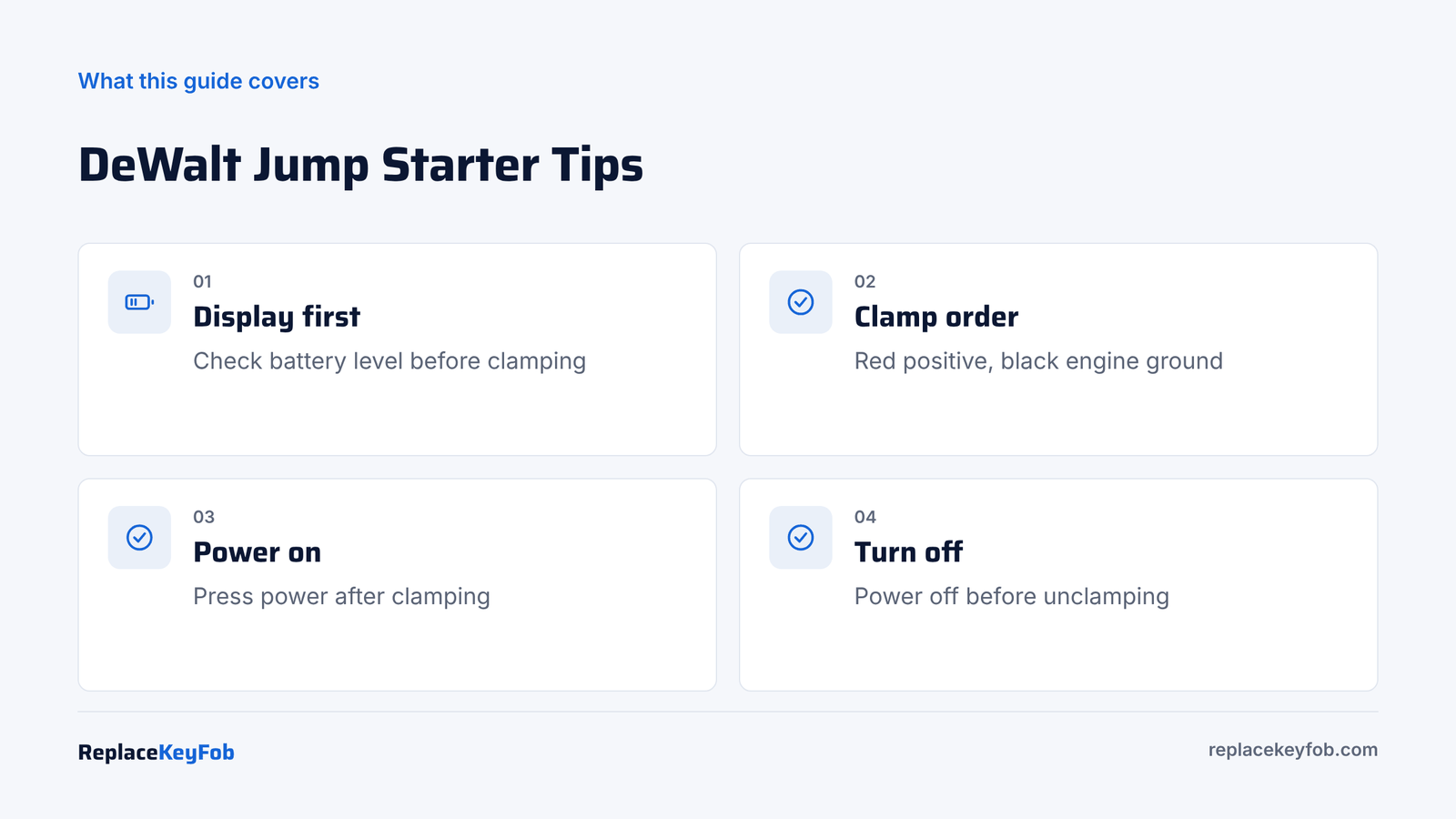
What the Controls Usually Do
Layouts vary by model, but most DeWalt jump starters have:
| Control or display | What it does |
|---|---|
| Power button or switch | Turns the unit and clamp output on and off |
| Battery level display | LEDs or LCD showing internal battery charge |
| Reverse polarity indicator | Light and/or alarm if clamps are on the wrong posts |
| Compressor button and PSI display | Runs the air compressor, sets or shows tire pressure |
| USB and 12V ports | Charge devices or run small 12V accessories |
| AC outlet (power station models) | Runs small AC devices through the inverter |
| Charging port | Where the AC cord, adapter or extension cord plugs in |
If you are not sure which button is which, the printed label on the face panel or the model’s manual is the final word.
What You Need
- The DeWalt unit, fully charged.
- Safety glasses and work gloves.
- A wire brush for corroded terminals.
- Your car’s owner’s manual if the battery is in the trunk or under a seat.
Digital tire pressure gauge
The built-in compressor gauge is handy but a separate digital gauge confirms the final pressure before you drive off.
As an Amazon Associate, ReplaceKeyFob earns from qualifying purchases.
How to Use a DeWalt Jump Starter
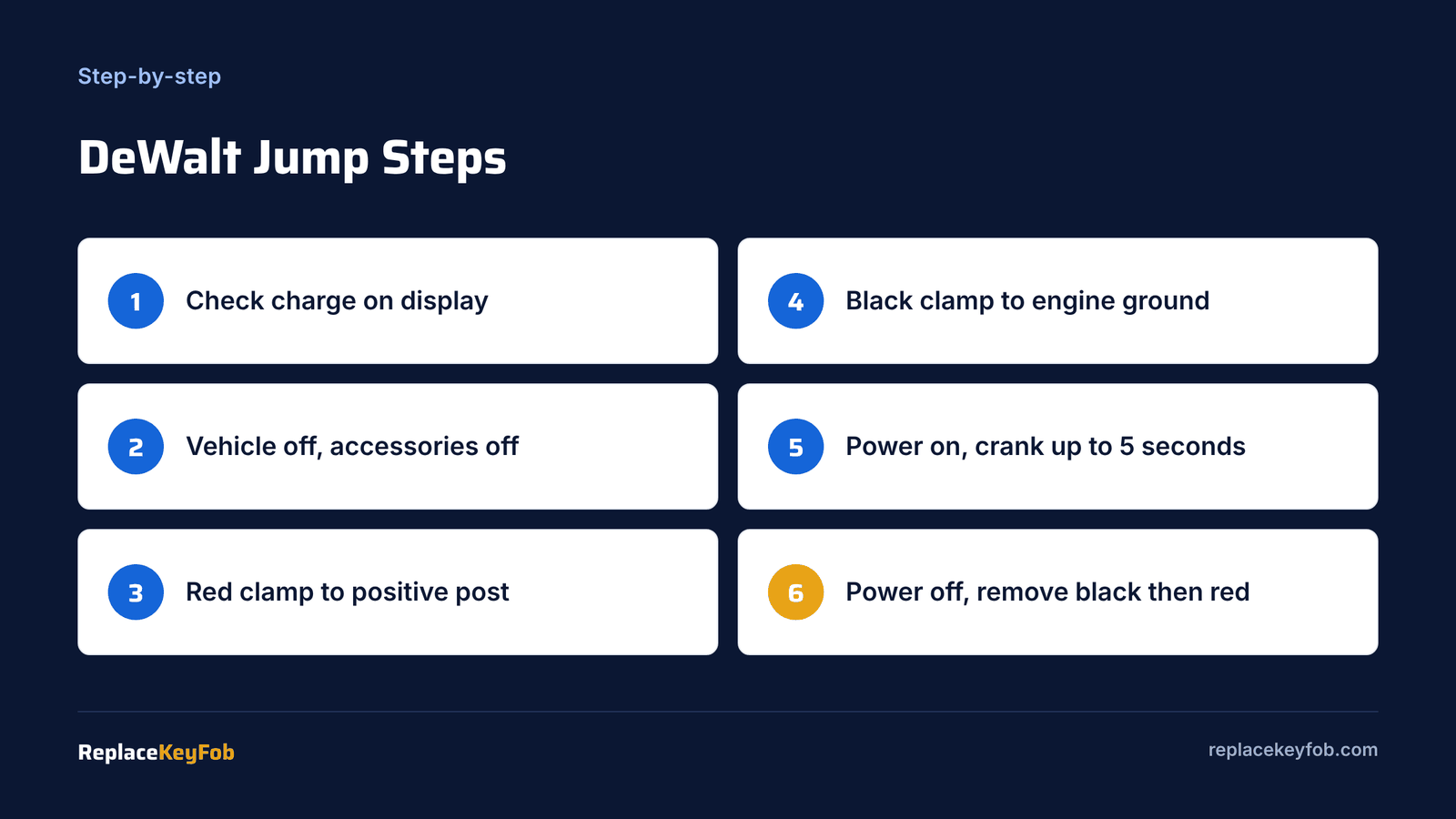
- Check the battery level. If the display is low, charge it before trying. A weak unit can click a starter without turning the engine.
- Turn the vehicle off. Switch off headlights, wipers, HVAC fan and radio. Put the car in Park or Neutral with the brake on.
- Make sure the jump starter is off.
- Clamp red to positive. Attach the red clamp to the positive (+) battery terminal or the under-hood positive jump post.
- Clamp black to ground. Attach the black clamp to unpainted metal on the engine block or chassis, away from the battery and fuel lines.
- Check for a polarity warning. If it lights or sounds, disconnect and swap the clamps.
- Turn the unit on. On most models this is the main power button; on some it is a separate jump switch.
- Crank the engine for up to 5 seconds.
- Rest between tries. Wait about 1 to 2 minutes before the next attempt, to let the starter cool and the unit recover.
- Once it starts, turn the jump starter off before you remove the clamps.
- Remove the black clamp first, then the red clamp. Store them in their holders.
Let the vehicle run or drive for at least 20 to 30 minutes so the alternator can recharge the car battery.
How to Use the DeWalt 1600 Peak Amp Jump Starter
The 1600 peak amp power station type is one of DeWalt’s most common units. It is heavy, but it handles most cars, SUVs and many V8 trucks. Tips for better results:
- Pre-charge a deeply flat battery. If the car battery is extremely low, connect the clamps, turn the unit on, and wait a minute or two before cranking if your manual allows it. The car battery absorbs a little charge and the starter sees steadier voltage.
- Ground to the engine block on V8s. A short return path reduces voltage loss.
- Turn off the inverter and compressor before jumping, so all the power goes to the starter.
- Use two or three short cranks instead of one long one on cold mornings.
For diesel pickups, cycle the glow plug light before cranking. Our guide on how to jump start a truck explains the extra steps for dual-battery diesels.
How to Charge a DeWalt Jump Starter
Many DeWalt lead-acid jump starters have a built-in AC charger. You plug a standard household extension cord into the charging port on the back and into the wall; others use a separate AC adapter or a 12V DC cord. Lithium models usually charge from USB-C.
- Turn the unit off and dock the clamps.
- Connect the charging cord the manual specifies.
- Watch the display. Most show charging progress and a full indication.
- Give it a complete charge before first use. Lead-acid units often need many hours.
- Recharge after every jump and at least once a month in storage. Lithium models can usually go about 3 months between top-ups.
Do not use a cord that is damaged, and do not charge it next to fuel cans or in a wet area. For charge times and storage habits across brands, see how to charge a jump starter.
How to Turn Off a DeWalt Jump Starter
People often think their DeWalt is off when the display is still on or a port is still live. To be sure:
- Press and hold the power button if a short press only changes the display mode (check your model’s manual).
- Turn off each function you used: compressor, USB, 12V socket and AC inverter often have their own buttons.
- Look for the display to go dark and the LEDs to go out.
- Some models have an auto-off timer that shuts the unit down after a period of no use, but do not rely on it.
Leaving a function on for a few days can drain the internal battery completely, which is hard on a lead-acid unit.
Using the Compressor
- Start the car, if possible, to spare the unit’s battery.
- Connect the hose to the tire valve.
- Set the target PSI on the display if your model has auto-stop. Use the pressure on the driver door jamb sticker.
- Press the compressor button. Run it in short sessions and let it cool between tires.
- Remove the hose and confirm pressure with a separate gauge.
Troubleshooting a DeWalt Jump Starter
| Symptom | Likely cause | Fix |
|---|---|---|
| Display on, no crank | Jump output not switched on | Press power or jump switch after clamping |
| Polarity alarm | Clamps reversed | Swap clamps |
| Clicks, no crank | Poor contact or very low car battery | Clean posts; ground to engine; pre-charge |
| Unit drains overnight | A port or the inverter left on | Switch off every function |
| Will not charge | Bad extension cord or charger fault | Try a known-good cord; check manual |
| Holds charge only a few days | Internal battery worn | Replace battery or unit |
If the car needs jumping often, the car battery or alternator is the real problem. Test the battery with a multimeter and check charging voltage with the engine running.
Safety Tips
- Never jump a battery that is frozen, cracked or leaking.
- Keep the unit on the ground, not on the engine.
- Do not smoke or create sparks near the battery.
- Keep clamps docked when not in use. Touching clamps on a live unit can spark or weld.
- Unplug and stop using the unit if it smells of acid or the case bulges.
Is a DeWalt Jump Starter Worth It?
The big power station models are good for home garages and work trucks because they jump, inflate and power small tools in one box. They are heavy to carry in a car. A compact lithium pack is easier to keep in the glove box. In 2026, DeWalt lead-acid power stations typically cost about $150 to $250 and lithium packs about $100 to $200. Compare options in our list of jump starters with air compressor.
Frequently Asked Questions
Charge it, clamp red to positive and black to engine ground, turn the unit on, and crank for up to 5 seconds. Turn off the compressor and inverter first so all the power goes to the starter.
Many lead-acid DeWalt units charge through a built-in AC charger using a household extension cord, while others use an adapter or USB-C. Charge fully before first use and after every jump.
Press or hold the power button until the display goes dark, and turn off any compressor, USB, 12V or AC function you used. Some models also have an auto-off timer.
Most DeWalt jump starters have their own built-in battery and do not run on DeWalt power tool battery packs. Check your model’s label.
On most models a beep with a warning light means reverse polarity. Disconnect and reconnect red to positive and black to ground.